Skip to content
recaplica

    One moment: security check

    Cloudflare wants to make sure you're not a robot. Tick the box below and your search will continue on its own.

    IT
    recaplica Cesare Pavese: Life, Works and the Myth of the Countryside
    © 2026 Recaplica · recaplica.com — All rights reserved
    Home › Literature

    Cesare Pavese: Life, Works and the Myth of the Countryside

    By Recaplica Newsroom · Updated on September 29, 2026

    What to print

    Page numbers appear when printing with default margins.

    Slides

    Choose a cut

    Flash10 slidesThe essential thread, to present in classFull16 slidesEvery chapter and the deeper detail

    Both come with speaker notes.

    Telegram channel
    recaplica Clear in 30 seconds, yours in 10 minutes.
    In 30 seconds Key points Deep dive Slides Myths Mind map Quiz Flashcards FAQ

    In 30 seconds quick read

    Cesare Pavese (1908-1950) was one of the central voices in twentieth-century Italian fiction, known for novels set in the Langhe hills and for his editorial work at Einaudi. His books return again and again to the tension between the city and the rural world he came from, rendered with a realism that owes much to Giovanni Verga and to the American writers Pavese himself translated. He was also a poet and diarist: the collection Death Will Come and Will Have Your Eyes and the diary The Business of Living remain among his most-read works, alongside the novel The Moon and the Bonfires. A quiet anti-fascist, he paid for it with arrest and internal exile before joining the Italian Communist Party after the war; he took his own life in Turin in 1950.

    Key Points

    • Born in Santo Stefano Belbo (Cuneo) on 9 September 1908; he studied at the D'Azeglio classical lyceum in Turin, where one of his teachers was Augusto Monti.
    • His realism combines the lesson of Giovanni Verga with American literature, which he translated and introduced to Italy together with Elio Vittorini.
    • The theme of the countryside and the return to one's origins, often tied to myth and childhood, runs through most of his novels.
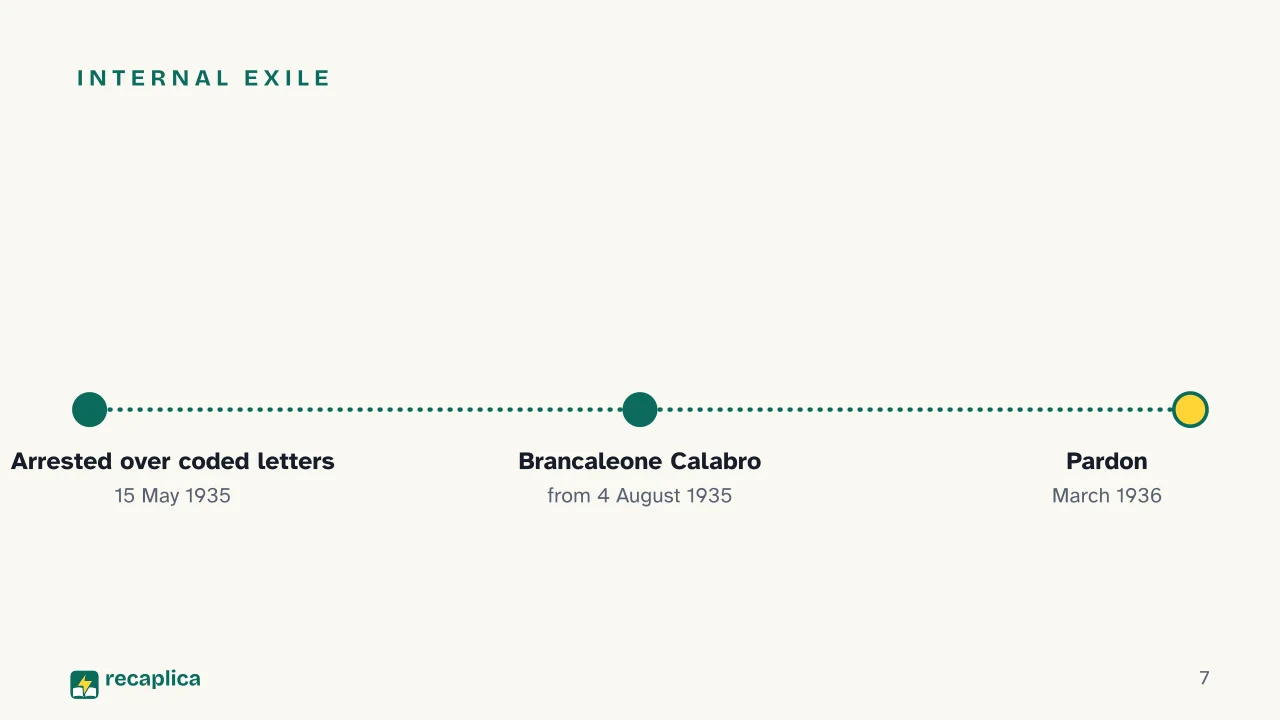
    • Arrested in 1935 for possessing coded letters linked to an anti-fascist network, he was confined to Brancaleone Calabro until 1936.
    • He directed the publishing house Einaudi from 1938 until his death, promoting the work of Carl Gustav Jung and Karl Kerényi, among others.
    • He took his own life in Turin on 27 August 1950, a few months after the publication of The Moon and the Bonfires.

    Deep Dive

    Origins and education

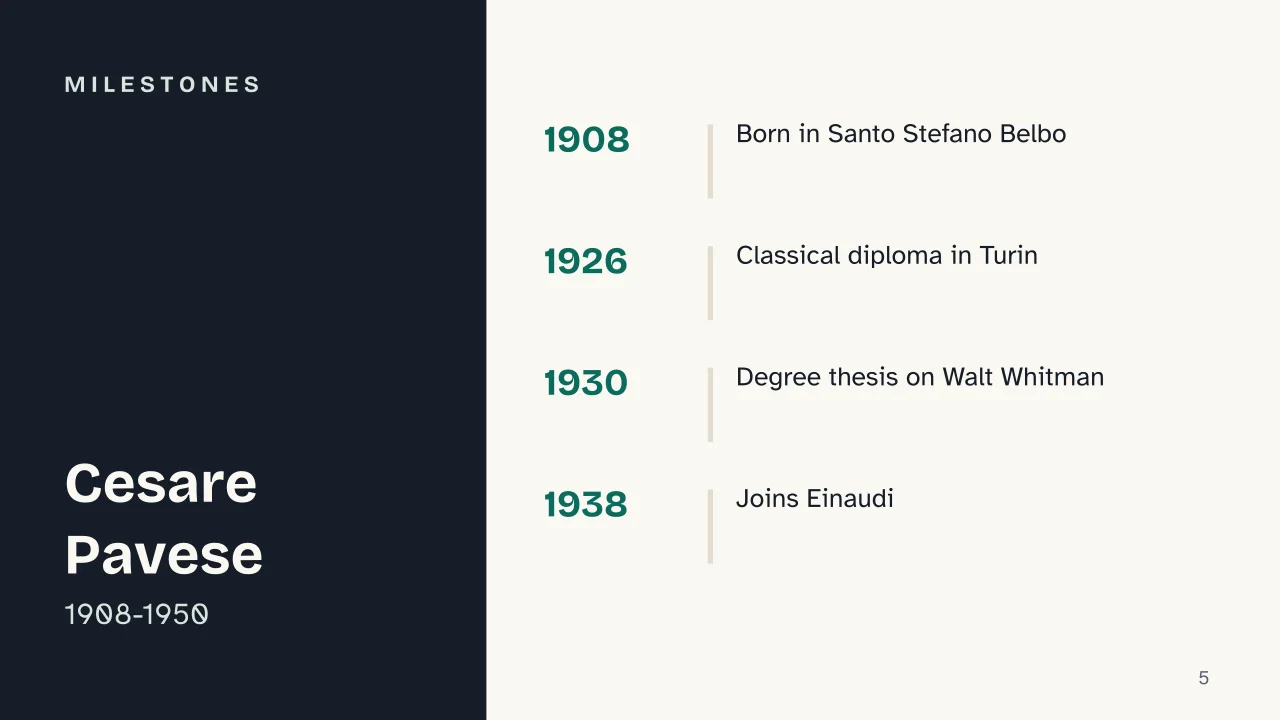
    Cesare Pavese was born on 9 September 1908 in Santo Stefano Belbo, in the province of Cuneo, to Eugenio and Consolina Mesturini. He grew up between his home village and Turin, where he completed his studies.

    He attended the Massimo D’Azeglio classical lyceum from 1923, where one of his teachers was Augusto Monti, the figure who, according to ANPI, introduced him to Turin’s anti-fascist circles. After finishing school in 1926, he enrolled in the Faculty of Letters at the University of Turin, and in 1930 he defended his degree thesis on the American poet Walt Whitman.

    Anti-fascism and internal exile

    Pavese never joined the National Fascist Party, and made a living from private lessons and translations from English. For years his anti-fascism stayed quiet rather than militant, but it was still enough to cost him dearly, in the same repressive climate described in The Mussolini Myth: How Fascist Propaganda Built the Duce.

    On 15 May 1935 Pavese was arrested as editor of the magazine la Cultura, for possessing coded letters tied to a network of anti-fascist contacts. He was sentenced to internal exile and, after arriving in Brancaleone Calabro on 4 August 1935, stayed there until March 1936, when he was granted a pardon.

    The publisher Einaudi and American literature

    In 1938 Pavese joined the publishing house Einaudi, where he became a highly respected editorial director, remaining active there until his death. Among other things, he was behind the so-called “collana viola”, a series on ethnology and myth studies that included works by Carl Gustav Jung, Lucien Lévy-Bruhl and Karl Kerényi.

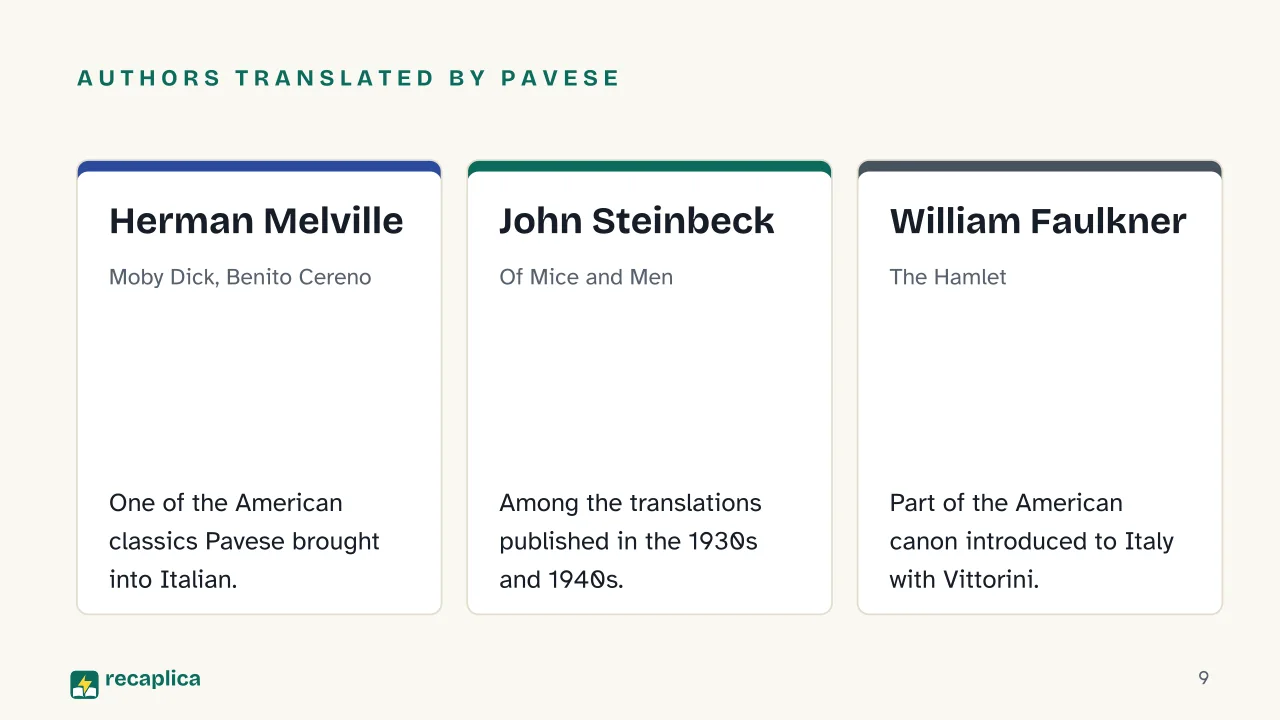
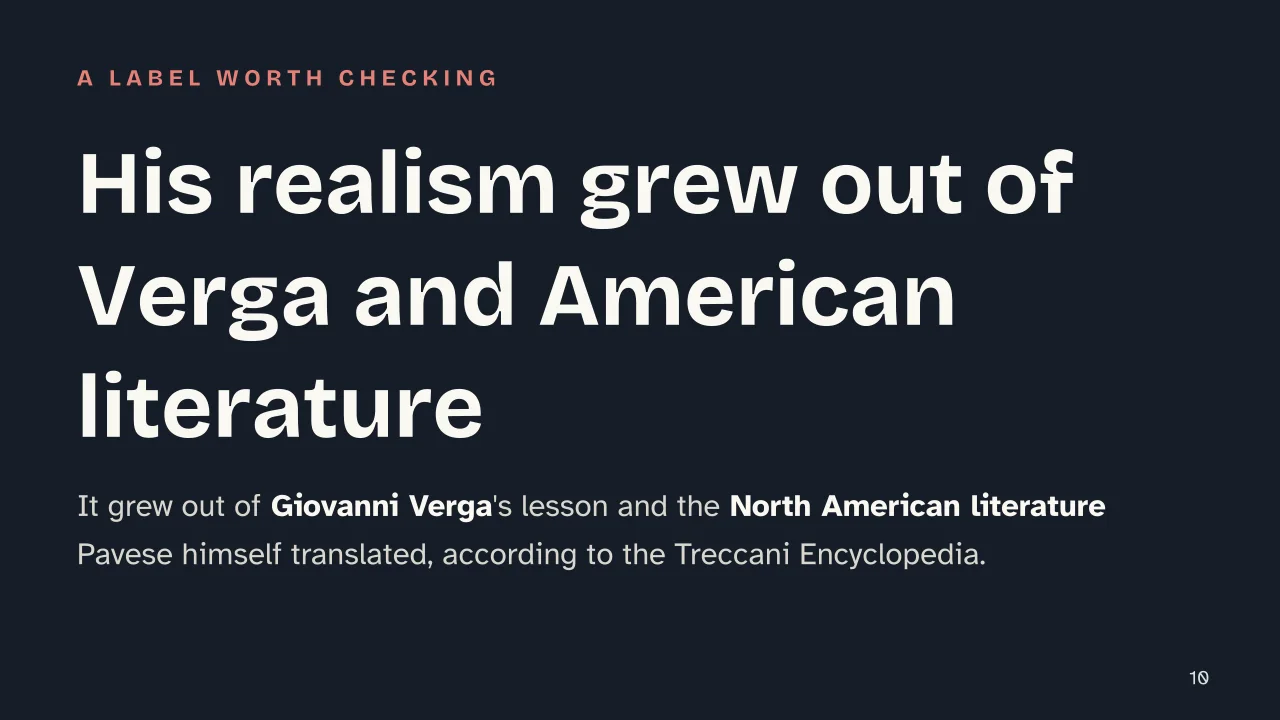
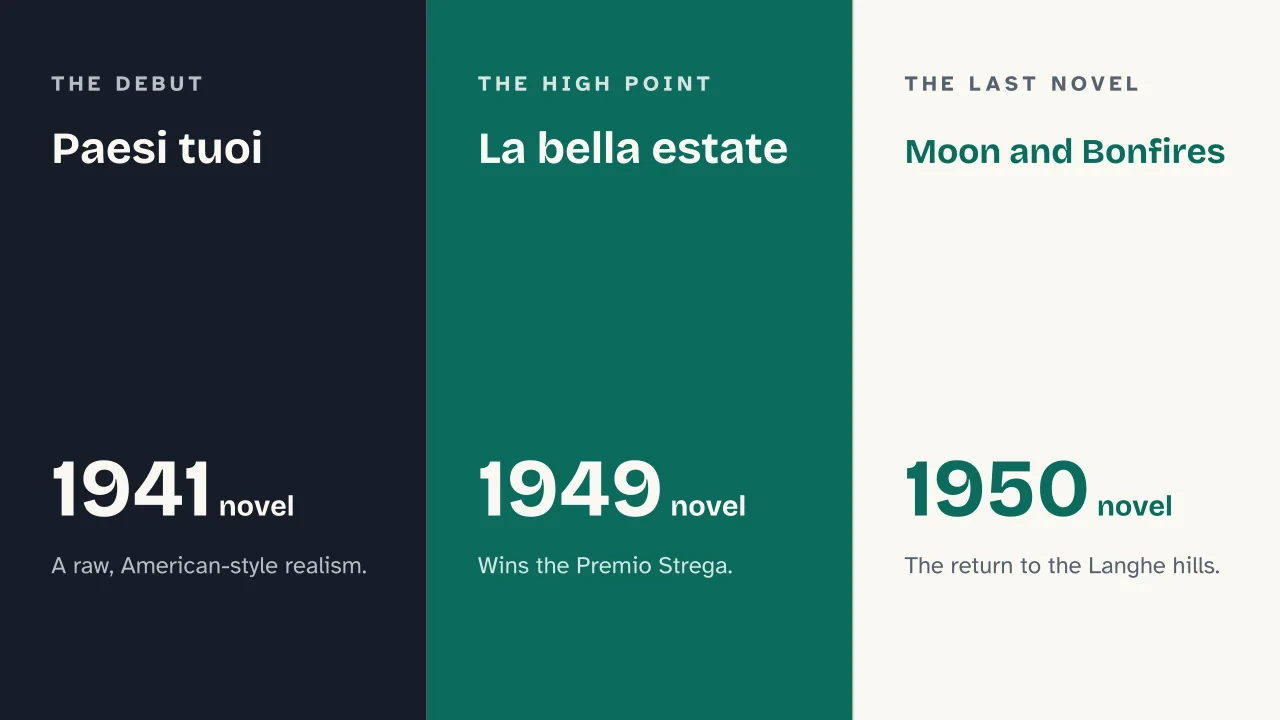
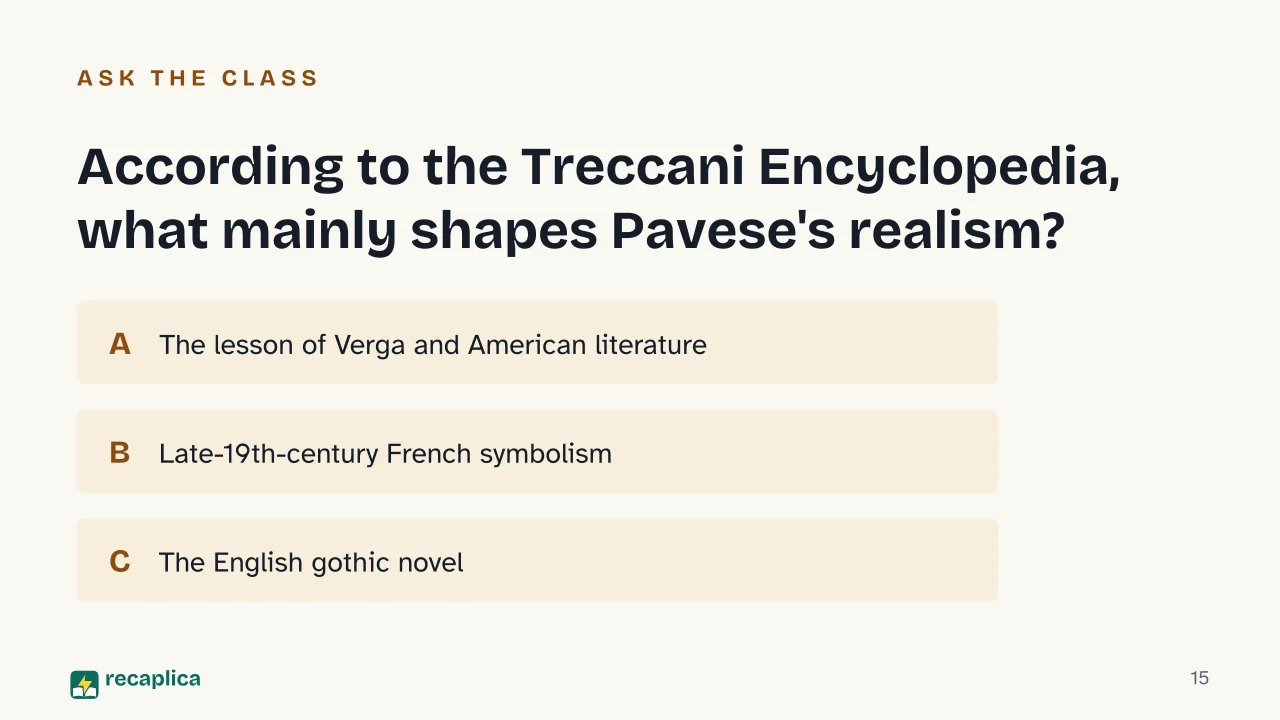
    He was also a tireless translator: he brought Herman Melville (Moby Dick, Benito Cereno), Sherwood Anderson, John Dos Passos, John Steinbeck, William Faulkner, James Joyce and Gertrude Stein into Italian, helping Elio Vittorini introduce North American literature to Italian readers. According to the Treccani Encyclopedia, his realism owes a double debt to this work: to the lesson of Giovanni Verga and Verismo: Life, Works and Key Traits, and to the American literature he had made himself a translator of. The novel Paesi tuoi, published in 1941, was described by the Dizionario Biografico degli Italiani as a work “meant to renew Italian narrative prose”, for its dry, near-brutal storytelling drawn from American models.

    The myth of the countryside and his style

    A recurring movement runs through Pavese’s novels: the search for human contact and a return to the rural world he came from, as a defence against the mechanical nature of city life, according to the Treccani Encyclopedia. It is a memory that, centred on childhood, rises to myth or spills into symbol.

    Practical example: in Prima che il gallo canti (1948) and in La bella estate (1949, winner of the Premio Strega), these approaches converge: the landscape is not just the backdrop to the story but a constant counterpoint of meaning and feeling, in what the Treccani Encyclopedia points to as the artistic high points of his fiction.

    Pavese in twentieth-century Italian literature

    According to the Treccani Encyclopedia, Pavese played an essential role in the passage between the culture of the 1930s and the new democratic culture of the postwar years. Around him, other authors were reshaping Italian fiction in those same decades from different angles: Luigi Pirandello: life, plays, and the 1934 Nobel Prize on the side of theatre and the crisis of identity, Italo Svevo: life, works and thought on the side of the psychological novel.

    Three books, in particular, capture the different directions his writing took. The Moon and the Bonfires, his last novel, follows an emigrant’s return to his native village in the Langhe. Verrà la morte e avrà i tuoi occhi (Death Will Come and Will Have Your Eyes) collects his final poems, written in March 1950 and dedicated to the actress Constance Dowling. Il mestiere di vivere (The Business of Living) is the diary Pavese kept from 1935 to 1950, published after his death.

    The final years and death

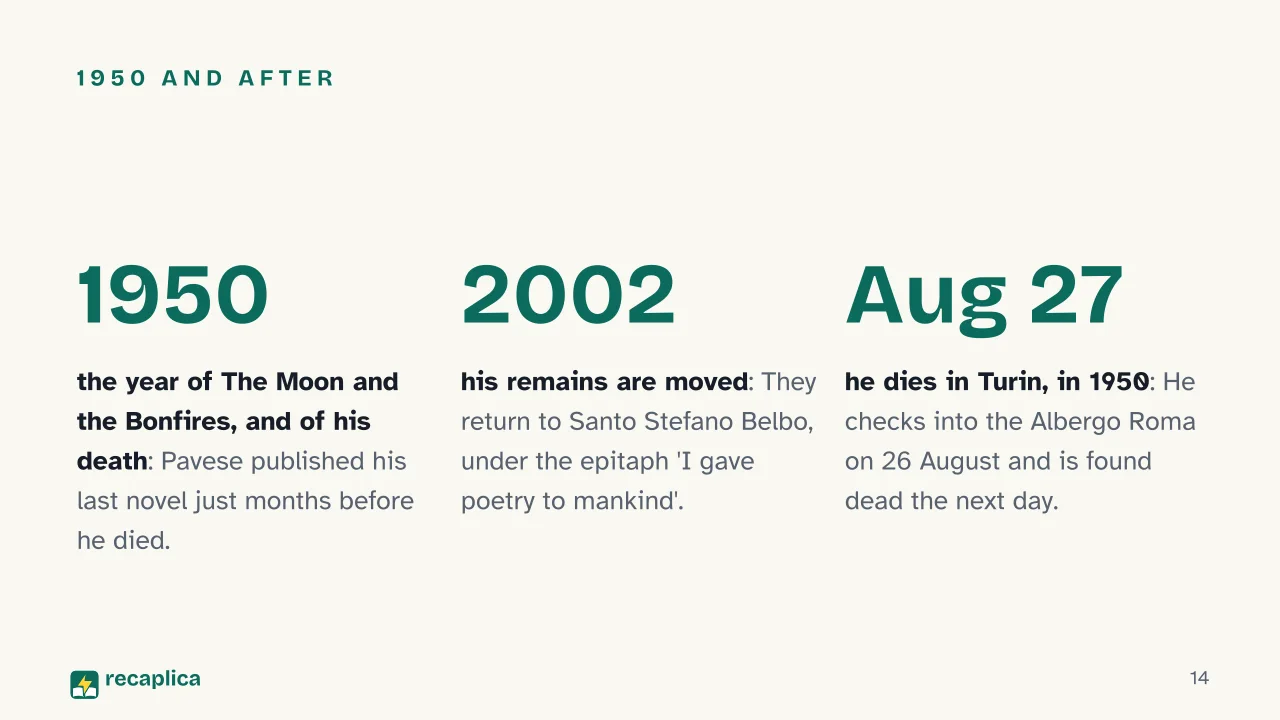
    1950 was both the year of success and the year of the end. Pavese saw The Moon and the Bonfires published, and around the same time wrote the poems that would become Death Will Come and Will Have Your Eyes.

    On 26 August 1950, in the early afternoon, he went to the Albergo Roma in Turin; he took his own life with a sleeping draught and was found dead the evening of the next day, 27 August. After the war he had joined the Italian Communist Party and worked on the Piedmont edition of the newspaper l’Unità. In 2002 his remains were moved to the cemetery of Santo Stefano Belbo, under the epitaph “Ho dato poesia agli uomini” (“I gave poetry to mankind”).

    Slide deck

    Slides ready to download and make your own in PowerPoint or Google Slides, with speaker notes. Pick the Flash cut or the Full one.
    Slide 1 of the presentation on Cesare Pavese: Cesare PaveseSlide 2 of the presentation on Cesare Pavese: Just the sad poet remembered for his suicide?Slide 3 of the presentation on Cesare Pavese: The journey aheadSlide 4 of the presentation on Cesare Pavese: Chapter 01: OriginsSlide 5 of the presentation on Cesare Pavese: MilestonesSlide 6 of the presentation on Cesare Pavese: Chapter 02: Anti-fascismSlide 7 of the presentation on Cesare Pavese: Internal exileSlide 8 of the presentation on Cesare Pavese: Chapter 03: The publisher and AmericaSlide 9 of the presentation on Cesare Pavese: Authors translated by Pavese: Herman Melville, John Steinbeck, William FaulknerSlide 10 of the presentation on Cesare Pavese: His realism grew out of Verga and American literatureSlide 11 of the presentation on Cesare Pavese: Chapter 04: The myth of the countrysideSlide 12 of the presentation on Cesare Pavese: Paesi tuoi · La bella estate · Moon and BonfiresSlide 13 of the presentation on Cesare Pavese: Chapter 05: The final yearsSlide 14 of the presentation on Cesare Pavese: 1950 and afterSlide 15 of the presentation on Cesare Pavese: According to the Treccani Encyclopedia, what mainly shapes Pavese's realism?Slide 16 of the presentation on Cesare Pavese: To learn more
    Flash10 slidesThe essential thread, to present in classFull16 slidesEvery chapter and the deeper detail

    Common myths

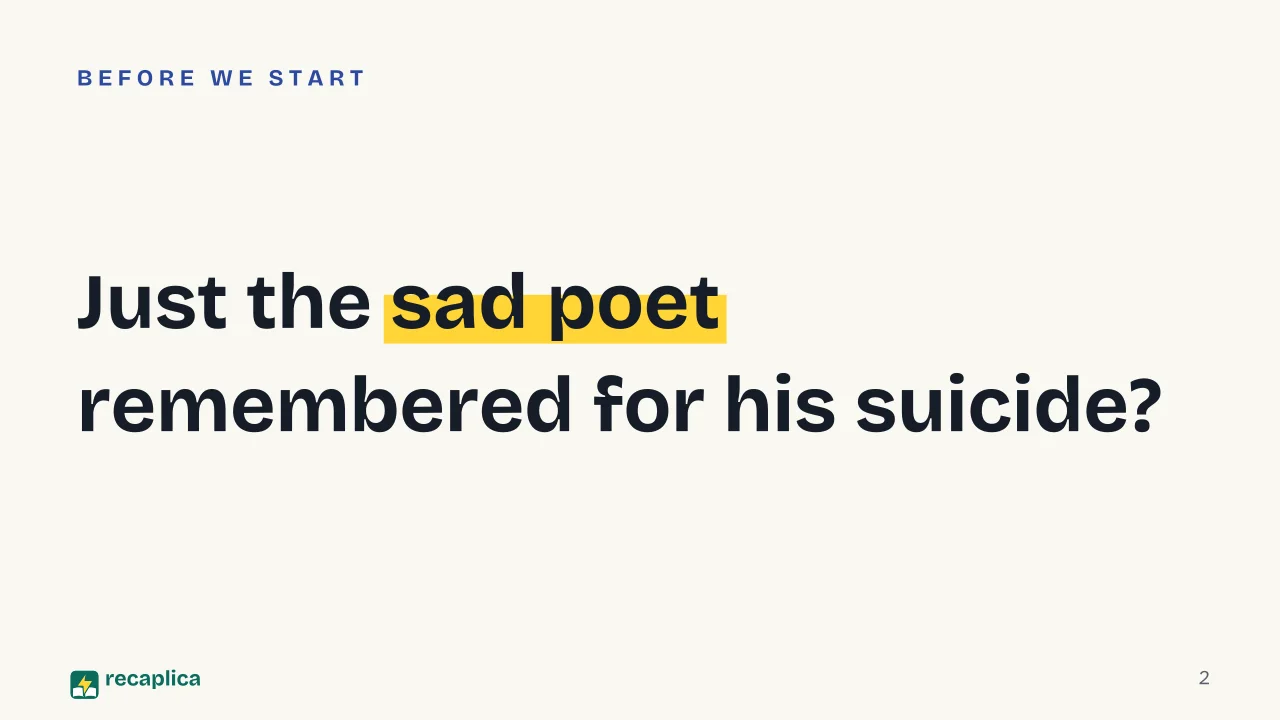
    • ✗ Myth Many people think of Pavese mainly as the melancholy poet remembered for his suicide.

      ✓ Reality The greater part of his output was actually prose: the novels Paesi tuoi and La bella estate through to The Moon and the Bonfires, plus the diary The Business of Living and years of editorial work at Einaudi, from 1938 until his death.

    • ✗ Myth Pavese is often called, without hesitation, a Neorealist writer.

      ✓ Reality The Treccani Encyclopedia instead describes his realism as a meeting point between the lesson of Giovanni Verga and the North American literature Pavese translated with Elio Vittorini.

    • ✗ Myth Many assume Pavese's political engagement was a long-standing militancy.

      ✓ Reality According to ANPI he joined the Italian Communist Party only after the Liberation and never carried the Fascist Party card: his anti-fascism stayed quiet through the 1930s, but it still cost him his arrest in 1935.

    Mind map

    Drag the background to move around and the nodes to reposition them; use − and + to collapse and expand branches.
    Customize
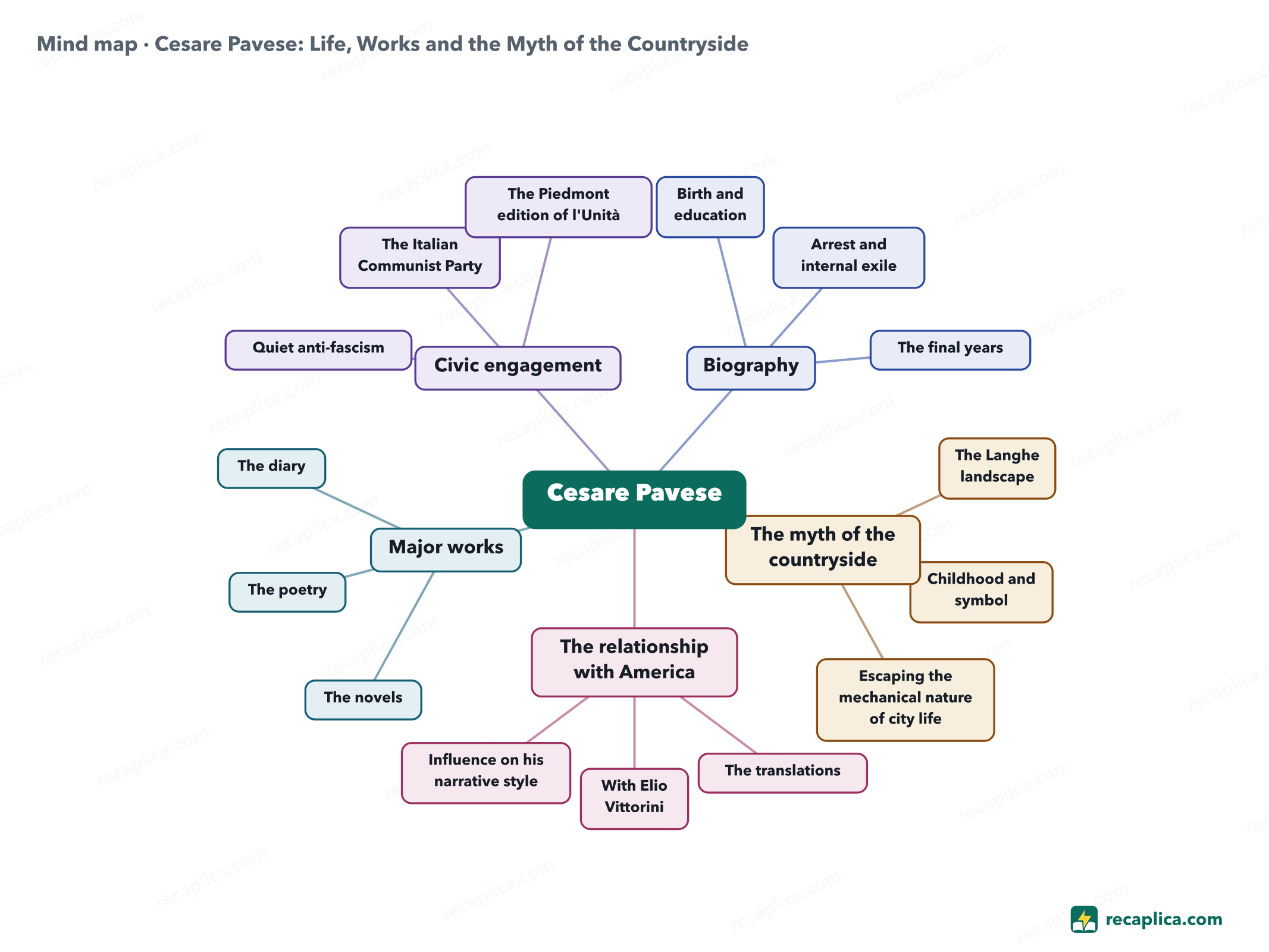
    Mind map: Cesare Pavese: Life, Works and the Myth of the Countryside
    • Cesare Pavese
      • Biography
        • Birth and education Santo Stefano Belbo, 1908, D'Azeglio lyceum with Augusto Monti
        • Arrest and internal exile 1935, Brancaleone Calabro until 1936
        • The final years Death in Turin in 1950
      • The myth of the countryside
        • The Langhe landscape
        • Childhood and symbol
        • Escaping the mechanical nature of city life
      • The relationship with America
        • The translations Melville, Steinbeck, Faulkner, Anderson, Dos Passos
        • With Elio Vittorini
        • Influence on his narrative style
      • Major works
        • The novels Paesi tuoi, La bella estate, The Moon and the Bonfires
        • The poetry Death Will Come and Will Have Your Eyes
        • The diary The Business of Living
      • Civic engagement
        • Quiet anti-fascism
        • The Italian Communist Party Joined after the Liberation
        • The Piedmont edition of l'Unità

    Quiz: test yourself

    Answer the questions to check what you have learned: you get instant feedback and a short explanation.

    Grade 0/10 0/5
    1 In what year was Cesare Pavese born?

    He was born on 9 September 1908 in Santo Stefano Belbo, in the province of Cuneo, according to the Treccani Dizionario Biografico degli Italiani.

    2 Which author was the subject of Pavese's 1930 degree thesis?

    The thesis, defended at the University of Turin, focused on the American poet Walt Whitman.

    3 Why was Pavese arrested in 1935?

    He was arrested as editor of the magazine la Cultura for possessing coded letters; he was then confined to Brancaleone Calabro.

    4 True or false: according to the Treccani Encyclopedia, Pavese's realism derives mainly from the lesson of Giovanni Verga and North American literature.

    True: the Treccani Encyclopedia describes a realism shaped by Verga's lesson and by the North American literature Pavese translated.

    5 Which publishing house did Pavese direct from 1938 until his death?

    He joined Einaudi in 1938 and became its editorial director, promoting among other things a series on myth and ethnology studies.

    Answers: 1-B · 2-B · 3-B · 4-A · 5-C

    Flashcards

    Tap the card to flip it and check whether you remember the answer, then move to the next one.

    1 / 8

    Explain it in your own words

    The ultimate test: if you can explain it in simple words, you've truly understood it. Write your explanation, then compare it with the Recap.

    Your explanation is saved only on this device.

    Cesare Pavese (1908-1950) was one of the central voices in twentieth-century Italian fiction, known for novels set in the Langhe hills and for his editorial work at Einaudi. His books return again and again to the tension between the city and the rural world he came from, rendered with a realism that owes much to Giovanni Verga and to the American writers Pavese himself translated. He was also a poet and diarist: the collection Death Will Come and Will Have Your Eyes and the diary The Business of Living remain among his most-read works, alongside the novel The Moon and the Bonfires. A quiet anti-fascist, he paid for it with arrest and internal exile before joining the Italian Communist Party after the war; he took his own life in Turin in 1950.

    Frequently asked questions

    Was Cesare Pavese a Neorealist writer?

    The sources consulted don't use this label strictly for Pavese: the Treccani Encyclopedia describes his realism as shaped by the lesson of Giovanni Verga and by the North American literature he translated.

    What is Cesare Pavese's best-known novel?

    The Moon and the Bonfires, published in 1950: Pavese's last novel, set in the Langhe hills and following an emigrant's return to his native village.

    Why was Pavese arrested and confined?

    In 1935 he was arrested as editor of the magazine la Cultura for possessing coded letters tied to his anti-fascist contacts, and was then confined to Brancaleone Calabro until March 1936.

    Did Pavese join a political party?

    Yes: according to ANPI, after the Liberation he joined the Italian Communist Party and worked on the Piedmont edition of the newspaper l'Unità.

    What does the epitaph on Pavese's grave say?

    'Ho dato poesia agli uomini' ('I gave poetry to mankind'): the inscription chosen for his grave in Santo Stefano Belbo, where his remains were moved in 2002.

    Sources

    • Treccani, Dizionario Biografico degli Italiani, «PAVESE, Cesare» (Roberto Gigliucci, 2014)
    • ANPI, «Cesare Pavese»
    • Treccani, Enciclopedia Italiana, «Pavése, Cesare»

    Every Recap goes through an independent review before publication.

    Every evening, the day's new Recaps on our Telegram channel. Join the channel →

    Keep learning

    • Literature Death Will Come and Will Have Your Eyes: Cesare Pavese's Poetry Collection "Death Will Come and Will Have Your Eyes" is the poetry collection Cesare Pavese dedicated to the American actress Constance Dowling. Einaudi published the book posthumously in 1951, edited by Massimo Mila and Italo Calvino; it brings together nineteen poems in all: the ten from 1950 that give the collection its title, written between March 11 and April 11 of that year, and nine more written in 1945. Treccani reads the book as Pavese's return to Leopardi's two themes, love and death. In a letter dated April 17, 1950, Pavese wrote: "The poems came to you, and they go away with you." Read the Recap →
    • Literature The Path to the Spider's Nests by Italo Calvino The Path to the Spider's Nests is Italo Calvino's debut novel, published by Einaudi in the autumn of 1947. It tells the story of the Italian Resistance through Pin, a boy who steals a pistol from a sailor and hides it in a place only he knows. Calvino wrote it in about twenty days, at 23, to meet a literary prize deadline of December 31, 1946 — the same young man who had joined the partisans in 1944 under the nom de guerre Santiago. The novel is the book critics point to when they introduce Calvino's early phase, known as fantastic neorealism: a war told through a child's fable-like gaze rather than a direct, adult account. Read the Recap →
    • Literature Primo Levi: Life, Books and the Testimony of Auschwitz Primo Levi was born in Turin in 1919 and graduated in chemistry in 1941, right as Italy's fascist racial laws were making his life harder. Arrested in the Aosta Valley in December 1943, he was deported to Auschwitz in February 1944 and survived until liberation in January 1945. In 1947 he published 'If This Is a Man', the account of his imprisonment, which became one of the most widely read testimonies of 20th-century Italian literature about the Nazi camps. In the years that followed he also wrote novels, science fiction stories and books that wove chemistry together with writing, such as 'The Periodic Table'. He died in Turin in 1987, in the same house where he was born. Read the Recap →

    recaplica

    Clear in 30 seconds, yours in 10 minutes.

    Recaps Mind maps Request a Recap Telegram channel Mind map maker Our method About Privacy & cookies Legal notes & terms of use

    © 2026 Recaplica · A project by Curi S.r.l. — VAT IT05472000750

    Statistics, only if you say so

    To learn which Recaps help most we would use Google Analytics, with aggregate, anonymous data. It starts only with your OK, and you can change your mind anytime. Privacy policy