Skip to content
recaplica

    One moment: security check

    Cloudflare wants to make sure you're not a robot. Tick the box below and your search will continue on its own.

    IT
    recaplica Death Will Come and Will Have Your Eyes: Cesare Pavese's Poetry Collection
    © 2026 Recaplica · recaplica.com — All rights reserved
    Home › Literature

    Death Will Come and Will Have Your Eyes: Cesare Pavese's Poetry Collection

    By Recaplica Newsroom · Updated on September 29, 2026

    What to print

    Page numbers appear when printing with default margins.

    Slides

    Choose a cut

    Flash10 slidesThe essential thread, to present in classFull14 slidesEvery chapter and the deeper detail

    Both come with speaker notes.

    Telegram channel
    recaplica Clear in 30 seconds, yours in 10 minutes.
    In 30 seconds Key points Figures Deep dive Slides Myths Mind map Quiz Flashcards FAQ

    In 30 seconds quick read

    "Death Will Come and Will Have Your Eyes" is the poetry collection Cesare Pavese dedicated to the American actress Constance Dowling. Einaudi published the book posthumously in 1951, edited by Massimo Mila and Italo Calvino; it brings together nineteen poems in all: the ten from 1950 that give the collection its title, written between March 11 and April 11 of that year, and nine more written in 1945. Treccani reads the book as Pavese's return to Leopardi's two themes, love and death. In a letter dated April 17, 1950, Pavese wrote: "The poems came to you, and they go away with you."

    Key Points

    • The collection was published posthumously in 1951 by Einaudi, in the "Poeti" series, edited by Massimo Mila and Italo Calvino.
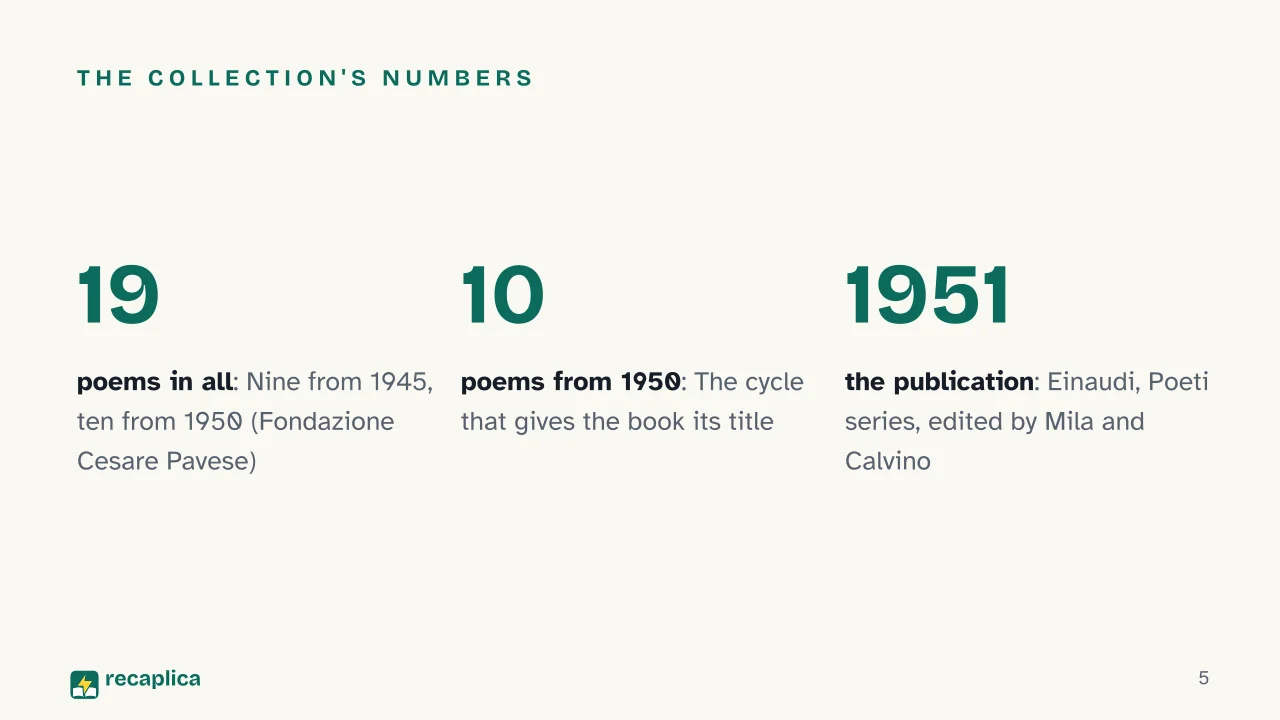
    • The book holds nineteen poems in all, nine written in 1945 and ten in 1950, according to the Fondazione Cesare Pavese.
    • The ten poems from 1950 form the cycle that gives the book its title; Pavese dedicated them to Constance Dowling, the American actress with whom he had a relationship Treccani describes as decisive.
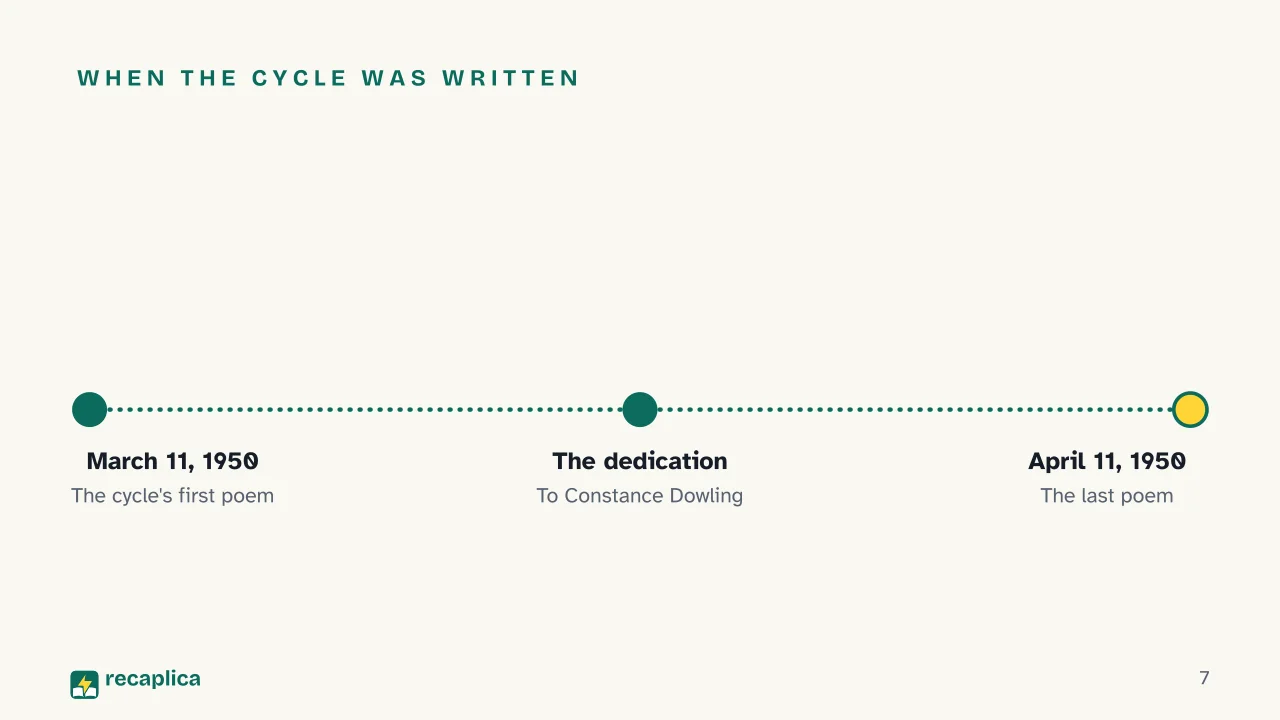
    • They were written between March 11 and April 11, 1950, based on the dates of the first and last poem of the cycle reported by VIV-IT.
    • Treccani traces the book to Pavese's return to the two Leopardian themes, love and death.
    • Compared with Hard Labor, according to Einaudi's catalog note these poems leave behind the narrative, epic vein for a lyrical, subjective register.

    Key figures

    • 19 The poems in the 1951 Einaudi volume in all: nine written in 1945 and ten in 1950. Source: Fondazione Cesare Pavese
    • 10 The poems written in 1950 that make up the eponymous cycle, dedicated to Constance Dowling. Source: Fondazione Cesare Pavese
    • March 11 - April 11, 1950 The period in which the poems of the cycle were written, from the date of the first to that of the last. Source: VIV-IT

    Deep Dive

    A Book Published After Pavese’s Death

    According to Treccani, “Death Will Come and Will Have Your Eyes” is Cesare Pavese’s last volume of verse, published posthumously in 1951. Einaudi placed it in the “Poeti” series, edited by Massimo Mila and Italo Calvino. The volume is not limited to the eponymous cycle: it also includes the group of poems “The Land and Death.”

    Two Numbers Not to Confuse

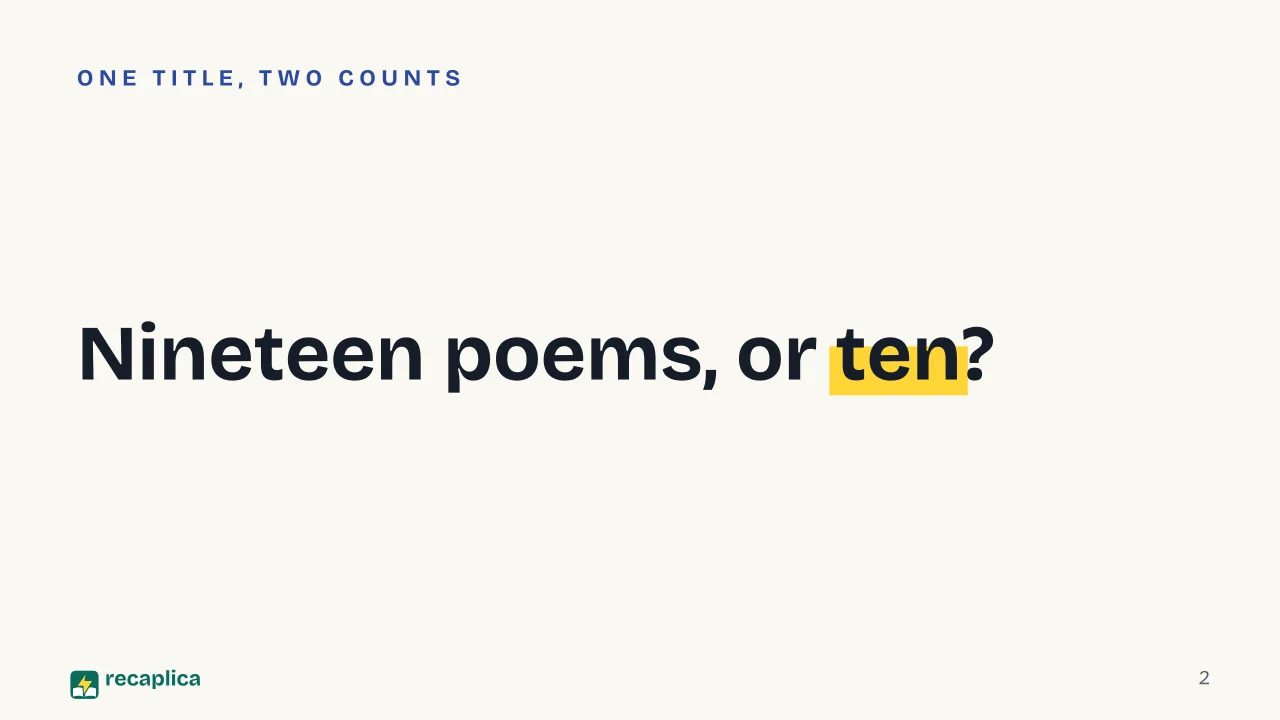
    The volume and the eponymous cycle don’t hold the same number of poems. According to the Fondazione Cesare Pavese, the 1951 book gathers nineteen poems in all: nine written in 1945 and ten in 1950. It’s the ten from 1950 that make up the cycle giving the whole collection its name.

    1951 Einaudi volumeTitle cycle
    Poems1910
    Years written1945 and 19501950
    Dedication—Constance Dowling

    A Month of Writing, for an American Actress

    According to VIV-IT, every poem in the cycle carries a date: the first is from March 11, 1950, the last from April 11 of that same year. Treccani ties those pages to the relationship, described as decisive, that Pavese had with the American actress Constance Dowling, to whom his last volume of verse is dedicated.

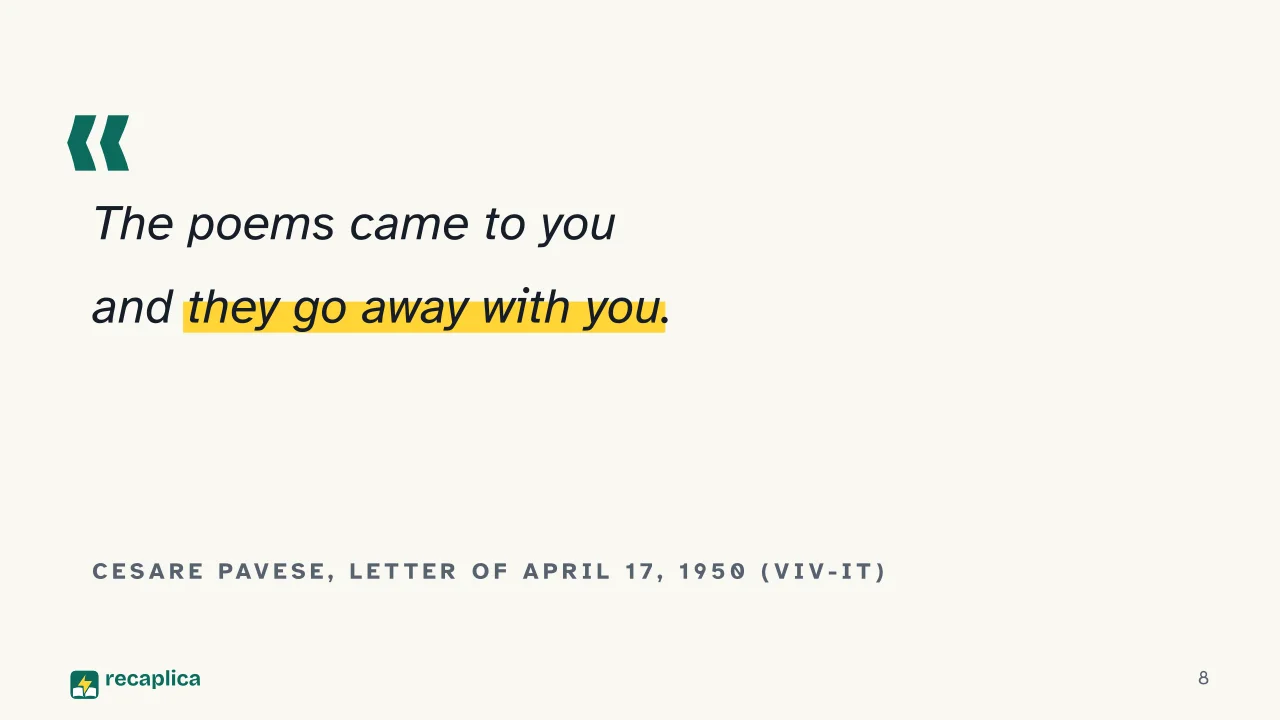
    On April 17, 1950, a few days after the last poem of the cycle, Pavese wrote in a letter:

    The poems came to you, and they go away with you.

    — Cesare Pavese, letter of April 17, 1950, quoted by VIV-IT.

    Love and Death, a Leopardian Echo

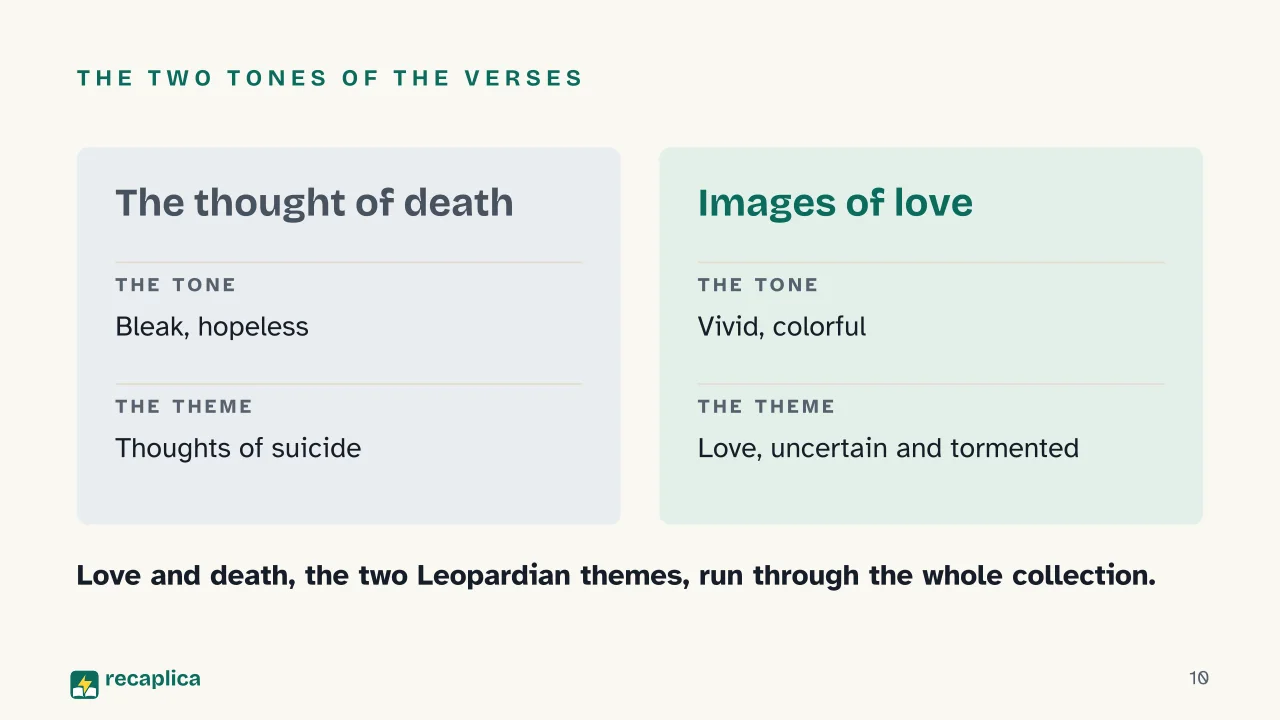
    According to Treccani, the book grew out of Pavese’s return to the “two beautiful things” of Giacomo Leopardi, love and death: the two themes that run through the whole collection. VIV-IT describes a register split between two tones: on one side, the thought of suicide, the “absurd vice,” with bleak tones and hopeless words; on the other, love, which still carries uncertainty and torment, told through vivid, colorful images.

    “The absurd vice” is the title of a biography of Pavese written by Davide Laiolo, not another work within the collection.

    A Different Style From Hard Labor

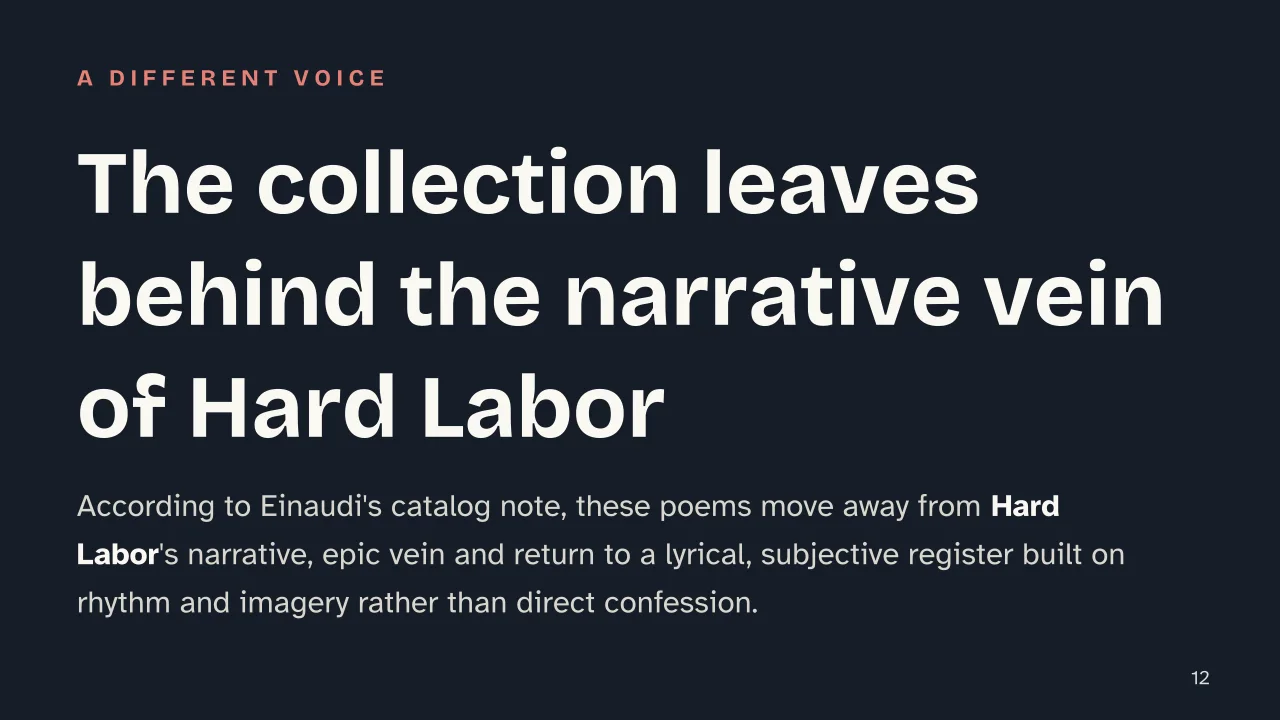
    According to Einaudi’s catalog note, the poems in this collection move away from the narrative, epic vein of Hard Labor and return to a lyrical, subjective register, built more on rhythm, imagery and sound than on direct confession.

    Slide deck

    Slides ready to download and make your own in PowerPoint or Google Slides, with speaker notes. Pick the Flash cut or the Full one.
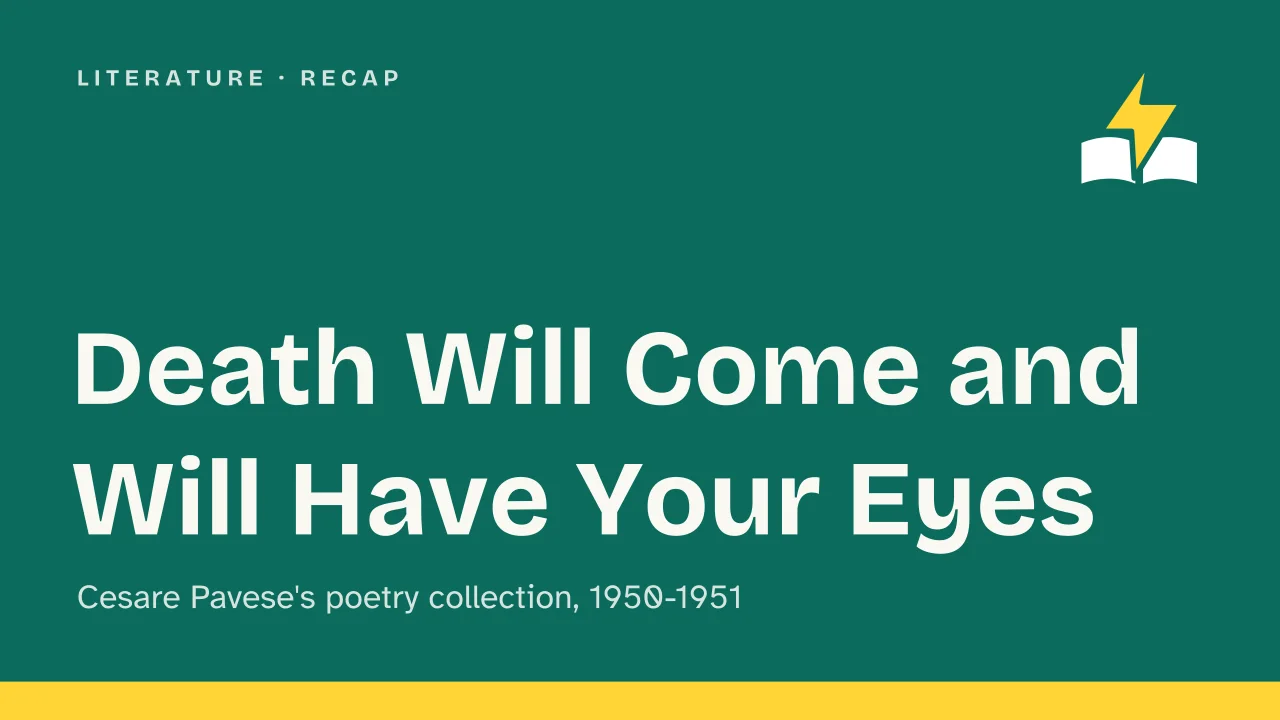
    Slide 1 of the presentation on Death Will Come and Will Have Your Eyes: Death Will Come and Will Have Your EyesSlide 2 of the presentation on Death Will Come and Will Have Your Eyes: Nineteen poems, or ten?Slide 3 of the presentation on Death Will Come and Will Have Your Eyes: What's aheadSlide 4 of the presentation on Death Will Come and Will Have Your Eyes: Chapter 01: A book published after deathSlide 5 of the presentation on Death Will Come and Will Have Your Eyes: The collection's numbersSlide 6 of the presentation on Death Will Come and Will Have Your Eyes: Chapter 02: The 1950 cycleSlide 7 of the presentation on Death Will Come and Will Have Your Eyes: When the cycle was writtenSlide 8 of the presentation on Death Will Come and Will Have Your Eyes: Cesare Pavese, letter of April 17, 1950 (VIV-IT)Slide 9 of the presentation on Death Will Come and Will Have Your Eyes: Chapter 03: Love and death, a recurring pairSlide 10 of the presentation on Death Will Come and Will Have Your Eyes: The two tones of the versesSlide 11 of the presentation on Death Will Come and Will Have Your Eyes: Chapter 04: A different voiceSlide 12 of the presentation on Death Will Come and Will Have Your Eyes: The collection leaves behind the narrative vein of Hard LaborSlide 13 of the presentation on Death Will Come and Will Have Your Eyes: How many poems does the 1951 Einaudi volume hold in all?Slide 14 of the presentation on Death Will Come and Will Have Your Eyes: The full Recap
    Flash10 slidesThe essential thread, to present in classFull14 slidesEvery chapter and the deeper detail

    Common myths

    • ✗ Myth The 1951 volume contains the same ten poems as the eponymous cycle.

      ✓ Reality According to the Fondazione Cesare Pavese, the 1951 Einaudi volume gathers nineteen poems in all: nine written in 1945 and ten in 1950. Only those last ten make up the cycle that gives the whole collection its name and that Pavese dedicated to Constance Dowling.

    • ✗ Myth The poems continue the narrative style of Hard Labor.

      ✓ Reality According to Einaudi's catalog note, no: compared with Hard Labor, these verses leave the narrative, epic vein behind and return to a lyrical, subjective register, where rhythm, imagery and sound matter more than direct confession.

    • ✗ Myth The Absurd Vice is another work in the collection.

      ✓ Reality No. Davide Laiolo chose that title for his biography of Pavese. Within the collection, the thought of suicide appears as the bleak undertone of some poems, according to VIV-IT, not as the title of a separate text.

    Mind map

    Drag the background to move around and the nodes to reposition them; use − and + to collapse and expand branches.
    Customize
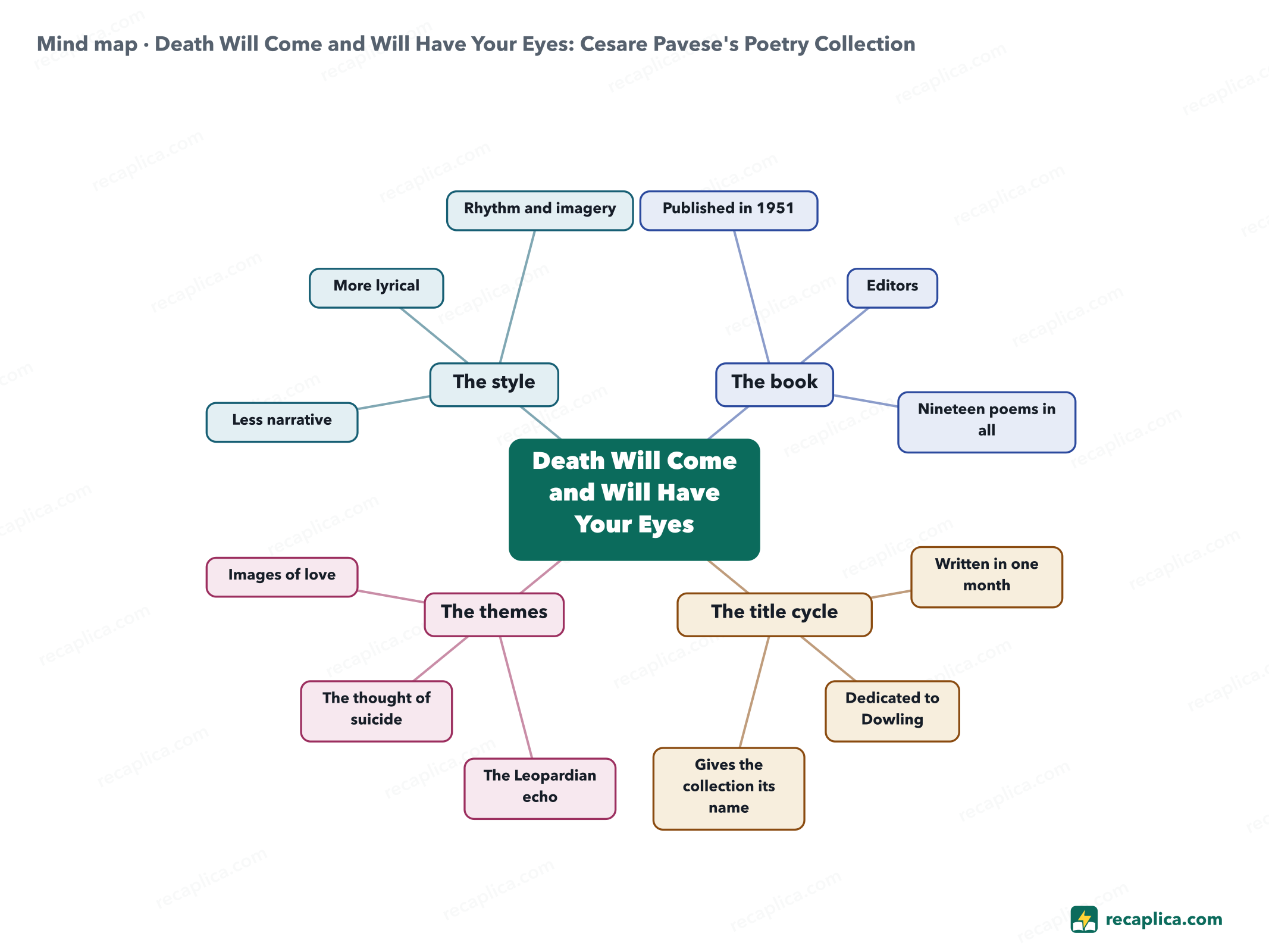
    Mind map: Death Will Come and Will Have Your Eyes: Cesare Pavese's Poetry Collection
    • Death Will Come and Will Have Your Eyes
      • The book Published posthumously in 1951
        • Published in 1951 Einaudi, Poeti series
        • Editors Massimo Mila and Italo Calvino
        • Nineteen poems in all Nine from 1945, ten from 1950
      • The title cycle The ten poems from 1950
        • Written in one month From March 11 to April 11, 1950
        • Dedicated to Dowling American actress Constance Dowling
        • Gives the collection its name
      • The themes Love and death
        • The Leopardian echo Love and death, according to Treccani
        • The thought of suicide The Absurd Vice, a bleak undertone
        • Images of love Vivid and colorful, according to VIV-IT
      • The style Compared with Hard Labor
        • Less narrative Moves away from the epic vein
        • More lyrical A subjective register
        • Rhythm and imagery Not direct confession

    Quiz: test yourself

    Answer the questions to check what you have learned: you get instant feedback and a short explanation.

    Grade 0/10 0/5
    1 In what year was Death Will Come and Will Have Your Eyes published?

    The volume was published posthumously in 1951 by Einaudi. 1950 is instead the year Pavese wrote the ten poems of the cycle that gives the collection its title.

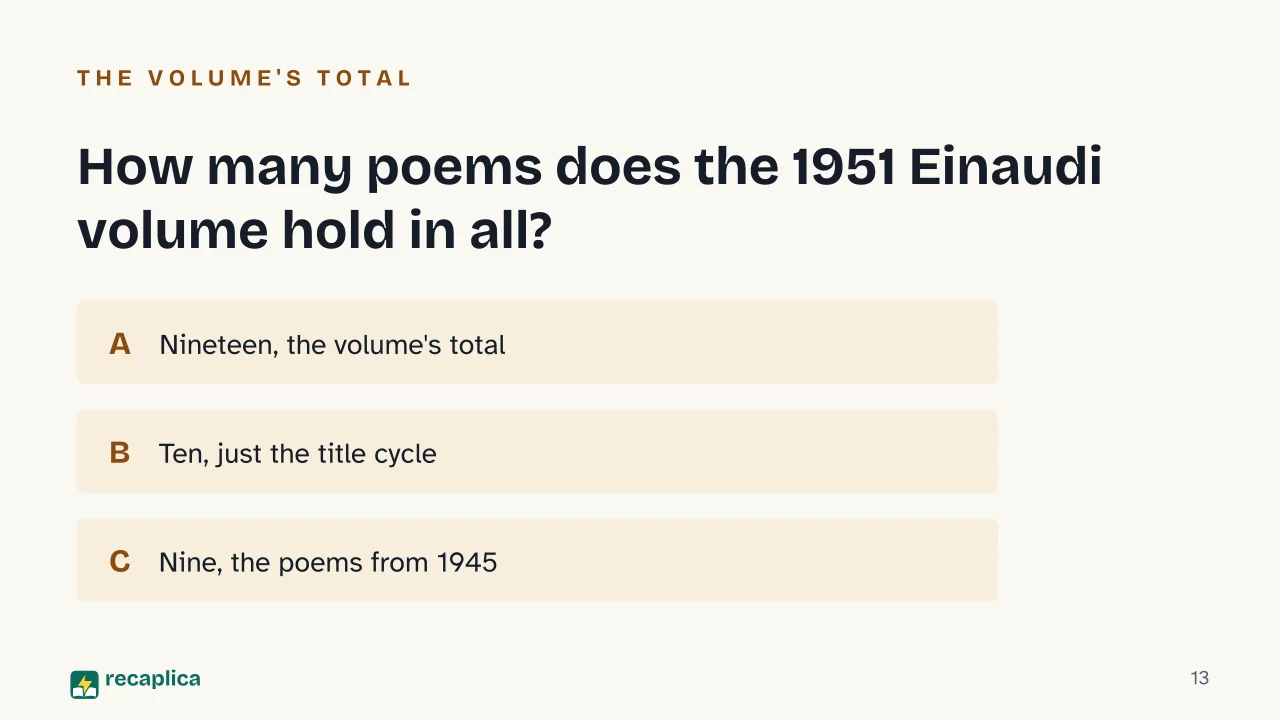
    2 How many poems does the 1951 Einaudi volume hold in all?

    The Fondazione Cesare Pavese lists nineteen poems in all, nine from 1945 and ten from 1950. The cycle that gives the collection its title holds only ten, those from 1950.

    3 Who are the ten poems of the 1950 eponymous cycle dedicated to?

    Constance Dowling is the American actress with whom Pavese had, according to Treccani, a decisive relationship; he dedicated his last volume of verse to her.

    4 Who edited the 1951 Einaudi edition?

    The Fondazione Cesare Pavese credits both with editing the volume, in Einaudi's "Poeti" series.

    5 Between which dates were the poems of the title cycle written?

    VIV-IT reports that every poem in the cycle carries a date, from the first poem on March 11 to the last on April 11, 1950.

    Answers: 1-A · 2-A · 3-A · 4-A · 5-A

    Flashcards

    Tap the card to flip it and check whether you remember the answer, then move to the next one.

    1 / 8

    Explain it in your own words

    The ultimate test: if you can explain it in simple words, you've truly understood it. Write your explanation, then compare it with the Recap.

    Your explanation is saved only on this device.

    "Death Will Come and Will Have Your Eyes" is the poetry collection Cesare Pavese dedicated to the American actress Constance Dowling. Einaudi published the book posthumously in 1951, edited by Massimo Mila and Italo Calvino; it brings together nineteen poems in all: the ten from 1950 that give the collection its title, written between March 11 and April 11 of that year, and nine more written in 1945. Treccani reads the book as Pavese's return to Leopardi's two themes, love and death. In a letter dated April 17, 1950, Pavese wrote: "The poems came to you, and they go away with you."

    Frequently asked questions

    What is Death Will Come and Will Have Your Eyes about?

    It is the poetry collection Cesare Pavese dedicated to Constance Dowling, the American actress with whom he had, according to Treccani, a decisive relationship. The central themes, again according to Treccani, are love and death, the same ones Pavese returns to from the Leopardian tradition; the thought of suicide, told in bleak tones, and love, told through vivid images, are the two voices VIV-IT finds in the verses.

    Where can I read the full text of the poems?

    In the printed Einaudi edition, edited by Massimo Mila and Italo Calvino, which collects the nineteen poems of the 1951 volume. It is the reference edition for readers looking for the complete text, not an online excerpt.

    How many poems does the collection really have, ten or nineteen?

    Both numbers are correct, but they refer to two different things: the 1951 Einaudi volume holds nineteen poems in all, nine from 1945 and ten from 1950; the cycle that gives the book its title counts only the ten from 1950.

    Who is Constance Dowling?

    The American actress to whom Pavese dedicated his last volume of verse. Treccani describes the relationship between the two as decisive for the writing of the 1950 cycle.

    What does the collection's title mean?

    It takes up the opening line of the poem of the same name, written by Pavese in the spring of 1950. The line opens the cycle dedicated to Dowling and anticipates the two themes that, according to Treccani, run through the whole volume: love and death.

    Sources

    • Cesare Pavese — Una poesia al giorno, Treccani
    • Cesare Pavese: works — Fondazione Cesare Pavese
    • Verrà la morte e avrà i tuoi occhi — Giulio Einaudi editore
    • Verrà la morte e avrà i tuoi occhi, le ultime poesie — VIV-IT

    Every Recap goes through an independent review before publication.

    Every evening, the day's new Recaps on our Telegram channel. Join the channel →

    Keep learning

    • Literature The Path to the Spider's Nests by Italo Calvino The Path to the Spider's Nests is Italo Calvino's debut novel, published by Einaudi in the autumn of 1947. It tells the story of the Italian Resistance through Pin, a boy who steals a pistol from a sailor and hides it in a place only he knows. Calvino wrote it in about twenty days, at 23, to meet a literary prize deadline of December 31, 1946 — the same young man who had joined the partisans in 1944 under the nom de guerre Santiago. The novel is the book critics point to when they introduce Calvino's early phase, known as fantastic neorealism: a war told through a child's fable-like gaze rather than a direct, adult account. Read the Recap →
    • Literature The Moon and the Bonfires by Cesare Pavese: Summary, Characters and Themes «The Moon and the Bonfires» is the last novel Cesare Pavese finished. He wrote it between September and November 1949, and Einaudi published it in 1950. The narrator is a foundling known only by his nickname, Anguilla — «Eel» in English — who comes home to the village that raised him after making money in the United States, and finds a place the war has reworked. The book is laid out as episodes that look unconnected, and what ties them together is the narrator's own remembering. The critic Silverio Novelli, writing for Treccani, argues that the homecoming never gives Anguilla back the identity he is after: it sharpens his sense of belonging nowhere. Read the Recap →
    • Literature Zeno's Conscience (Confessions of Zeno): Summary and Analysis Zeno's Conscience is the novel Italo Svevo published in 1923, the third and last of his major novels after A Life (1892) and As a Man Grows Older (1898). The book takes the shape of a memoir that Zeno Cosini writes at his psychoanalyst's urging, working through his life not in chronological order but chapter by chapter, each one built around a separate theme: smoking, his father's death, his marriage to Augusta, an affair with his lover Carla, and a business partnership with his brother-in-law Guido Speier. Zeno's account can't be taken at face value, since it passes through his own subjective memory and self-deceptions he never intended. Svevo paid to publish the book himself, and it barely sold in Italy at first; it found an audience only years later, after his friend James Joyce brought it to the attention of two French critics. Read the Recap →

    recaplica

    Clear in 30 seconds, yours in 10 minutes.

    Recaps Mind maps Request a Recap Telegram channel Mind map maker Our method About Privacy & cookies Legal notes & terms of use

    © 2026 Recaplica · A project by Curi S.r.l. — VAT IT05472000750

    Statistics, only if you say so

    To learn which Recaps help most we would use Google Analytics, with aggregate, anonymous data. It starts only with your OK, and you can change your mind anytime. Privacy policy