|
recaplica
The Path to the Spider's Nests by Italo Calvino |
| © 2026 Recaplica · recaplica.com — All rights reserved |
The Path to the Spider's Nests by Italo CalvinoWhat to print Page numbers appear when printing with default margins. SlidesChoose a cut Flash10 slidesThe essential thread, to present in classFull16 slidesEvery chapter and the deeper detailBoth come with speaker notes. In 30 seconds quick readThe Path to the Spider's Nests is Italo Calvino's debut novel, published by Einaudi in the autumn of 1947. It tells the story of the Italian Resistance through Pin, a boy who steals a pistol from a sailor and hides it in a place only he knows. Calvino wrote it in about twenty days, at 23, to meet a literary prize deadline of December 31, 1946 — the same young man who had joined the partisans in 1944 under the nom de guerre Santiago. The novel is the book critics point to when they introduce Calvino's early phase, known as fantastic neorealism: a war told through a child's fable-like gaze rather than a direct, adult account. Key Points
Deep DiveWhen Italo Calvino submitted The Path to the Spider’s Nests for a literary prize at the end of 1946, he was 23 and carried an experience he never narrates in the first person in the book: fighting with the partisans. The novel appeared the following year, in the autumn of 1947, published by Einaudi, and became the text through which textbooks and anthologies introduce the first phase of his writing, the one critics call fantastic neorealism. Who Calvino was before the novelIn June 1944 Calvino joined the partisans under the nom de guerre Santiago, taken from his birthplace, Santiago de Las Vegas, in Cuba. He served in the 16th detachment of the 9th Communist Garibaldi brigade “Felice Cascione”; between February and April 1945 he moved to the 2nd Garibaldi assault division “Felice Cascione” and took part in fighting along the border between Liguria and Piedmont, including at Bregalla and Baiardo, in the final months of World War 2 in Italy. Less than two years after that experience, Calvino wrote a novel that does not recount it directly: the war is told by a boy standing on the margins of the Resistance, not by one of its protagonists. For a literary prize with a deadline of December 31, 1946, he wrote The Path to the Spider’s Nests in about twenty days. The plot of The Path to the Spider’s NestsThe novel’s protagonist is Pin, a boy who lives on the edge of the old town, brother of a woman who works as a prostitute and an unwilling companion to the men who pass through her house. The story begins when Pin steals a pistol from a sailor and hides it somewhere only he knows: a path where spiders build their nests among the grass, the “spider’s nests” of the title. From there the boy brushes against the world of adults, men and women caught up in the Resistance in different ways, without fully grasping what is at stake: for Pin, the war remains, in part, a dangerous game among grown-ups.
Fantastic neorealismThe term describes how Calvino, in this novel, holds together two things that seem opposed: the historical substance of the Resistance and a fable-like gaze, almost like a story for children. Treccani describes the novel’s style as a harsh, distorted fable, close to the perception of a boy raised in the alleys of old Sanremo — a description that keeps both poles in view: the fable, which is the form, and the harshness and distortion, which are the historical content filtered through it. It is neither a direct account of the partisan war nor a comforting fairy tale: it is a reading of the Resistance built on a partial, childlike point of view, one that can distort events without making them false. It remains one possible reading of the book, not the only one: the novel also lends itself to a more political or more linguistic analysis, depending on what a reader chooses to focus on. Compared with the nineteenth-century verismo of Giovanni Verga, which portrayed the poor with an almost documentary eye, Calvino shifts the filter from objective observation to the viewpoint of a single child, gaps and all. The fascism the novel leaves in the background had, in the years before, built an image of itself very different from the one Calvino’s fellow partisans knew firsthand, as the Recap on the Mussolini myth recounts. The 1947 reception and the 1964 returnOn its release, the novel shared a literary prize, but also drew reservations from Giansiro Ferrata, Elio Vittorini and Cesare Pavese. A Mondadori publisher’s page, recalling Pavese’s 1947 presentation, remembers that text as calling the novel Calvino’s “first masterpiece” — a judgment the page attributes to Pavese, though it does not appear to have been verified against the original text of the presentation. Seventeen years later, for a new Einaudi edition dated June 20, 1964, in the “I coralli” series, Calvino returned to his debut novel with an eighteen-page author’s preface. Calvino made his debut in an Italian literary twentieth century that had already made room for writers like Luigi Pirandello, even if working from very different premises. Slide deckSlides ready to download and make your own in PowerPoint or Google Slides, with speaker notes. Pick the Flash cut or the Full one.     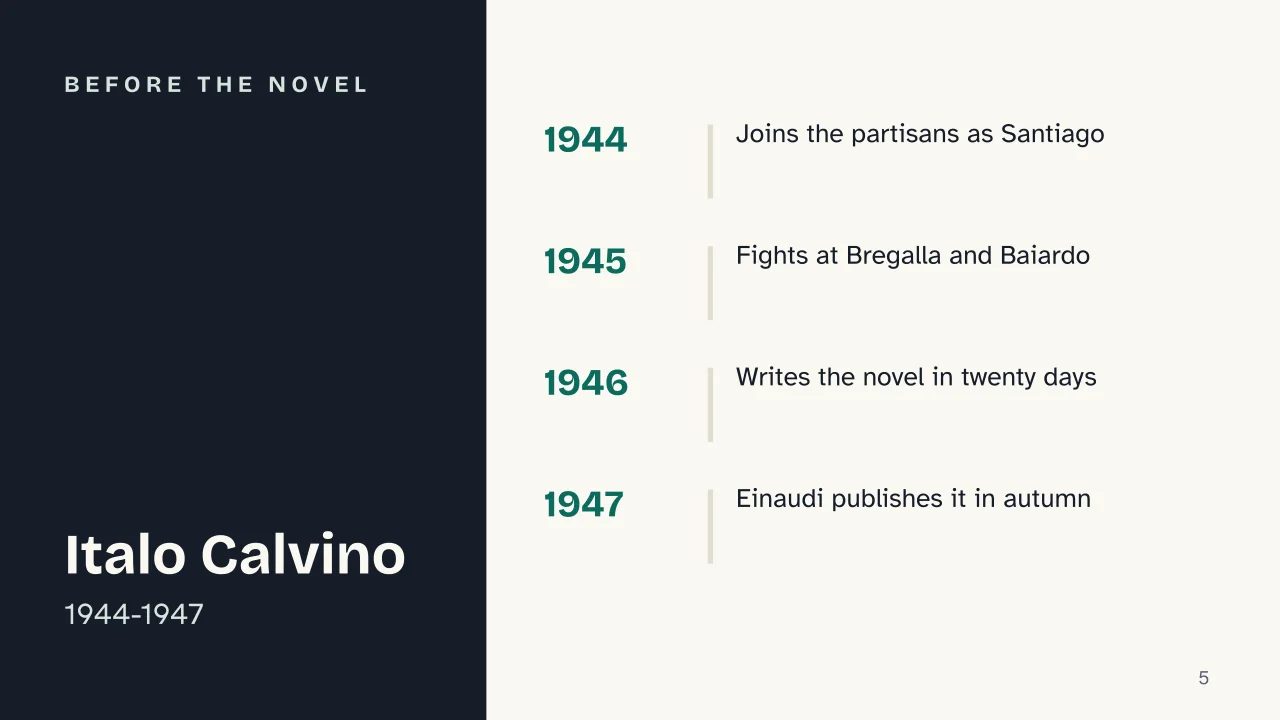  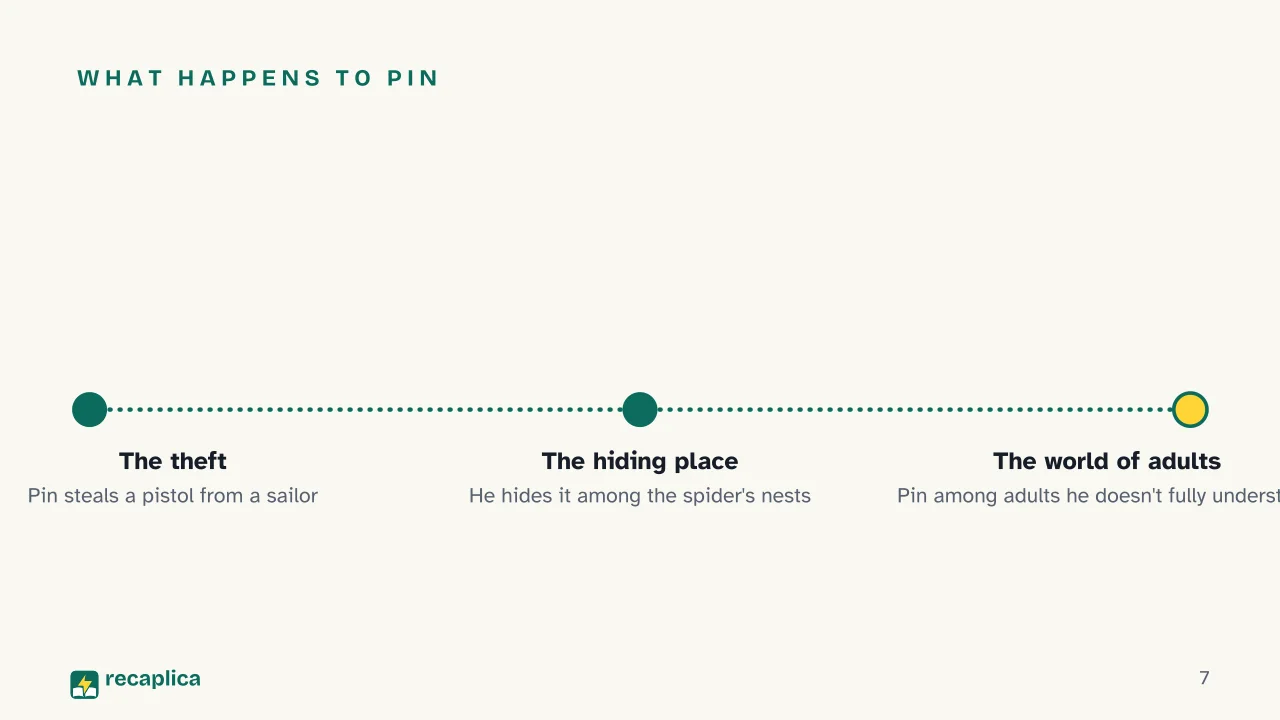 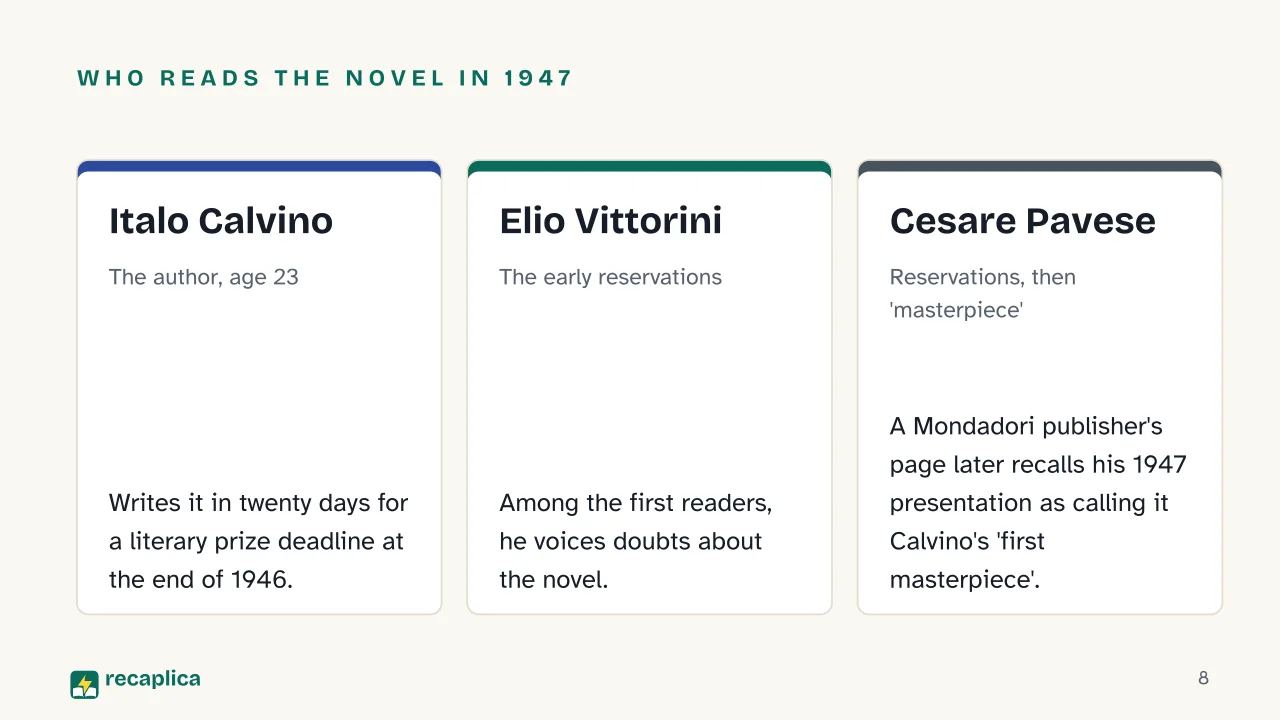   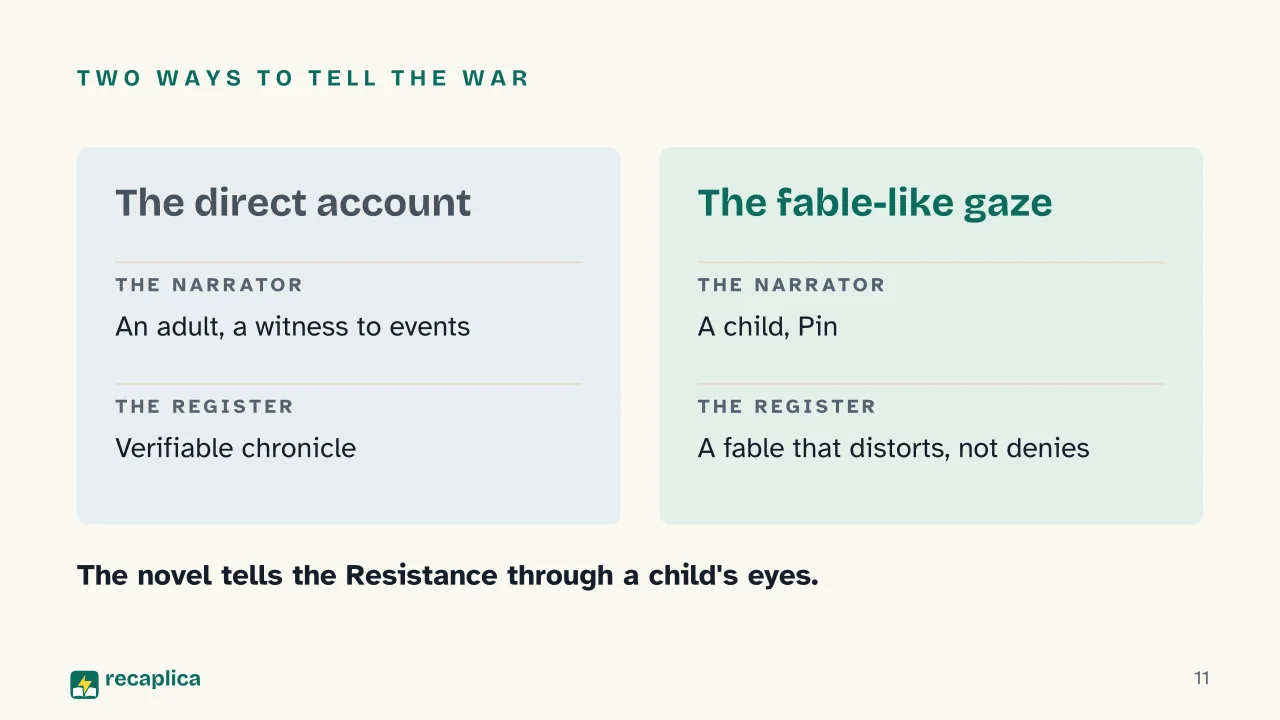  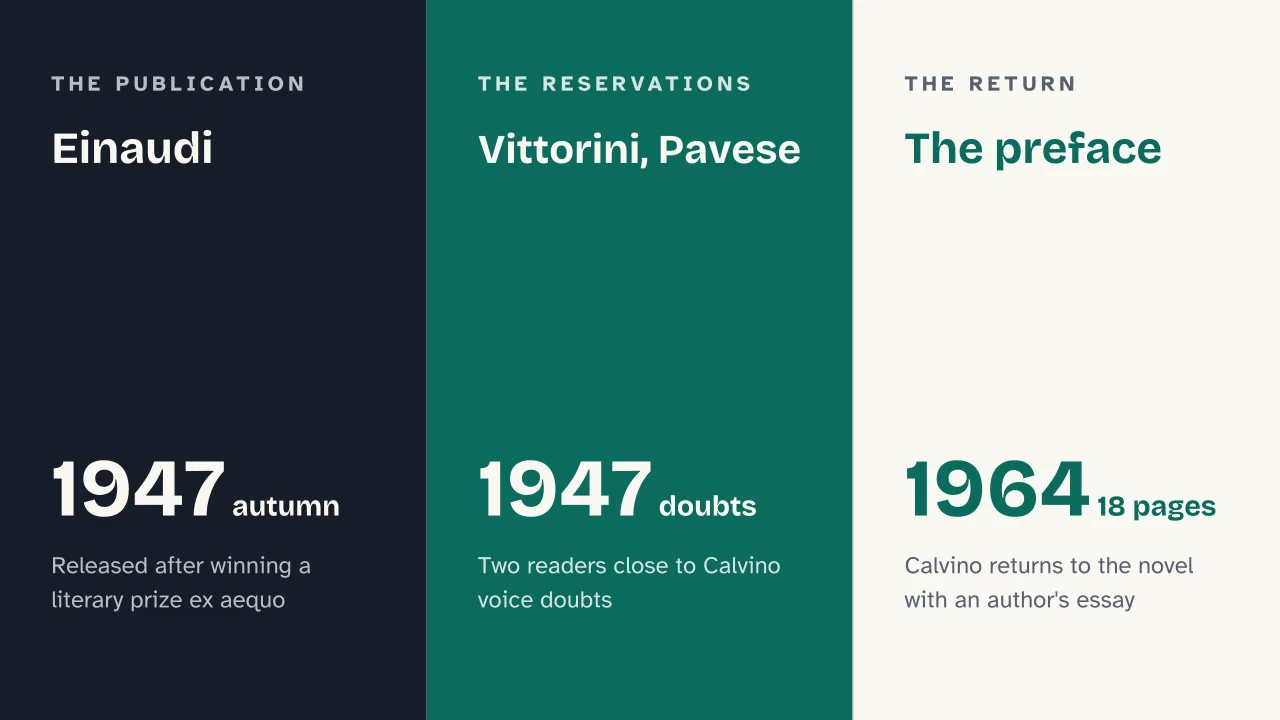 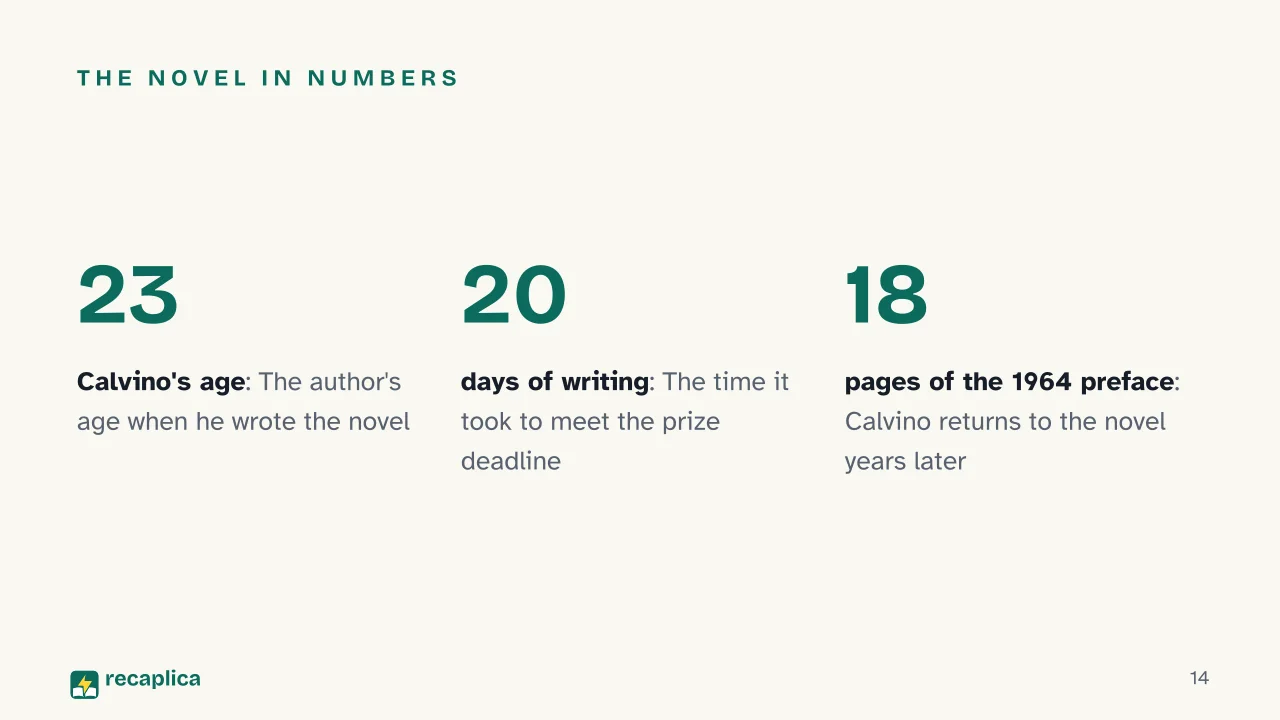   Common myths
Mind mapDrag the background to move around and the nodes to reposition them; use − and + to collapse and expand branches. 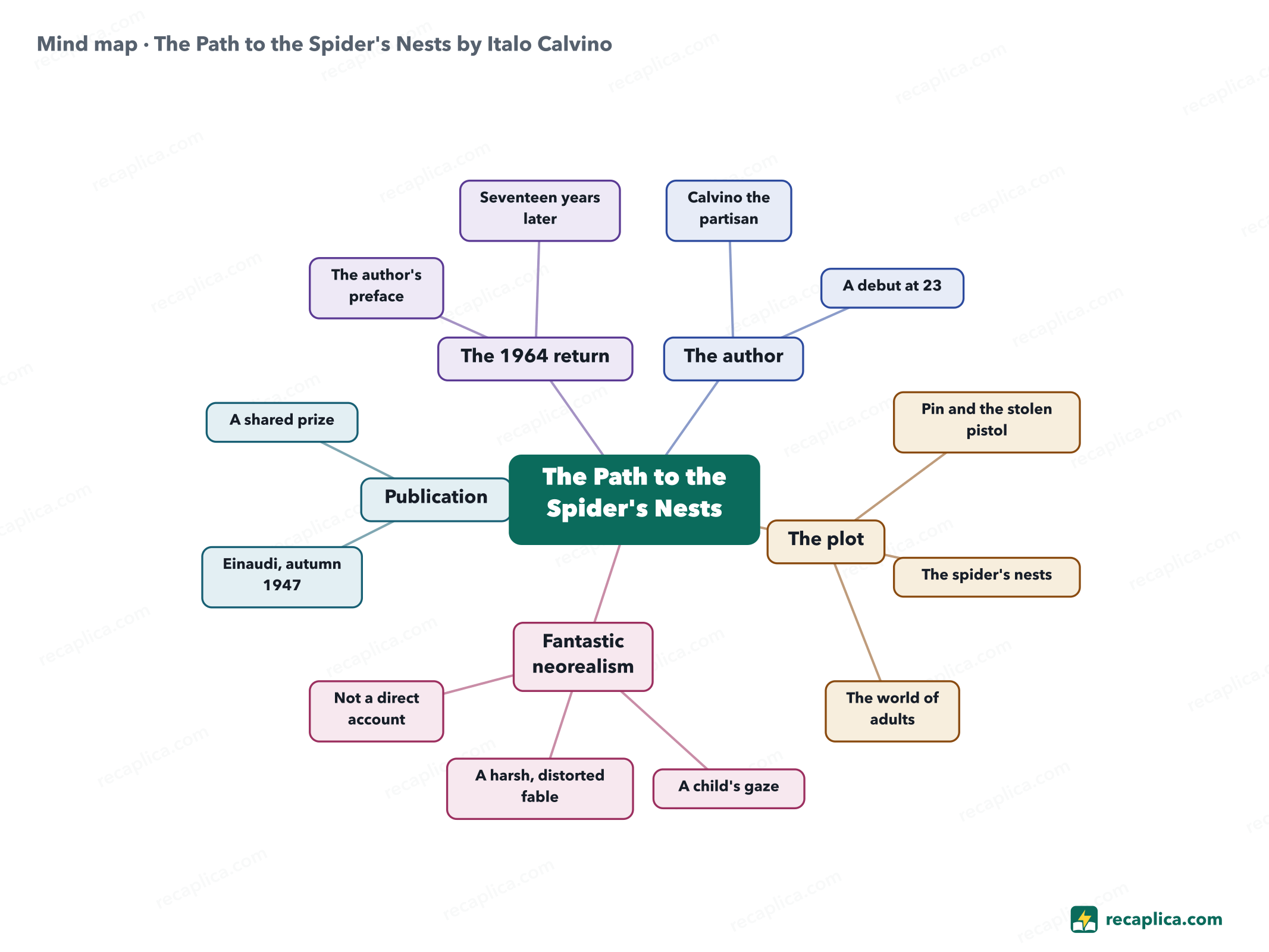
Quiz: test yourselfAnswer the questions to check what you have learned: you get instant feedback and a short explanation. Grade 0/10 0/5
FlashcardsTap the card to flip it and check whether you remember the answer, then move to the next one. 1 / 7 Explain it in your own wordsThe ultimate test: if you can explain it in simple words, you've truly understood it. Write your explanation, then compare it with the Recap. Your explanation is saved only on this device.
Frequently asked questionsWhat is The Path to the Spider's Nests about?It tells the story of the Italian Resistance through Pin, a boy who lives on the fringes of the partisan struggle: the war reaches him filtered through his own limited understanding, not as a direct adult account. What happens in the novel?Pin steals a pistol from a sailor and hides it in a secret spot only he knows, a path where spiders build their nests in the grass, the title's 'spider's nests'. From there he brushes against the adult world of the Resistance without fully grasping what is at stake. What is Calvino's fantastic neorealism?It is the term used to describe Calvino's first narrative phase: the historical substance of the Resistance told through a childlike, fable-like gaze. Who is Pin, the novel's protagonist?A boy who lives on the edge of the old town, brother of a woman who works as a prostitute; he steals a pistol from a sailor and hides it in his secret refuge, the spider's nests. How was The Path to the Spider's Nests received when it came out?In 1947 it shared a literary prize, but also met early reservations from Elio Vittorini and Cesare Pavese, two readers close to Calvino; in 1964 Calvino himself returned to the novel with an eighteen-page preface. Every Recap goes through an independent review before publication. |