|
recaplica
Primo Levi: Life, Books and the Testimony of Auschwitz | |||||||||
| © 2026 Recaplica · recaplica.com — All rights reserved | |||||||||
Primo Levi: Life, Books and the Testimony of AuschwitzWhat to print Page numbers appear when printing with default margins. SlidesChoose a cut Flash10 slidesThe essential thread, to present in classFull16 slidesEvery chapter and the deeper detailBoth come with speaker notes. In 30 seconds quick readPrimo Levi was born in Turin in 1919 and graduated in chemistry in 1941, right as Italy's fascist racial laws were making his life harder. Arrested in the Aosta Valley in December 1943, he was deported to Auschwitz in February 1944 and survived until liberation in January 1945. In 1947 he published 'If This Is a Man', the account of his imprisonment, which became one of the most widely read testimonies of 20th-century Italian literature about the Nazi camps. In the years that followed he also wrote novels, science fiction stories and books that wove chemistry together with writing, such as 'The Periodic Table'. He died in Turin in 1987, in the same house where he was born. Key Points
Key figures
Deep DiveThe formative yearsPrimo Levi was born in Turin on 31 July 1919. In 1934 he entered the Massimo D’Azeglio lyceum, graduating in 1937, and that same year he enrolled at the University of Turin’s School of Sciences to study chemistry. In November 1938 the fascist regime issued the racial laws, barring Jews from public schools and complicating things even for those, like Levi, already inside the university: finding a professor willing to supervise his thesis became difficult. Levi graduated anyway, in July 1941, with the highest marks and honours. His diploma, though, carried a note that says everything about the climate of those years: the wording “of the Jewish race”, imposed by those same racial laws. Levi was not the only Italian Jewish writer of the twentieth century to turn his own identity, worked out in a city like Turin or, farther east, Trieste, into literature: Italo Svevo, born decades earlier, built his best-known novel, Zeno’s Conscience, around a self-examination that starts from the very same place, a man telling his own story with the tools he knows best. In Levi’s case, those tools belonged to a chemist. Arrest and deportationOn 8 September 1943 the Badoglio government announced the armistice with the Allies. On 13 December 1943 Levi was arrested by fascist militia together with other companions at Amay, a hamlet of the municipality of Saint-Vincent on the road toward the Col de Joux and Brusson — which is why looser accounts name one nearby town or the other instead of the precise spot. Moved to the transit camp at Fossoli, near Modena, Levi was put on a train that left for Poland on 22 February 1944, together with about 650 other Italian Jews. At Auschwitz-Birkenau he was tattooed with the number 174517, according to the Holocaust Historical Society, and assigned to the Monowitz subcamp, where he worked as an assistant in a laboratory of the German chemical company I.G. Farben. It was there that his training as a chemist, the same degree that carried the discriminatory note, may well have helped him survive, with indoor work in the camp, in the last months of World War II. Levi fell ill shortly before the camp’s evacuation, which spared him the forced marches west: he was liberated by the Red Army on 27 January 1945, while still in the camp infirmary. Return and the making of a writerGetting home took time. Levi left Poland only in June 1945, on a long and winding journey across eastern Europe, and reached Turin on 19 October 1945. He found work at a paint factory, and around the same time began writing what would become his first book.
“If This Is a Man” came out in 1947, published by the small press De Silva. The book does not merely narrate events: it records names, numbers, everyday gestures of the camp, in an almost scientific manner. The chapter-by-chapter content of this book deserves a Recap of its own, and we will return to it in a future piece.
The other books, beyond AuschwitzOne common reading of Levi reduces him to the writer of a single subject, the deportation. That reading only tells part of the story. In 1966, under the pen name Damiano Malabaila, he published “Natural Histories”, a collection of science fiction stories. In 1971 came “Vizio di forma” (Flaw of Form), another collection in the same genre. In 1975 he published “The Periodic Table”, an autobiographical book made of twenty-one chapters, each tied to an element of the periodic table, weaving together his life as a chemist and as a writer. In 1978 came “The Wrench”, a novel about the trade of an industrial rigger, which won him the Strega Prize. In 1982 he published “If Not Now, When?”, and in 1986, a year before his death, “The Drowned and the Saved”, a later and darker reflection on the memory of the Holocaust. The chemist who writes: Levi’s outlookOne of the central threads in Levi’s thinking is that chemistry and writing were never separate activities. He said chemistry teaches you to separate, weigh and distinguish things, exercises just as useful to someone setting out to tell a story. He never drew a sharp line between his identity as a chemist and as a writer: the first gave him the tools to bring order to his memories, the second the means to share them. A literary legacyPrimo Levi died in Turin on 11 April 1987, in the same house where he was born. Biographical sources agree on the date and the place. His work remains today among the central references of 20th-century Italian literature on the deportation, taught in schools and studied in Holocaust research, and it is also valued for the range of forms he moved through, from the novel to science fiction, from memoir to a story about industrial work. Slide deckSlides ready to download and make your own in PowerPoint or Google Slides, with speaker notes. Pick the Flash cut or the Full one.     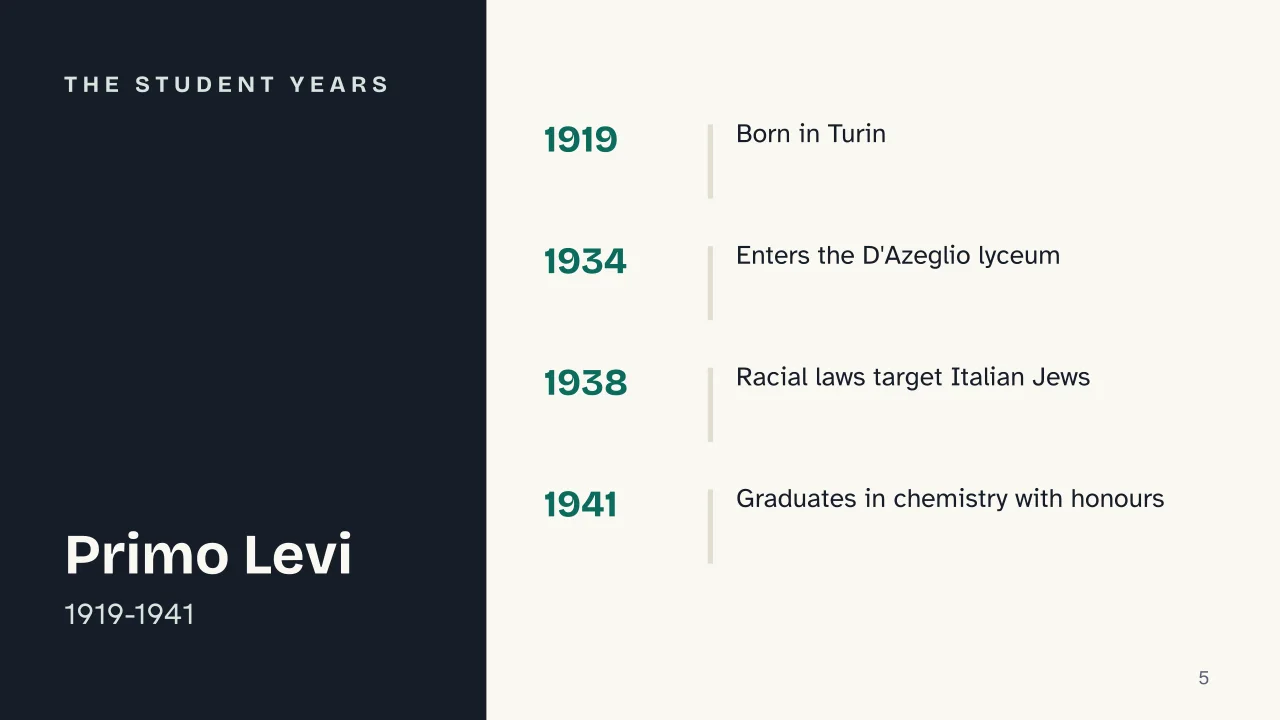  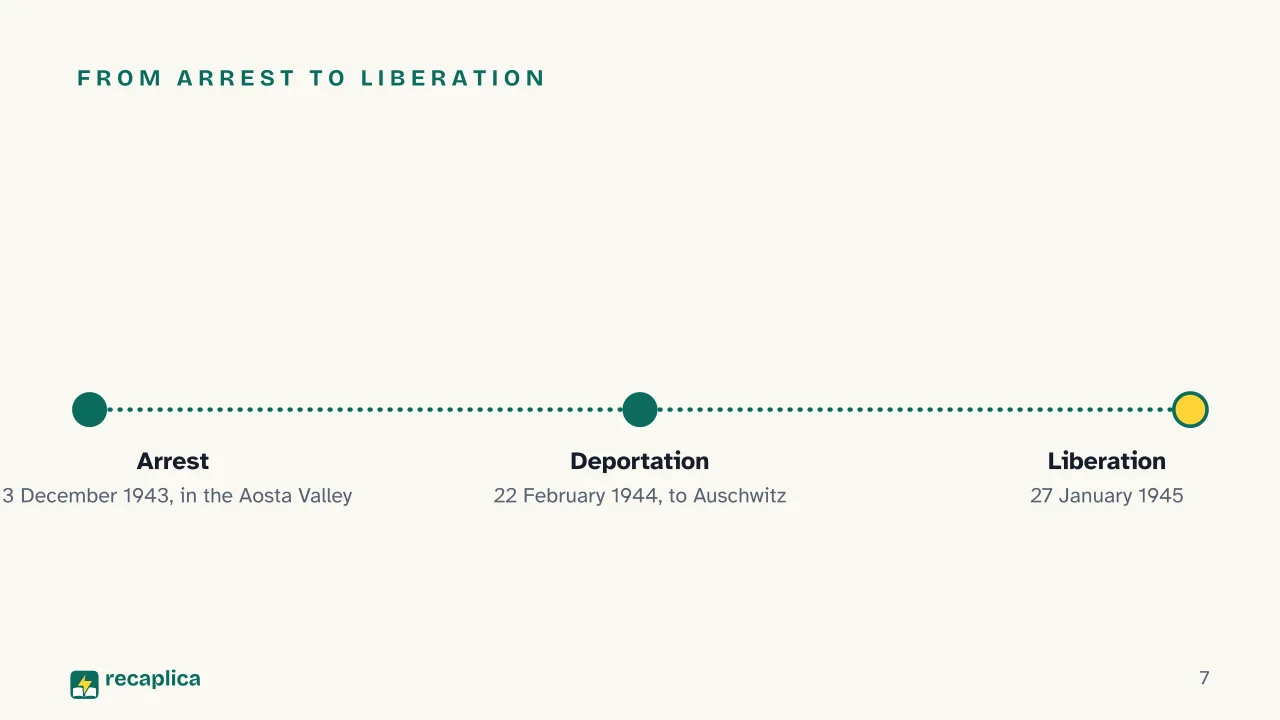 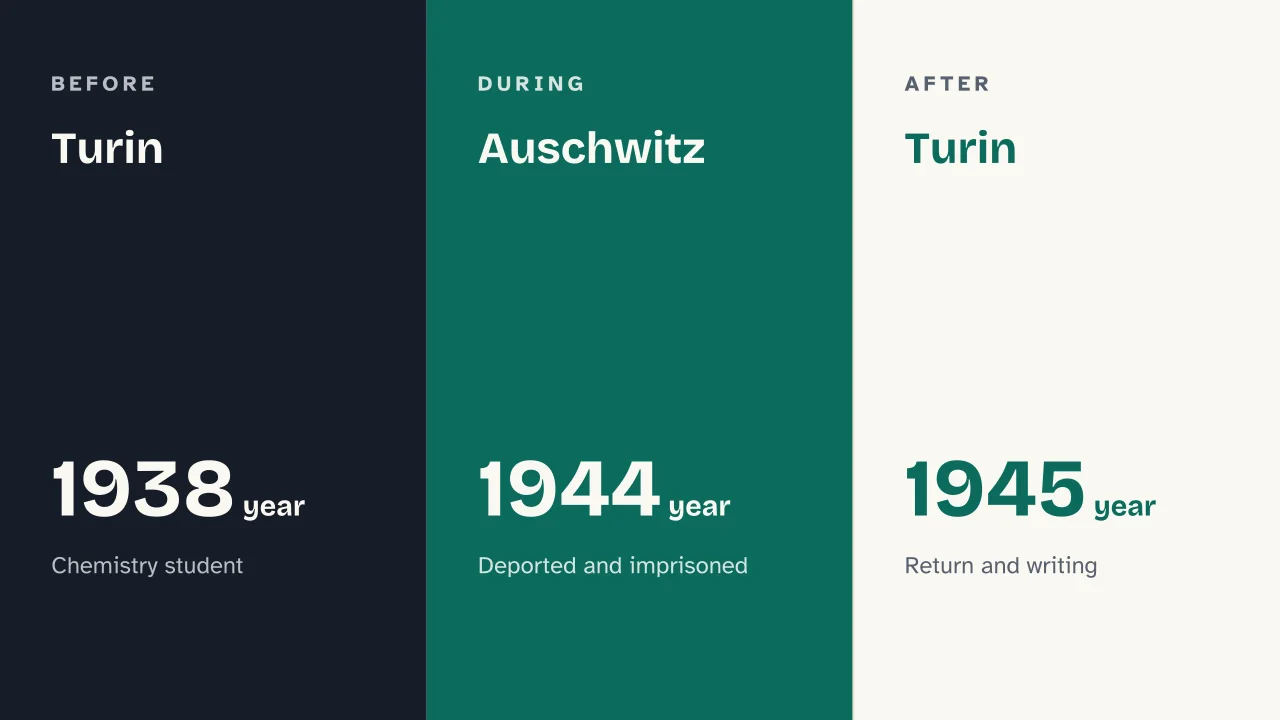  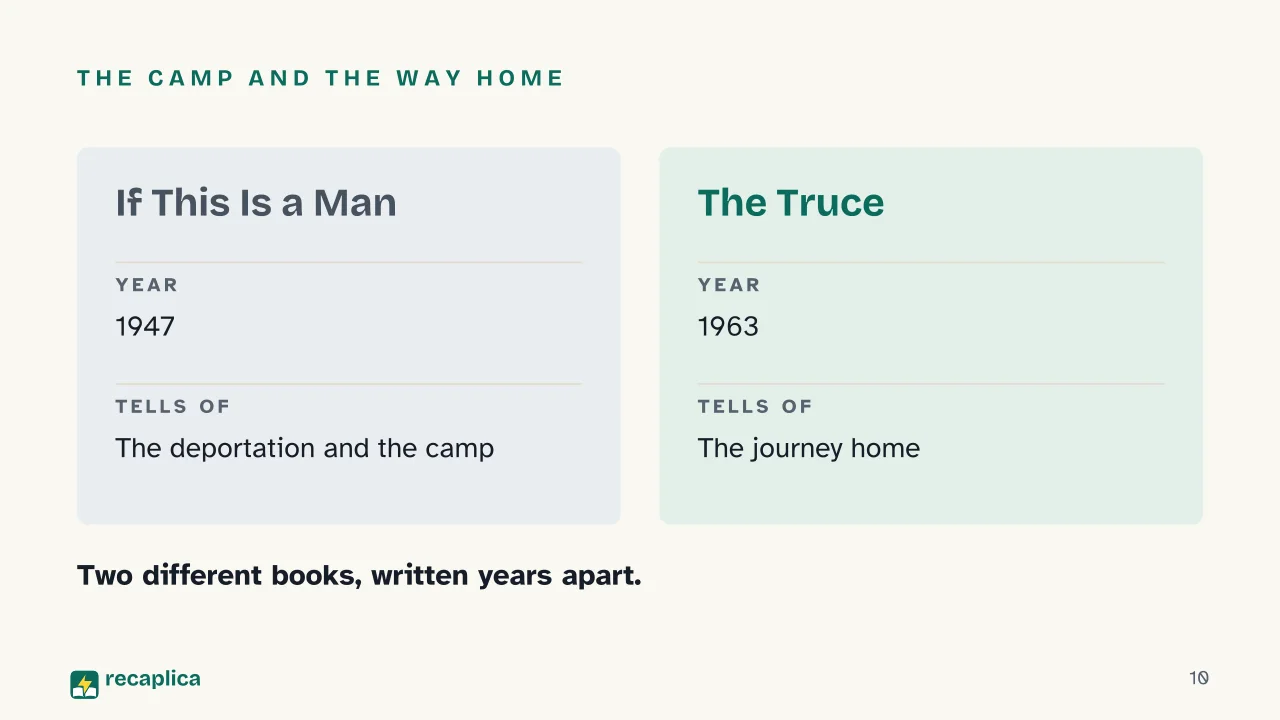  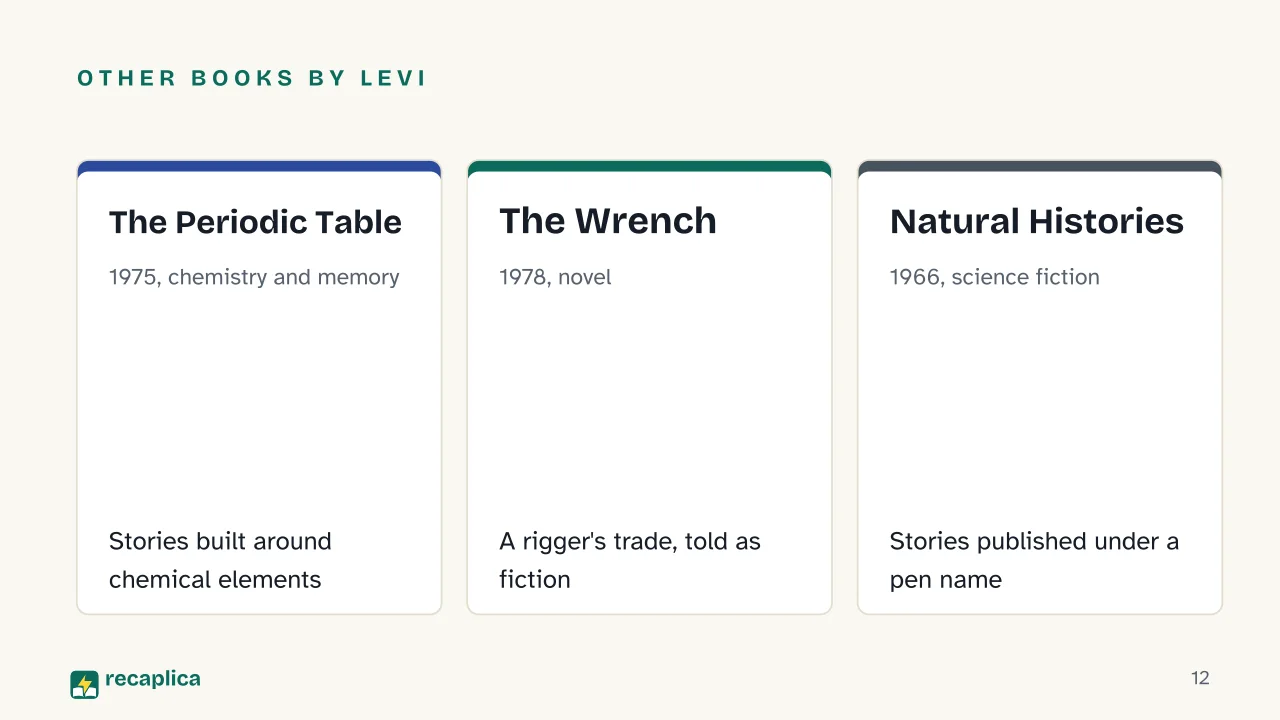 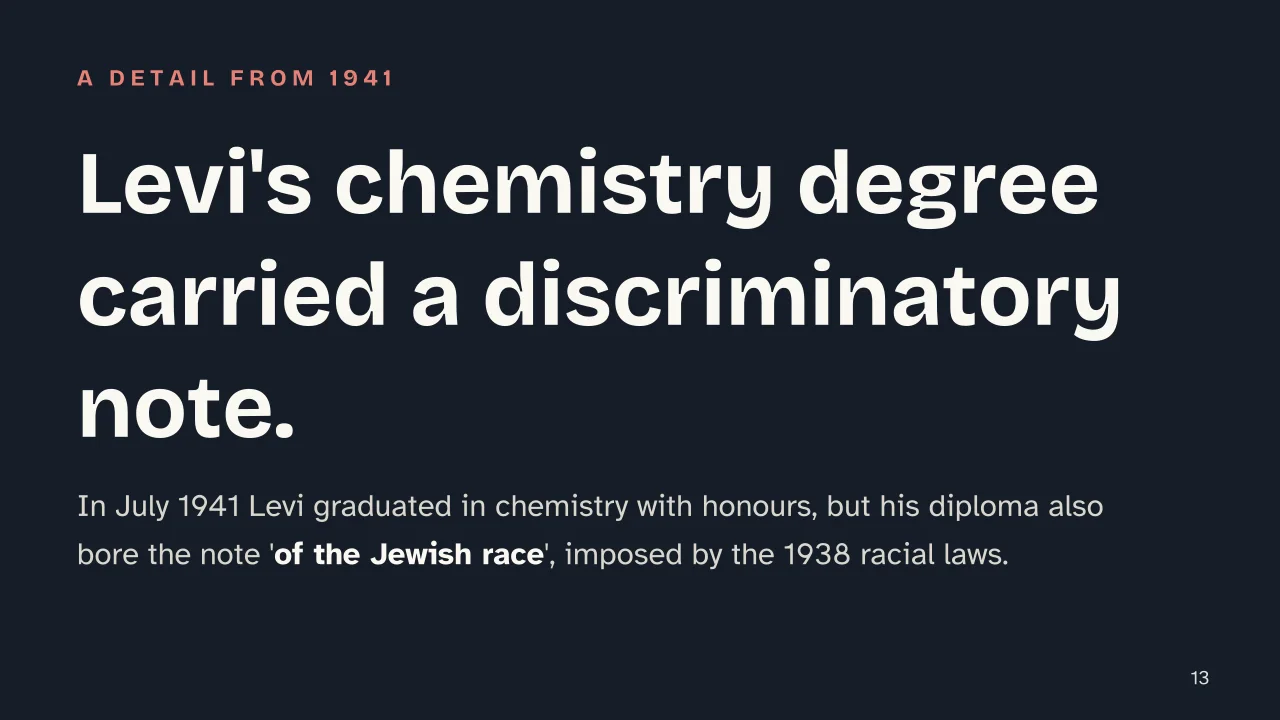 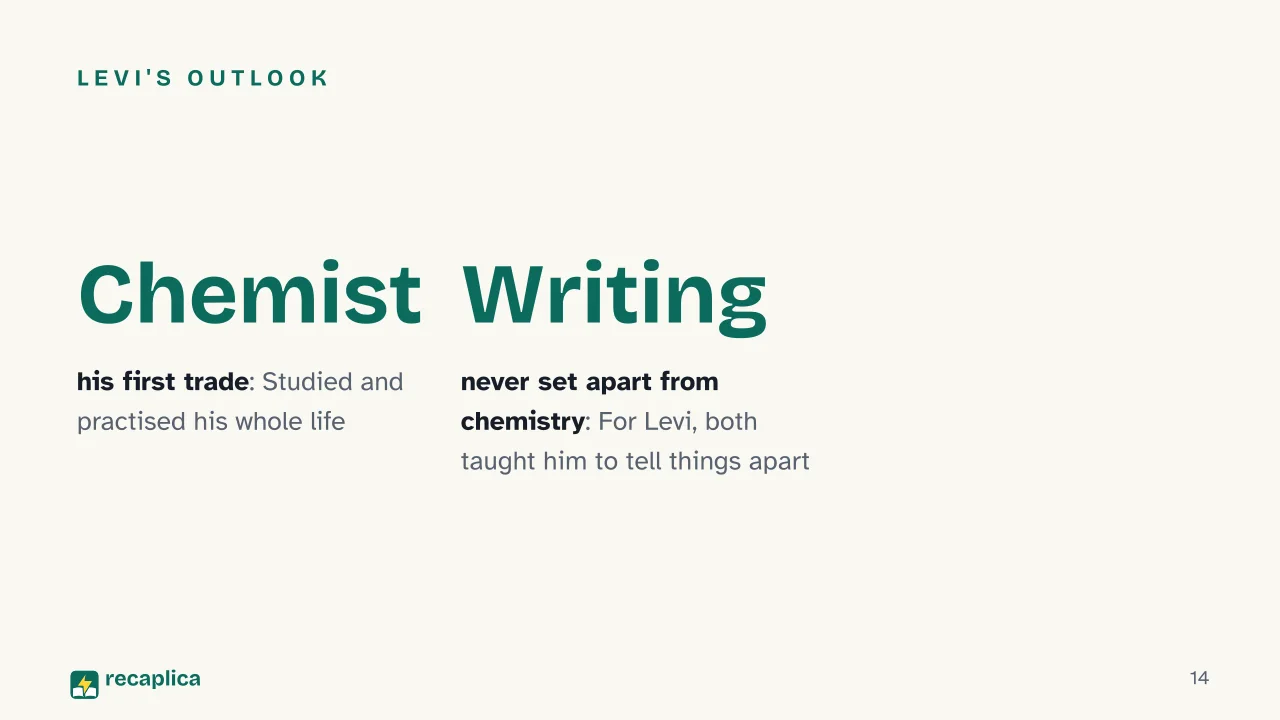 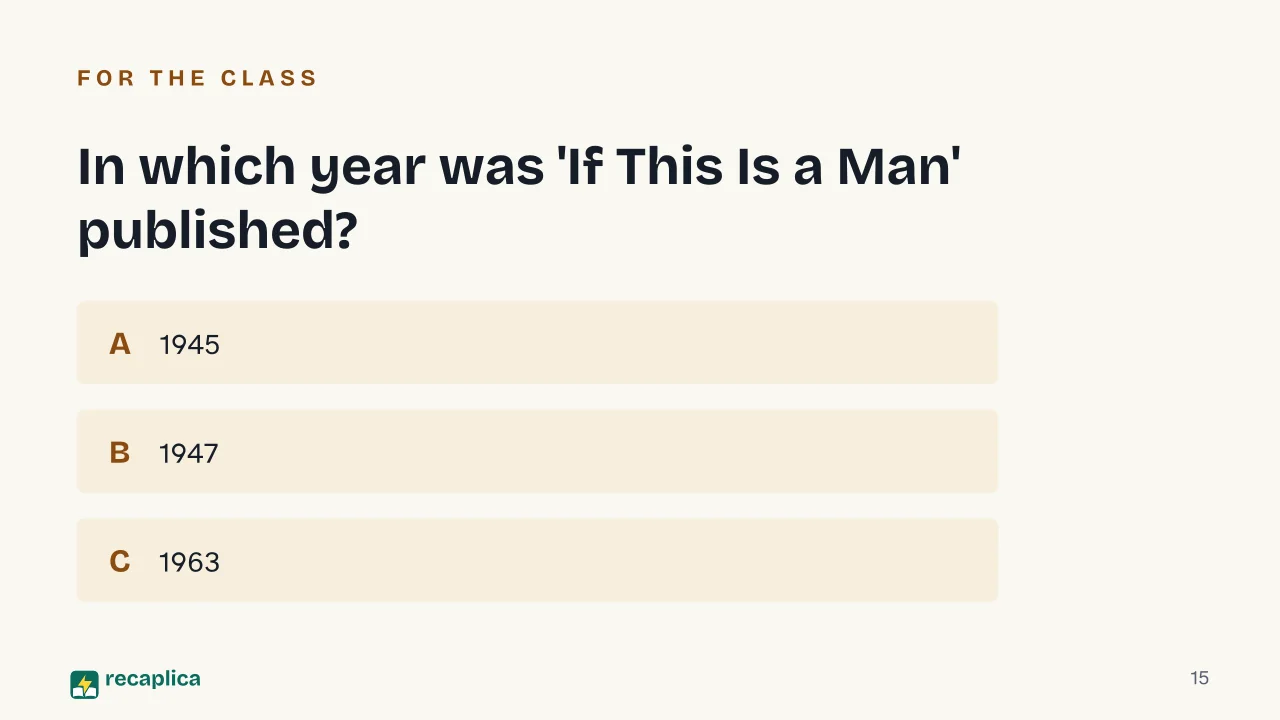  Common myths
Mind mapDrag the background to move around and the nodes to reposition them; use − and + to collapse and expand branches. 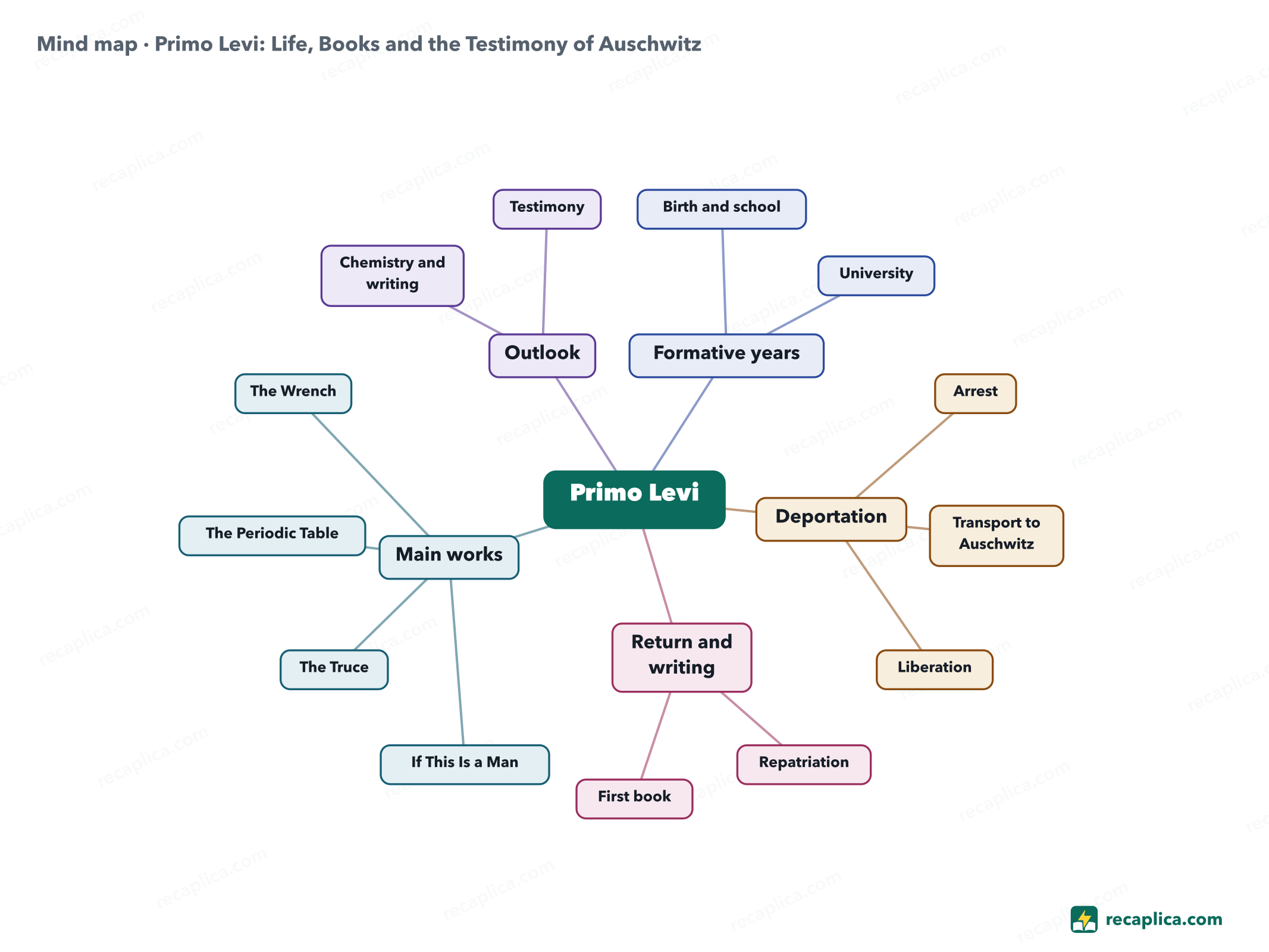
Quiz: test yourselfAnswer the questions to check what you have learned: you get instant feedback and a short explanation. Grade 0/10 0/5
FlashcardsTap the card to flip it and check whether you remember the answer, then move to the next one. 1 / 8 Explain it in your own wordsThe ultimate test: if you can explain it in simple words, you've truly understood it. Write your explanation, then compare it with the Recap. Your explanation is saved only on this device.
Frequently asked questionsWho was Primo Levi?Primo Levi was an Italian writer and chemist, born in Turin in 1919. Deported to Auschwitz in 1944, he survived the imprisonment and told of the experience in 'If This Is a Man', published in 1947. He died in Turin in 1987. What did Primo Levi write?Besides 'If This Is a Man' (1947) and 'The Truce' (1963), Levi wrote science fiction stories such as 'Natural Histories' (1966), the autobiographical book 'The Periodic Table' (1975) and the novel 'The Wrench' (1978), among other works. What is a summary of Primo Levi's life?Born in Turin in 1919, Levi graduated in chemistry in 1941 despite the fascist racial laws. Arrested in the Aosta Valley in December 1943, he was deported to Auschwitz in February 1944 and freed in January 1945. Back in Turin in October 1945, he published 'If This Is a Man' in 1947 and kept writing until his death in 1987. Why does Primo Levi matter to Italian literature?Because his testimony about Auschwitz, in 'If This Is a Man', is regarded as one of the most widely read accounts of the reality of the Nazi camps, and because throughout his work he brought the rigour of his scientific training together with his writing, without treating them as separate trades. How did Primo Levi die?He died on 11 April 1987, in Turin, in the same house where he was born, according to the available biographical sources. Every Recap goes through an independent review before publication. |