Skip to content
recaplica

    One moment: security check

    Cloudflare wants to make sure you're not a robot. Tick the box below and your search will continue on its own.

    IT
    recaplica Luigi Pirandello: life, plays, and the 1934 Nobel Prize
    © 2026 Recaplica · recaplica.com — All rights reserved
    Home › Literature

    Luigi Pirandello: life, plays, and the 1934 Nobel Prize

    By Recaplica Newsroom · Updated on September 2, 2026

    What to print

    Page numbers appear when printing with default margins.

    Slides

    Choose a cut

    Flash10 slidesThe essential thread, to present in classFull17 slidesEvery chapter and the deeper detail

    Both come with speaker notes.

    Telegram channel
    recaplica Clear in 30 seconds, yours in 10 minutes.
    In 30 seconds Key points Figures Deep dive Slides Myths Mind map Quiz Flashcards FAQ

    In 30 seconds quick read

    Luigi Pirandello was a Sicilian novelist and playwright, born in Agrigento in 1867 and dead in Rome in 1936, and one of the towering figures of 20th-century Italian literature. He wrote novels, over a hundred short stories, and dozens of plays, circling again and again around the same problem: the gap between the mask that society forces us to wear and a reality that keeps shifting underneath it. His narrative masterpiece is The Late Mattia Pascal (1904); on stage, he rewrote the rules with Six Characters in Search of an Author (1921), inventing what's now called "theatre within the theatre." In 1934 he won the Nobel Prize in Literature for his bold and inventive renewal of dramatic and scenic art.

    Key Points

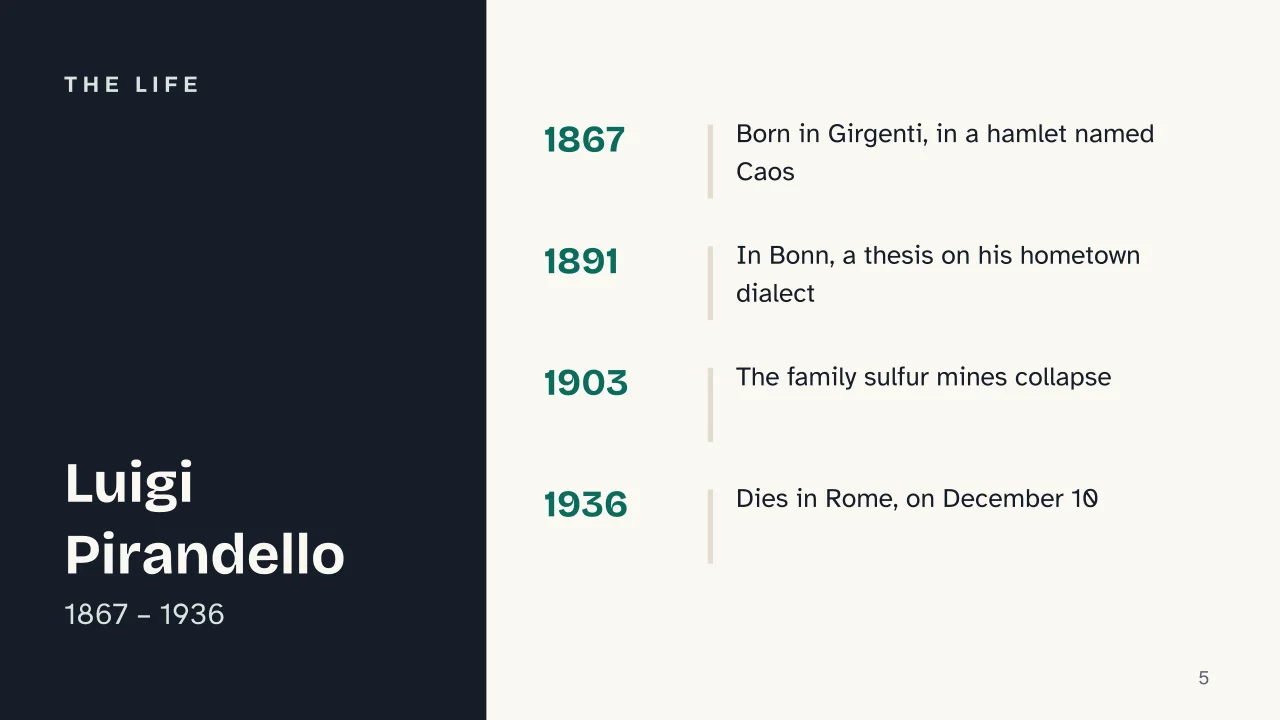
    • Pirandello was born on June 28, 1867, in Girgenti (today Agrigento), Sicily, and died on December 10, 1936, in Rome.
    • His work is built around the clash between 'form' (the mask imposed by society, family, and convention) and 'life' (a reality that never stops changing and keeps undoing every fixed role), a tension he laid out in the essay On Humor (1908).
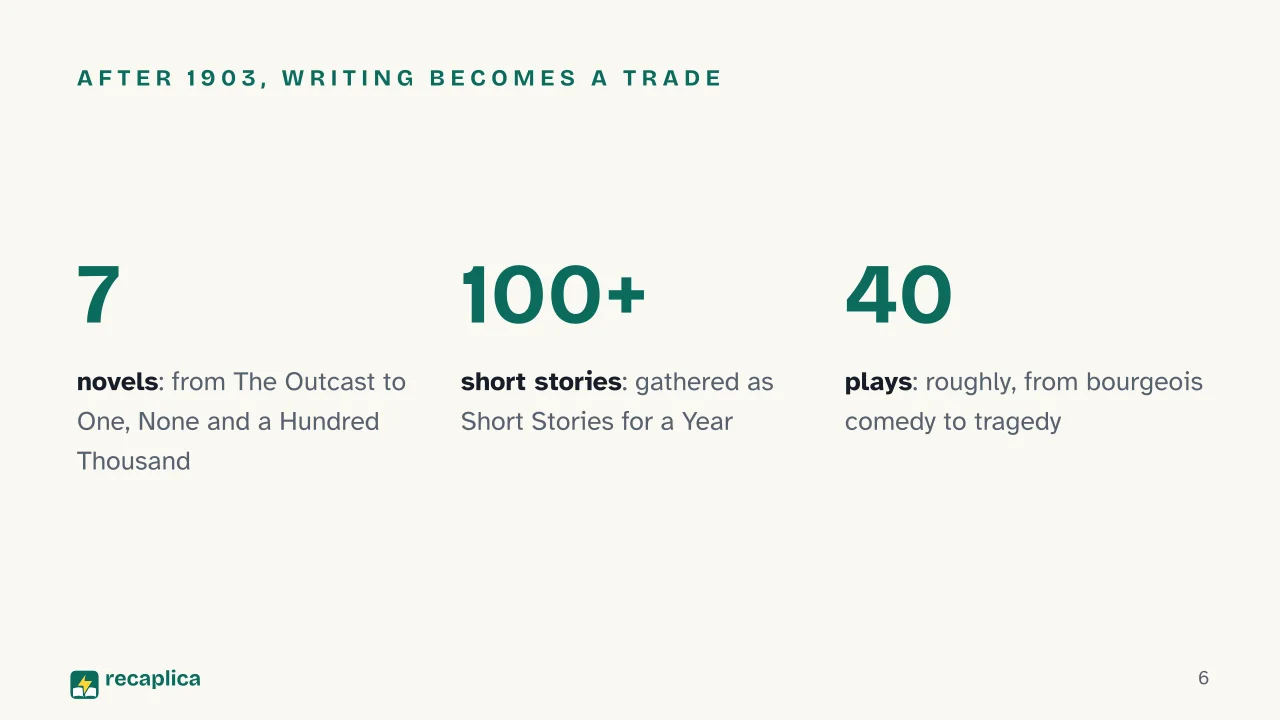
    • The Late Mattia Pascal (1904) is his narrative masterpiece; overall he wrote seven novels, more than 100 short stories, and roughly 40 plays.
    • With Six Characters in Search of an Author (1921) he invented 'theatre within the theatre': the characters confront a stage manager and lay the machinery of the performance bare in front of the audience. The Rome premiere was a disaster, but within months the play became a triumph abroad too.
    • In 1934 he won the Nobel Prize in Literature, with the official citation 'for his bold and ingenious revival of dramatic and scenic art.'
    • His private life was marked by his family's financial collapse in 1903 and by the permanent hospitalization, from 1919, of his wife Antonietta Portulano for severe nervous disorders.

    Key figures

    • 1934 the year Pirandello won the Nobel Prize in Literature, awarded at a ceremony in Stockholm on December 10, with the prize handed over by King Gustav V of Sweden Source: NobelPrize.org
    • May 9, 1921 the premiere date of Six Characters in Search of an Author at Rome's Teatro Valle, a notorious flop that turned into a triumph within months Source: Istituto di Studi Pirandelliani e sul Teatro Contemporaneo
    • Over 100 short stories, around 40 plays, 7 novels the overall scale of Pirandello's literary output Source: NobelPrize.org

    Deep Dive

    A childhood in a hamlet called Chaos

    Luigi Pirandello was born on June 28, 1867, in Girgenti, today’s Agrigento, into a well-off family with major investments in sulfur mining. Even the exact spot of his birth has a strange charm to it: a rural hamlet named Caos, “Chaos,” where his mother had taken refuge from the cholera epidemic sweeping Sicily that year. The house, originally a late-18th-century farm building that belonged to his mother’s family, the Ricci-Gramitto, is a museum today.

    As a young man he also worked in the family mines; he studied in Palermo and Rome before moving on to Bonn, Germany, where in 1891 he defended a dissertation on the dialect of his hometown. Back in Italy, he married Antonietta Portulano in 1894, a match arranged by the two families, and from 1897 to 1922 he taught aesthetics and stylistics at an institute in Rome.

    A financial collapse that turned him into a professional writer

    1903 was a turning point. His father’s mining business collapsed financially, and the family fortune took a serious hit. It was at this point that Pirandello began writing not just out of vocation but out of necessity: from then on, his literary output became almost relentless, spanning novels, short stories, and, later, theatre.

    His personal life grew more complicated in the same period. His wife Antonietta developed increasingly severe nervous disorders, rooted in obsessive jealousy, and was permanently hospitalized in a Rome clinic in 1919, where she remained until her death, never accepting a separation or seeing her husband again. From 1925 onward, Pirandello had an intense and lasting relationship with the actress Marta Abba, who would become his muse and the leading interpreter of his later plays.

    From The Outcast to One, None and a Hundred Thousand

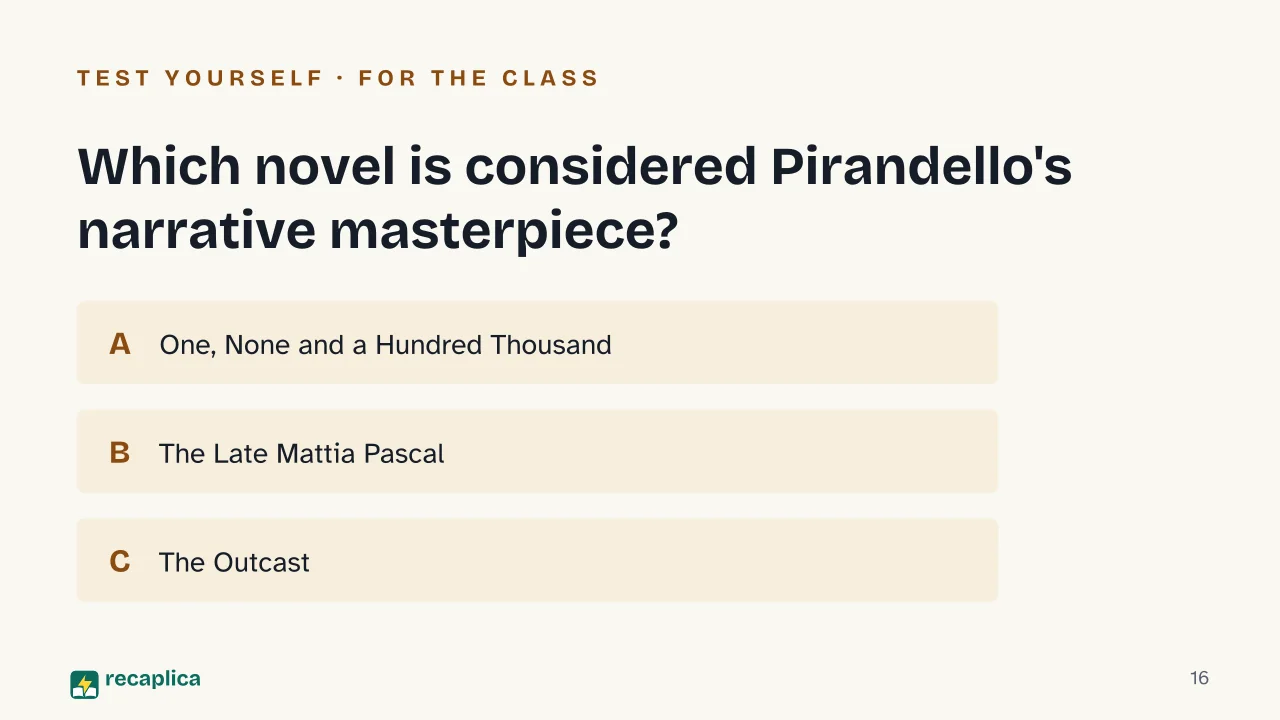
    Over the course of his life Pirandello wrote seven novels. The Late Mattia Pascal (1904) is considered his narrative masterpiece: the story of a man who exploits a bureaucratic mix-up to be presumed dead and start over elsewhere, only to discover that escaping your own identity is harder than it looks. Before and after it came The Outcast (1901), Her Husband (1911), The Old and the Young (1913), Shoot! (1916), and, in 1926, One, None and a Hundred Thousand, which pushes the theme of identity to its furthest extreme: how many different people are we, depending on who’s looking at us?

    Alongside the novels runs an enormous body of short fiction, over a hundred stories eventually gathered under the collective title Short Stories for a Year, running from Love Without Love (1894) all the way to Berecche and the War (1919). The title states the plan: one story for every day of the year, three hundred and sixty-five in all — a project that remained unfinished.

    On Humor: the mask and life

    In 1908 Pirandello published the essay On Humor, the theoretical text that explains where the rest of his writing comes from. The basic idea is that everyone builds a “form” for themselves, a mask made of roles and habits used to face the world; but life, which never stops changing, eventually exposes that form as false, revealing its contradiction. Humor, for Pirandello, grows out of this gap between what we believe ourselves to be and what reality forces us to see: a bitter irony, far removed from any light laugh, born from recognizing life’s contradictions.

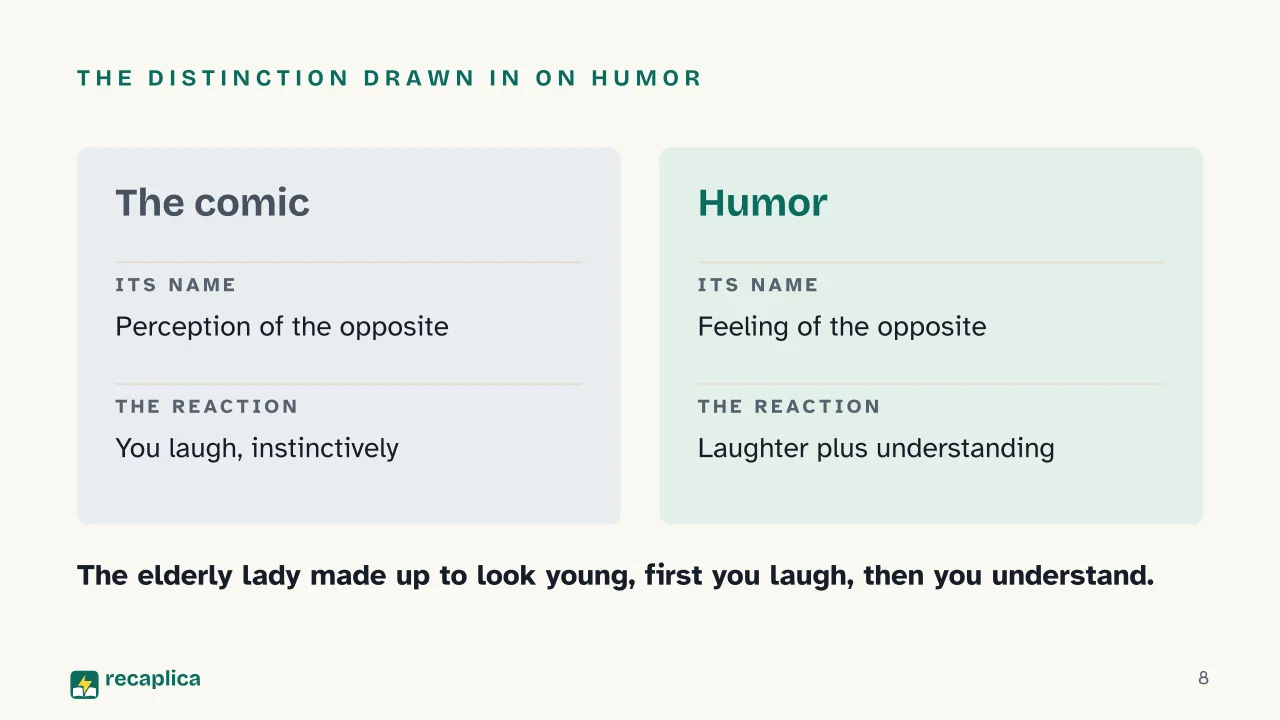
    The essay draws the distinction precisely, and it’s the one every test asks for. Faced with an elderly lady clumsily made up and dressed like a young woman, the first reaction is laughter: that is the comic, which Pirandello calls the “perception of the opposite” — instinctively noticing that something is off. But if reflection leads us to ask why she does it — perhaps in the painful illusion of holding on to the affection of a younger husband — the laughter mixes with understanding: that is the “feeling of the opposite”, true humor. No longer just seeing the dissonance, but feeling the pain behind it. It’s the thread running through his novels, short stories, and plays alike.

    From bourgeois comedy to theatre within the theatre

    Pirandello’s theatre falls into two broad phases. The first, closer to traditional bourgeois comedy, includes titles such as Sicilian Limes (1910), Think It Over, Giacomino! (1916), Right You Are (If You Think So) (1917), Cap and Bells (1918), and The Rules of the Game (1918). The second phase, that of tragedy, carries the same obsessions (identity, the mask, the relativity of truth) to the point of openly breaking stage conventions: this is where the drama Henry IV (1922) belongs, along with the so-called “theatre within the theatre” trilogy made up of Six Characters in Search of an Author (1921), Each in His Own Way (1924), and Tonight We Improvise (1930).

    PhasePeriodMain titlesWhat changes
    Bourgeois comedy1910-1918Right You Are (If You Think So), The Rules of the GameFamily conflicts and settings, but still within traditional stage conventions
    Second phase (tragedy)1921-1930Henry IV, Six Characters in Search of an Author, Each in His Own Way, Tonight We ImproviseOpenly breaks stage conventions; in the trilogy, the machinery of the performance itself (actors, director, wings) becomes visible to the audience

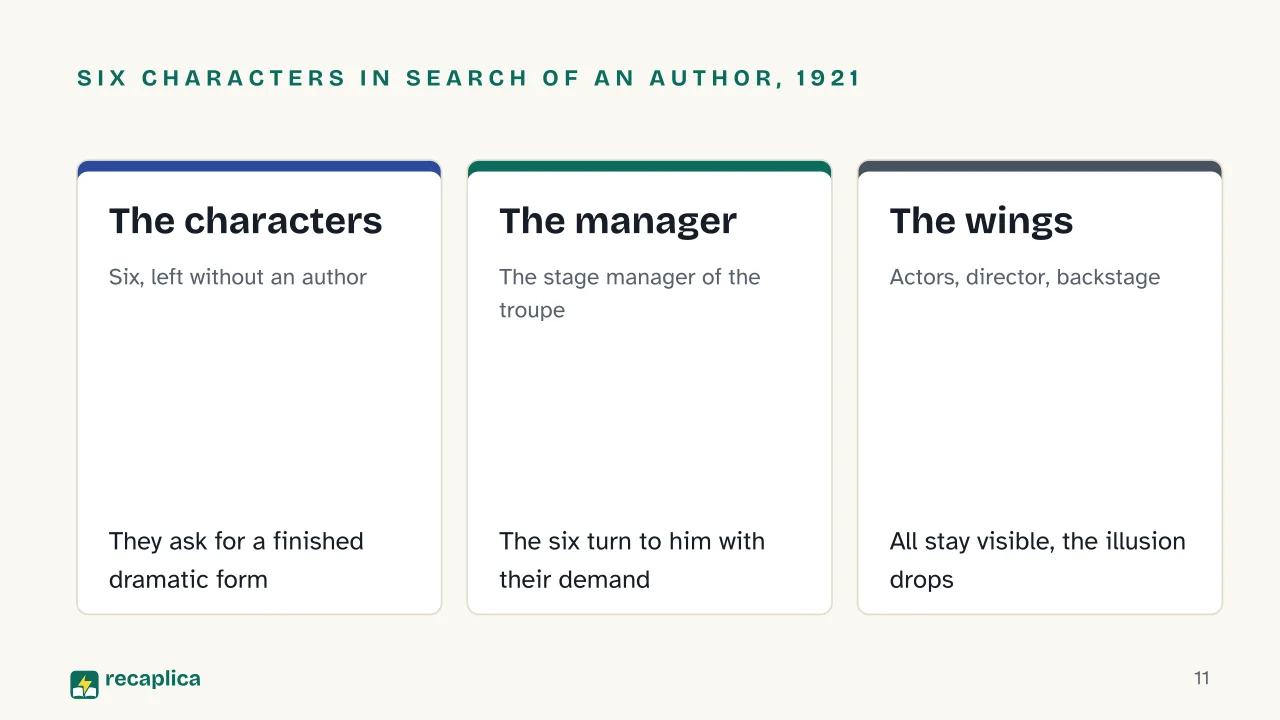
    Practical example: in Six Characters in Search of an Author, six figures left without a finished story burst into a theatre where a troupe is rehearsing a different play, and ask the stage manager to give them the dramatic form that the author who imagined them never got around to finishing. The audience watches the attempt, staged right in front of it, to build a story that’s still unfinished: the actors, the director, and the wings all remain visible, and stage illusion stops pretending to hide itself. It’s in this gap, between characters demanding to exist and the machinery of the performance that gives them a stage, that Pirandello invents “theatre within the theatre.”

    A flop that turned into a triumph

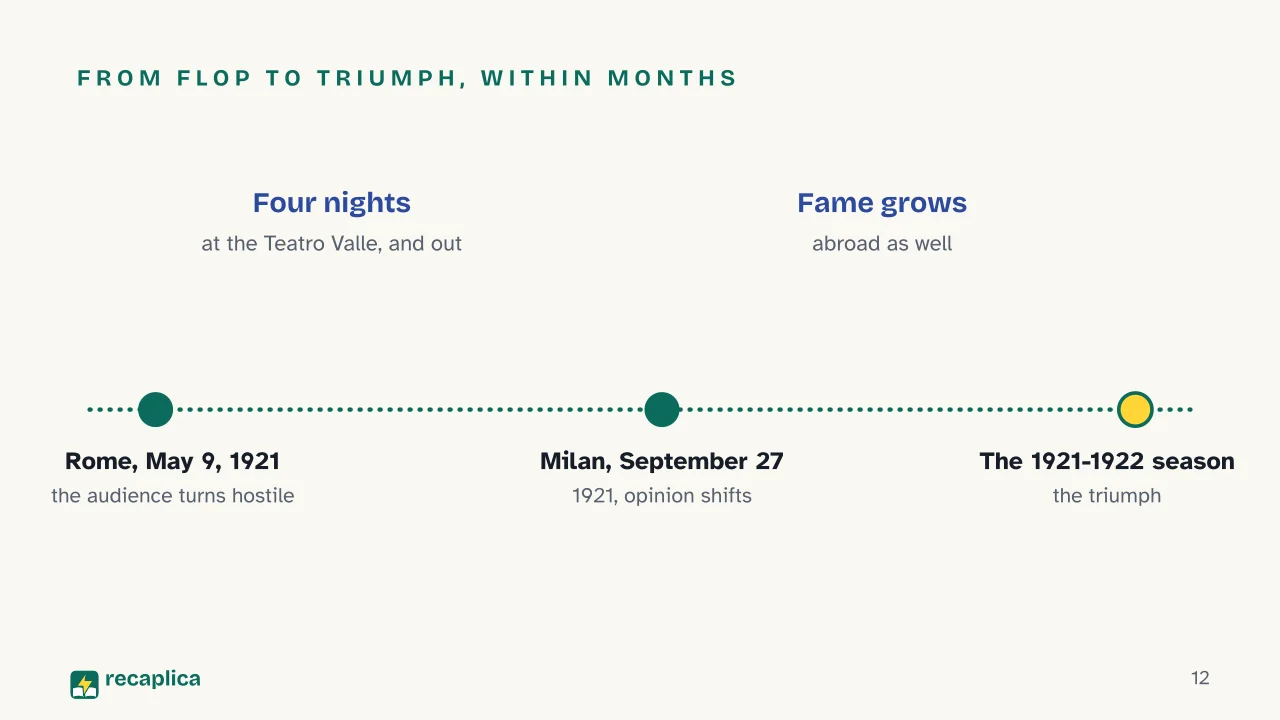
    The premiere of Six Characters in Search of an Author, on May 9, 1921, at Rome’s Teatro Valle with Dario Niccodemi’s company, was a disaster. The audience openly turned against the play, which upended stage conventions that had until then seemed untouchable; the production limped through just four nights in Rome. But opinion shifted quickly: later runs in Bologna and then Milan, on September 27, 1921, were met with growing attention, building to a triumph that defined the entire 1921-1922 season. From that point on, Pirandello’s fame grew abroad too, to the point of drawing caricaturists in newspapers across Germany, France, and Argentina.

    The 1934 Nobel Prize

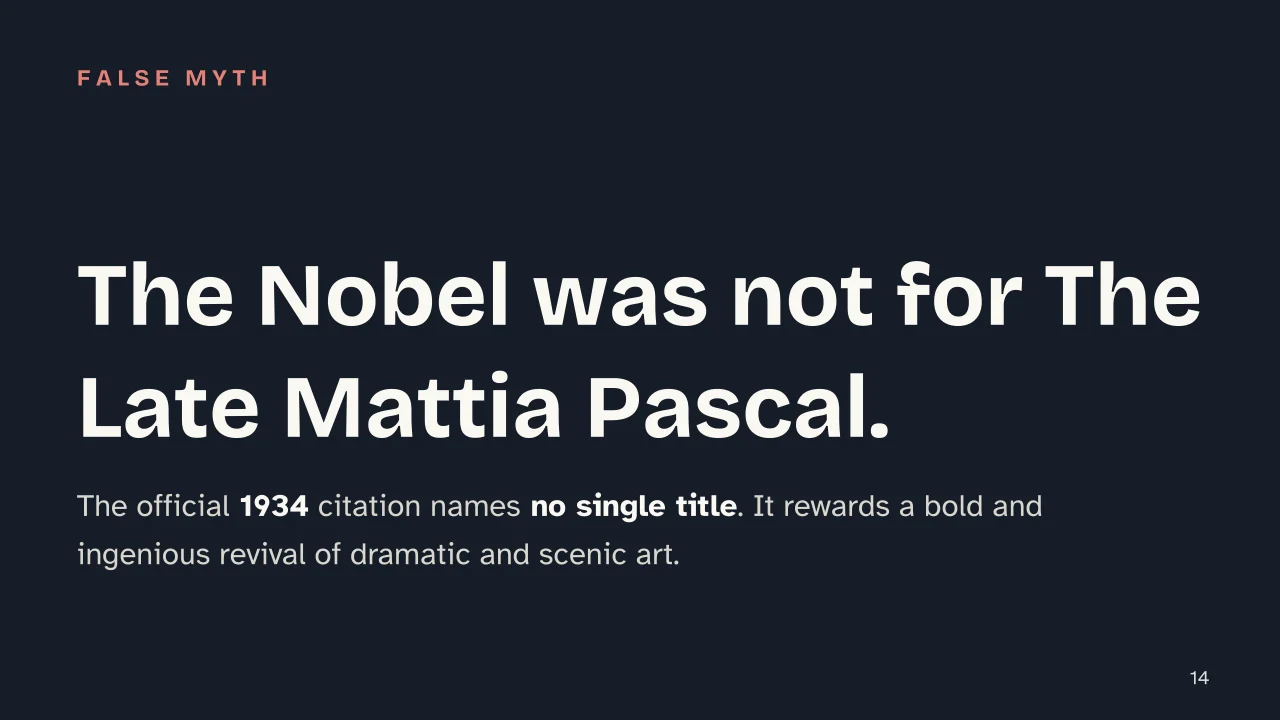
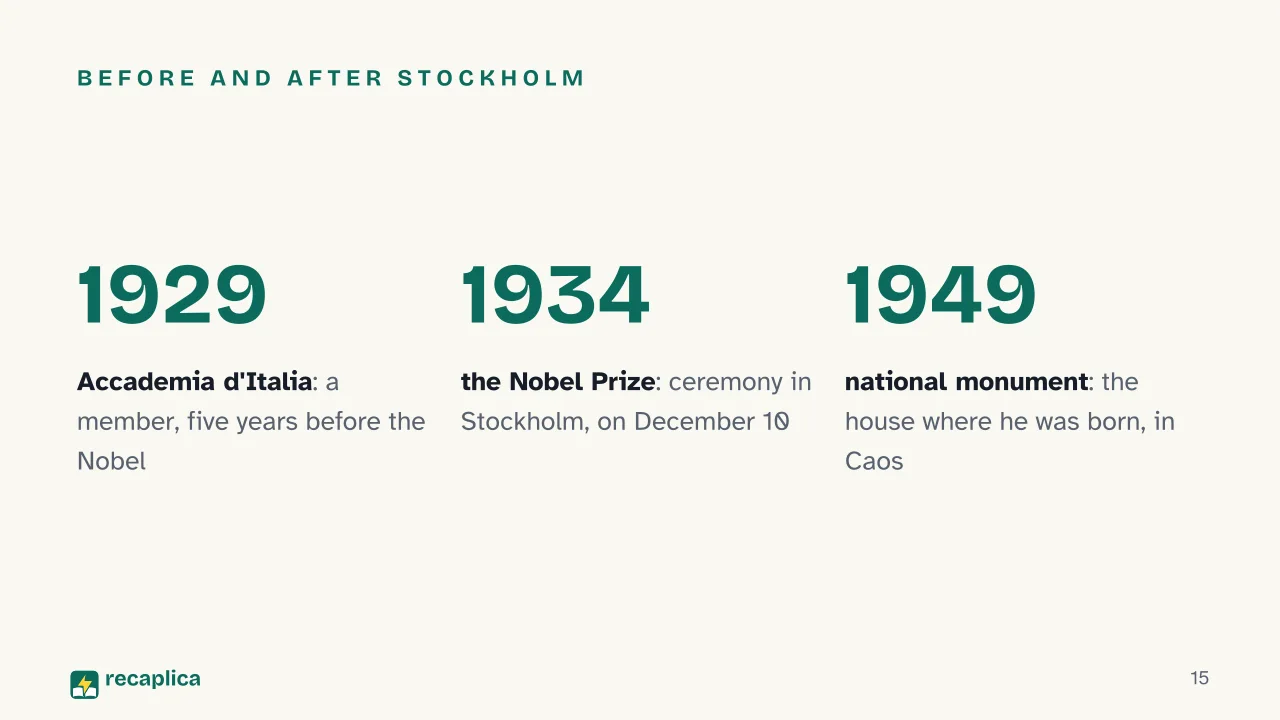
    In 1934 the Swedish Academy awarded Luigi Pirandello the Nobel Prize in Literature, with a citation that named no single book but rather his body of work as a whole: “for his bold and ingenious revival of dramatic and scenic art.” The ceremony was held in Stockholm on December 10, 1934, with the prize presented by King Gustav V of Sweden. Five years earlier, in 1929, Pirandello had already been named a member of the Accademia d’Italia; in 1924 he had instead joined the National Fascist Party, a move that caused public scandal at the time.

    Pirandello died in Rome on December 10, 1936: the very same date, exactly two years on, as the Stockholm ceremony.

    A legacy that reshaped 20th-century theatre

    For much of his career, critics dismissed him as an eccentric writer with weak prose; real fame arrived through the theatre only once he was already past fifty. From then on, his experimentation went on to shape playwriting for decades afterward: reacting against the verbal and musical virtuosity that had dominated Italian literature in the preceding years, Pirandello pushed for a plainer, more anti-literary language, paving the way for writers such as Alvaro, Moravia, and Brancati.

    Today the house where he was born, in the Caos hamlet outside Agrigento, is a House Museum: declared a national monument in 1949, damaged in 1943 when a nearby munitions depot exploded, and acquired and restored by the Sicilian Region starting in 1952. Since 1987 it has formed a single institution with the Luigi Pirandello Library in Agrigento. The pine tree under which his ashes rest, as he had asked, is gone: a whirlwind struck it hard in 1997, and a tombstone carved by sculptor Marino Mazzacurati now marks the spot, holding the urn. The museum reopened on December 10, 2021, the anniversary of the writer’s death, with a multimedia tour narrated by actor Leo Gullotta.

    Slide deck

    Slides ready to download and make your own in PowerPoint or Google Slides, with speaker notes. Pick the Flash cut or the Full one.
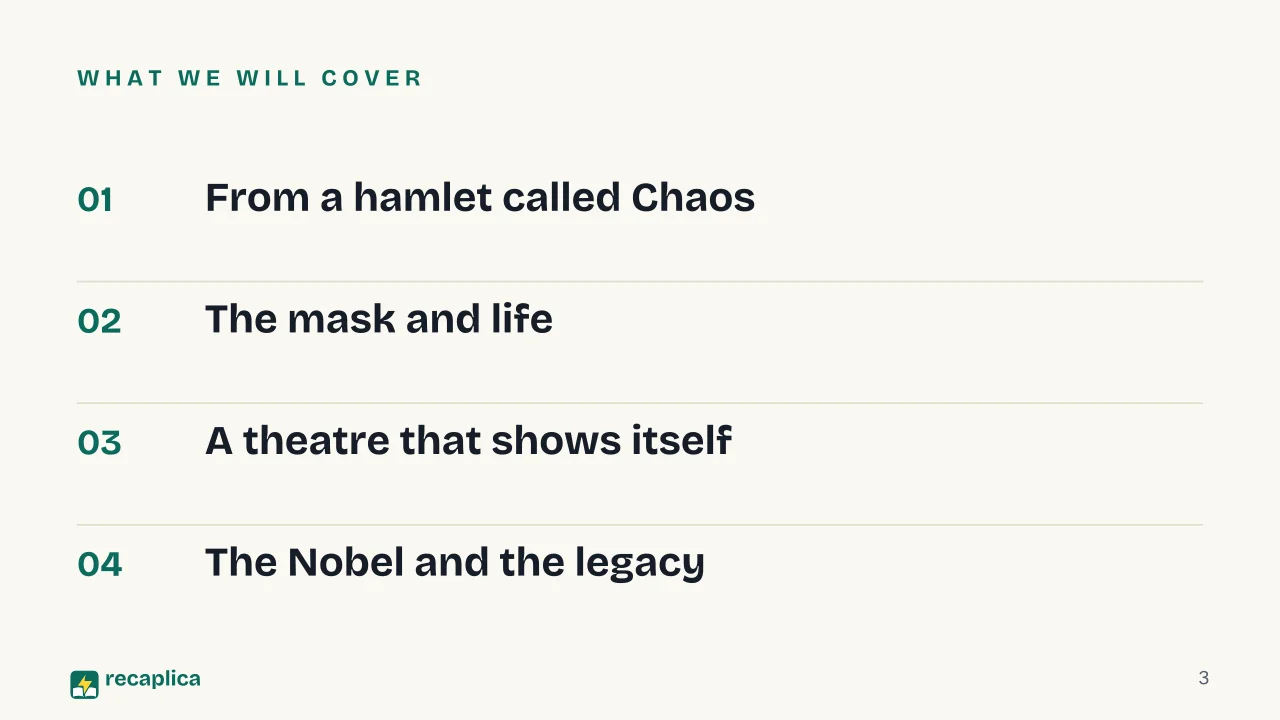
    Slide 1 of the presentation on Luigi Pirandello: Luigi PirandelloSlide 2 of the presentation on Luigi Pirandello: How many different people are we, depending on who is looking at us?Slide 3 of the presentation on Luigi Pirandello: What we will coverSlide 4 of the presentation on Luigi Pirandello: Chapter 01: From a hamlet called ChaosSlide 5 of the presentation on Luigi Pirandello: The lifeSlide 6 of the presentation on Luigi Pirandello: After 1903, writing becomes a tradeSlide 7 of the presentation on Luigi Pirandello: Chapter 02: The mask and lifeSlide 8 of the presentation on Luigi Pirandello: The distinction drawn in On HumorSlide 9 of the presentation on Luigi Pirandello: What happens when life exposes the mask as false?Slide 10 of the presentation on Luigi Pirandello: Chapter 03: A theatre that shows itselfSlide 11 of the presentation on Luigi Pirandello: Six Characters in Search of an Author, 1921: The characters, The manager, The wingsSlide 12 of the presentation on Luigi Pirandello: From flop to triumph, within monthsSlide 13 of the presentation on Luigi Pirandello: Chapter 04: The Nobel and the legacySlide 14 of the presentation on Luigi Pirandello: The Nobel was not for The Late Mattia Pascal.Slide 15 of the presentation on Luigi Pirandello: Before and after StockholmSlide 16 of the presentation on Luigi Pirandello: Which novel is considered Pirandello's narrative masterpiece?Slide 17 of the presentation on Luigi Pirandello: And now, the review
    Flash10 slidesThe essential thread, to present in classFull17 slidesEvery chapter and the deeper detail

    Common myths

    • ✗ Myth Pirandello won the Nobel Prize for The Late Mattia Pascal, his best-known novel.

      ✓ Reality The official 1934 Nobel citation doesn't name a single title: it rewards 'his bold and ingenious revival of dramatic and scenic art,' meaning his work on theatre as a whole. The Late Mattia Pascal remains his narrative masterpiece, but it's a novel written three decades before the prize, and it belongs to a different genre altogether.

    • ✗ Myth Six Characters in Search of an Author was a hit from its very first performance.

      ✓ Reality The Rome premiere, on May 9, 1921 at the Teatro Valle, was a notorious flop: the audience reacted with open hostility because the play broke stage conventions that were considered untouchable, and it closed after just four nights. Opinion shifted within months, as later runs in Bologna and then Milan, on September 27, 1921, met growing enthusiasm, culminating in a triumph that defined the following theatre season.

    • ✗ Myth Pirandello was primarily a novelist, and his theatre career grew naturally out of the success of his books.

      ✓ Reality It's the reverse. For years his prose was judged clumsy in style and too bizarre in its inventions; real fame arrived through the theatre, when he was already in his fifties, chiefly after Six Characters in Search of an Author in 1921.

    Mind map

    Drag the background to move around and the nodes to reposition them; use − and + to collapse and expand branches.
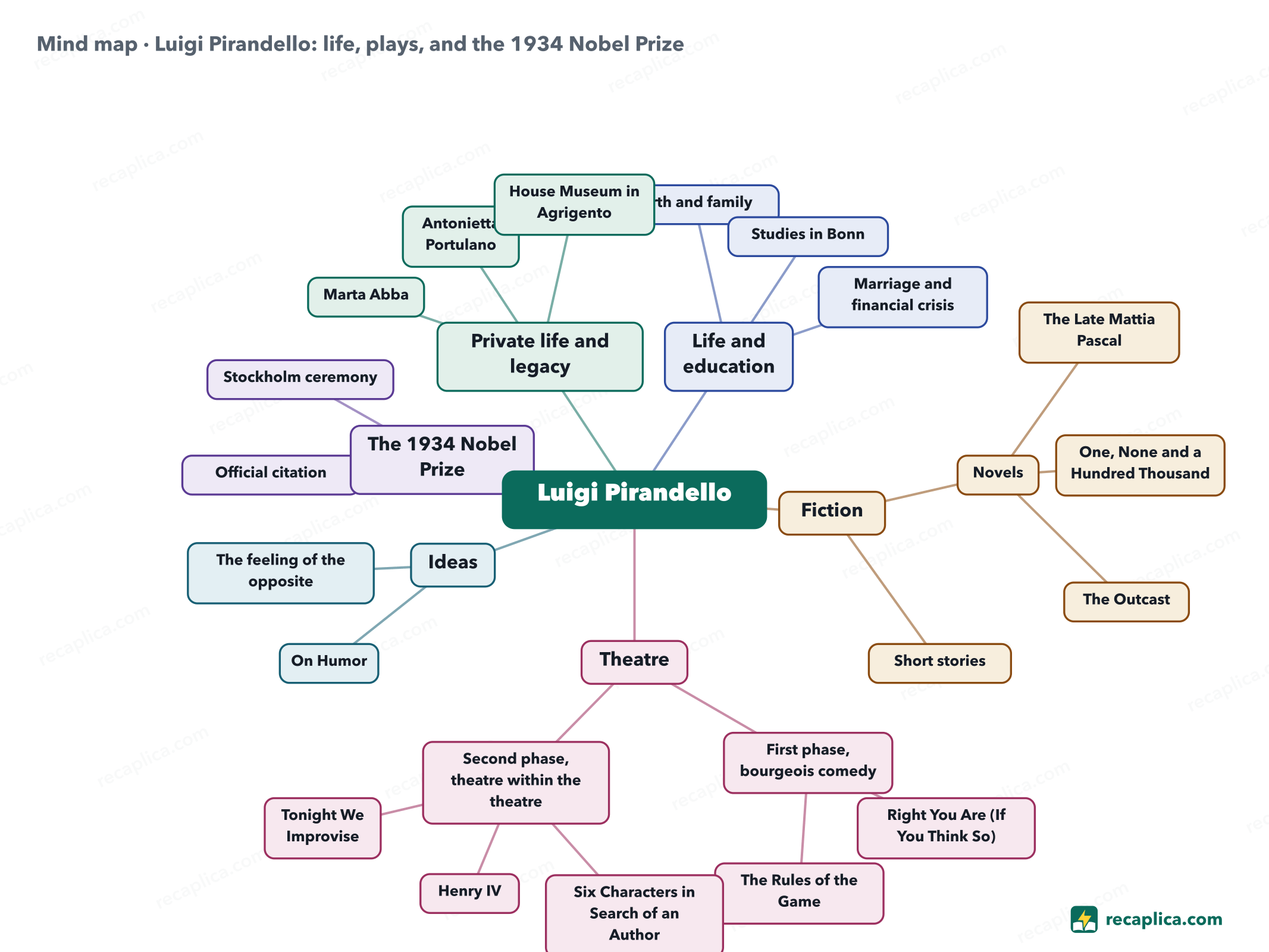
    Customize
    Mind map: Luigi Pirandello: life, plays, and the 1934 Nobel Prize
    • Luigi Pirandello
      • Life and education
        • Birth and family Girgenti (today Agrigento), 1867, family with investments in sulfur mines
        • Studies in Bonn Doctorate in philology in 1891, dissertation on the dialect of Girgenti
        • Marriage and financial crisis Married Antonietta Portulano in 1894, family mining business collapsed in 1903
      • Fiction
        • Novels Seven in total
          • The Late Mattia Pascal 1904, his narrative masterpiece
          • One, None and a Hundred Thousand 1926
          • The Outcast 1901
        • Short stories Over 100, collected as Short Stories for a Year
      • Theatre
        • First phase, bourgeois comedy
          • Right You Are (If You Think So) 1917
          • The Rules of the Game 1918
        • Second phase, theatre within the theatre
          • Six Characters in Search of an Author 1921
          • Henry IV 1922
          • Tonight We Improvise 1930
      • Ideas
        • On Humor 1908 essay, the tension between form (the mask) and life (authenticity)
        • The feeling of the opposite Sensing both sides of the same reality at once
      • The 1934 Nobel Prize
        • Official citation A bold and ingenious revival of dramatic and scenic art
        • Stockholm ceremony December 10, 1934, prize presented by King Gustav V
      • Private life and legacy
        • Marta Abba Relationship from 1925, muse and lead interpreter
        • Antonietta Portulano Hospitalized from 1919 for severe nervous disorders
        • House Museum in Agrigento National monument since 1949, reopened with a multimedia tour in 2021

    Quiz: test yourself

    Answer the questions to check what you have learned: you get instant feedback and a short explanation.

    Grade 0/10 0/5
    1 In what year did Luigi Pirandello win the Nobel Prize in Literature?

    Pirandello received the Nobel Prize in Literature in 1934, at a ceremony held in Stockholm on December 10 of that year, with the prize presented by King Gustav V of Sweden.

    2 Which novel is considered Pirandello's narrative masterpiece?

    The Late Mattia Pascal, published in 1904, is considered his narrative masterpiece; One, None and a Hundred Thousand (1926) is another major novel, but a later one.

    3 True or false: the 1921 Rome premiere of Six Characters in Search of an Author was met with great enthusiasm from the audience.

    False: it was a notorious flop. The audience reacted with open hostility because the play broke long-standing stage conventions, and it closed after just four nights in Rome. Success came only months later, with the runs in Bologna and Milan.

    4 In his 1908 essay On Humor, what kind of comedy does Pirandello describe?

    For Pirandello, the irony of humor isn't funny: it appears when someone has built an image of themselves, a role, and reality, which never holds still, reveals how fragile and contradictory that image really was.

    5 What 1903 financial event pushed Pirandello to start writing for a living?

    In 1903 his father's mining business went under, dealing a serious blow to the family's finances: from that point on, Pirandello needed to write to earn a living, alongside his teaching job.

    Answers: 1-B · 2-C · 3-B · 4-B · 5-B

    Flashcards

    Tap the card to flip it and check whether you remember the answer, then move to the next one.

    1 / 8

    Explain it in your own words

    The ultimate test: if you can explain it in simple words, you've truly understood it. Write your explanation, then compare it with the Recap.

    Your explanation is saved only on this device.

    Luigi Pirandello was a Sicilian novelist and playwright, born in Agrigento in 1867 and dead in Rome in 1936, and one of the towering figures of 20th-century Italian literature. He wrote novels, over a hundred short stories, and dozens of plays, circling again and again around the same problem: the gap between the mask that society forces us to wear and a reality that keeps shifting underneath it. His narrative masterpiece is The Late Mattia Pascal (1904); on stage, he rewrote the rules with Six Characters in Search of an Author (1921), inventing what's now called "theatre within the theatre." In 1934 he won the Nobel Prize in Literature for his bold and inventive renewal of dramatic and scenic art.

    Frequently asked questions

    Why did Luigi Pirandello win the Nobel Prize?

    In 1934 the Nobel committee awarded him the Prize in Literature 'for his bold and ingenious revival of dramatic and scenic art': a recognition of his theatrical work as a whole, not of any single title. The ceremony was held in Stockholm on December 10, 1934.

    What does 'theatre within the theatre' mean?

    It's the device Pirandello invented in Six Characters in Search of an Author (1921), in which characters left without an author confront a stage manager and ask him to give them a finished dramatic form. The audience openly sees the actors, the director, and the wings, that is, the machinery of the performance itself.

    Why did Pirandello join the National Fascist Party?

    He requested membership in a telegram made public by the newspaper L'Impero on September 19, 1924, in the months following the murder of Giacomo Matteotti: he himself explained the move as a reaction to that killing, and the request caused scandal and accusations of opportunism. In those years he also took over the direction of the Teatro d'Arte in Rome (inaugurated on April 2, 1925), which he kept alive almost to the point of bankruptcy, partly with his own money.

    Can you visit Pirandello's childhood home?

    Yes: it's the House Museum in Contrada Caos, Agrigento, declared a national monument in 1949 and acquired by the Sicilian Region in 1952. Since 1987 it has formed a single institution with the Luigi Pirandello Library, and since 2021 it has offered a multimedia tour narrated by actor Leo Gullotta.

    What is Pirandello's most famous book?

    The Late Mattia Pascal, published in 1904, is considered his narrative masterpiece. On stage, his best-known work is instead Six Characters in Search of an Author (1921), which introduced the 'theatre within the theatre' device.

    Sources

    • NobelPrize.org — Luigi Pirandello, Biographical
    • NobelPrize.org — Luigi Pirandello, Facts
    • NobelPrize.org — The Nobel Prize in Literature 1934, Summary
    • Treccani, Enciclopedia — Pirandello, Luigi
    • Encyclopaedia Britannica — Luigi Pirandello
    • Regione Siciliana / Parco Archeologico Valle dei Templi — Pirandello House Museum
    • Istituto di Studi Pirandelliani e sul Teatro Contemporaneo — I Sei Personaggi
    • Treccani, Dizionario Biografico degli Italiani — Pirandello, Luigi
    • Luigi Pirandello, L'umorismo (Carabba, 1908) — full text on Wikisource

    Every Recap goes through an independent review before publication.

    Every evening, the day's new Recaps on our Telegram channel. Join the channel →

    Keep learning

    • Literature Cesare Pavese: Life, Works and the Myth of the Countryside Cesare Pavese (1908-1950) was one of the central voices in twentieth-century Italian fiction, known for novels set in the Langhe hills and for his editorial work at Einaudi. His books return again and again to the tension between the city and the rural world he came from, rendered with a realism that owes much to Giovanni Verga and to the American writers Pavese himself translated. He was also a poet and diarist: the collection Death Will Come and Will Have Your Eyes and the diary The Business of Living remain among his most-read works, alongside the novel The Moon and the Bonfires. A quiet anti-fascist, he paid for it with arrest and internal exile before joining the Italian Communist Party after the war; he took his own life in Turin in 1950. Read the Recap →
    • Literature Death Will Come and Will Have Your Eyes: Cesare Pavese's Poetry Collection "Death Will Come and Will Have Your Eyes" is the poetry collection Cesare Pavese dedicated to the American actress Constance Dowling. Einaudi published the book posthumously in 1951, edited by Massimo Mila and Italo Calvino; it brings together nineteen poems in all: the ten from 1950 that give the collection its title, written between March 11 and April 11 of that year, and nine more written in 1945. Treccani reads the book as Pavese's return to Leopardi's two themes, love and death. In a letter dated April 17, 1950, Pavese wrote: "The poems came to you, and they go away with you." Read the Recap →
    • Literature The Path to the Spider's Nests by Italo Calvino The Path to the Spider's Nests is Italo Calvino's debut novel, published by Einaudi in the autumn of 1947. It tells the story of the Italian Resistance through Pin, a boy who steals a pistol from a sailor and hides it in a place only he knows. Calvino wrote it in about twenty days, at 23, to meet a literary prize deadline of December 31, 1946 — the same young man who had joined the partisans in 1944 under the nom de guerre Santiago. The novel is the book critics point to when they introduce Calvino's early phase, known as fantastic neorealism: a war told through a child's fable-like gaze rather than a direct, adult account. Read the Recap →

    recaplica

    Clear in 30 seconds, yours in 10 minutes.

    Recaps Mind maps Request a Recap Telegram channel Mind map maker Our method About Privacy & cookies Legal notes & terms of use

    © 2026 Recaplica · A project by Curi S.r.l. — VAT IT05472000750

    Statistics, only if you say so

    To learn which Recaps help most we would use Google Analytics, with aggregate, anonymous data. It starts only with your OK, and you can change your mind anytime. Privacy policy