Skip to content
recaplica

    One moment: security check

    Cloudflare wants to make sure you're not a robot. Tick the box below and your search will continue on its own.

    IT
    recaplica Civil Service: What It Is and How It Works in Italy
    © 2026 Recaplica · recaplica.com — All rights reserved
    Home › Civics

    Civil Service: What It Is and How It Works in Italy

    By Recaplica Newsroom · Updated on September 29, 2026

    What to print

    Page numbers appear when printing with default margins.

    Slides

    Choose a cut

    Flash10 slidesThe essential thread, to present in classFull15 slidesEvery chapter and the deeper detail

    Both come with speaker notes.

    Telegram channel
    recaplica Clear in 30 seconds, yours in 10 minutes.
    In 30 seconds Key points Figures Deep dive Slides Myths Mind map Quiz Flashcards FAQ

    In 30 seconds quick read

    The civil service is both the activity of running public affairs and the set of bodies that carry it out: ministries and agencies, public bodies, independent authorities, state-owned enterprises, and local government such as regions, provinces and municipalities. In Italy, the Constitution's Articles 97 and 98 require sound administration and impartiality, entry to public jobs through open competitive exams, and service to the Nation rather than to any government or party. Part of this machinery — state bodies such as ministries — has no legal personality of its own, because it coincides with the state itself; another part, public bodies, has its own separate legal personality. In 2022, Italy's statistics agency ISTAT counted 12,776 active public institutions, employing more than 3.4 million people.

    Key Points

    • The civil service is both the activity of public administration and the bodies that carry it out, per the definition used by the Treccani encyclopedia.
    • It spans ministries, agencies, public bodies, independent administrative authorities, state-owned enterprises, and local government (regions, provinces, municipalities).
    • Article 97 of the Italian Constitution requires sound administration and impartiality, and entry to public jobs through a competitive exam, except where the law provides otherwise.
    • Article 98 states that public employees serve the Nation exclusively, with legal limits on party membership for categories such as judges and military officers.
    • State bodies without their own legal personality, like ministries, are distinct from public bodies, which have separate legal personality.
    • In 2022, ISTAT counted 12,776 active public institutions in Italy, with 3,441,200 employees out of 3,656,268 total personnel.

    Key figures

    • 12,776 active public institutions counted in Italy in 2022, across roughly 104,000 work sites Source: ISTAT, permanent census of public institutions
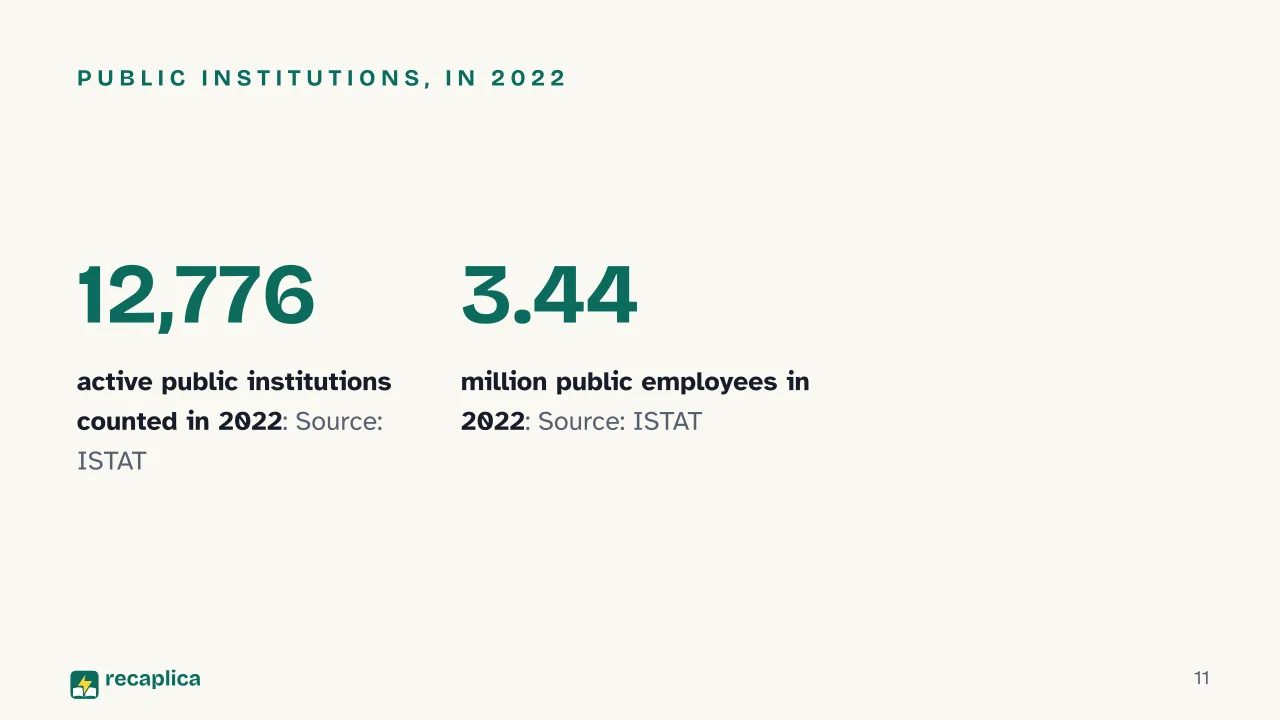
    • 3,441,200 public employees in the strict sense in 2022, 94.1% of the 3,656,268 total personnel counted Source: ISTAT, permanent census of public institutions
    • over 9,300 new hires and recruitments across public administrations authorized in 2025 by decree Source: Italy's Ministry for the Civil Service

    Deep Dive

    What the civil service is

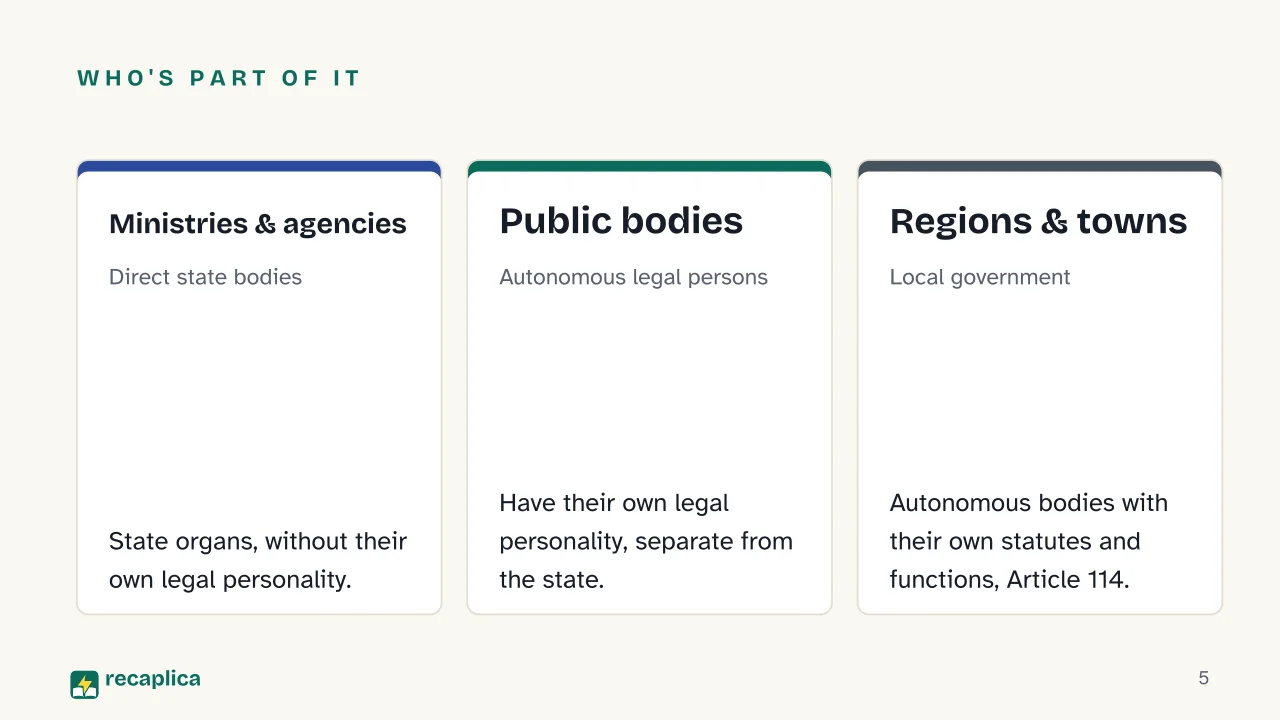
    Per the Treccani encyclopedia, the civil service is at once an activity — running public affairs — and the set of bodies responsible for that function. It is not a single entity but a system spanning ministries and administrative agencies, public bodies, independent administrative authorities, state-owned enterprises, and local government such as regions, provinces and municipalities.

    That structure is not accidental: it follows a precise constitutional framework, the same one that governs Italy’s constitutional bodies, even though the civil service, unlike those bodies, carries out the laws rather than writing or interpreting them.

    How it’s structured, from the centre to the regions

    Italy’s civil service operates on several levels. At the central level sit the ministries and state administrative agencies; at the local level, regions, provinces and municipalities manage their own functions under the autonomy principle set out in the Constitution.

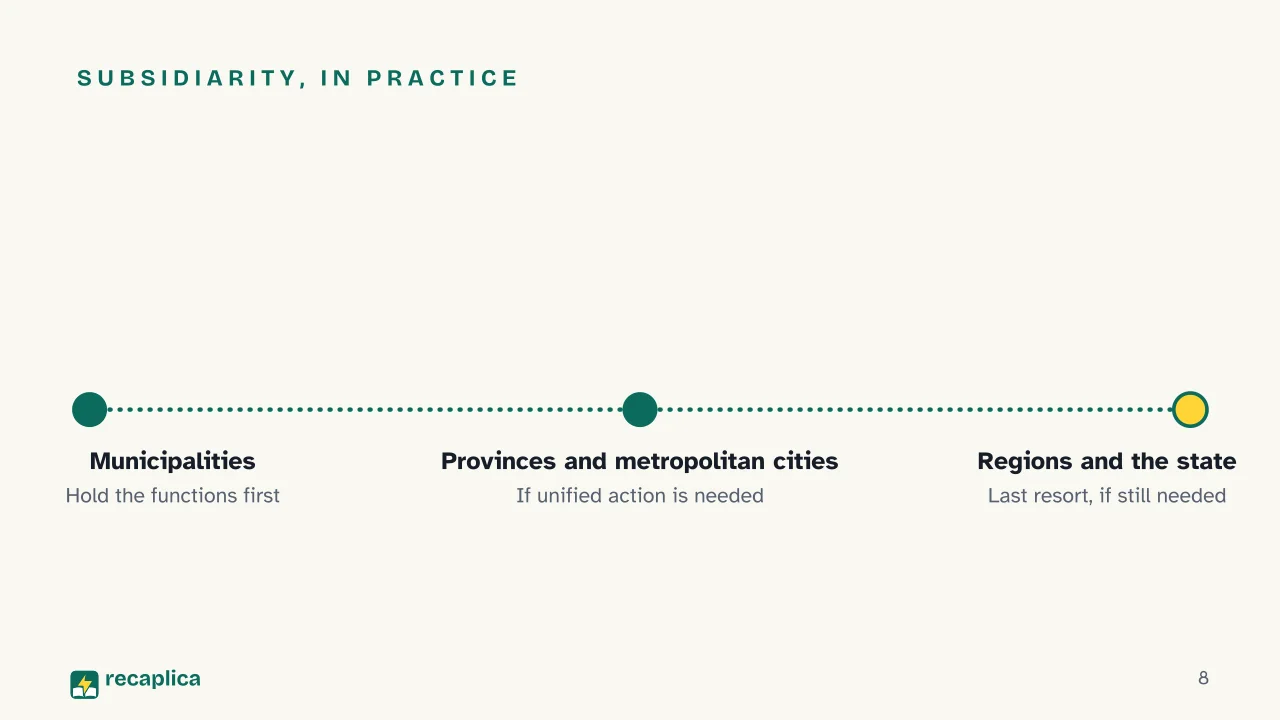
    Linking the two levels is the subsidiarity principle, set out in Article 118, paragraph 1, of the Constitution: administrative functions belong first to municipalities, moving up to provinces, metropolitan cities, regions or the state only when a unified approach is needed. Article 114, paragraph 2, of the Constitution defines municipalities, provinces, metropolitan cities and regions as autonomous bodies, each with its own statute, powers and functions under the principles the Constitution sets.

    Direct and indirect administration

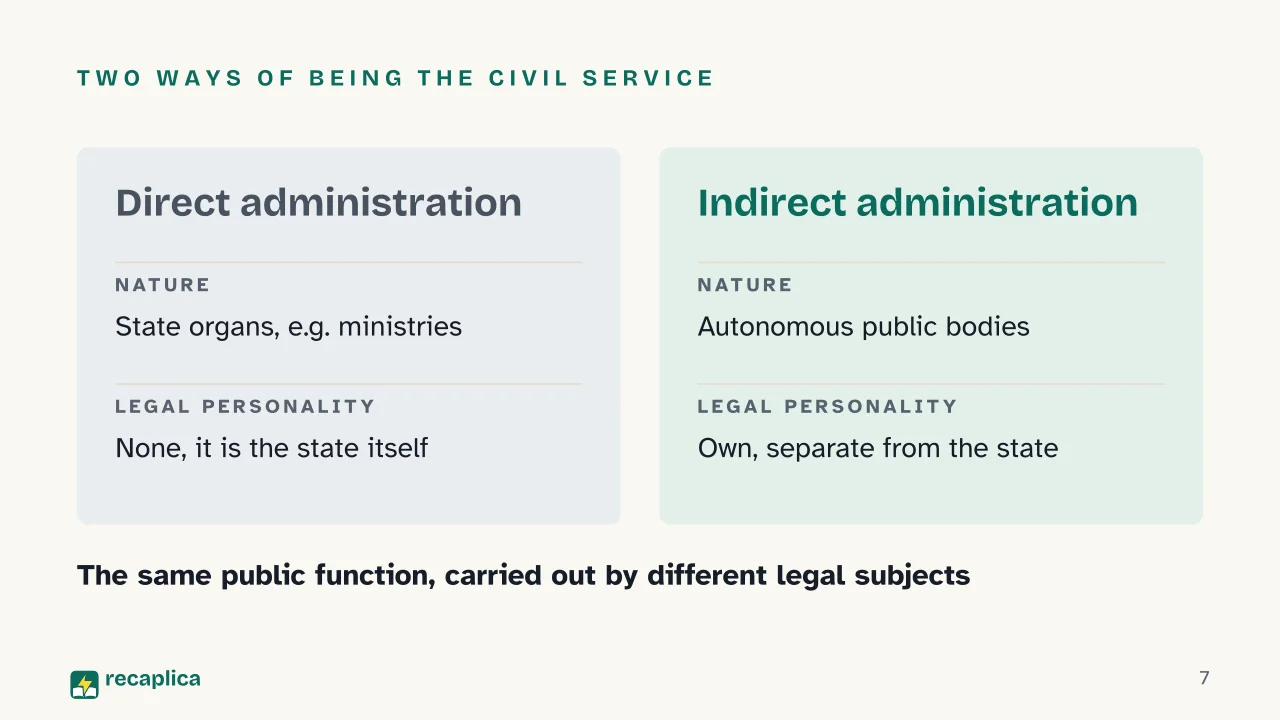
    Running through this structure is a distinction based on the legal nature of the bodies involved. Ministerial bodies are state organs without their own legal personality: they act in the name of the state itself, which answers for them directly. Public bodies, by contrast, are autonomous public legal persons: they have a legal personality of their own, separate from the state’s, and answer for themselves even in court.

    FeatureDirect administration (e.g. ministries)Indirect administration (e.g. public bodies)
    NatureState organAutonomous body
    Legal personalityNone, coincides with the stateOwn and separate
    Who answers for its actsThe state itselfThe body itself

    Practical example: a ministry office issuing a decree acts as the state in person, with no intermediate legal subject; a public body running a service, by contrast, can be sued as a party in its own right, because it has its own legal personality, separate from the state’s.

    The constitutional principles

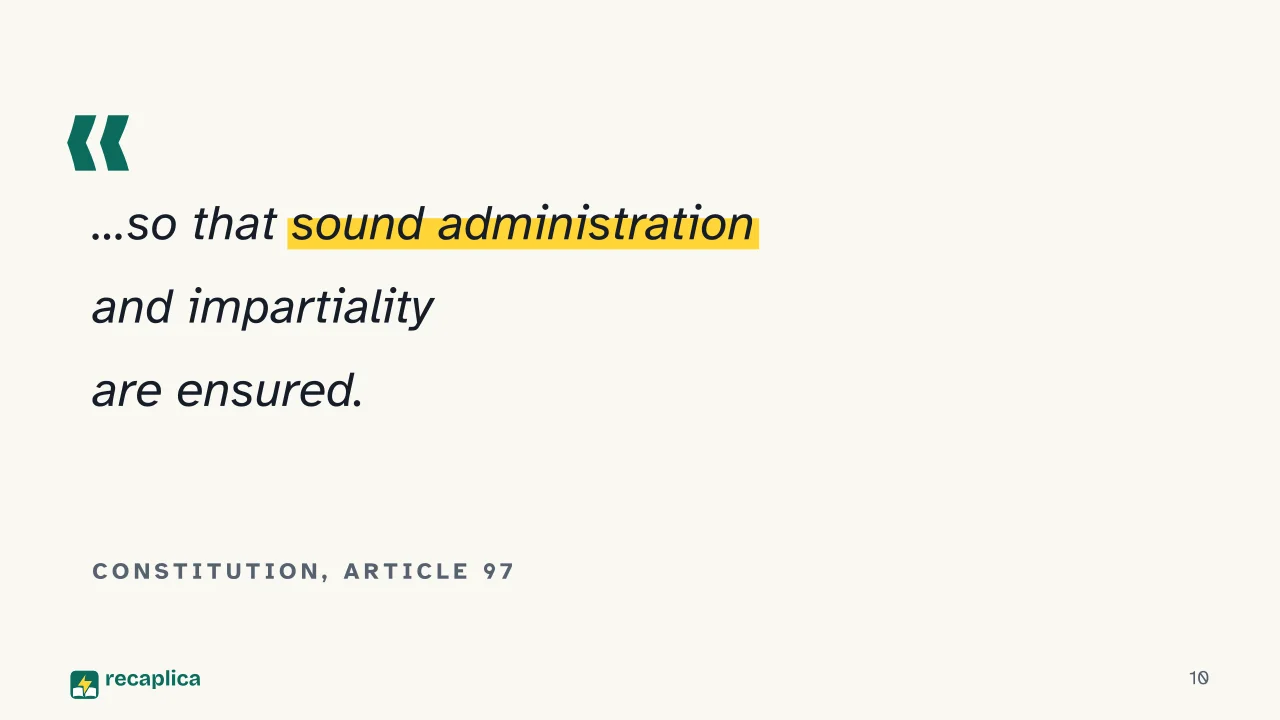
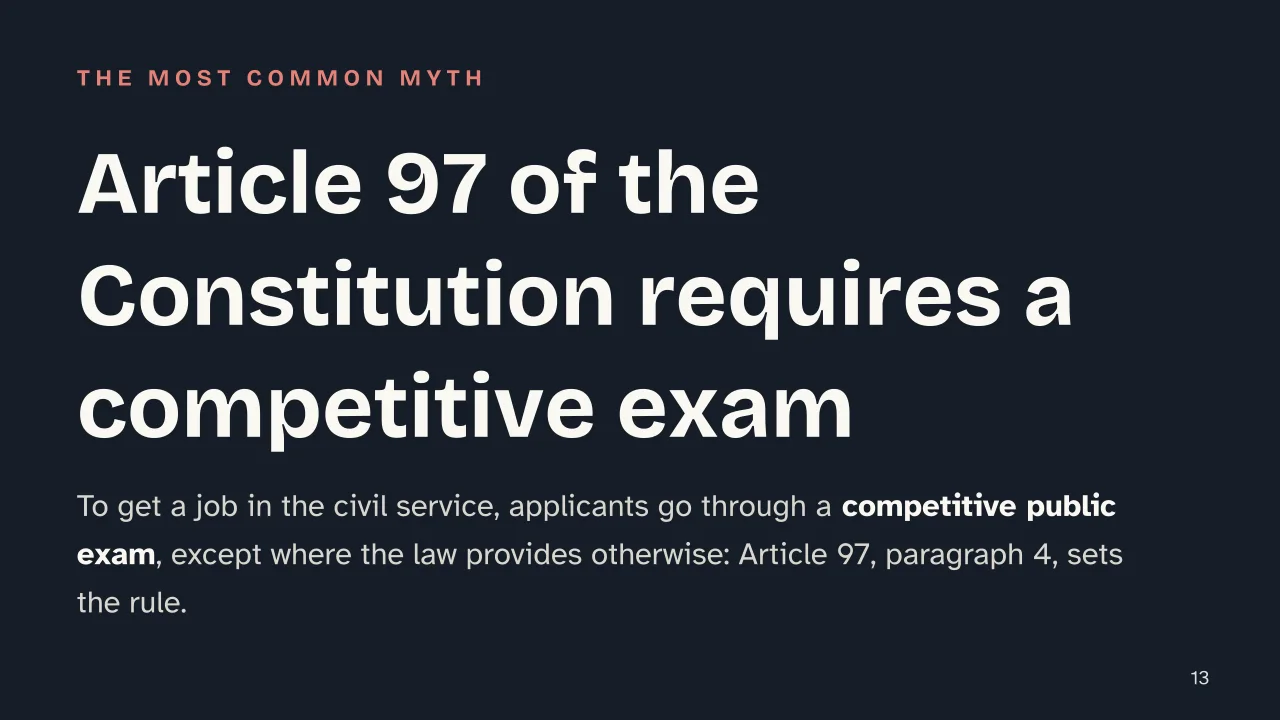
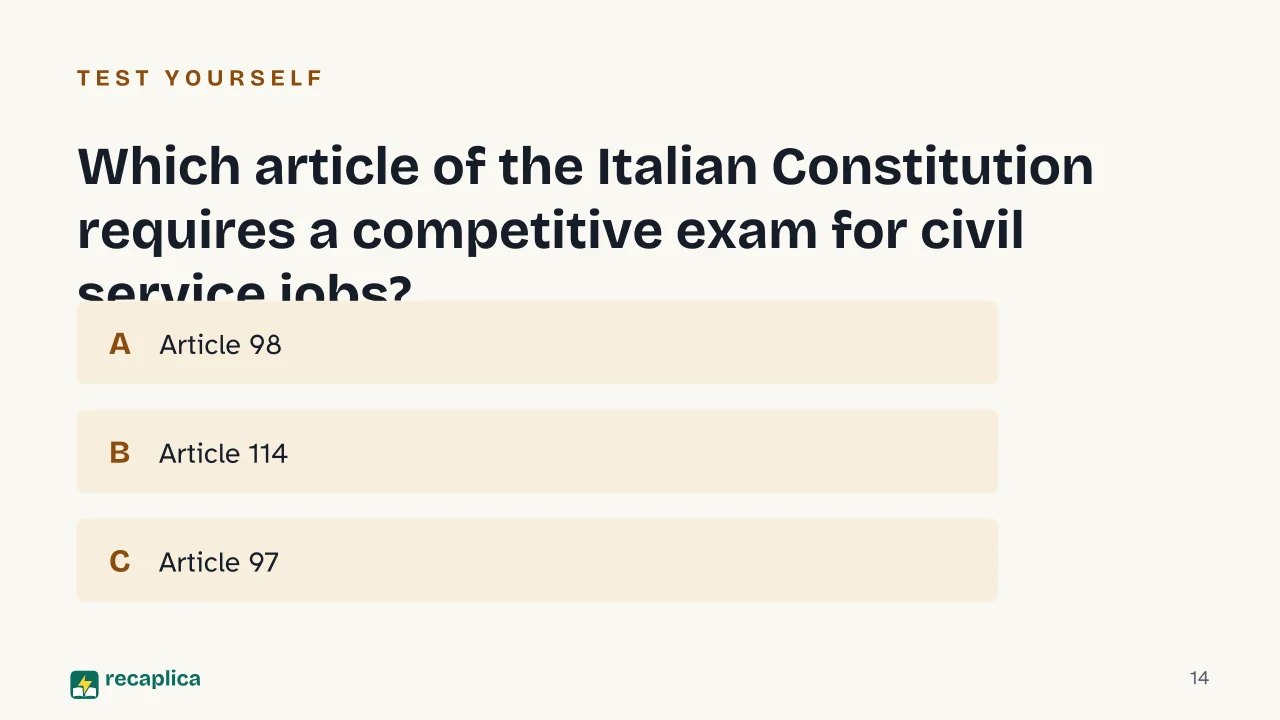
    Article 97 of the Constitution, paragraph 2, requires that public offices be organized under legal provisions that ensure sound administration and impartiality: two criteria that apply to every public body, from a ministry down to a small municipality. The same article, paragraph 4, requires that public jobs be filled through a competitive exam, except where the law provides otherwise.

    Article 98, paragraph 1, adds that public employees serve the Nation exclusively: not the government in office, and not a party. The Constitution does set specific limits, though — for instance, allowing the law to restrict party membership for judges, career military officers on active duty, police officers and diplomatic and consular representatives abroad. Article 97, paragraph 1, also ties sound administration to budget balance and the sustainability of public debt, in line with EU law under how the European Union works.

    What it does in everyday life

    Every time someone renews an ID card at a municipal office, files a claim with the social security agency INPS, or checks a region’s public data, they are dealing with the civil service. The legal rules that govern these services are applied by administrative bodies, in the everyday practice of offices, service counters and online portals.

    Italy’s Ministry for the Civil Service, a department of the Prime Minister’s office, illustrates how this machinery gets modernized: a 2025 decree authorized more than 9,300 new hires and recruitments across public administrations.

    Public personnel, by the numbers

    ISTAT’s permanent census of public institutions, referring to 2022, counted 12,776 active public institutions in Italy, spread across roughly 104,000 work sites. Total personnel stood at 3,656,268, including the armed and police forces and public employees stationed abroad. Of these, 3,441,200 were employees in the strict sense (94.1% of the total) — 2,970,251 on permanent contracts and 470,949 on fixed-term contracts — while 215,068 were non-employee personnel (5.9%). Their national collective contracts are negotiated by ARAN, the agency that represents public administrations at the bargaining table.

    These are figures from a single point in time, the 2022 survey, and should not be read as valid for every year that follows.

    Slide deck

    Slides ready to download and make your own in PowerPoint or Google Slides, with speaker notes. Pick the Flash cut or the Full one.
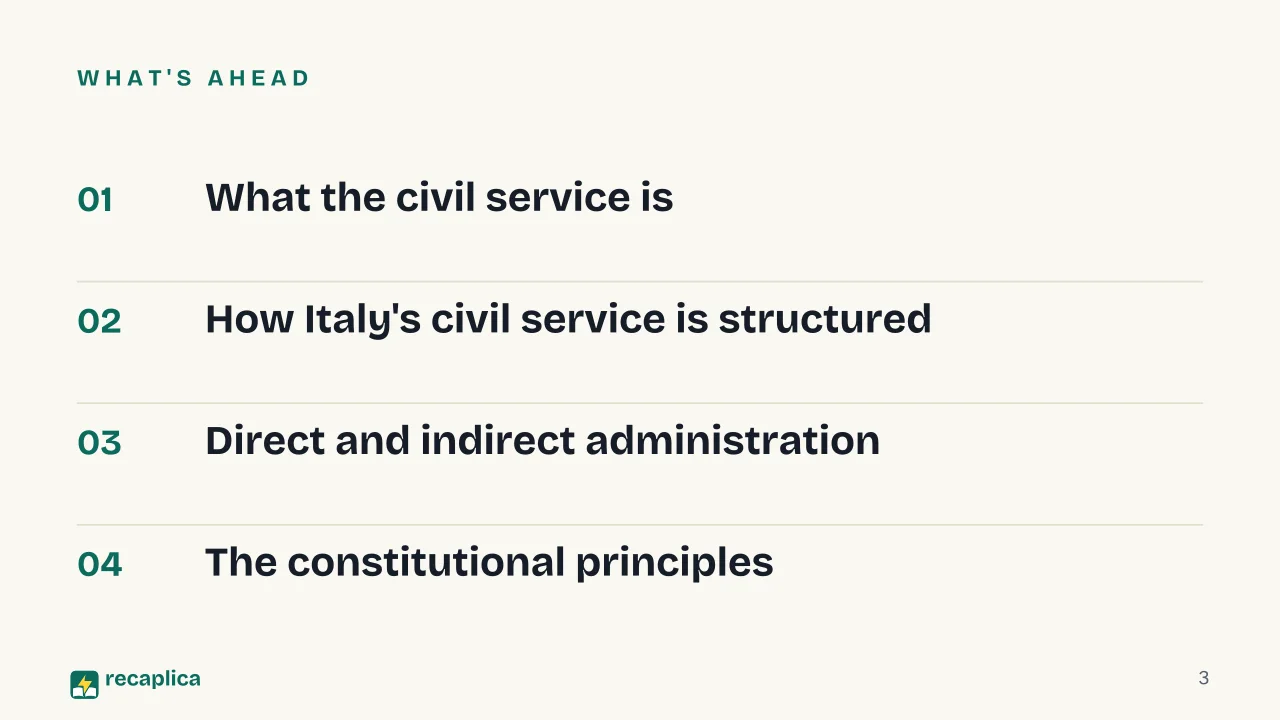
    Slide 1 of the presentation on Civil Service: Civil ServiceSlide 2 of the presentation on Civil Service: Who actually runs the public services you use every day?Slide 3 of the presentation on Civil Service: What's aheadSlide 4 of the presentation on Civil Service: Chapter 01: What the civil service isSlide 5 of the presentation on Civil Service: Who's part of it: Ministries & agencies, Public bodies, Regions & townsSlide 6 of the presentation on Civil Service: Chapter 02: How Italy's civil service is structuredSlide 7 of the presentation on Civil Service: Two ways of being the civil serviceSlide 8 of the presentation on Civil Service: Subsidiarity, in practiceSlide 9 of the presentation on Civil Service: Chapter 03: The constitutional principlesSlide 10 of the presentation on Civil Service: Constitution, Article 97Slide 11 of the presentation on Civil Service: Public institutions, in 2022Slide 12 of the presentation on Civil Service: Chapter 04: What it does, in practiceSlide 13 of the presentation on Civil Service: Article 97 of the Constitution requires a competitive examSlide 14 of the presentation on Civil Service: Which article of the Italian Constitution requires a competitive exam for civil service jobs?Slide 15 of the presentation on Civil Service: The full Recap
    Flash10 slidesThe essential thread, to present in classFull15 slidesEvery chapter and the deeper detail

    Common myths

    • ✗ Myth The civil service is just the central state, the ministries in Rome.

      ✓ Reality The Treccani encyclopedia lists a much wider set of bodies: ministries and state agencies, but also public bodies, independent administrative authorities, state-owned enterprises, and local government such as regions, provinces and municipalities. Someone paying a parking fine at a municipal office or renewing an ID card is dealing with the civil service just as much as someone contacting a ministry.

    • ✗ Myth Getting a civil service job depends entirely on whatever rules the hiring body sets.

      ✓ Reality Article 97, paragraph 4, of the Italian Constitution requires that public jobs be filled through a competitive exam, except where the law provides otherwise: it is a principle written into the Constitution itself, not a practice each body can choose to follow or skip.

    • ✗ Myth Direct administration and indirect administration are two names for the same thing.

      ✓ Reality What changes is the legal nature of the bodies involved: ministerial bodies are state organs without their own legal personality, while public bodies have their own separate legal personality, distinct from the state's, per the Treccani entry in the Enciclopedia del XXI Secolo.

    Mind map

    Drag the background to move around and the nodes to reposition them; use − and + to collapse and expand branches.
    Customize
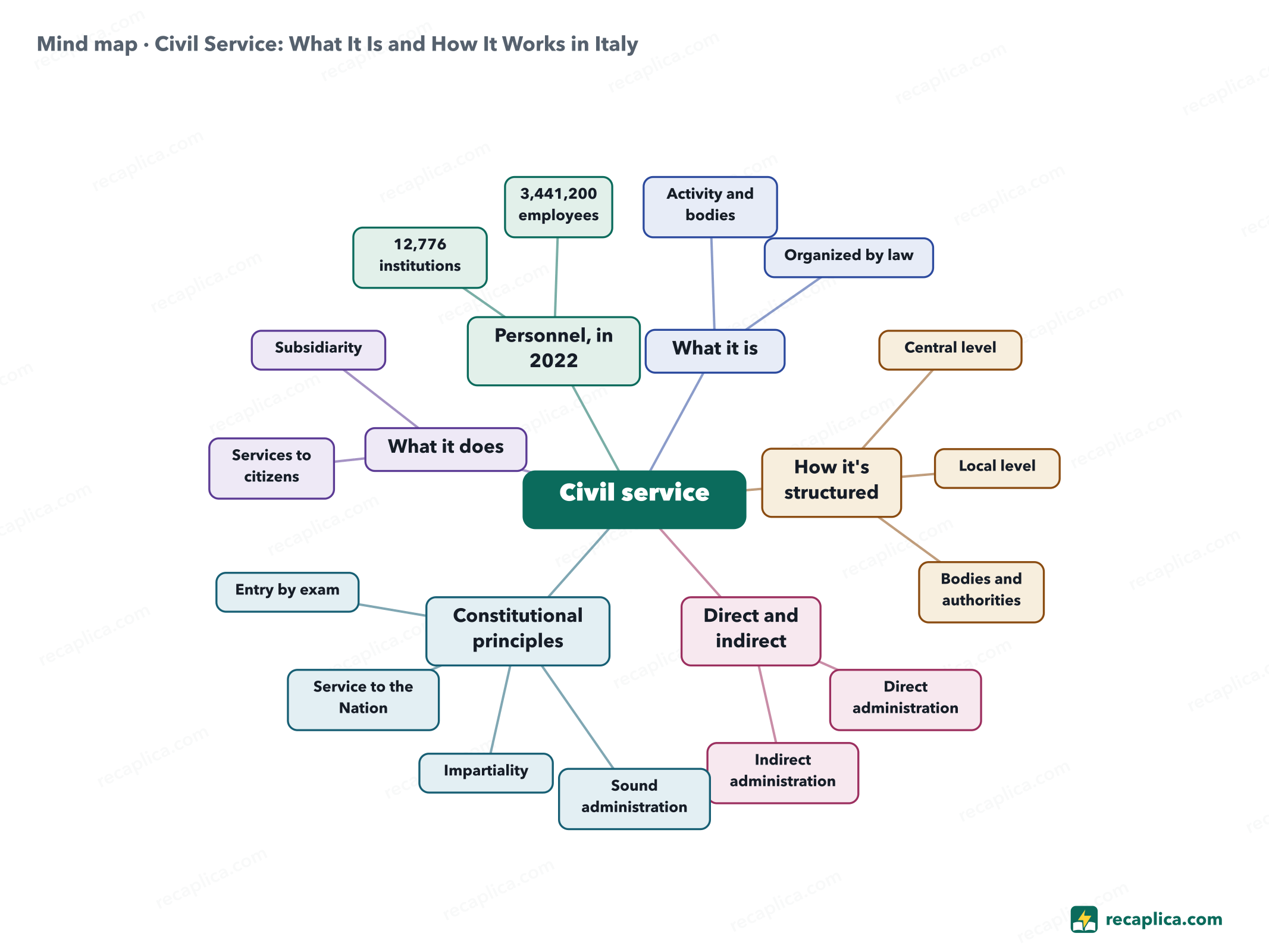
    Mind map: Civil Service: What It Is and How It Works in Italy
    • Civil service
      • What it is
        • Activity and bodies Treccani's definition
        • Organized by law Article 97, Constitution
      • How it's structured
        • Central level Ministries and agencies
        • Local level Regions, provinces, municipalities
        • Bodies and authorities Public bodies, independent authorities
      • Direct and indirect
        • Direct administration State organs, no legal personality of their own
        • Indirect administration Public bodies, with autonomous legal personality
      • Constitutional principles
        • Sound administration Article 97, paragraph 2
        • Impartiality Article 97, paragraph 2
        • Service to the Nation Article 98, paragraph 1
        • Entry by exam Article 97, paragraph 4
      • What it does
        • Services to citizens
        • Subsidiarity Functions go first to municipalities, Article 118
      • Personnel, in 2022
        • 12,776 institutions Source: ISTAT
        • 3,441,200 employees Source: ISTAT

    Quiz: test yourself

    Answer the questions to check what you have learned: you get instant feedback and a short explanation.

    Grade 0/10 0/5
    1 How does the Treccani encyclopedia define the civil service?

    Per the Treccani entry, the civil service is both the activity of running public affairs and the bodies that carry it out: ministries, agencies, public bodies, independent authorities, state-owned enterprises and local government.

    2 Under the Italian Constitution, how does someone get a job in the civil service?

    Article 97, paragraph 4, of the Constitution states that public jobs are filled through a competitive exam, except where the law provides otherwise.

    3 Per Article 98 of the Italian Constitution, who do public employees serve?

    Article 98, paragraph 1, states that public employees serve the Nation exclusively: a duty distinct from loyalty to any sitting government or party.

    4 True or false: according to Treccani's Enciclopedia del XXI Secolo, ministerial bodies are state organs without their own legal personality.

    True: the entry distinguishes ministerial bodies, which are state organs without their own legal personality, from public bodies, which are autonomous public legal persons.

    5 How many active public institutions did Italy have in 2022, per ISTAT's permanent census?

    ISTAT's permanent census of public institutions, referring to 2022, counted 12,776 active public institutions across roughly 104,000 work sites; the other figures are the total personnel count and the hires authorized in 2025.

    Answers: 1-B · 2-C · 3-C · 4-A · 5-B

    Flashcards

    Tap the card to flip it and check whether you remember the answer, then move to the next one.

    1 / 8

    Explain it in your own words

    The ultimate test: if you can explain it in simple words, you've truly understood it. Write your explanation, then compare it with the Recap.

    Your explanation is saved only on this device.

    The civil service is both the activity of running public affairs and the set of bodies that carry it out: ministries and agencies, public bodies, independent authorities, state-owned enterprises, and local government such as regions, provinces and municipalities. In Italy, the Constitution's Articles 97 and 98 require sound administration and impartiality, entry to public jobs through open competitive exams, and service to the Nation rather than to any government or party. Part of this machinery — state bodies such as ministries — has no legal personality of its own, because it coincides with the state itself; another part, public bodies, has its own separate legal personality. In 2022, Italy's statistics agency ISTAT counted 12,776 active public institutions, employing more than 3.4 million people.

    Frequently asked questions

    What is the civil service?

    Per the Treccani encyclopedia, it is both the activity of running public affairs and the bodies that carry it out: ministries and state agencies, public bodies, independent administrative authorities, state-owned enterprises, and local government such as regions, provinces and municipalities.

    What is the difference between direct and indirect administration?

    Direct administration covers state organs, such as ministries, that have no legal personality of their own: they act in the name of the state itself. Indirect administration covers public bodies, which do have their own separate legal personality, distinct from the state's.

    How do you get a public-sector job in Italy?

    Article 97 of the Constitution requires that access to civil service jobs go through a competitive public exam, except where the law provides otherwise.

    How many public employees does Italy have?

    Per ISTAT's permanent census of public institutions, referring to 2022, total public personnel stood at 3,656,268 (including the armed and police forces), of which 3,441,200 were employees in the strict sense, or 94.1% of the total.

    What does Italy's Ministry for the Civil Service do?

    It is the department of the Prime Minister's office responsible for organizing and reforming public administration: among the initiatives listed on its website is a 2025 decree authorizing more than 9,300 new hires and recruitments across public administrations.

    Sources

    • Constitution of the Italian Republic, Article 97 — Brocardi.it
    • Constitution of the Italian Republic, Article 98 — Brocardi.it
    • Treccani, Enciclopedia — Pubblica amministrazione
    • Treccani, Enciclopedia del XXI Secolo — Pubblica amministrazione in Italia
    • Italy's Ministry for the Civil Service — funzionepubblica.gov.it
    • ISTAT — Permanent census of public institutions

    Every Recap goes through an independent review before publication.

    Every evening, the day's new Recaps on our Telegram channel. Join the channel →

    Keep learning

    • Civics Federalism Explained: Who Decides What, and at Which Level Federalism is the general idea that a country's power is shared out among several levels of government, with a constitution fixing who holds which piece. Subsidiarity is the rule that decides where a task lands: it starts at the level closest to people and only moves up when a wider scale is genuinely needed. Italy uses subsidiarity heavily, spelled out in Article 118 of its Constitution, and Article 117 divides lawmaking power between the national government and the regions. Even so, Treccani's entry on Italian regional law is explicit that Italy remains a variant of the unitary state, not a federation in the technical sense used for countries like Germany, the United States or Switzerland, because judicial power in Italy stays with the central government alone. Read the Recap →
    • Civics Crimes Against Humanity: Definition and the Link to Human Dignity Crimes against humanity are a category of international criminal law: acts such as murder, extermination, or persecution, committed as part of a widespread or systematic attack against a civilian population. The 1998 Rome Statute defines them in Article 7 and assigns them to the International Criminal Court, operational since 2002. The concept is older, though: it dates back to 1945, with the charter that created the Nuremberg tribunal. This Recap explains the definition, where it stops and genocide or war crimes begin, and why we connect it to the principle of human dignity written into Italy's constitution. Read the Recap →
    • Civics Popular Sovereignty and Citizenship: What They Mean Popular sovereignty is the principle, written into Article 1 of Italy's Constitution, that state power belongs to the people, who exercise it within the forms and limits the Constitution itself sets, through Parliament, elections, and the tools it provides, not through a direct vote on every law. Citizenship is a different matter: the legal status that ties a person to a state, together with the rights and duties that relationship carries, as the Enciclopedia Treccani defines it. In Italy, Law No. 91 of February 5, 1992 makes a person a citizen at birth mainly through jus sanguinis, at least one citizen parent, reserving birth on Italian soil for cases where both parents are unknown or stateless. The idea that power comes from the people themselves, rather than from a sovereign standing above them, traces back to Jean-Jacques Rousseau and his 1762 Social Contract, and it is, according to the Stanford Encyclopedia of Philosophy, the version of sovereignty most widespread in contemporary constitutional governments around the world. Read the Recap →

    recaplica

    Clear in 30 seconds, yours in 10 minutes.

    Recaps Mind maps Request a Recap Telegram channel Mind map maker Our method About Privacy & cookies Legal notes & terms of use

    © 2026 Recaplica · A project by Curi S.r.l. — VAT IT05472000750

    Statistics, only if you say so

    To learn which Recaps help most we would use Google Analytics, with aggregate, anonymous data. It starts only with your OK, and you can change your mind anytime. Privacy policy