|
recaplica
ARAN, Italy's public-sector collective bargaining agency |
| © 2026 Recaplica · recaplica.com — All rights reserved |
ARAN, Italy's public-sector collective bargaining agencyWhat to print Page numbers appear when printing with default margins. SlidesChoose a cut Flash10 slidesThe essential thread, to present in classFull15 slidesEvery chapter and the deeper detailBoth come with speaker notes. In 30 seconds quick readARAN is the agency that negotiates Italy's public-sector employment contracts on behalf of every public administration in the country. It was set up in 1993 as a technical agency under public law, and its role was later confirmed by two further laws, in 2001 and 2009. Public administrations, through sector committees, give ARAN its mandate for the negotiation. And a contract ARAN negotiates only takes effect once Italy's Court of Auditors has certified that it is financially sustainable. Key Points
Key figures
Deep DiveMany people who search for ARAN online run into an unrelated kitchen-furniture brand: that is a coincidence of names, nothing more. The ARAN this Recap describes is Italy’s public-sector collective bargaining agency, the public body that negotiates the national employment contracts of the country’s public employees — from schoolteachers to city hall clerks, from doctors to ministry staff. What ARAN isARAN is a technical agency under public law, with organisational, managerial and financial autonomy, according to its own official website. It was established by Legislative Decree 29 of 1993, and its role was later expanded and reconfirmed by Legislative Decrees 165 of 2001 and 150 of 2009. Under Legislative Decree 165/2001, Italy’s public administrations are legally represented by ARAN for the purposes of national collective bargaining: it is ARAN, not each individual ministry, municipality or health authority, that sits at the table with trade unions to negotiate public employees’ contracts. ARAN also carries out the research, monitoring and documentation work that bargaining requires, and prepares reports on pay trends for the government, sector committees and the relevant parliamentary committees. ARAN’s internal structure is split across three departments: Bargaining 1, Bargaining 2, and Studies, Resources and Services. Its headquarters are in Rome, at Via G.B. Morgagni 30/E. Who runs ARANLegislative Decree 165/2001 identifies two bodies within ARAN: the President and the Steering and Control Board. ARAN’s official website also lists a Board of Auditors among its bodies, responsible for financial oversight. The President is appointed by presidential decree and chosen from among experts in labour economics, labour law, personnel policy and corporate strategy; the term lasts four years, renewable once. The Steering and Control Board has four members with expertise in industrial relations and personnel management, plus the President; it decides by majority vote and coordinates the agency’s bargaining strategy. Both the President and the Board are subject to specific rules on political and union-related conflicts of interest, set out in Legislative Decree 165/2001. Who gives ARAN its mandateARAN’s mandate for the negotiation comes from outside the agency. Under Legislative Decree 165/2001, the power to direct ARAN belongs to public administrations, exercised through their own representative bodies, grouped into sector committees: one within the Conference of Regions for healthcare administrations, and one hosted by the national associations of municipalities, provinces and chambers of commerce for local authorities. For other administrations, the sector committee is formed by the Prime Minister acting through the minister responsible for public administration, after consulting the relevant ministries and other representative bodies. Representatives appointed by the sector committees can also assist ARAN during the negotiations, and the same power to redraw the bargaining sectors themselves is exercised collectively by the sector committees. This mandate mechanism sits at the heart of how the wider Italian civil service works: individual administrations do not negotiate on their own, but delegate that job to a single technical body, while keeping control over the goals through sector committees. ARAN itself is a technical agency created by ordinary law, tasked with one specific operational job. How a collective agreement is madeThe process starts with the mandates issued by sector committees, which go to the government for a review of their financial and economic sustainability within twenty days. Once it has received that mandate, ARAN negotiates with trade unions, keeping sector committees and the government informed throughout. Once a draft agreement is reached, ARAN sends the Court of Auditors its costing of the contract. The Court certifies whether those costs are reliable and compatible with public budgeting and planning instruments, and it has fifteen days to do so: if that deadline passes with no ruling, the certification counts as positive. If the certification is negative, the procedure calls for negotiations to reopen and the costs to be adjusted, before the certification step is repeated.
The bargaining sectorsARAN negotiates collective contracts across five sectors, according to its own website: central government functions, local government functions, education and research, the Prime Minister’s Office, and healthcare. Each sector has a corresponding executive-level area, covering staff with executive rank. ARAN’s website puts the number of public administrations it represents at roughly 20,000, employing around 2,600,000 people in total. Anyone who wants to check which sector committee covers a given administration, or follow the stages of a contract renewal, can do so online too: like many other digital public administration services, much of ARAN’s documentation is published on its institutional portal, with no need to visit an office in person. Slide deckSlides ready to download and make your own in PowerPoint or Google Slides, with speaker notes. Pick the Flash cut or the Full one.   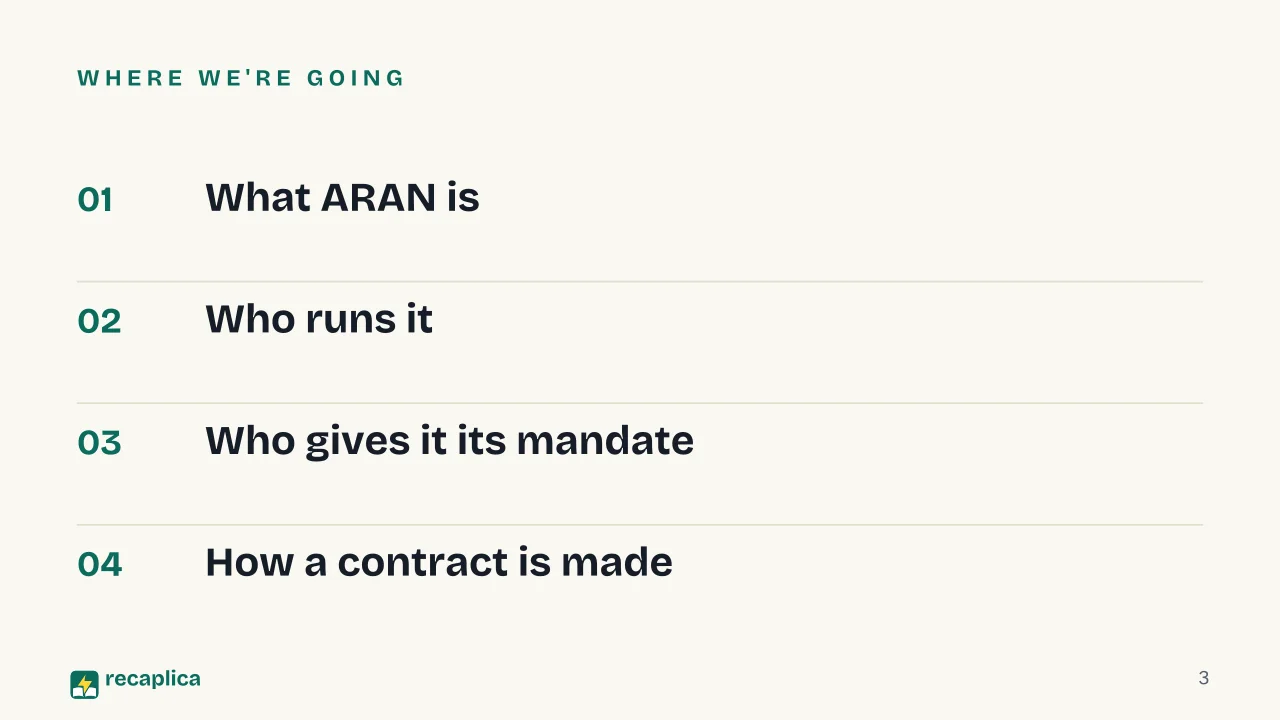  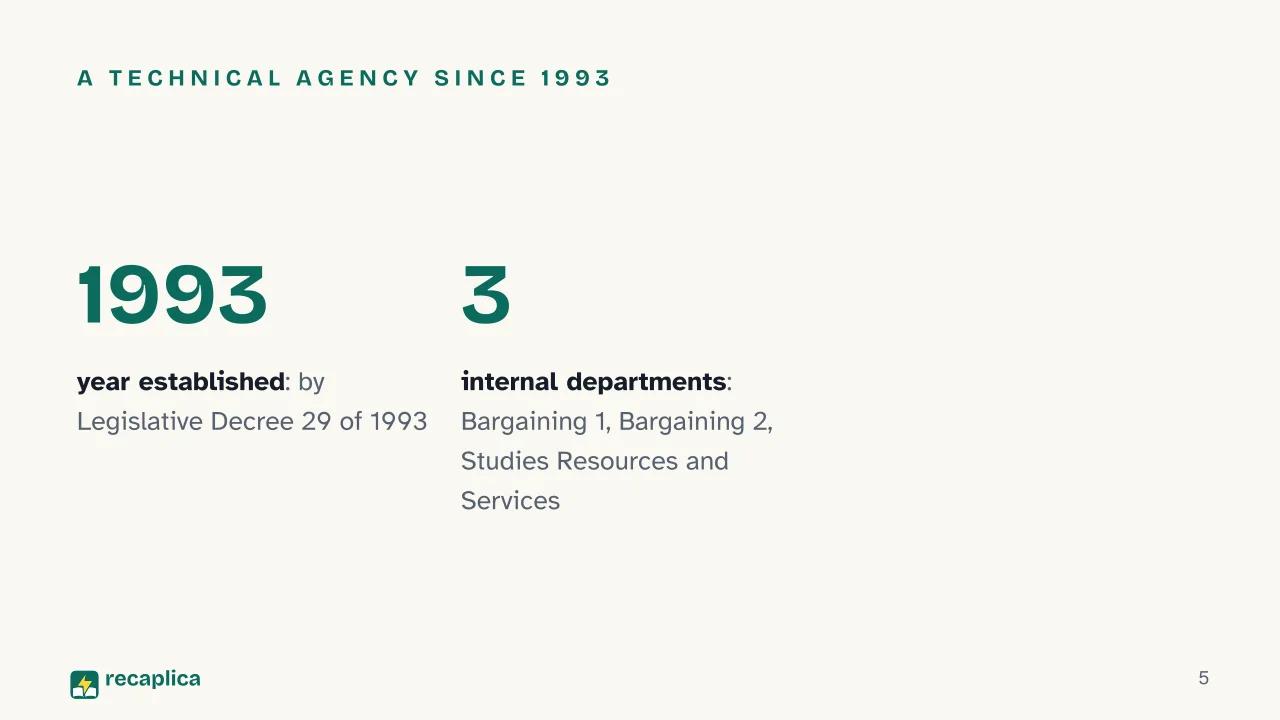  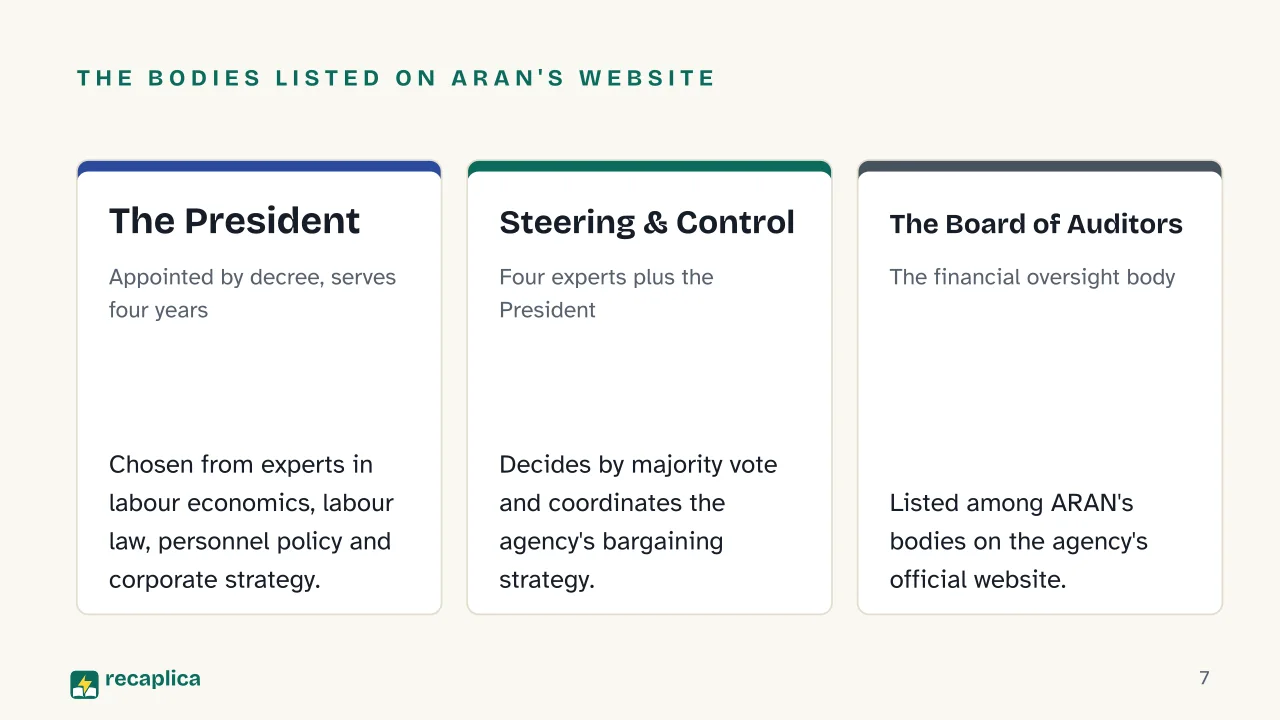  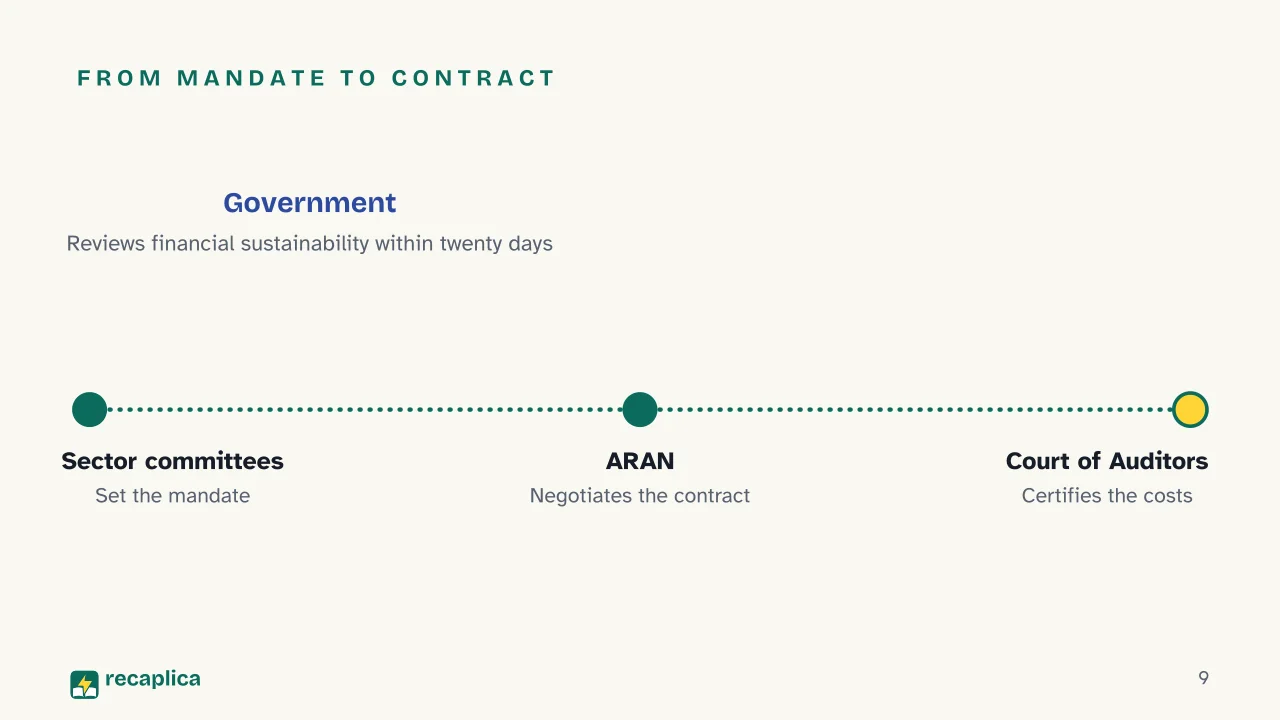  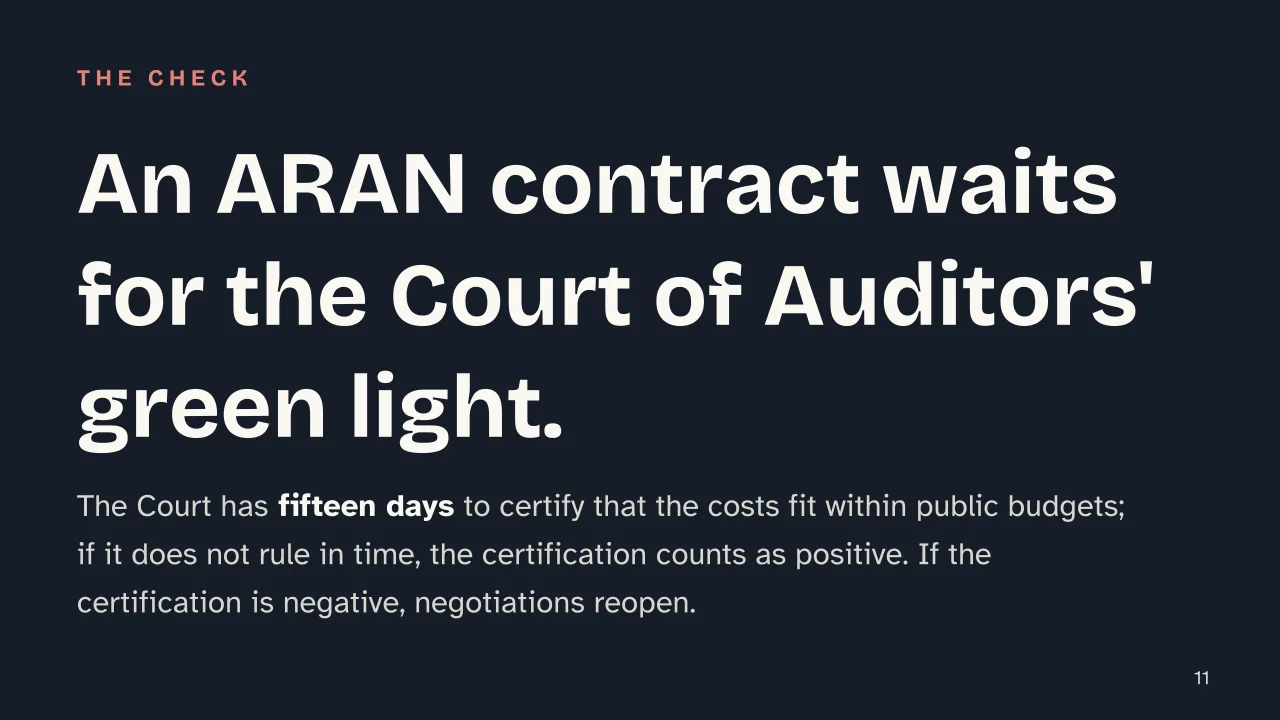 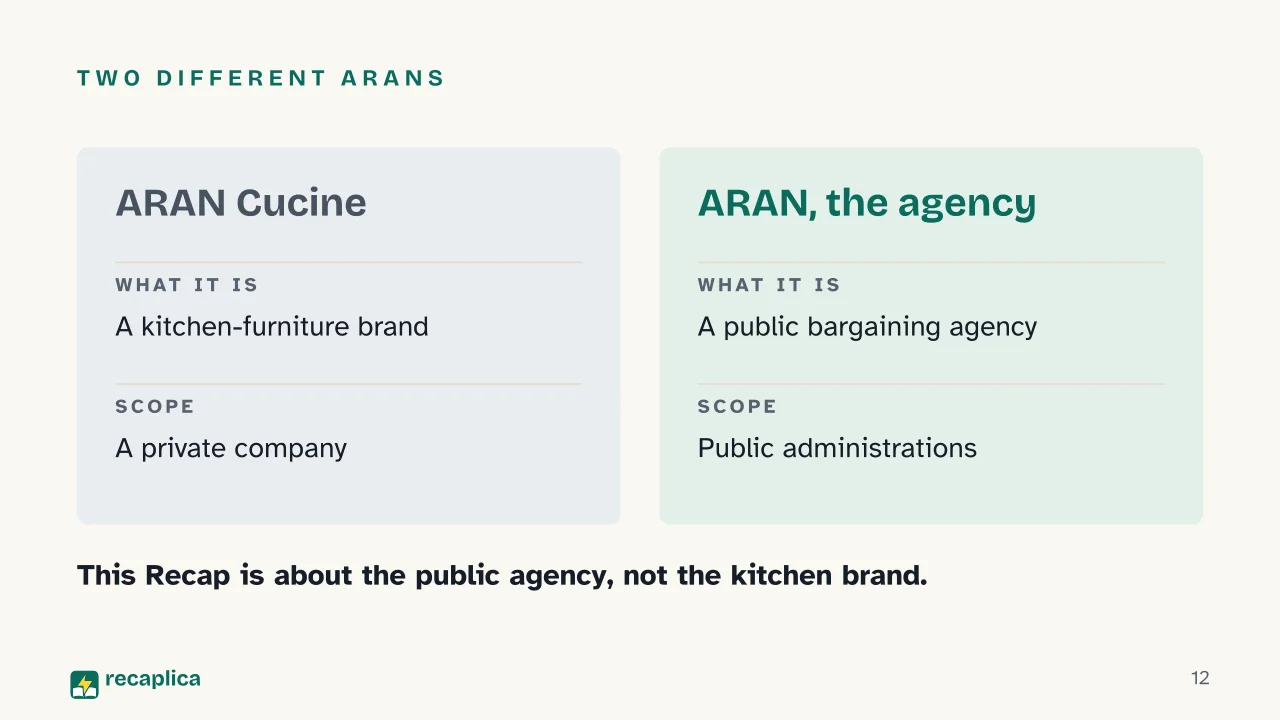 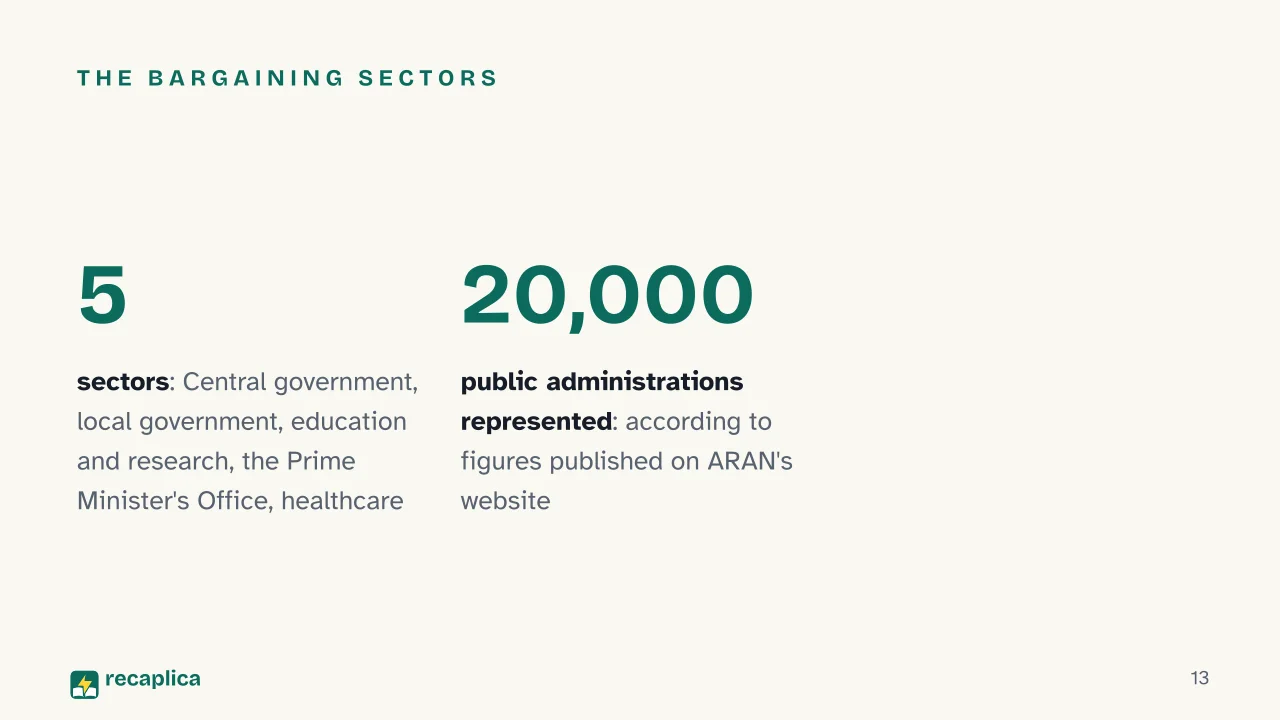 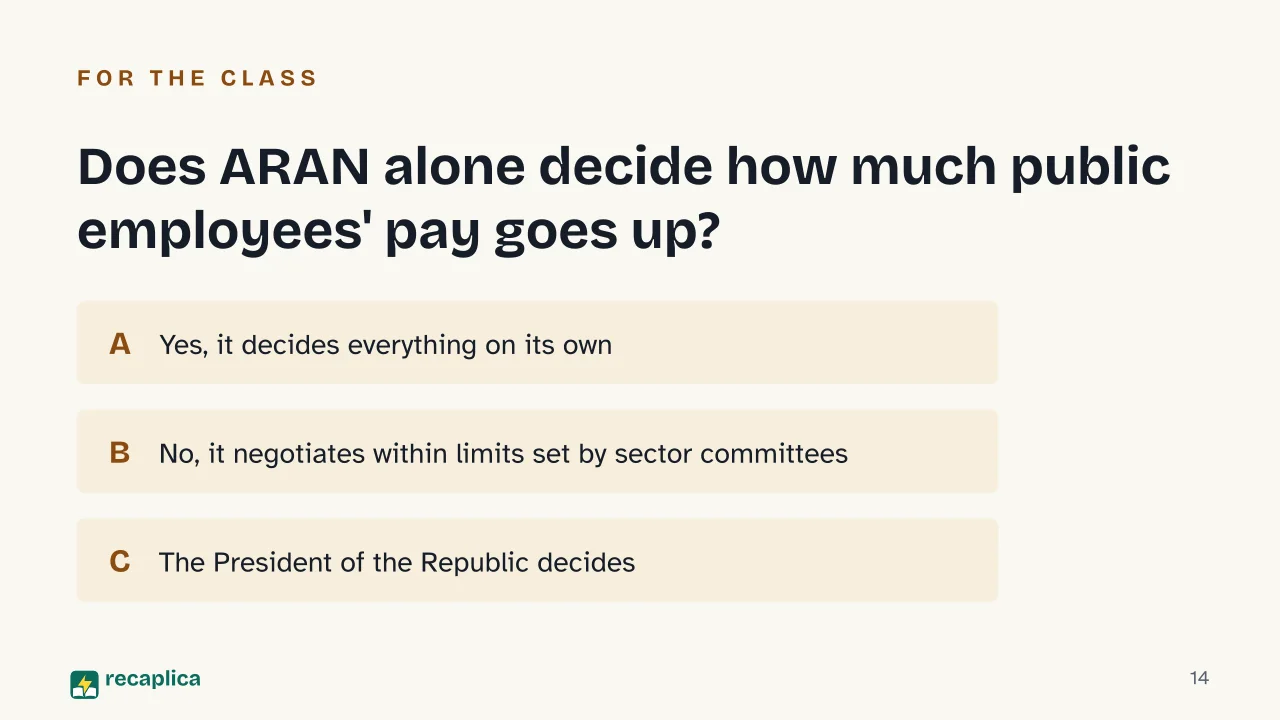  Common myths
Mind mapDrag the background to move around and the nodes to reposition them; use − and + to collapse and expand branches. 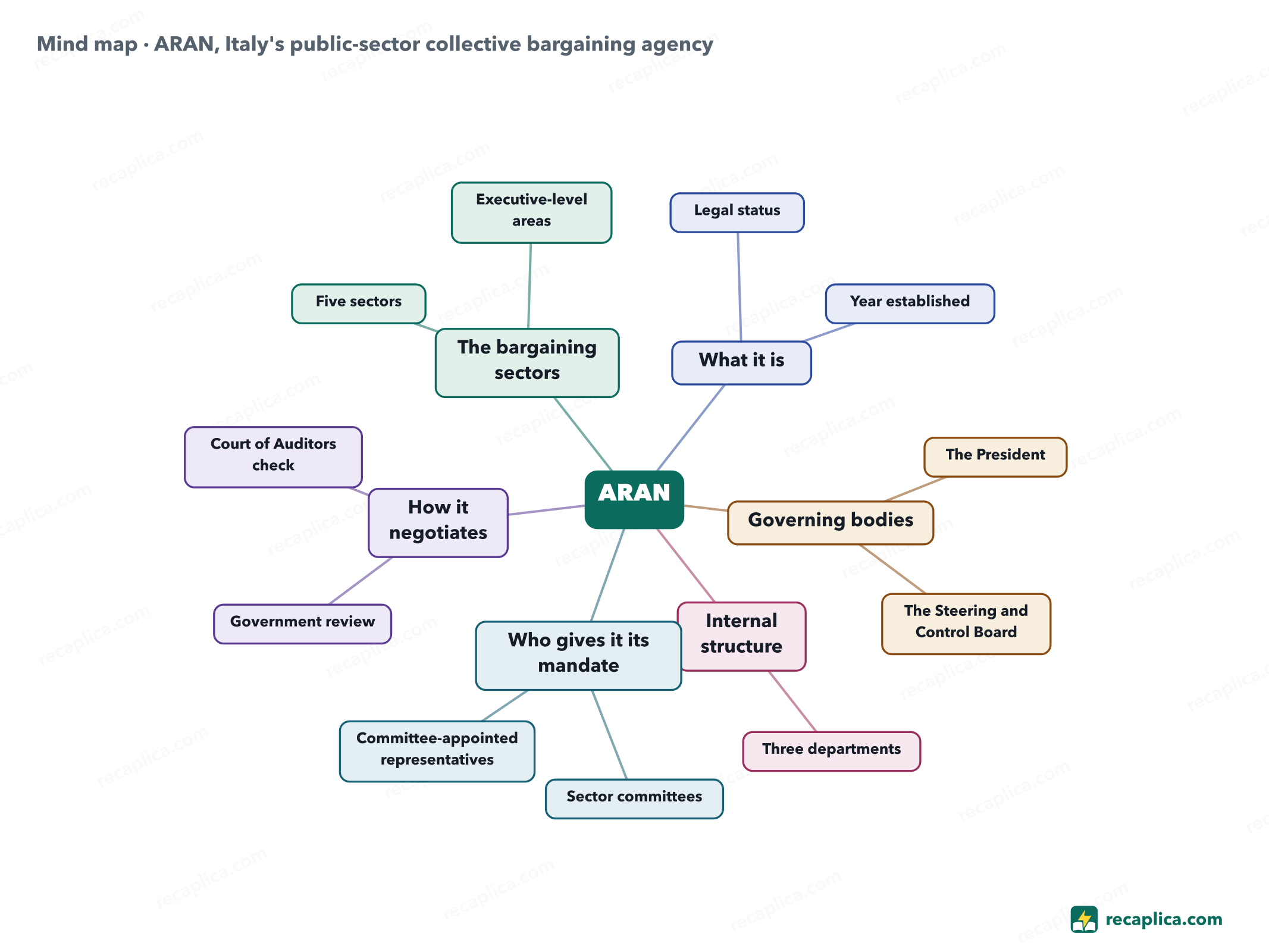
Quiz: test yourselfAnswer the questions to check what you have learned: you get instant feedback and a short explanation. Grade 0/10 0/5
FlashcardsTap the card to flip it and check whether you remember the answer, then move to the next one. 1 / 8 Explain it in your own wordsThe ultimate test: if you can explain it in simple words, you've truly understood it. Write your explanation, then compare it with the Recap. Your explanation is saved only on this device.
Frequently asked questionsWhat is ARAN?ARAN is Italy's public-sector collective bargaining agency: a public technical agency, established in 1993, that represents public administrations in national collective bargaining and negotiates their employment contracts. How does collective bargaining work in Italy's public sector?Public administrations give ARAN a mandate through sector committees; ARAN negotiates with trade unions; the resulting agreement then goes to the Court of Auditors, which certifies its financial sustainability before it becomes operative. Which public employees' contracts does ARAN negotiate?The national collective contracts of five sectors: central government functions, local government functions, education and research, the Prime Minister's Office, and healthcare, plus the corresponding executive-level areas. Is ARAN the same as ARAN Cucine?No. ARAN Cucine is a private kitchen-furniture brand with no connection to the ARAN in this Recap, which is the public agency that negotiates public employees' contracts. Who checks whether the contracts ARAN negotiates are sustainable for public finances?Italy's Court of Auditors, which receives ARAN's costing of a contract and certifies whether it fits within public budgeting and planning instruments, within fifteen days. Every Recap goes through an independent review before publication. |