Skip to content
recaplica

    One moment: security check

    Cloudflare wants to make sure you're not a robot. Tick the box below and your search will continue on its own.

    IT
    recaplica Federalism Explained: Who Decides What, and at Which Level
    © 2026 Recaplica · recaplica.com — All rights reserved
    Home › Civics

    Federalism Explained: Who Decides What, and at Which Level

    By Recaplica Newsroom · Updated on September 29, 2026

    What to print

    Page numbers appear when printing with default margins.

    Slides

    Choose a cut

    Flash10 slidesThe essential thread, to present in classFull17 slidesEvery chapter and the deeper detail

    Both come with speaker notes.

    Telegram channel
    recaplica Clear in 30 seconds, yours in 10 minutes.
    In 30 seconds Key points Deep dive Slides Myths Mind map Quiz Flashcards FAQ

    In 30 seconds quick read

    Federalism is the general idea that a country's power is shared out among several levels of government, with a constitution fixing who holds which piece. Subsidiarity is the rule that decides where a task lands: it starts at the level closest to people and only moves up when a wider scale is genuinely needed. Italy uses subsidiarity heavily, spelled out in Article 118 of its Constitution, and Article 117 divides lawmaking power between the national government and the regions. Even so, Treccani's entry on Italian regional law is explicit that Italy remains a variant of the unitary state, not a federation in the technical sense used for countries like Germany, the United States or Switzerland, because judicial power in Italy stays with the central government alone.

    Key Points

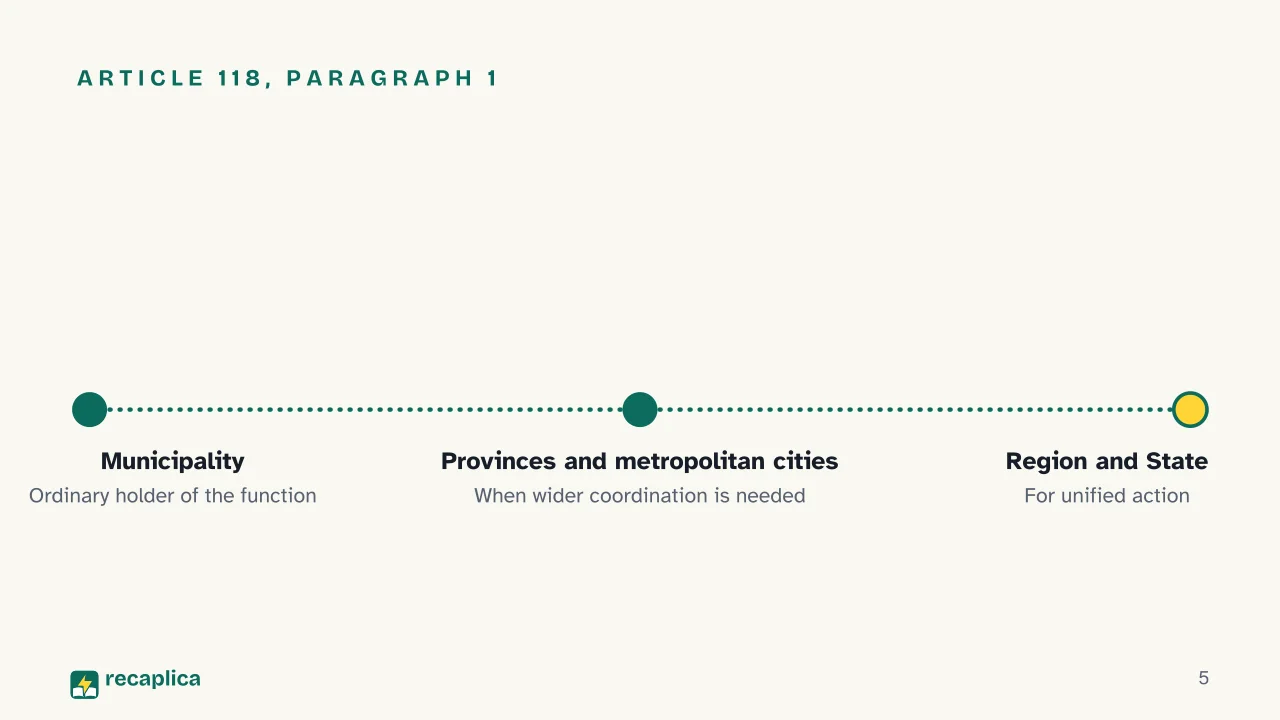
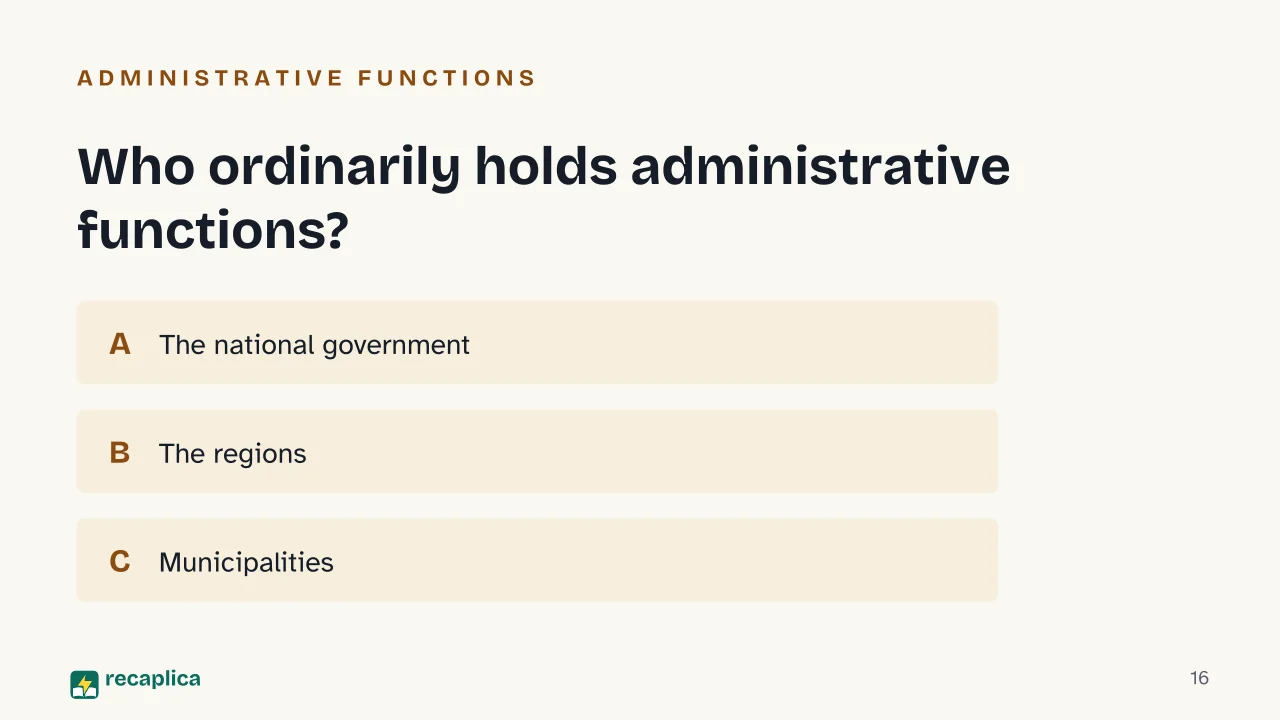
    • Article 118, paragraph 1, gives administrative functions to municipalities first, moving them up only when a wider, unified scale is needed (vertical subsidiarity).
    • Article 118, paragraph 4, asks the State, regions and local authorities to support citizens' own initiative, individually or in groups, before stepping in directly (horizontal subsidiarity).
    • Article 117 splits lawmaking power into matters reserved to the State, matters shared between State and regions, and a residual area left to the regions.
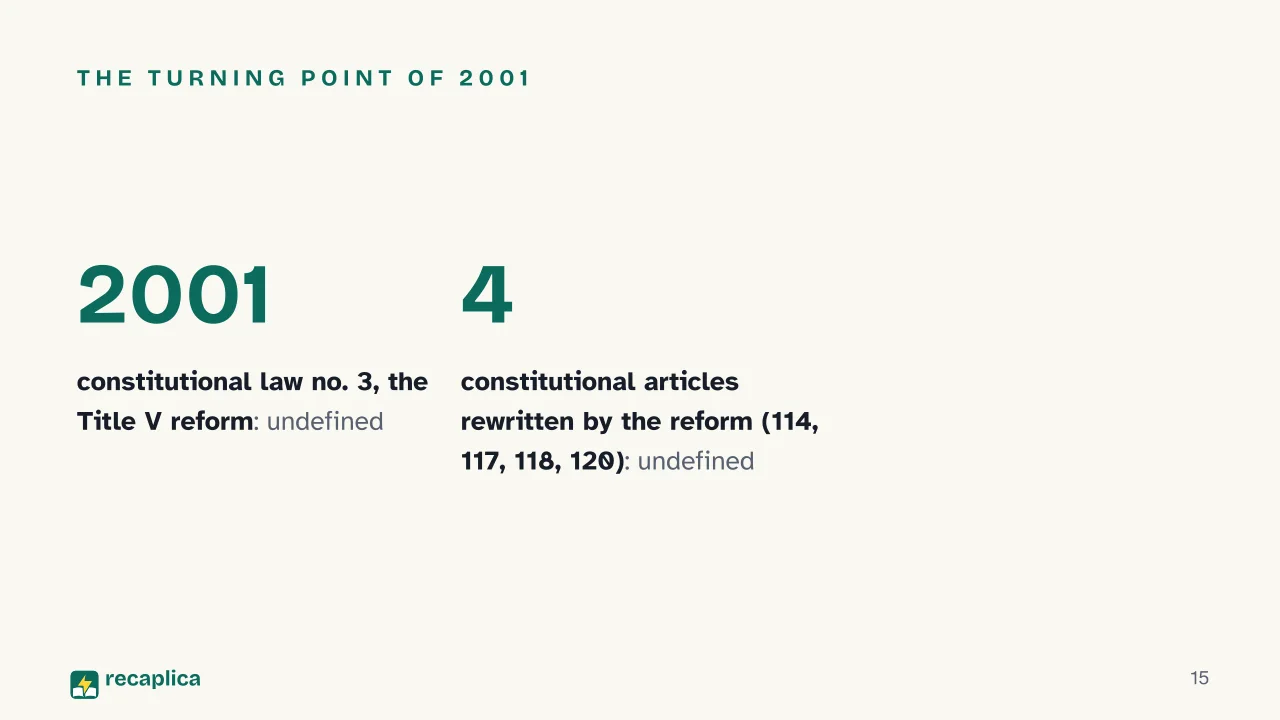
    • Constitutional law no. 3 of 2001 rewrote Title V of the Italian Constitution, reshaping how the State, regions and local authorities relate to each other.
    • Treccani's entry on federalism defines a true federal state as two levels of government with legislative and executive power formally divided by the constitution.
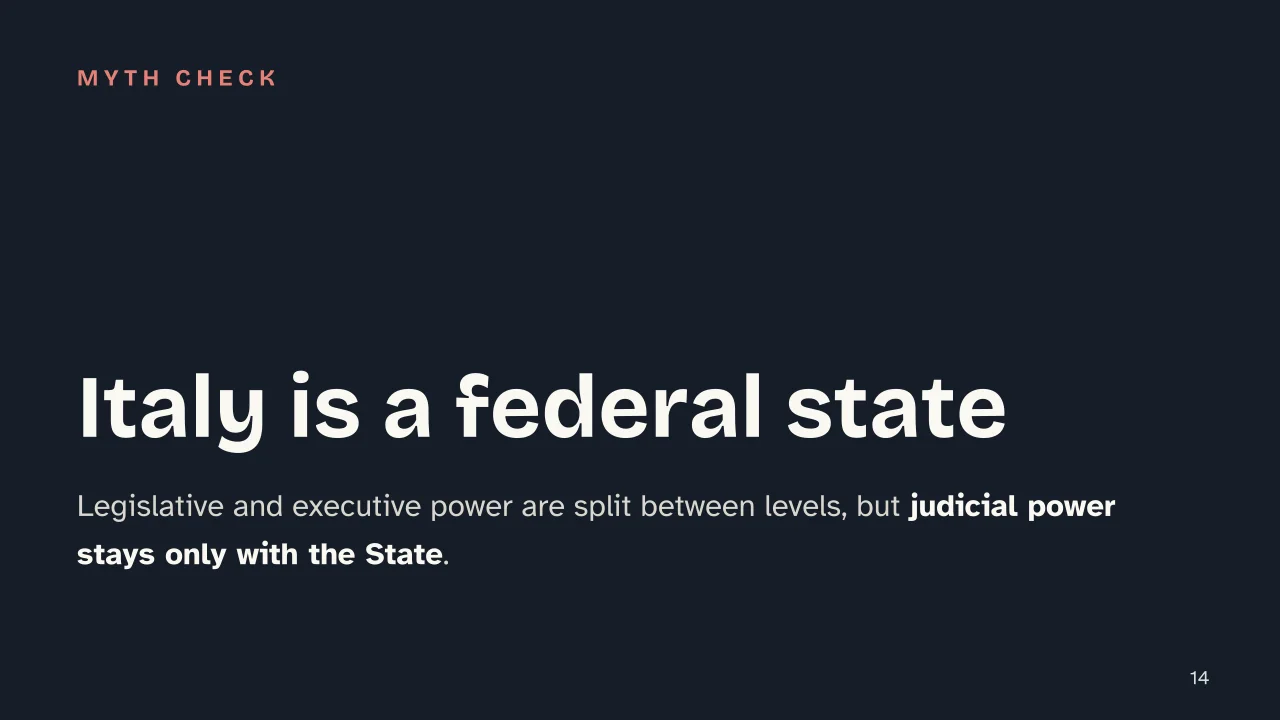
    • Italy, for Treccani's entry on Italian regional law, remains a variant of the unitary state: the judiciary belongs to the central government alone, while legislative and executive power are split between levels.

    Deep Dive

    Article 114 of the Italian Constitution states that “the Republic is made up of municipalities, provinces, metropolitan cities, regions and the State,” and that these bodies are “autonomous entities with their own statutes, powers and functions according to the principles set out in the Constitution.” Behind that flat list of bodies sits a precise rule for who decides what: the principle of subsidiarity, written into Article 118 — and the same rule that, at a larger scale, is what federalism is really about.

    What federalism means, in general

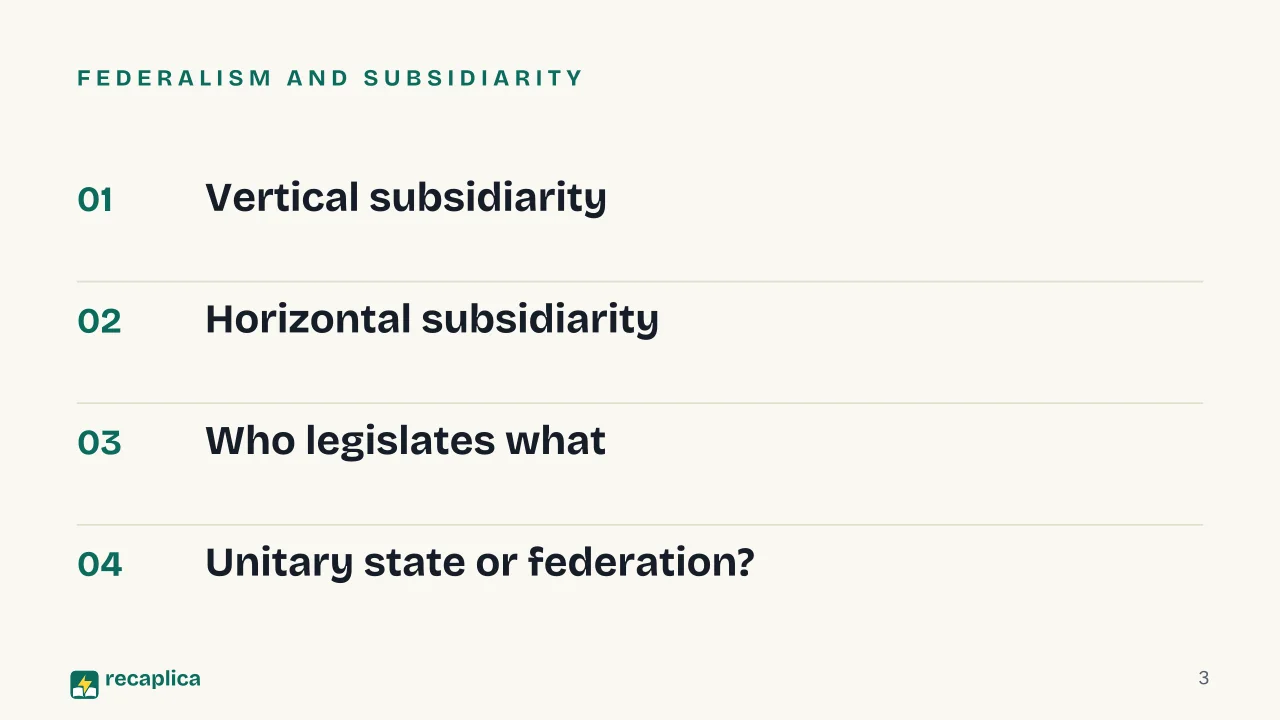
    Federalism describes a country where power doesn’t sit in one place: a constitution splits legislative and executive authority between a central government and other levels below it, each with a guaranteed area of financial autonomy. Germany, the United States and Switzerland are textbook cases — two levels of government, both acting directly on citizens, each with powers the other cannot simply take away. Subsidiarity is the working rule inside that split: it decides, task by task, which level actually handles something, starting from the level closest to people and moving up only when a wider scale is genuinely required.

    Italy is not one of the textbook federations, but it runs heavily on subsidiarity, and its Constitution spells the rule out in unusual detail.

    Vertical subsidiarity: starting from the municipality

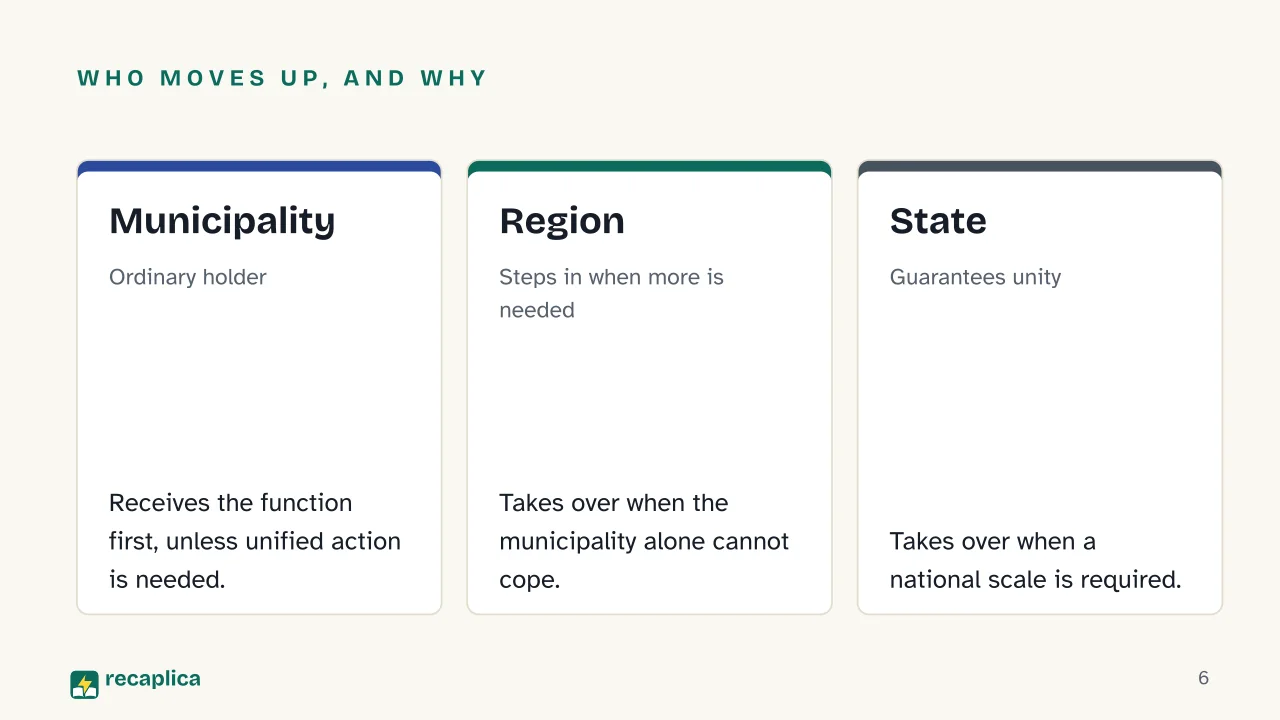
    Article 118, paragraph 1, of the Italian Constitution states that “administrative functions are attributed to municipalities unless, to ensure their unified exercise, they are conferred upon provinces, metropolitan cities, regions or the State, on the basis of the principles of subsidiarity, differentiation and adequacy.” By default, a municipality holds the function; moving it up a level only happens when keeping it at a small, nearby level would prevent it from being carried out in a unified way.

    Paragraph 2 of the same article adds that municipalities, provinces and metropolitan cities hold both their own administrative functions and those assigned to them by national or regional law, according to their respective competencies. It isn’t a fixed list of subjects per level, but a mechanism that switches on whenever a given function calls for it.

    Practical example: collecting household waste stays a municipal service in most cases, but planning a treatment plant that serves several municipalities can move up to the regional level, because a single municipality wouldn’t be able to coordinate a wider catchment area on its own.

    Anyone who wants the bigger picture of how the Italian state is built, before getting to subsidiarity, can start with the Recap on Italian Constitution: structure, principles, and how it works.

    Horizontal subsidiarity: citizens first

    Article 118, paragraph 4, of the Italian Constitution asks every level of government, from the State down to municipalities, to “favor the autonomous initiative of citizens, individually or in association, for the performance of activities of general interest, on the basis of the principle of subsidiarity.” Here subsidiarity doesn’t regulate the handover of a function from one level of government to another: it regulates the relationship between institutions and the people they are meant to serve.

    A group of parents who organize after-school tutoring on their own, an association that runs a public park, or a committee that cleans up a stretch of coastline are all the kind of initiative Article 118 asks institutions to support, before institutions step in themselves with a direct public service.

    Who legislates what: the split under Article 117

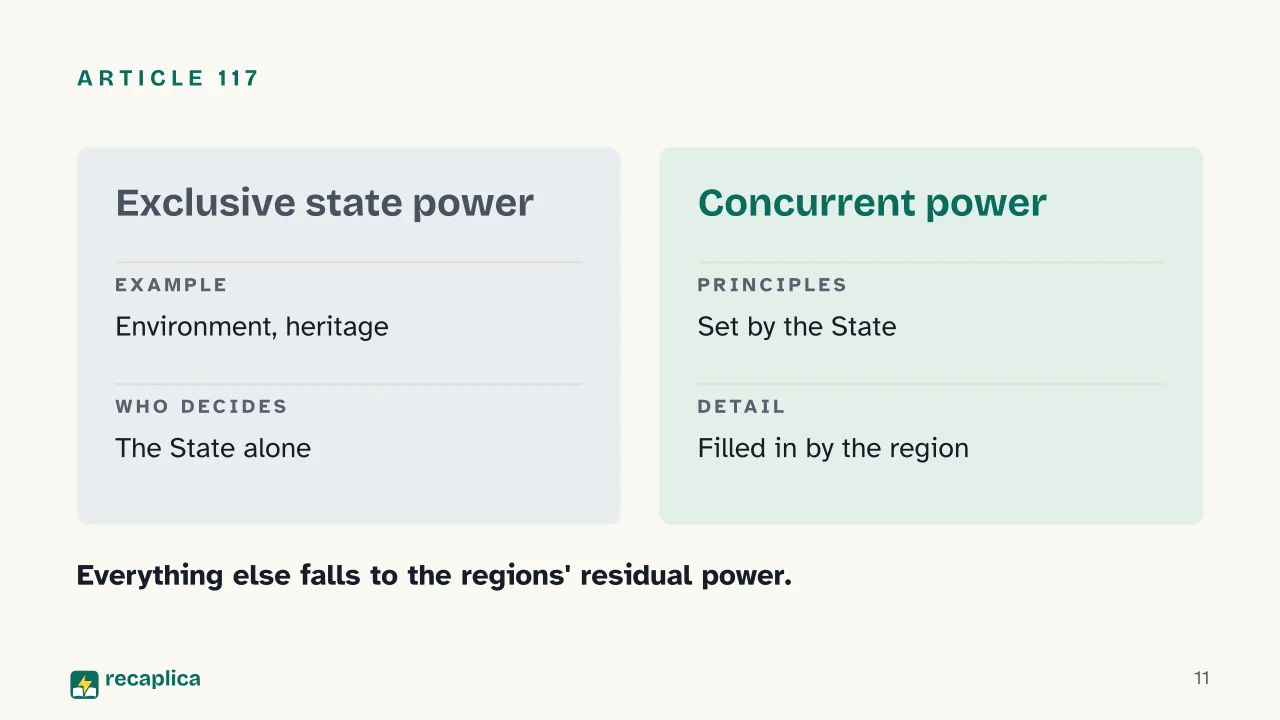
    Paragraph 1 of Article 117 states that “legislative power is exercised by the State and the regions in compliance with the Constitution, as well as the constraints deriving from EU law and international obligations.” From there, the constitutional text distinguishes three different situations. Some matters remain under the exclusive legislative power of the State: among them, the article names, word for word, “the protection of the environment, ecosystems and cultural heritage.” Others fall under concurrent legislation: “legislative power belongs to the regions, except for setting the fundamental principles, which is reserved to State legislation.” For everything else, a residual rule applies: “legislative power belongs to the regions with regard to any matter not expressly reserved to State legislation.”

    This architecture dates back to constitutional law no. 3 of 2001, which rewrote Title V of the Constitution. The dossier from the Italian Chamber of Deputies’ research service describes that reform as the intervention that “substantially rewrote the overall system of relations between the State, regions and local authorities,” and notes that “the principle of loyal cooperation must govern every relationship between the State and the regions.” Anyone curious about how the State itself is organized at the national level, downstream of this division of powers, can find the full picture in the Recap on Italian government structure: which bodies do what.

    When the national government can step in for the regions

    Article 120, paragraph 2, provides that “the Government can replace bodies of regions, metropolitan cities, provinces and municipalities” in defined cases: failing to comply with international treaties or EU law, a serious threat to public safety, or the need to protect “legal or economic unity” and, in particular, “the essential levels of services connected to civil and social rights.” The same provision adds that these substitute powers must be exercised “in compliance with the principle of subsidiarity and the principle of loyal cooperation”: even when the State steps in for a local authority, the Constitution points back to the same principle that governs the ordinary division of functions.

    Article 120, paragraph 1, also sets a limit running the other way, aimed at the regions: they cannot impose duties on goods crossing regional borders, obstruct the free movement of people and goods across the country, or restrict the right to work anywhere in the national territory.

    Why isn’t Italy a federal state?

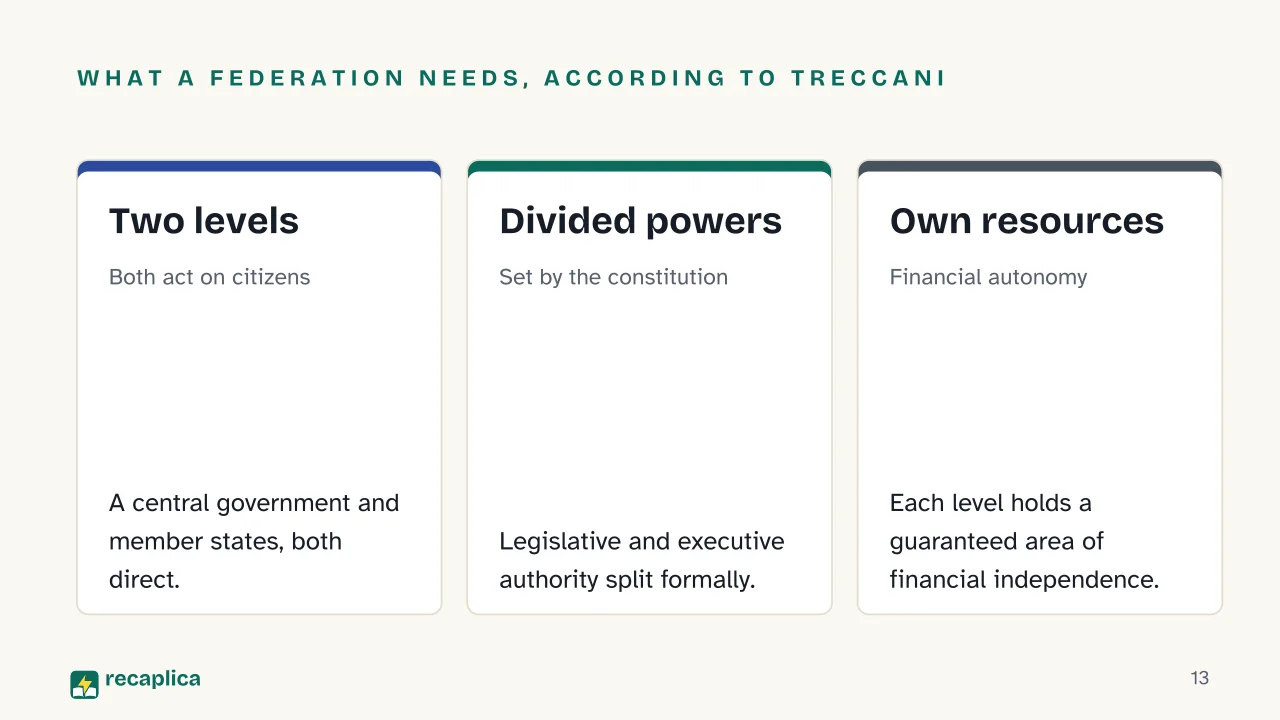
    Treccani’s entry on “Federalismo [dir. cost.],” written by Alberto Vespaziani, defines a federal state through a few technical elements: two levels of government that act directly on citizens, held together by a formal, constitutionally fixed division of legislative and executive authority, and by a split of financial resources that leaves each level a genuine area of autonomy. A federal state in the full sense, the entry explains, is the point where the federal principle and complete statehood meet.

    Italy doesn’t fit that definition. Treccani’s entry on “Diritto regionale” explains that the Italian system stays a variant of the unitary state: legislative and executive power are split between the different levels of government, but judicial power remains exclusively with the central State. The division of legislative powers just described under Article 117, however broad, never touches the judiciary, which stays a single, national power. The same entry cautions that real-world systems rarely match a pure model, since elements from different models tend to coexist rather than sort neatly into centralized or decentralized. That’s why, in legal scholarship, Italy is often described as a regional state — a descriptive label with no textual anchor in the Constitution itself.

    Anyone who wants to see how that separate, always-national judicial power actually works can read the Recap on the Italian legal system: how courts and judges are organized; and anyone comparing this setup with other ways of organizing power can turn to the Recap on types of government: forms of state vs. forms of government.

    Slide deck

    Slides ready to download and make your own in PowerPoint or Google Slides, with speaker notes. Pick the Flash cut or the Full one.
    Slide 1 of the presentation on Federalism Explained: FederalismSlide 2 of the presentation on Federalism Explained: Who decides first: the local council or the national government?Slide 3 of the presentation on Federalism Explained: Federalism and subsidiaritySlide 4 of the presentation on Federalism Explained: Chapter 01: Vertical subsidiaritySlide 5 of the presentation on Federalism Explained: Article 118, paragraph 1Slide 6 of the presentation on Federalism Explained: Who moves up, and why: Municipality, Region, StateSlide 7 of the presentation on Federalism Explained: Chapter 02: Horizontal subsidiaritySlide 8 of the presentation on Federalism Explained: Who acts first: the state or citizens?Slide 9 of the presentation on Federalism Explained: Vertical versus horizontalSlide 10 of the presentation on Federalism Explained: Chapter 03: Who legislates whatSlide 11 of the presentation on Federalism Explained: Article 117Slide 12 of the presentation on Federalism Explained: Chapter 04: Unitary state or federation?Slide 13 of the presentation on Federalism Explained: What a federation needs, according to Treccani: Two levels, Divided powers, Own resourcesSlide 14 of the presentation on Federalism Explained: Italy is a federal stateSlide 15 of the presentation on Federalism Explained: The turning point of 2001Slide 16 of the presentation on Federalism Explained: Who ordinarily holds administrative functions?Slide 17 of the presentation on Federalism Explained: Go further
    Flash10 slidesThe essential thread, to present in classFull17 slidesEvery chapter and the deeper detail

    Common myths

    • ✗ Myth Italy is a federal state, just like Germany or the United States.

      ✓ Reality Regions with wide-ranging autonomy make it look that way, but Treccani's entry on Italian regional law files Italy under the unitary state, as a variant of it. What the levels of government share is legislative and executive power; judicial power remains exclusively with the central government. A federation in the technical sense, per Treccani's entry on federalism, needs a formal constitutional division of legislative and executive authority between two levels of government that both act directly on citizens. Italy has plenty of decentralization, but its Constitution never sets up that formal two-level split of legislative and executive power the way federations do.

    • ✗ Myth Horizontal subsidiarity is about giving regions more power over the national government.

      ✓ Reality Article 118, paragraph 4, doesn't address the relationship between the State and the regions at all: it asks every level of government, including the State, to support citizens' independent initiative before stepping in with direct public action. The rule concerns institutions and citizens, not the balance of power among levels of government.

    • ✗ Myth Every policy area belongs either fully to the national government or fully to the regions, with nothing in between.

      ✓ Reality Article 117 also allows for concurrent legislation, where both the State and a region legislate on the same matter: the State sets the fundamental principles, and the region fills in the detail. Alongside that middle ground sit matters reserved exclusively to the State and a residual area left to the regions for everything the Constitution doesn't expressly reserve to the State.

    Mind map

    Drag the background to move around and the nodes to reposition them; use − and + to collapse and expand branches.
    Customize
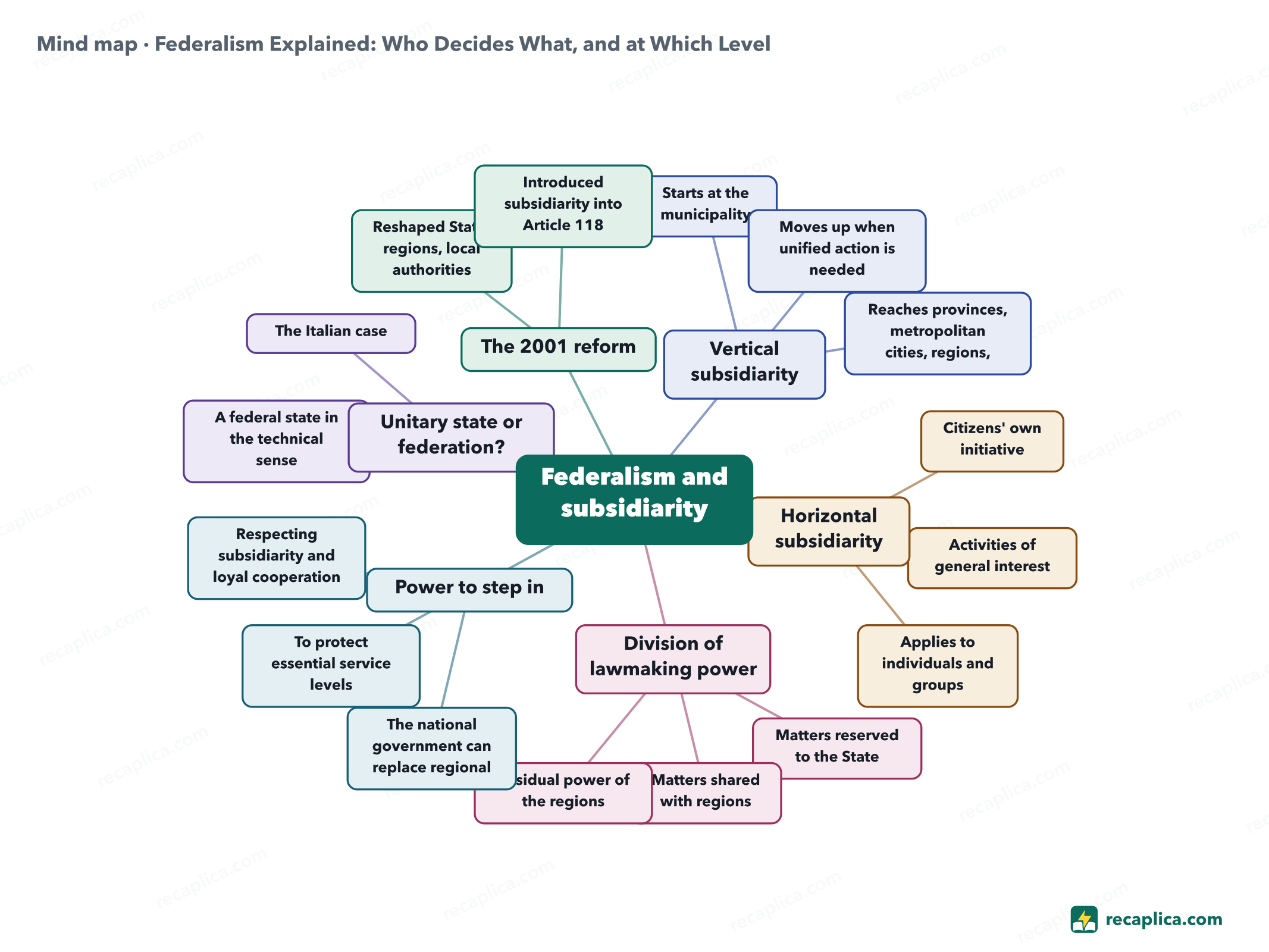
    Mind map: Federalism Explained: Who Decides What, and at Which Level
    • Federalism and subsidiarity
      • Vertical subsidiarity Article 118, paragraph 1
        • Starts at the municipality
        • Moves up when unified action is needed
        • Reaches provinces, metropolitan cities, regions, the State
      • Horizontal subsidiarity Article 118, paragraph 4
        • Citizens' own initiative
        • Activities of general interest
        • Applies to individuals and groups
      • Division of lawmaking power Article 117
        • Matters reserved to the State Environment, ecosystems, heritage, among others
        • Matters shared with regions Fundamental principles stay with the State
        • Residual power of the regions
      • Power to step in Article 120, paragraph 2
        • The national government can replace regional or local bodies
        • To protect essential service levels
        • Respecting subsidiarity and loyal cooperation
      • Unitary state or federation?
        • A federal state in the technical sense Two levels of government, powers split by constitution
        • The Italian case Variant of the unitary state, judiciary stays central
      • The 2001 reform Constitutional law no. 3
        • Reshaped State, regions, local authorities
        • Introduced subsidiarity into Article 118

    Quiz: test yourself

    Answer the questions to check what you have learned: you get instant feedback and a short explanation.

    Grade 0/10 0/5
    1 Under Article 118 of the Italian Constitution, who ordinarily holds administrative functions?

    Under Article 118, paragraph 1, the municipality is the default holder; a higher level takes over only where unified exercise of the function requires it.

    2 What does horizontal subsidiarity mean, under Article 118, paragraph 4?

    Paragraph 4 asks the State, regions, metropolitan cities, provinces and municipalities to support citizens' independent initiative, alone or in groups, for activities of general interest.

    3 According to Treccani, what marks out a federal state in the technical sense?

    Treccani's entry on federalism describes a federal state as a marriage of the federal principle and statehood, resting on a formal constitutional division of legislative and executive power between two levels of government.

    4 Why does Treccani's entry on Italian regional law call Italy a variant of the unitary state?

    Because the courts are the exception: legislative and executive power are shared between levels of government in Italy, while the judiciary answers to the central government alone.

    5 In which year did the reform of Title V rewrite the relationship between the State, regions and local authorities?

    It was constitutional law no. 3 of 2001, the Title V reform; the Italian Chamber of Deputies' research service credits it with redrawing, from top to bottom, how the State, the regions and local authorities relate to one another.

    Answers: 1-C · 2-B · 3-B · 4-B · 5-B

    Flashcards

    Tap the card to flip it and check whether you remember the answer, then move to the next one.

    1 / 7

    Explain it in your own words

    The ultimate test: if you can explain it in simple words, you've truly understood it. Write your explanation, then compare it with the Recap.

    Your explanation is saved only on this device.

    Federalism is the general idea that a country's power is shared out among several levels of government, with a constitution fixing who holds which piece. Subsidiarity is the rule that decides where a task lands: it starts at the level closest to people and only moves up when a wider scale is genuinely needed. Italy uses subsidiarity heavily, spelled out in Article 118 of its Constitution, and Article 117 divides lawmaking power between the national government and the regions. Even so, Treccani's entry on Italian regional law is explicit that Italy remains a variant of the unitary state, not a federation in the technical sense used for countries like Germany, the United States or Switzerland, because judicial power in Italy stays with the central government alone.

    Frequently asked questions

    What is federalism?

    Federalism is a way of organizing a country where power is split between a central government and other levels of government below it, with a constitution formally dividing legislative and executive authority between them. Classic examples are Germany, the United States and Switzerland.

    What is the difference between vertical and horizontal subsidiarity?

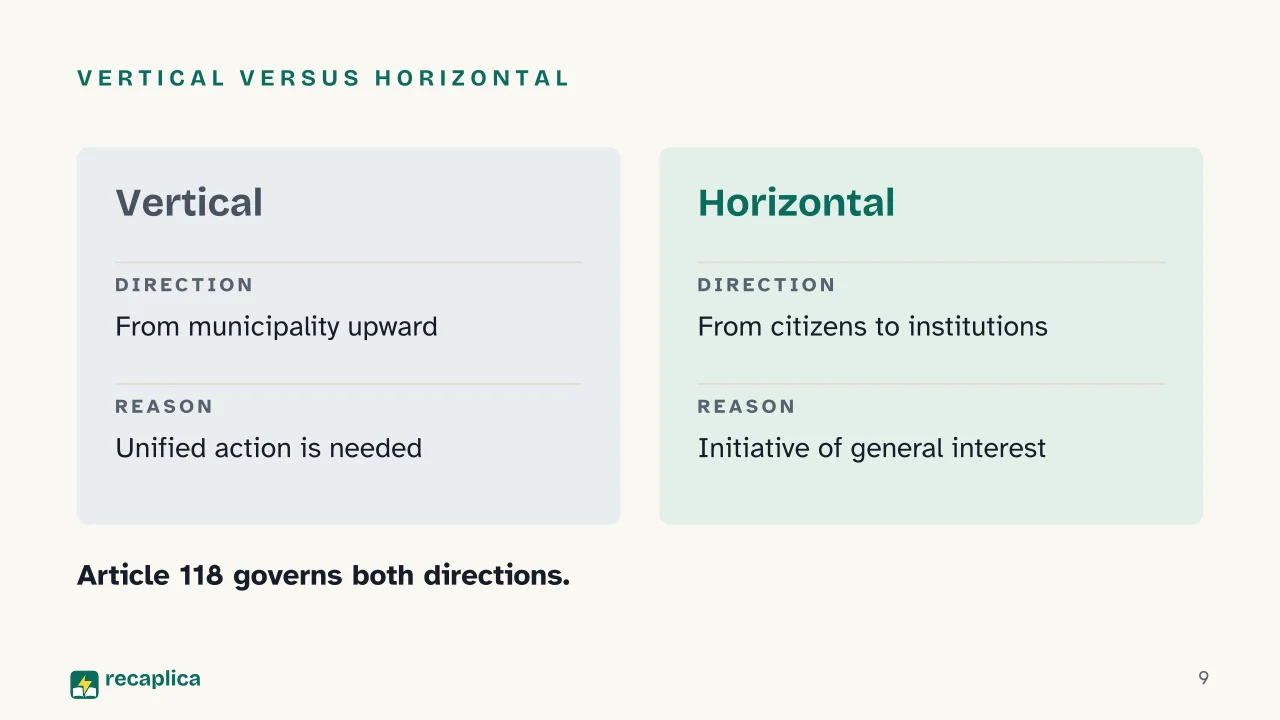
    Vertical subsidiarity (Art. 118, para. 1) governs how administrative functions move between levels of government, starting at the municipality and moving upward only when needed. Horizontal subsidiarity (Art. 118, para. 4) concerns the relationship between institutions and citizens: institutions must support citizens' own initiative for activities of general interest.

    Is Italy a federal state, like Germany or the United States?

    No. Treccani's entry on Italian regional law calls Italy a variant of the unitary state: judicial power remains exclusively with the central government. In a federation in the technical sense, by contrast, the constitution itself formally splits legislative and executive authority across two levels of government, each in direct contact with citizens.

    Who decides on environmental and heritage protection in Italy?

    The State alone: Article 117 of the Italian Constitution puts environmental protection, ecosystems and cultural heritage on the list of matters reserved to its exclusive legislative power.

    What are the national government's powers to step in for regions or local authorities?

    Under Article 120, paragraph 2, the national government may take the place of a regional, metropolitan, provincial or municipal body when that body breaches international or EU obligations, when public safety is seriously endangered, or when essential service levels must be protected. Even then, subsidiarity and loyal cooperation still apply.

    Sources

    • Constitution of the Italian Republic, Art. 114
    • Constitution of the Italian Republic, Art. 117
    • Constitution of the Italian Republic, Art. 118
    • Constitution of the Italian Republic, Art. 120
    • Italian Chamber of Deputies — dossier on the division of legislative powers under Title V
    • Treccani, Diritto on-line — Federalismo [dir. cost.]
    • Treccani, XXI Secolo — Diritto regionale

    Every Recap goes through an independent review before publication.

    Every evening, the day's new Recaps on our Telegram channel. Join the channel →

    Keep learning

    • Civics Civil Service: What It Is and How It Works in Italy The civil service is both the activity of running public affairs and the set of bodies that carry it out: ministries and agencies, public bodies, independent authorities, state-owned enterprises, and local government such as regions, provinces and municipalities. In Italy, the Constitution's Articles 97 and 98 require sound administration and impartiality, entry to public jobs through open competitive exams, and service to the Nation rather than to any government or party. Part of this machinery — state bodies such as ministries — has no legal personality of its own, because it coincides with the state itself; another part, public bodies, has its own separate legal personality. In 2022, Italy's statistics agency ISTAT counted 12,776 active public institutions, employing more than 3.4 million people. Read the Recap →
    • Civics Crimes Against Humanity: Definition and the Link to Human Dignity Crimes against humanity are a category of international criminal law: acts such as murder, extermination, or persecution, committed as part of a widespread or systematic attack against a civilian population. The 1998 Rome Statute defines them in Article 7 and assigns them to the International Criminal Court, operational since 2002. The concept is older, though: it dates back to 1945, with the charter that created the Nuremberg tribunal. This Recap explains the definition, where it stops and genocide or war crimes begin, and why we connect it to the principle of human dignity written into Italy's constitution. Read the Recap →
    • Civics Popular Sovereignty and Citizenship: What They Mean Popular sovereignty is the principle, written into Article 1 of Italy's Constitution, that state power belongs to the people, who exercise it within the forms and limits the Constitution itself sets, through Parliament, elections, and the tools it provides, not through a direct vote on every law. Citizenship is a different matter: the legal status that ties a person to a state, together with the rights and duties that relationship carries, as the Enciclopedia Treccani defines it. In Italy, Law No. 91 of February 5, 1992 makes a person a citizen at birth mainly through jus sanguinis, at least one citizen parent, reserving birth on Italian soil for cases where both parents are unknown or stateless. The idea that power comes from the people themselves, rather than from a sovereign standing above them, traces back to Jean-Jacques Rousseau and his 1762 Social Contract, and it is, according to the Stanford Encyclopedia of Philosophy, the version of sovereignty most widespread in contemporary constitutional governments around the world. Read the Recap →

    recaplica

    Clear in 30 seconds, yours in 10 minutes.

    Recaps Mind maps Request a Recap Telegram channel Mind map maker Our method About Privacy & cookies Legal notes & terms of use

    © 2026 Recaplica · A project by Curi S.r.l. — VAT IT05472000750

    Statistics, only if you say so

    To learn which Recaps help most we would use Google Analytics, with aggregate, anonymous data. It starts only with your OK, and you can change your mind anytime. Privacy policy