Skip to content
recaplica

    One moment: security check

    Cloudflare wants to make sure you're not a robot. Tick the box below and your search will continue on its own.

    IT
    recaplica Inequalities with Square Roots: What They Are and How to Solve Them
    © 2026 Recaplica · recaplica.com — All rights reserved
    Home › Science

    Inequalities with Square Roots: What They Are and How to Solve Them

    By Recaplica Newsroom · Updated on September 20, 2026

    What to print

    Page numbers appear when printing with default margins.

    Slides

    Choose a cut

    Flash10 slidesThe essential thread, to present in classFull16 slidesEvery chapter and the deeper detail

    Both come with speaker notes.

    Telegram channel
    recaplica Clear in 30 seconds, yours in 10 minutes.
    In 30 seconds Key points Deep dive Slides Myths Mind map Quiz Flashcards FAQ

    In 30 seconds quick read

    An inequality with square roots has the unknown inside a radical. When the radical's index is even, the first step is requiring the radicand to be non-negative, the existence condition. The sign of the right-hand side then decides how to proceed: a less-than inequality needs just one system with three conditions, while a greater-than inequality needs two separate systems joined together. With an odd index, by contrast, the radical is defined for every number and both sides can be raised to the power directly, with no condition to set.

    Key Points

    • An inequality with a square root has the unknown inside the radical.
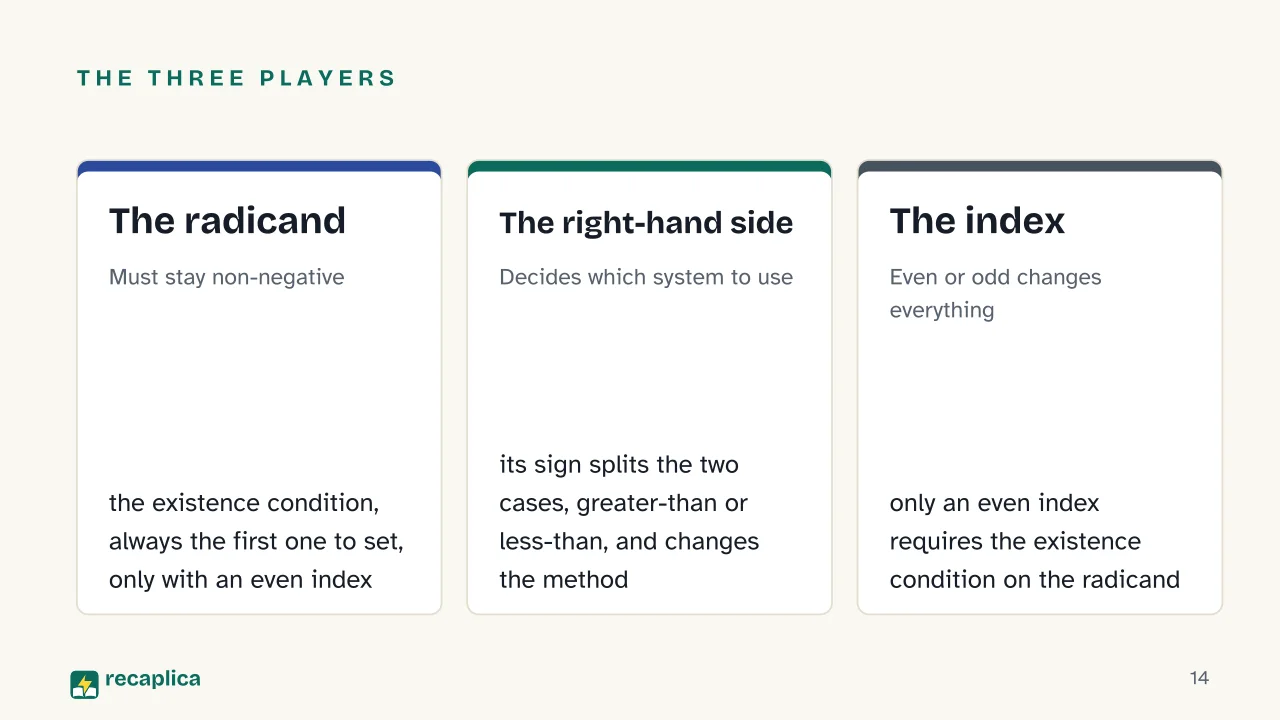
    • With an even index, the radicand must be non-negative first, the existence condition.
    • The sign of the right-hand side decides which system to set up.
    • The less-than case is a single system with three conditions.
    • The greater-than case is the union of two separate systems.
    • With an odd index no condition is needed, both sides can be raised to the power directly.

    Deep Dive

    An inequality with a square root has the unknown x inside a radical, under the root sign. In practice, what sits under the radical is not just a number but an expression with x, and that changes how the comparison between the two sides works compared with an ordinary inequality.

    The existence condition

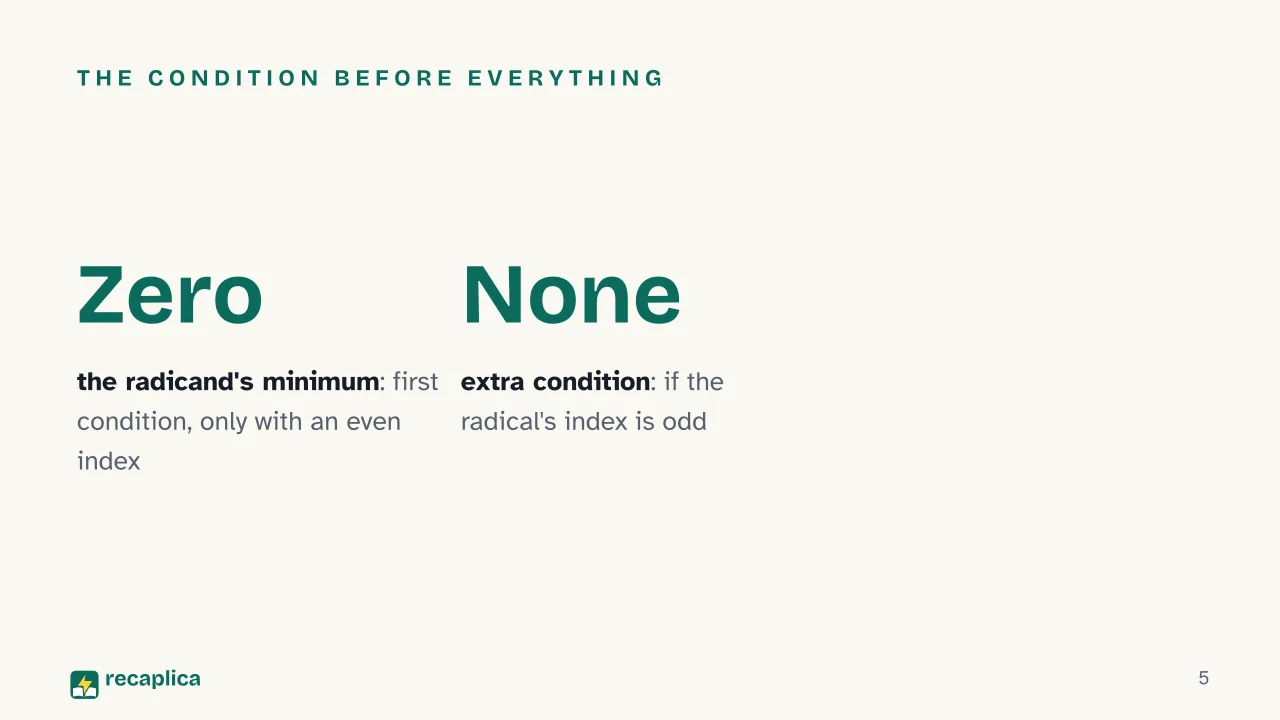
    When the radical has an even index (square root, fourth root, and so on), before comparing the two sides at all you need to make sure the radical makes sense in the first place. The condition to impose is that the radicand, the expression under the root, is greater than or equal to zero: that is the existence condition, and it comes before any comparison between the two sides. Skip this first step and values of x for which the radical isn’t even defined can slip in as solutions.

    The less-than case

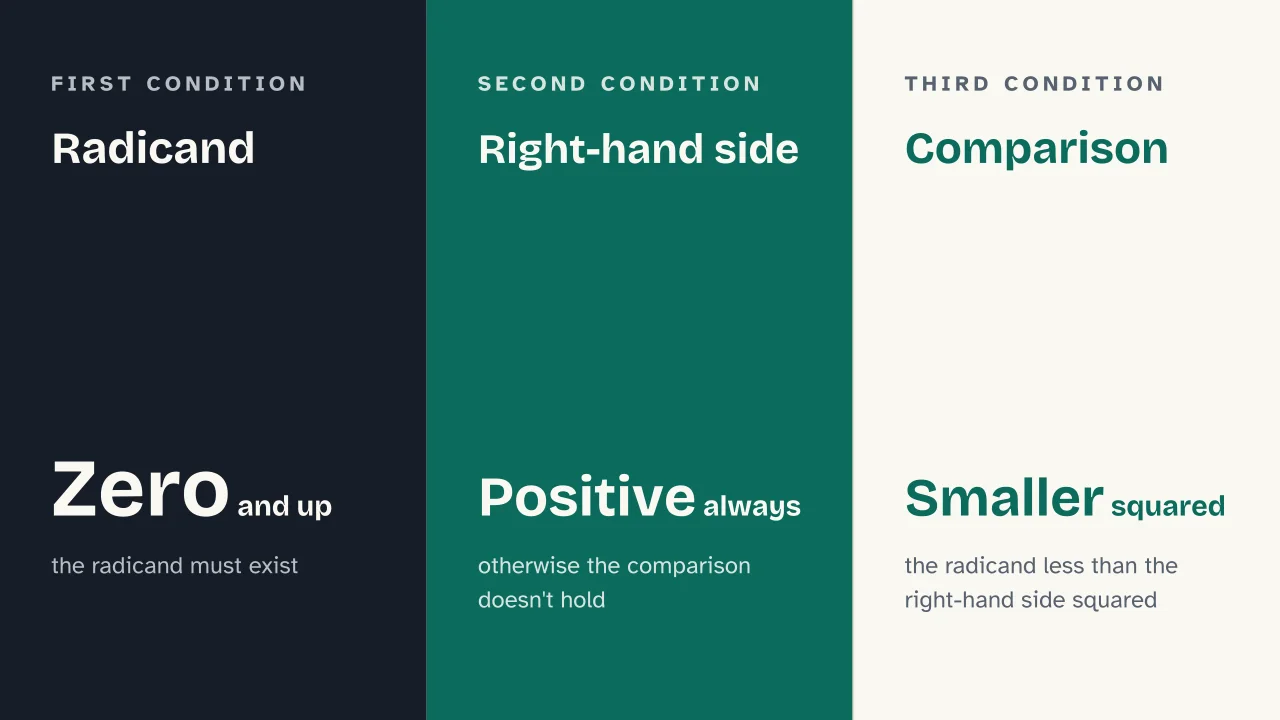
    When the inequality has the form “radical less than the right-hand side” (or less than or equal to), three conditions are needed together, in a single system: the radicand must be non-negative (the existence condition above), the right-hand side must be positive, and the radicand must be less than the square of the right-hand side. If even one of these three conditions fails, that stretch of x is not part of the solution.

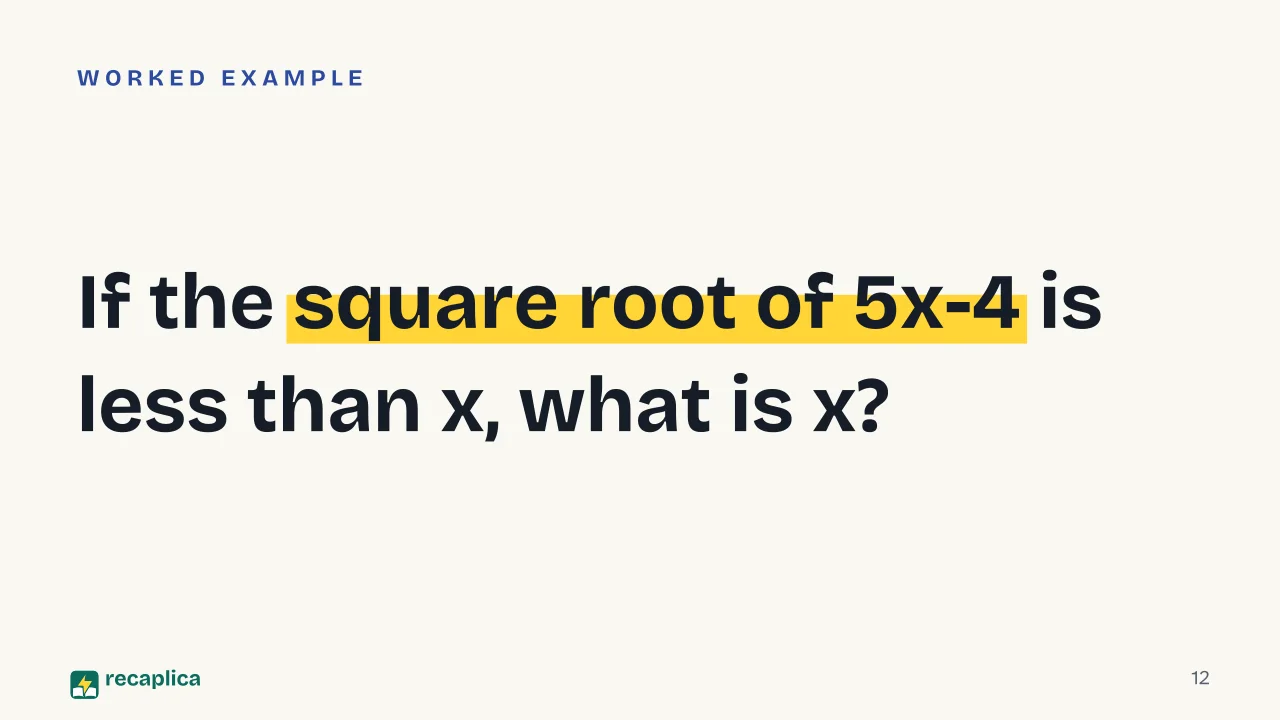
    Worked example: take the inequality with the square root of 5x-4 less than x. The three conditions to put into a system are: 5x-4 non-negative, x positive, and 5x-4 less than the square of x. Solving the system, the solution is x greater than or equal to 4/5 and less than 1, or x greater than 4.

    The greater-than case

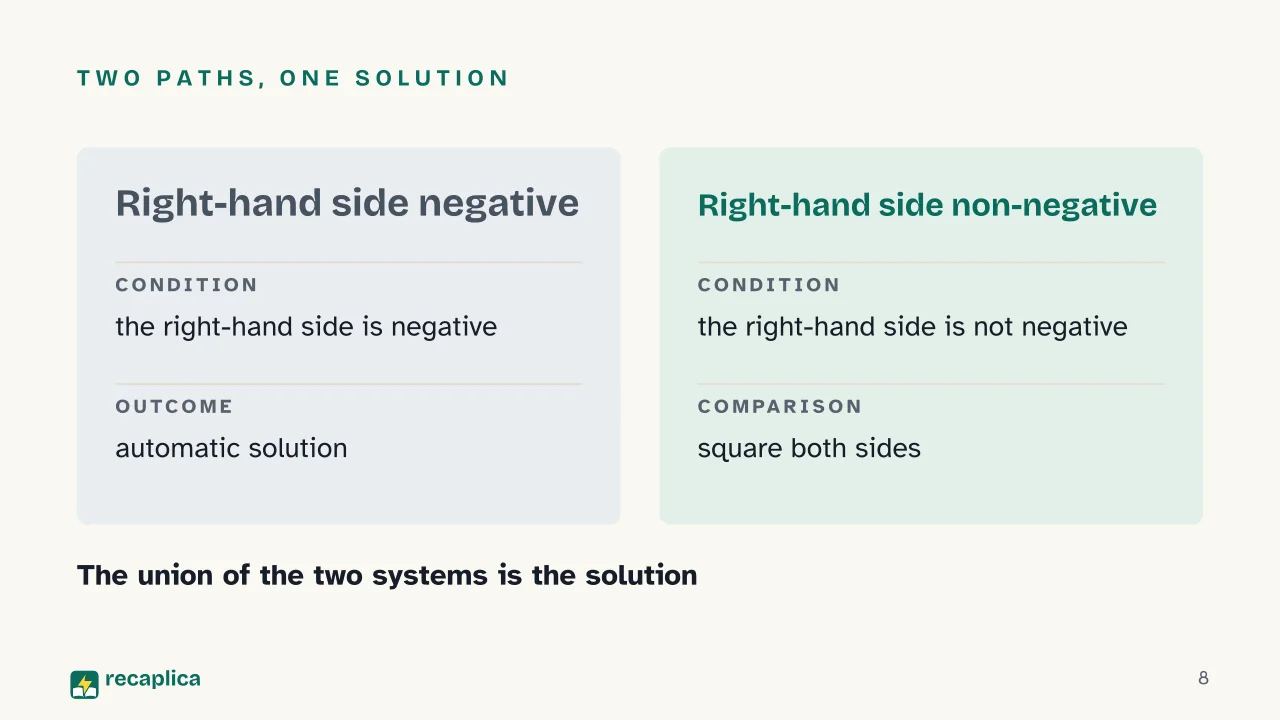
    When the inequality has the form “radical greater than the right-hand side” (or greater than or equal to), the reasoning splits into two paths that are then joined together. If the right-hand side is negative, the inequality is automatically satisfied wherever the existence condition on the radicand alone holds, because a radical, when it exists, is never negative. If instead the right-hand side is not negative, both sides must be squared and compared. The final solution is the union of the solutions found in the two cases, not their intersection: any point where the inequality holds in at least one of the two systems is part of the solution.

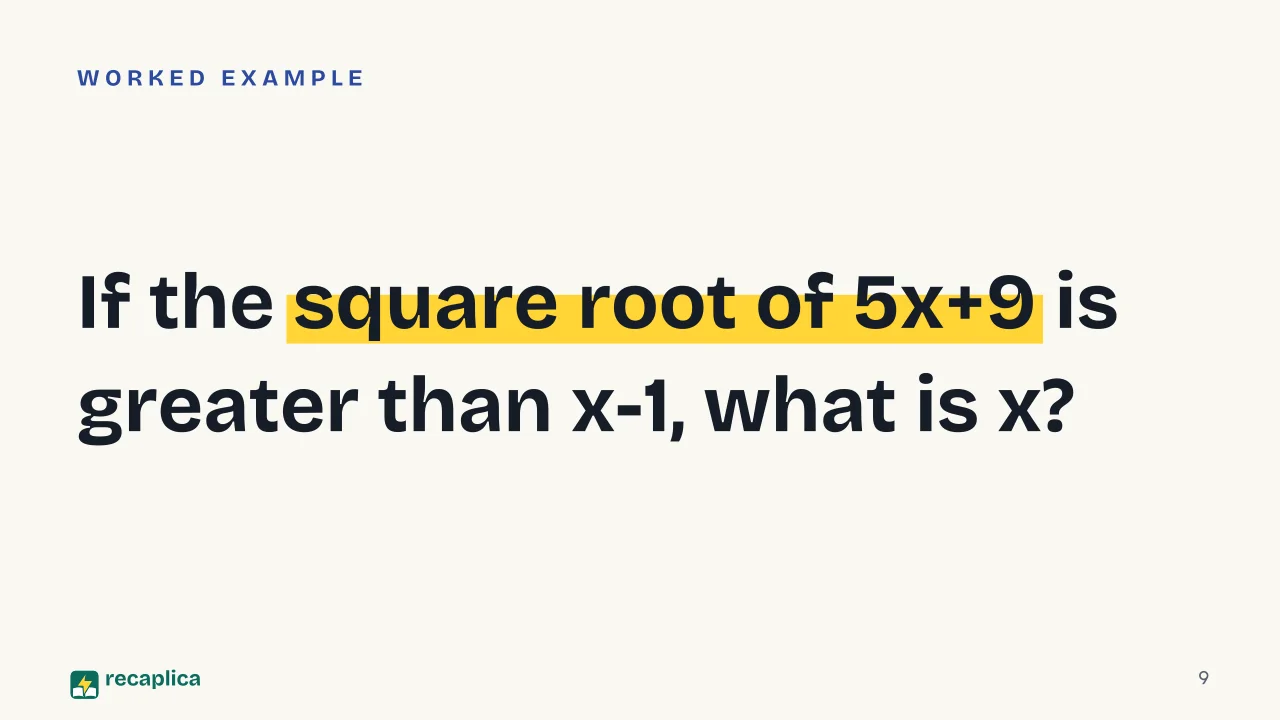
    Worked example: with the inequality square root of 5x+9 greater than x-1, the first system (right-hand side negative) gives -9/5 less than or equal to x less than 1; the second system (right-hand side non-negative, with squaring) gives 1 less than or equal to x less than 8. Joining the two solutions gives -9/5 less than or equal to x less than 8.

    The odd index, the simpler case

    With an odd index, cube root, fifth root, and so on, there is no existence condition to set: a radical with an odd index is defined for every real number, even when the radicand is negative. Both sides can then be raised directly to the matching power, keeping the inequality’s direction unchanged, with no need to split into separate systems. The same principle holds for equations with a radical, where raising both sides to a power to clear the root is the key step; the difference is that inequalities also require keeping track of the sign of both sides.

    ElementLess-than signGreater-than sign
    Number of systemsOneTwo, joined together
    Condition on the right-hand sideMust be positiveSplits into negative and non-negative
    Existence conditionAlways presentAlways present
    Squared comparisonAlways requiredOnly in the system with a non-negative right-hand side

    Anyone who has already reviewed how equations are solved, radicals included, will find the same underlying idea applied here to a comparison rather than an equality; and anyone who wants to revisit the basics of working with letters first can start from how symbolic notation works in algebra. To place these numbers in the right set (rational, irrational, real), the overview of number sets is a useful stop too.

    Slide deck

    Slides ready to download and make your own in PowerPoint or Google Slides, with speaker notes. Pick the Flash cut or the Full one.
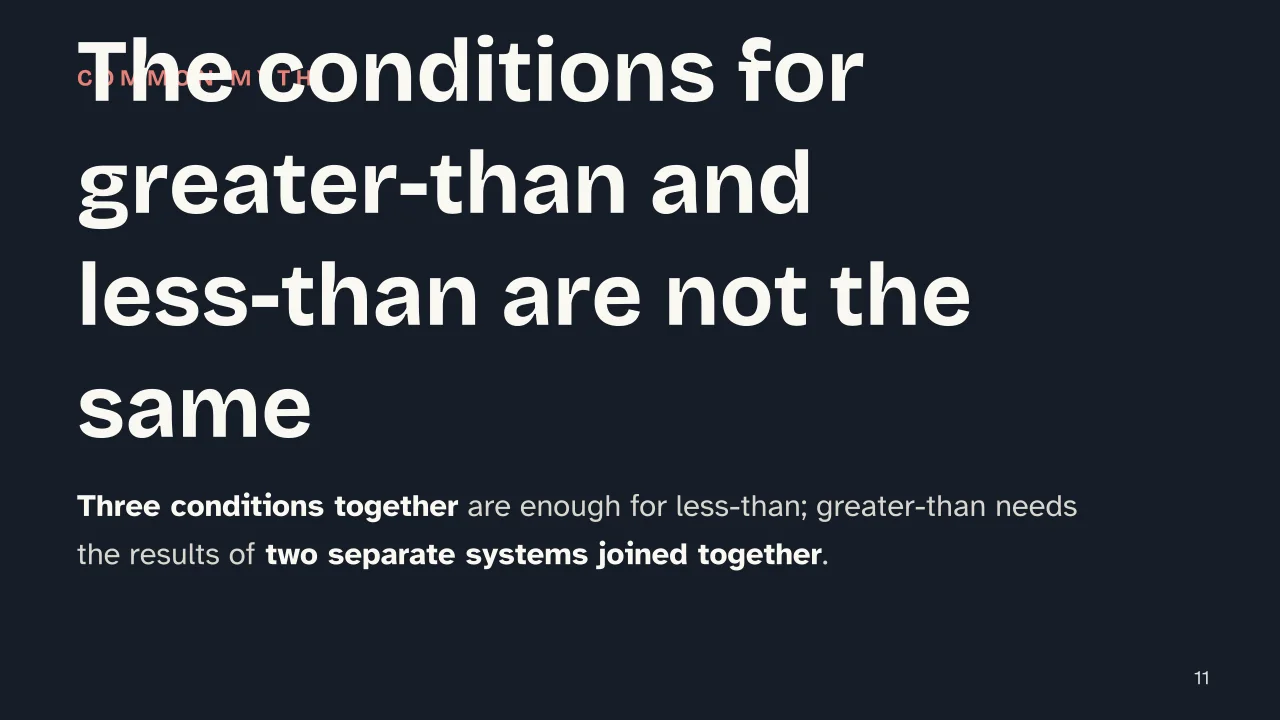
    Slide 1 of the presentation on Inequalities with Square Roots: Inequalities with Square RootsSlide 2 of the presentation on Inequalities with Square Roots: How do you solve an inequality with the unknown under a radical?Slide 3 of the presentation on Inequalities with Square Roots: The pathSlide 4 of the presentation on Inequalities with Square Roots: Chapter 01: Definition and existenceSlide 5 of the presentation on Inequalities with Square Roots: The condition before everythingSlide 6 of the presentation on Inequalities with Square Roots: Radicand · Right-hand side · ComparisonSlide 7 of the presentation on Inequalities with Square Roots: Chapter 02: The greater-than caseSlide 8 of the presentation on Inequalities with Square Roots: Two paths, one solutionSlide 9 of the presentation on Inequalities with Square Roots: If the square root of 5x+9 is greater than x-1, what is x?Slide 10 of the presentation on Inequalities with Square Roots: Chapter 03: A second exampleSlide 11 of the presentation on Inequalities with Square Roots: The conditions for greater-than and less-than are not the sameSlide 12 of the presentation on Inequalities with Square Roots: If the square root of 5x-4 is less than x, what is x?Slide 13 of the presentation on Inequalities with Square Roots: Chapter 04: The common mistakesSlide 14 of the presentation on Inequalities with Square Roots: The three players: The radicand, The right-hand side, The indexSlide 15 of the presentation on Inequalities with Square Roots: In the greater-than case, how is the final solution found?Slide 16 of the presentation on Inequalities with Square Roots: End of the Recap
    Flash10 slidesThe essential thread, to present in classFull16 slidesEvery chapter and the deeper detail

    Common myths

    • ✗ Myth The conditions for greater-than and less-than are the same, only the direction changes.

      ✓ Reality They are two different structures: the less-than case is a single system with three conditions, the greater-than case is the union of two separate systems.

    • ✗ Myth Forgetting the existence condition doesn't change the final result.

      ✓ Reality Without requiring the radicand to be non-negative, solutions where the radical isn't even defined can slip through, so the result comes out wrong.

    • ✗ Myth Radicals with an odd index also need the existence condition.

      ✓ Reality A radical with an odd index is defined for every real number, so with an odd index there is no condition to set before raising both sides to the power.

    Mind map

    Drag the background to move around and the nodes to reposition them; use − and + to collapse and expand branches.
    Customize
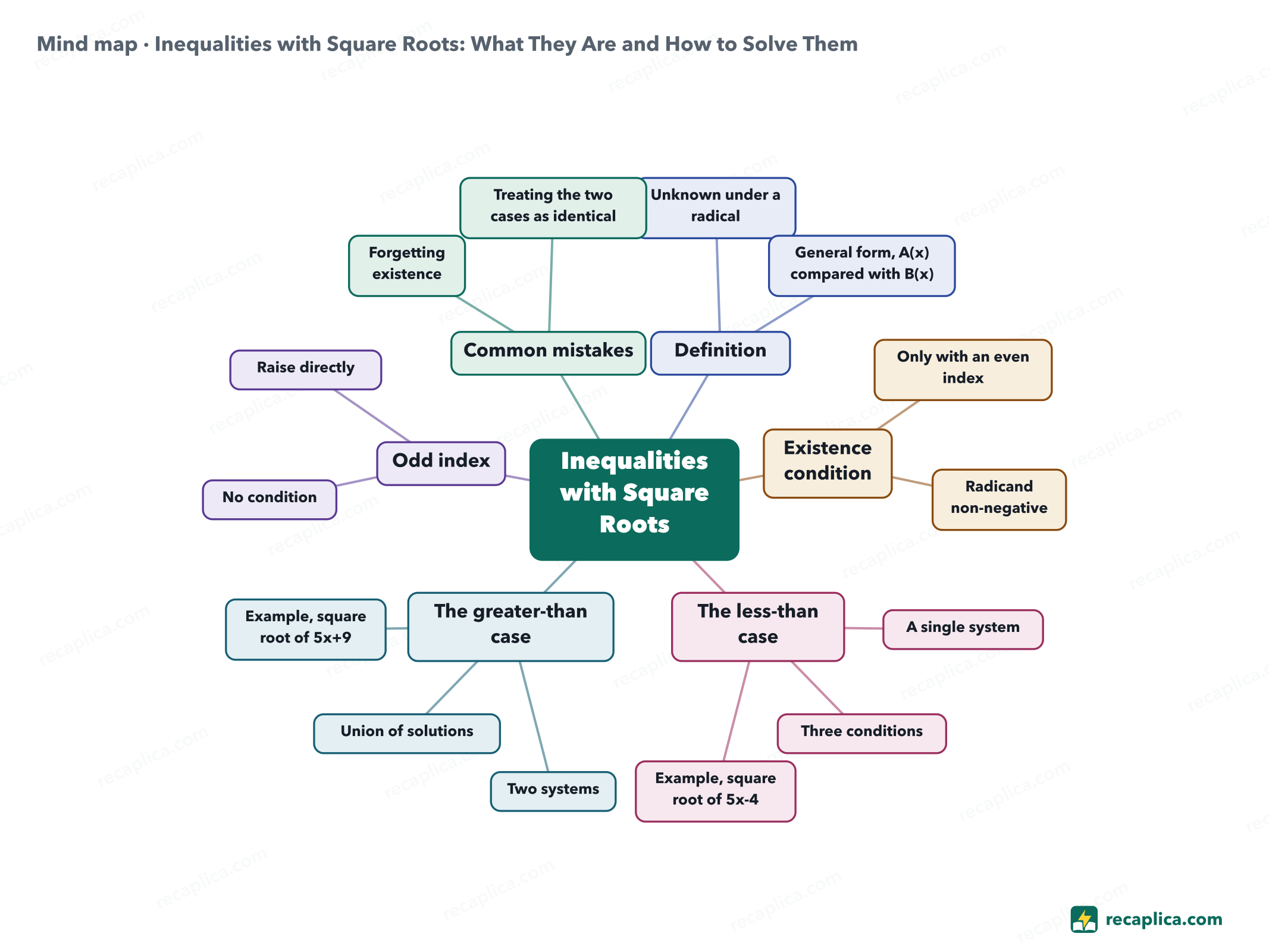
    Mind map: Inequalities with Square Roots: What They Are and How to Solve Them
    • Inequalities with Square Roots
      • Definition
        • Unknown under a radical
        • General form, A(x) compared with B(x)
      • Existence condition
        • Only with an even index
        • Radicand non-negative
      • The less-than case
        • A single system
        • Three conditions
        • Example, square root of 5x-4
      • The greater-than case
        • Two systems
        • Union of solutions
        • Example, square root of 5x+9
      • Odd index
        • No condition
        • Raise directly
      • Common mistakes
        • Forgetting existence
        • Treating the two cases as identical

    Quiz: test yourself

    Answer the questions to check what you have learned: you get instant feedback and a short explanation.

    Grade 0/10 0/5
    1 What is an inequality with a square root?

    The definition is about where the unknown sits, not the type of number in the solution: it is irrational because the radical contains the unknown.

    2 With an odd index, the existence condition on the radicand must always be imposed before solving.

    A radical with an odd index is defined for every real number, so with an odd index no condition is needed: both sides can be raised to the power directly.

    3 Which condition must be set first when the radical's index is even?

    Without this condition the radical is not even defined, so solutions with no real meaning could be accepted.

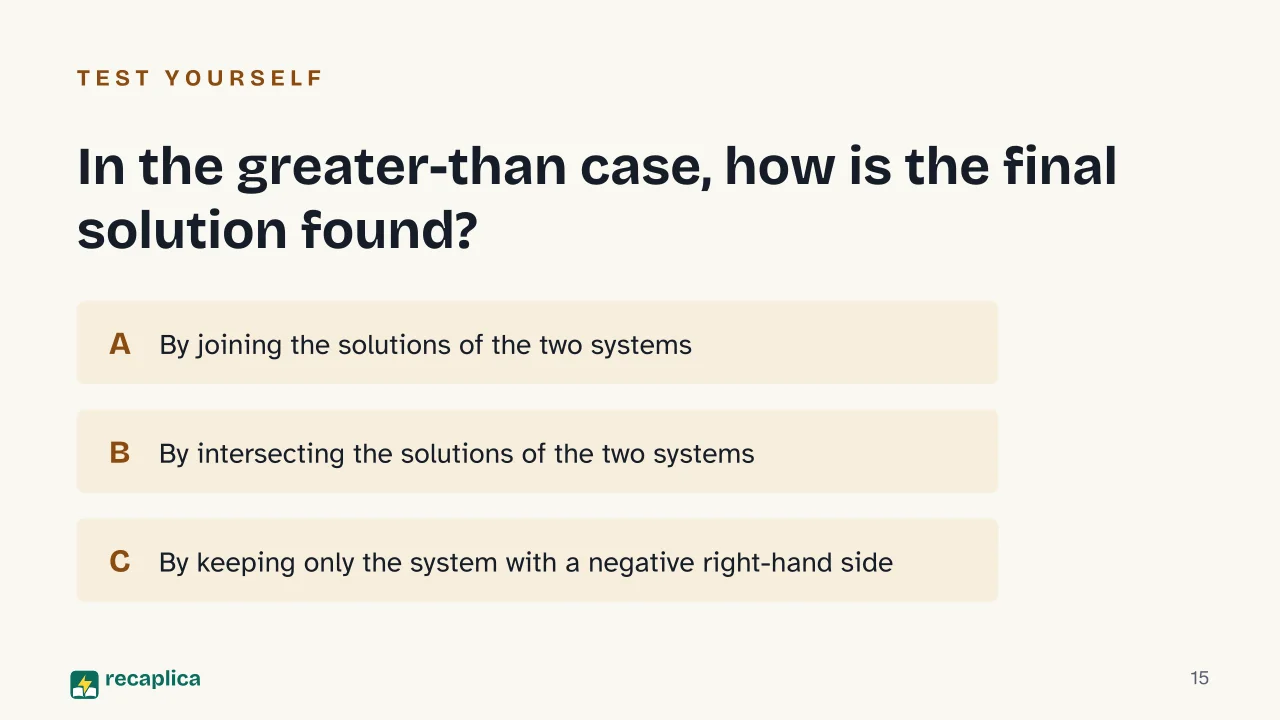
    4 In the greater-than case, how is the final solution found?

    The two systems cover two different situations for the right-hand side, so the overall solution puts both of them together.

    5 How many conditions make up the system in the less-than case?

    Non-negative radicand, positive right-hand side, and the radicand less than the square of the right-hand side: a single system with three conditions.

    Answers: 1-A · 2-B · 3-A · 4-A · 5-A

    Flashcards

    Tap the card to flip it and check whether you remember the answer, then move to the next one.

    1 / 6

    Explain it in your own words

    The ultimate test: if you can explain it in simple words, you've truly understood it. Write your explanation, then compare it with the Recap.

    Your explanation is saved only on this device.

    An inequality with square roots has the unknown inside a radical. When the radical's index is even, the first step is requiring the radicand to be non-negative, the existence condition. The sign of the right-hand side then decides how to proceed: a less-than inequality needs just one system with three conditions, while a greater-than inequality needs two separate systems joined together. With an odd index, by contrast, the radical is defined for every number and both sides can be raised to the power directly, with no condition to set.

    Frequently asked questions

    What are inequalities with radicals?

    They are inequalities where the unknown appears inside the radicand of a radical. When the index is even, before comparing the two sides you must require the radicand to be positive or zero, the existence condition.

    How do you solve an inequality with a square root using the less-than sign?

    With a single system of three conditions: the radicand non-negative, the right-hand side positive, and the radicand less than the square of the right-hand side. If even one condition fails, that part of the range is not part of the solution.

    How do you solve an inequality with a square root using the greater-than sign?

    You need the union of two systems: one for when the right-hand side is negative (where the existence condition alone is enough), the other for when it is non-negative (where the radicand is compared with the square of the right-hand side).

    Why doesn't an odd index need the existence condition?

    Because a radical with an odd index, cube root, fifth root, and so on, is defined for every real number, negative ones included. Both sides can then be raised to the power right away, keeping the inequality's direction unchanged.

    Where can I find worked examples of inequalities with square roots?

    In this Recap, in the in-depth section, with two fully solved examples, one with the greater-than sign and one with the less-than sign, both showing every step.

    Sources

    • Lezioni di Matematica – Disequazioni irrazionali con un polinomio a secondo membro e segno di maggiore
    • Esercizi Matematica – Disequazioni Irrazionali, spiegazione, regole ed esercizi
    • WeSchool – Le disequazioni irrazionali, come si risolvono
    • Math Camp – Disequazioni irrazionali

    Every Recap goes through an independent review before publication.

    Every evening, the day's new Recaps on our Telegram channel. Join the channel →

    Keep learning

    • Science Jerome Bruner: Who He Was and His Theory of Cognitive Development Jerome Bruner (1915-2016) was an American psychologist and one of the central figures of the cognitive revolution of the 1960s. He argued that knowledge is built through three modes of representation — enactive, iconic and symbolic — and that learning is shaped as much by culture and language as by a child's age. With David Wood and Gail Ross, in 1976 he developed the concept of scaffolding: the support a tutor gives a learner, gradually withdrawn as the learner becomes independent. From the spiral curriculum to discovery learning, Bruner's theory of cognitive development remains a reference point in education and developmental psychology. Read the Recap →
    • Science Mind in Society: Vygotsky's Book on Higher Psychological Processes Mind in Society: The Development of Higher Psychological Processes is the 1978 book that introduced Lev Vygotsky's ideas to English-speaking readers. The Soviet psychologist had died of tuberculosis in 1934. Vygotsky never wrote it as a single work: according to psychology historian Anton Yasnitsky, the volume is a compilation of fragments drawn from different texts, put together and translated by editors Michael Cole, Vera John-Steiner, Sylvia Scribner, and Ellen Souberman. It gathers eight essays on topics ranging from tools and symbols in child development to memory, research method, and the relationship between learning and development, including the zone of proximal development. Published by Harvard University Press, it remains the standard English-language reference for Vygotsky's sociocultural theory. Read the Recap →
    • Science Bandura's Social Learning Theory: Observation and Self-Efficacy Albert Bandura's social learning theory describes how people acquire behaviors, attitudes and emotional reactions by observing and imitating others in a social context, not only through direct reinforcement. Bandura set it out in a 1977 book, putting the observer's active role at the center of whether a behavior gets imitated. Modeling runs through four processes, attention, retention, motor reproduction and motivation, and the 1961 Bobo doll experiment showed that children imitate an observed adult's aggression. In 1986 Bandura renamed the theory "social cognitive theory", adding self-efficacy and reciprocal determinism between person, behavior and environment. Read the Recap →

    recaplica

    Clear in 30 seconds, yours in 10 minutes.

    Recaps Mind maps Request a Recap Telegram channel Mind map maker Our method About Privacy & cookies Legal notes & terms of use

    © 2026 Recaplica · A project by Curi S.r.l. — VAT IT05472000750

    Statistics, only if you say so

    To learn which Recaps help most we would use Google Analytics, with aggregate, anonymous data. It starts only with your OK, and you can change your mind anytime. Privacy policy