Skip to content
recaplica

    One moment: security check

    Cloudflare wants to make sure you're not a robot. Tick the box below and your search will continue on its own.

    IT
    recaplica Mind in Society: Vygotsky's Book on Higher Psychological Processes
    © 2026 Recaplica · recaplica.com — All rights reserved
    Home › Science

    Mind in Society: Vygotsky's Book on Higher Psychological Processes

    By Recaplica Newsroom · Updated on September 29, 2026

    What to print

    Page numbers appear when printing with default margins.

    Slides

    Choose a cut

    Flash10 slidesThe essential thread, to present in classFull17 slidesEvery chapter and the deeper detail

    Both come with speaker notes.

    Telegram channel
    recaplica Clear in 30 seconds, yours in 10 minutes.
    In 30 seconds Key points Figures Deep dive Slides Myths Mind map Quiz Flashcards FAQ

    In 30 seconds quick read

    Mind in Society: The Development of Higher Psychological Processes is the 1978 book that introduced Lev Vygotsky's ideas to English-speaking readers. The Soviet psychologist had died of tuberculosis in 1934. Vygotsky never wrote it as a single work: according to psychology historian Anton Yasnitsky, the volume is a compilation of fragments drawn from different texts, put together and translated by editors Michael Cole, Vera John-Steiner, Sylvia Scribner, and Ellen Souberman. It gathers eight essays on topics ranging from tools and symbols in child development to memory, research method, and the relationship between learning and development, including the zone of proximal development. Published by Harvard University Press, it remains the standard English-language reference for Vygotsky's sociocultural theory.

    Key Points

    • Mind in Society gathers essays by Lev Vygotsky, compiled and translated by Michael Cole, Vera John-Steiner, Sylvia Scribner, and Ellen Souberman, published in 1978 by Harvard University Press.
    • Psychology historian Anton Yasnitsky says Vygotsky never wrote this book as a single work: it is a compilation of fragments from texts written at different points in his career.
    • The book collects eight chapters, ranging from tools and symbols in child development to the prehistory of written language, by way of research method and the relationship between learning and development.
    • According to Yasnitsky, after the 1978 publication the zone of proximal development "became synonymous" with Vygotsky's name.
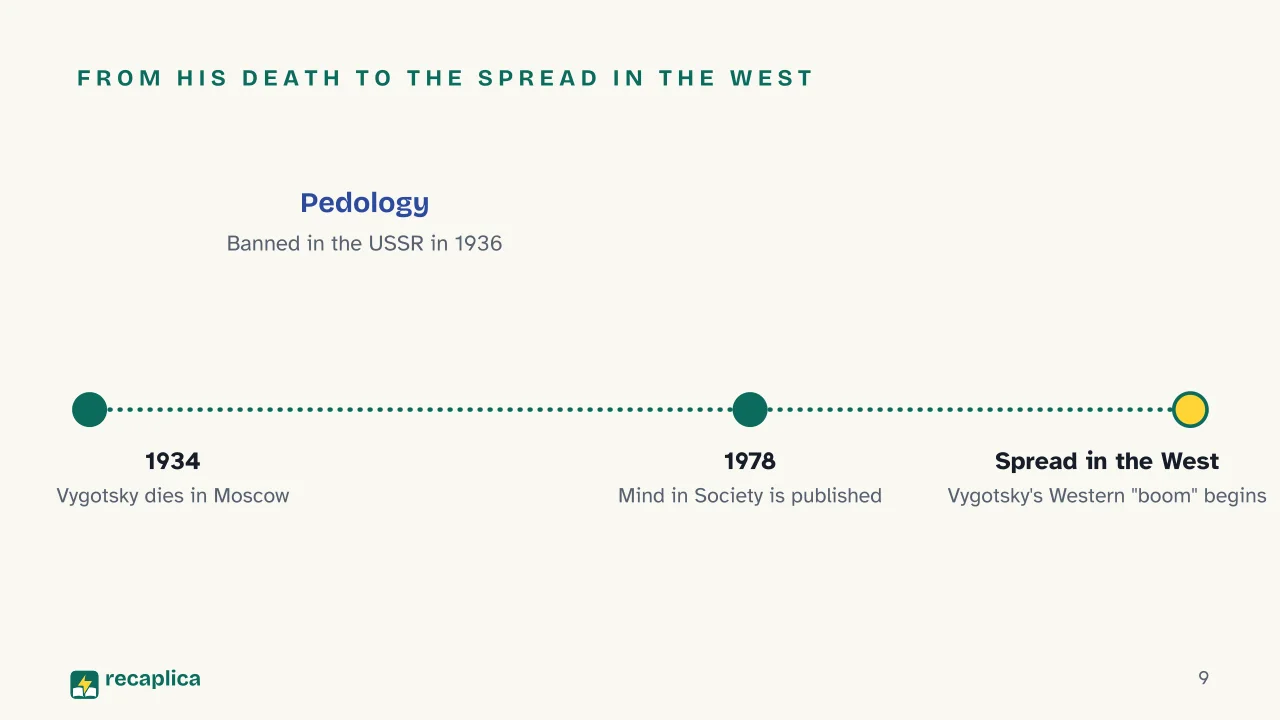
    • Vygotsky died of tuberculosis on June 11, 1934, before he could organize these writings into a book himself.
    • The University of North Texas Libraries catalog lists the book at 159 pages, plus eleven pages of front matter numbered in roman numerals.

    Key figures

    • 1978 the year Mind in Society was published, by Harvard University Press in Cambridge, Massachusetts Source: Book title page; University of North Texas Libraries catalog
    • 159 the book's page count, plus eleven pages of front matter numbered in roman numerals Source: University of North Texas Libraries catalog
    • 1934 the year Vygotsky died, on June 11, of tuberculosis Source: Biographical note by A. R. Luria, in the book

    Deep Dive

    Who Lev Vygotsky Was Before This Book

    Lev Vygotsky trained as a lawyer and philologist, and had already contributed to literary criticism, before he began his career as a psychologist after the Russian Revolution of 1917. The book’s introduction places among his scientific contemporaries Ivan Pavlov, Vladimir Bekhterev, and John B. Watson, popularizers of the stimulus-response theories of behavior grouped today under behaviorism, alongside Max Wertheimer, Wolfgang Kohler, Kurt Koffka, and Kurt Lewin, founders of Gestalt psychology.

    He died of tuberculosis on June 11, 1934. Shortly before, he had been invited to head the psychology department at the All-Union Institute of Experimental Medicine, according to the biographical note signed by A. R. Luria in the book, which also places his birth on November 5, 1896.

    A Book Born After His Death

    Mind in Society, The Development of Higher Psychological Processes came out in 1978 through Harvard University Press, in Cambridge, Massachusetts. The title page lists four editors and translators: Michael Cole, Vera John-Steiner, Sylvia Scribner, and Ellen Souberman.

    According to psychology historian Anton Yasnitsky, strange as it may sound, Vygotsky never wrote this book as a single work: it is a compilation and juxtaposition of fragments taken from different works, written during different periods of his career. Yasnitsky cites the editors’ preface (Cole et al., 1978, p. x), in which the editors themselves admit to having “constructed” some chapters, while others are summarized or based on Vygotsky’s writings: “We realize that in tampering with the original we may have distorted history; however, we hope that by stating our procedures and by adhering as closely as possible to the principles and content of the work, we have not distorted Vygotsky’s meaning,” they write, according to the quote reported by Yasnitsky.

    The editors give a different reason for choosing to publish these texts. In the book’s introduction they write that the essays “are certainly of interest from the perspective of intellectual history, but they are not historical relics,” offering them instead as a contribution to questions still open in contemporary psychology.

    The Eight Chapters

    The book opens with a first part, titled “Mind in Society, Basic Theory and Data,” followed by eight thematic chapters:

    1. Tool and Symbol in Child Development
    2. The Development of Perception and Attention
    3. Mastery of Memory and Thinking
    4. Internalization of Higher Psychological Functions
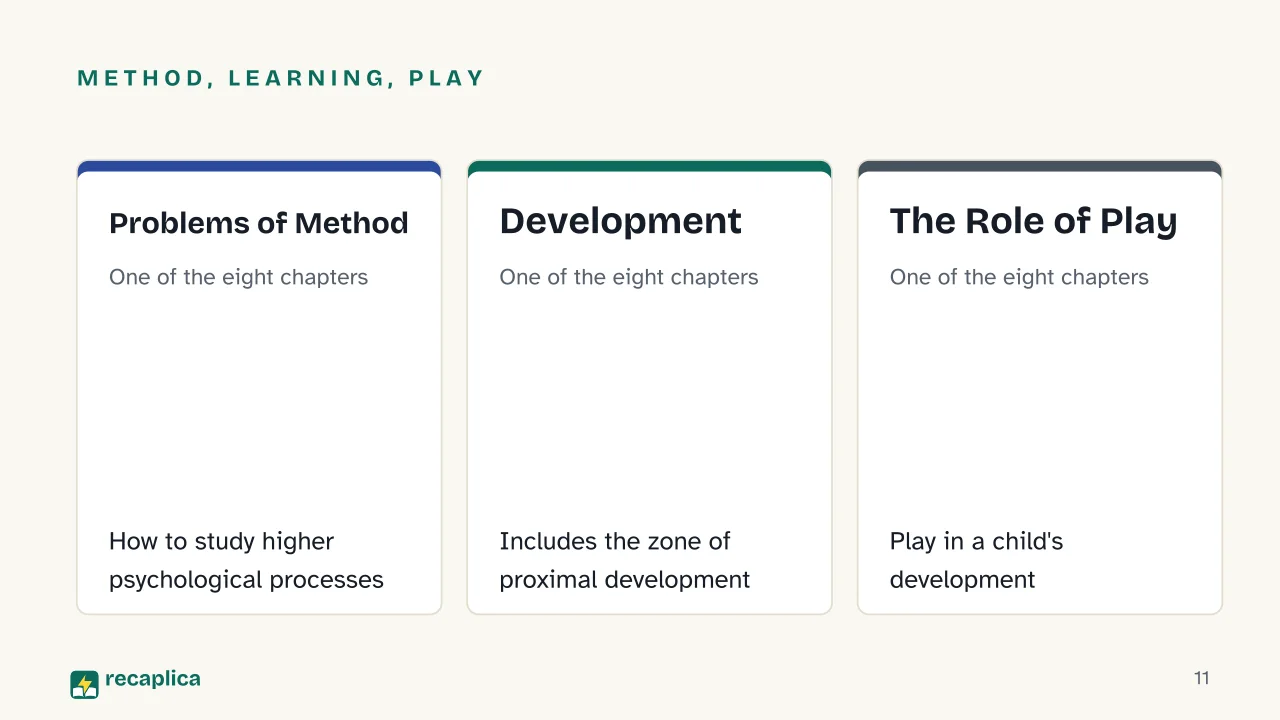
    5. Problems of Method
    6. Interaction between Learning and Development
    7. The Role of Play in Development
    8. The Prehistory of Written Language

    The chapter on the interaction between learning and development is where the zone of proximal development appears; readers who want the concept in full can turn to the Recap on Vygotsky and the Zone of Proximal Development. It is also the chapter closest to a student’s daily work, which is why it can interest anyone looking for an effective study method.

    Internalization of Higher Psychological Functions, another chapter in the volume, looks at how processes shared between people become individual capacities — a different model from the one cognitivism would later use, decades on, to describe the mind as an information processor.

    Method, From the Unpublished Notebooks

    In the introduction, the editors quote from Vygotsky’s unpublished notebooks on research method: “I don’t want to discover the nature of mind by patching together a lot of quotations. I want to find out how science has to be built, to approach the study of the mind having learned the whole of Marx’s method.” He adds that anyone who could discover what a “psychological” cell is — the mechanism producing even a single response — would thereby find the key to psychology as a whole.

    This idea of method is also the subject of the chapter Problems of Method, one of the book’s eight, and touches a question psychology as a scientific discipline has long faced: how to measure processes that cannot be observed directly.

    From Publication to Vygotsky’s Western “Boom”

    According to Yasnitsky, 1978 marks the beginning of what he calls the “cult” of Vygotsky, the “boom” still underway as he writes: that same year, Mind in Society came out under Vygotsky’s name, and Stephen Toulmin published his review, titled “The Mozart of Psychology.” After the book’s publication, Yasnitsky writes, the notion of the zone of proximal development “became synonymous” with Vygotsky’s name.

    Quote: “After the publication of Mind in Society, the celebrated notion of the ‘zone of proximal development’ became synonymous with Vygotsky’s name” (Yasnitsky, 2011).

    Even before his death, according to the book’s introduction, Vygotsky and his students had established a laboratory in Kharkov, headed by A. N. Leontiev, then also dean of the psychology faculty at Moscow University, and later by A. V. Zaporozhets, director of the Institute of Preschool Education.

    An Overshadowed Legacy, Censorship Among the Factors

    The spread of Vygotsky’s ideas at home was not straightforward. Among the factors Yasnitsky points to are the limited public access to manuscripts and documents held in the Vygotsky archives, and the difficulties surrounding the posthumous editing of his writings. On top of this, in 1936, the Communist Party’s Central Committee banned pedology, a discipline Vygotsky was associated with, and its condemnation helped obscure his legacy in the USSR.

    Why It Remains the English-Language Reference Text

    Harvard University Press presents the book as Vygotsky’s sociocultural theory of cognitive development “in his own words, collected and translated by an outstanding group of scholars,” edited by “a group of outstanding Vygotsky scholars” and made up of a selection of essays “most of which have previously been unavailable in English.” According to the publisher, the book’s underlying thesis is that the mind cannot be understood in isolation from the surrounding society.

    On the cover, the publisher also carries a third-party judgment, “a landmark book,” attributed to the magazine Contemporary Psychology: a quote gathered on the back cover, not verified for this piece directly against the original source.

    A paperback reprint dated October 15, 1980, tracked by some booksellers, should not be confused with the first edition: that one, from 1978, is confirmed independently by the book’s title page, the University of North Texas Libraries catalog, and the Google Books listing.

    Slide deck

    Slides ready to download and make your own in PowerPoint or Google Slides, with speaker notes. Pick the Flash cut or the Full one.

    Slide 1 of the presentation on Mind in Society: Mind in SocietySlide 2 of the presentation on Mind in Society: Who actually wrote this book?Slide 3 of the presentation on Mind in Society: What's aheadSlide 4 of the presentation on Mind in Society: Chapter 01: Who Vygotsky wasSlide 5 of the presentation on Mind in Society: His lifeSlide 6 of the presentation on Mind in Society: Chapter 02: A book born after his deathSlide 7 of the presentation on Mind in Society: The author on the cover didn't write these pages straight through.Slide 8 of the presentation on Mind in Society: A book made of numbersSlide 9 of the presentation on Mind in Society: From his death to the spread in the WestSlide 10 of the presentation on Mind in Society: Chapter 03: The eight chaptersSlide 11 of the presentation on Mind in Society: Method, learning, play: Problems of Method, Development, The Role of PlaySlide 12 of the presentation on Mind in Society: The zone of proximal development is just one of eight themes in the book.Slide 13 of the presentation on Mind in Society: Chapter 04: Why it's still the reference textSlide 14 of the presentation on Mind in Society: Before and after 1978Slide 15 of the presentation on Mind in Society: "A landmark book," according to the publisher.Slide 16 of the presentation on Mind in Society: How many chapters make up Mind in Society?Slide 17 of the presentation on Mind in Society: Now, for review
    Flash10 slidesThe essential thread, to present in classFull17 slidesEvery chapter and the deeper detail

    Common myths

    • ✗ Myth Mind in Society is a book Vygotsky wrote from start to finish as a single, unified work.

      ✓ Reality Psychology historian Anton Yasnitsky describes it as a compilation of fragments taken from texts written at different points in Vygotsky's career, put together by the editors after his death in 1934. The book itself is organized into thematic parts and chapters, not a continuous narrative.

    • ✗ Myth The eight chapters are faithful transcriptions of texts Vygotsky had already finished.

      ✓ Reality According to Yasnitsky, who cites the editors' preface (Cole et al., 1978, p. x), Michael Cole, Vera John-Steiner, Sylvia Scribner, and Ellen Souberman acknowledge having "constructed" some chapters, while others are summarized or based on Vygotsky's writings, with the declared risk of having distorted something along the way.

    • ✗ Myth The zone of proximal development is an isolated idea that appeared on its own in Vygotsky's story.

      ✓ Reality In the book it is one of eight themes, alongside tools, memory, method, and play. Yasnitsky notes it only became "synonymous" with Vygotsky's name after the 1978 publication.

    Mind map

    Drag the background to move around and the nodes to reposition them; use − and + to collapse and expand branches.
    Customize
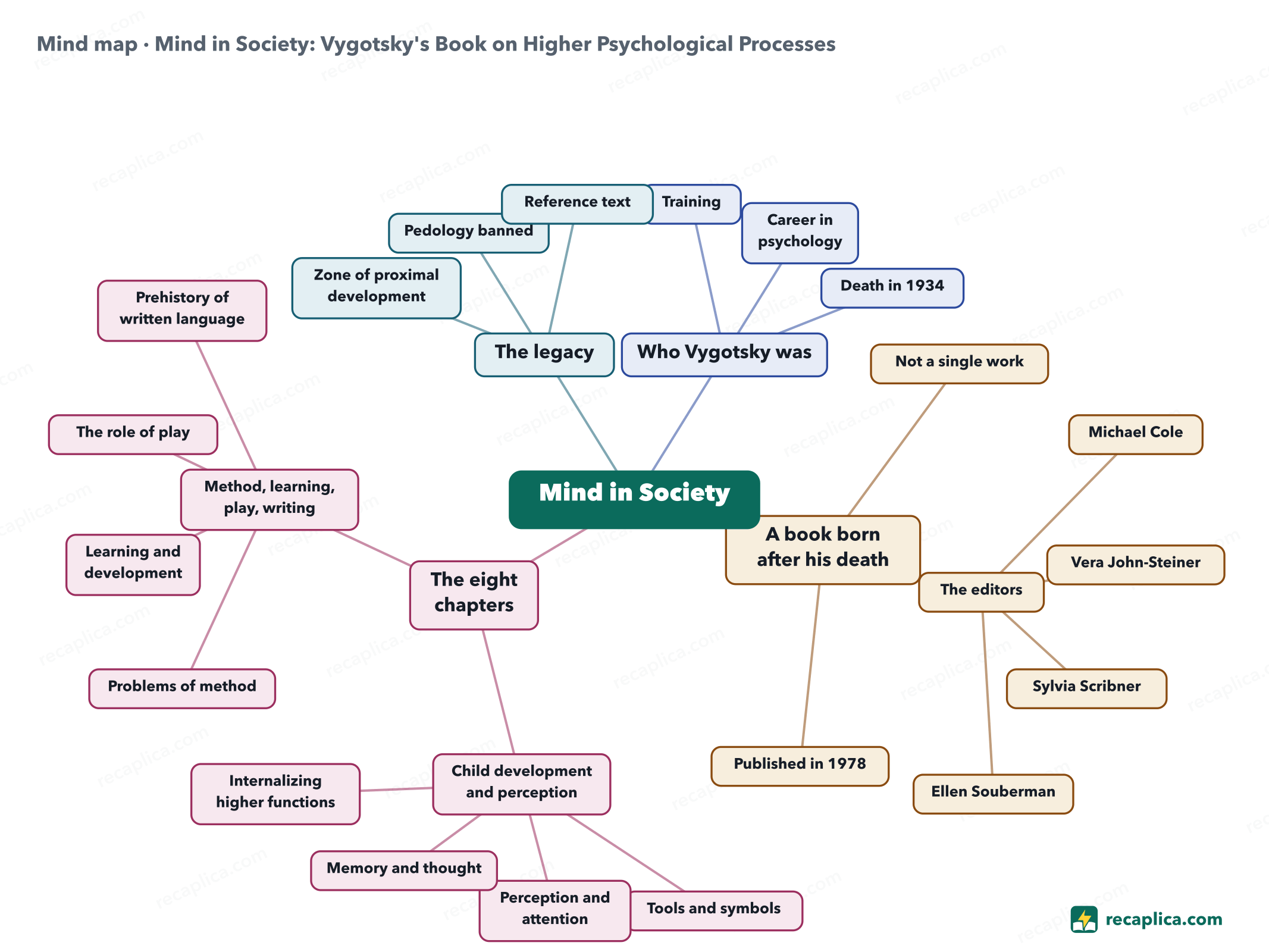
    Mind map: Mind in Society: Vygotsky's Book on Higher Psychological Processes
    • Mind in Society
      • Who Vygotsky was
        • Training A lawyer and philologist before turning to psychology
        • Career in psychology Began in 1917, after the Russian Revolution
        • Death in 1934 Tuberculosis, on June 11
      • A book born after his death
        • Not a single work A compilation of fragments, says historian Anton Yasnitsky
        • The editors
          • Michael Cole
          • Vera John-Steiner
          • Sylvia Scribner
          • Ellen Souberman
        • Published in 1978 Harvard University Press, Cambridge
      • The eight chapters
        • Child development and perception
          • Tools and symbols
          • Perception and attention
          • Memory and thought
          • Internalizing higher functions
        • Method, learning, play, writing
          • Problems of method
          • Learning and development Includes the zone of proximal development
          • The role of play
          • Prehistory of written language
      • The legacy
        • Zone of proximal development Became known in the West after 1978
        • Pedology banned In 1936 in the USSR, among the factors that clouded Vygotsky's legacy
        • Reference text The publisher calls it "a landmark book," citing Contemporary Psychology

    Quiz: test yourself

    Answer the questions to check what you have learned: you get instant feedback and a short explanation.

    Grade 0/10 0/5
    1 What year was Mind in Society published?

    The book came out in 1978 through Harvard University Press, as confirmed by the book's title page and the University of North Texas Libraries catalog.

    2 Who compiled and translated the essays collected in the book?

    The four editors and translators are listed on the book's title page. A. R. Luria wrote the biographical note on Vygotsky included in the volume, not the editing of the texts.

    3 True or false: Vygotsky wrote Mind in Society as a single, finished work.

    False. According to psychology historian Anton Yasnitsky, the book is a compilation of fragments from texts written at different points in Vygotsky's career, assembled by the editors after his death.

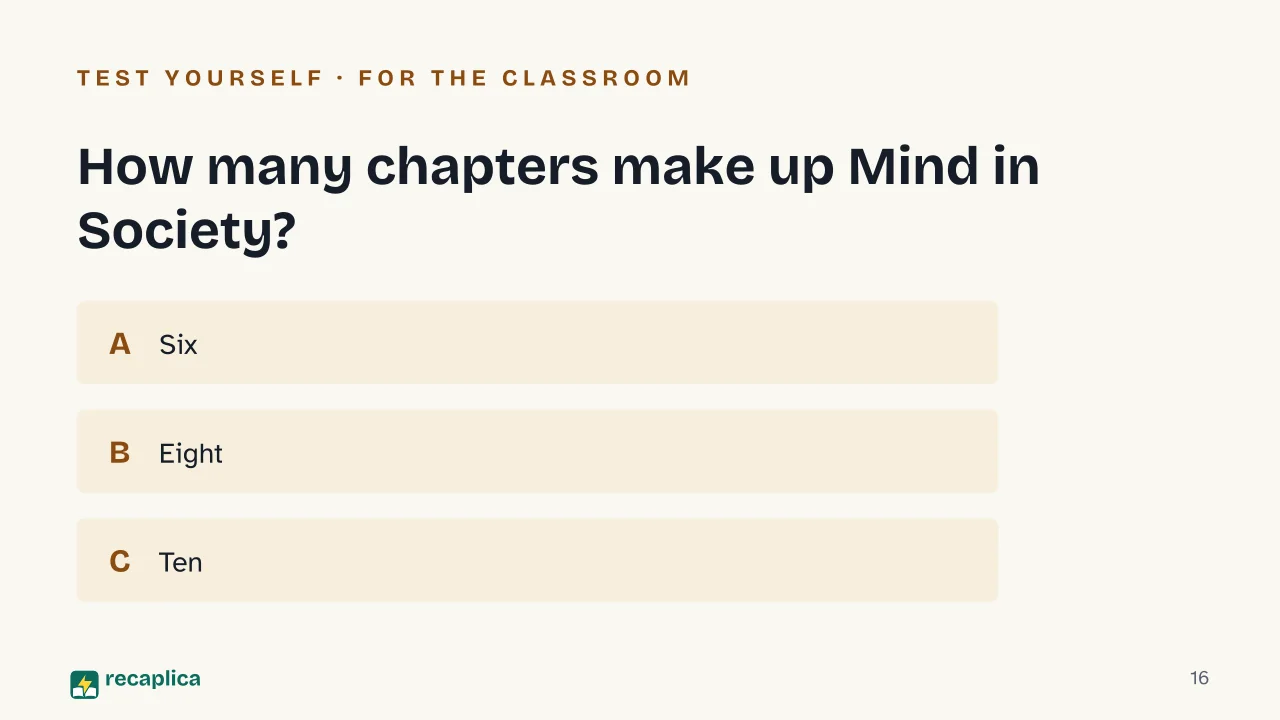
    4 How many chapters make up Mind in Society?

    The book gathers eight chapters, from child development to the prehistory of written language, according to the publisher's table of contents.

    5 Which chapter of the book introduces the zone of proximal development?

    The zone of proximal development appears in the chapter on the interaction between learning and development; it is the theme covered in full by the Recap on Vygotsky's zone of proximal development.

    Answers: 1-B · 2-B · 3-B · 4-C · 5-A

    Flashcards

    Tap the card to flip it and check whether you remember the answer, then move to the next one.

    1 / 7

    Explain it in your own words

    The ultimate test: if you can explain it in simple words, you've truly understood it. Write your explanation, then compare it with the Recap.

    Your explanation is saved only on this device.

    Mind in Society: The Development of Higher Psychological Processes is the 1978 book that introduced Lev Vygotsky's ideas to English-speaking readers. The Soviet psychologist had died of tuberculosis in 1934. Vygotsky never wrote it as a single work: according to psychology historian Anton Yasnitsky, the volume is a compilation of fragments drawn from different texts, put together and translated by editors Michael Cole, Vera John-Steiner, Sylvia Scribner, and Ellen Souberman. It gathers eight essays on topics ranging from tools and symbols in child development to memory, research method, and the relationship between learning and development, including the zone of proximal development. Published by Harvard University Press, it remains the standard English-language reference for Vygotsky's sociocultural theory.

    Frequently asked questions

    What is Mind in Society by Vygotsky?

    It is the title of the book Mind in Society, The Development of Higher Psychological Processes, published in 1978 by Harvard University Press. It gathers eight essays by Lev Vygotsky, compiled and translated into English after his death by Michael Cole, Vera John-Steiner, Sylvia Scribner, and Ellen Souberman.

    Did Vygotsky write this book himself?

    No. According to psychology historian Anton Yasnitsky, Vygotsky never wrote Mind in Society as a single work; it is a compilation of fragments from different periods of his career, put together by the editors after his death in 1934.

    What topics does Mind in Society cover?

    Eight chapters on tools and symbols in child development, perception and attention, memory and thought, the internalization of higher psychological functions, problems of method, the interaction between learning and development (including the zone of proximal development), the role of play, and the prehistory of written language.

    Who edited and translated Mind in Society?

    Four scholars, Michael Cole, Vera John-Steiner, Sylvia Scribner, and Ellen Souberman, listed on the book's title page as editors and translators.

    Why is Mind in Society considered Vygotsky's reference text?

    Because it gathers, in English and in a single volume, essays that the publisher says were mostly unavailable in that language before 1978. According to historian Anton Yasnitsky, its publication marks the start of Vygotsky's spread in the West.

    Sources

    • Mind in Society, The Development of Higher Psychological Processes — book text (Introduction and biographical note by A. R. Luria)
    • Harvard University Press, Mind in Society (book page, Harvard Book Store)
    • Google Books, Mind in Society, publisher's listing
    • Anton Yasnitsky, Lev Vygotsky, Philologist and Defectologist, A Sociointellectual Biography (Portraits of Pioneers in Developmental Psychology, 2011)
    • University of North Texas Libraries, catalog record for Mind in Society

    Every Recap goes through an independent review before publication.

    Every evening, the day's new Recaps on our Telegram channel. Join the channel →

    Keep learning

    • Science Jerome Bruner: Who He Was and His Theory of Cognitive Development Jerome Bruner (1915-2016) was an American psychologist and one of the central figures of the cognitive revolution of the 1960s. He argued that knowledge is built through three modes of representation — enactive, iconic and symbolic — and that learning is shaped as much by culture and language as by a child's age. With David Wood and Gail Ross, in 1976 he developed the concept of scaffolding: the support a tutor gives a learner, gradually withdrawn as the learner becomes independent. From the spiral curriculum to discovery learning, Bruner's theory of cognitive development remains a reference point in education and developmental psychology. Read the Recap →
    • Science Bandura's Social Learning Theory: Observation and Self-Efficacy Albert Bandura's social learning theory describes how people acquire behaviors, attitudes and emotional reactions by observing and imitating others in a social context, not only through direct reinforcement. Bandura set it out in a 1977 book, putting the observer's active role at the center of whether a behavior gets imitated. Modeling runs through four processes, attention, retention, motor reproduction and motivation, and the 1961 Bobo doll experiment showed that children imitate an observed adult's aggression. In 1986 Bandura renamed the theory "social cognitive theory", adding self-efficacy and reciprocal determinism between person, behavior and environment. Read the Recap →
    • Science Kepler's Laws of Planetary Motion, Explained Kepler's laws are three rules that describe how the planets move around the sun. Johannes Kepler worked them out from Tycho Brahe's observations, publishing the first two in 1609 and the third in 1619. They say that orbits are ellipses with the sun at one of the two foci, that a planet speeds up when it's close to the sun and slows down when it's far away, and that the square of the orbital period is proportional to the cube of the average distance from the sun. Before Kepler, orbits were assumed to be perfect circles, as in Copernicus's model. Read the Recap →

    recaplica

    Clear in 30 seconds, yours in 10 minutes.

    Recaps Mind maps Request a Recap Telegram channel Mind map maker Our method About Privacy & cookies Legal notes & terms of use

    © 2026 Recaplica · A project by Curi S.r.l. — VAT IT05472000750

    Statistics, only if you say so

    To learn which Recaps help most we would use Google Analytics, with aggregate, anonymous data. It starts only with your OK, and you can change your mind anytime. Privacy policy