Skip to content
recaplica

    One moment: security check

    Cloudflare wants to make sure you're not a robot. Tick the box below and your search will continue on its own.

    IT
    recaplica Jerome Bruner: Who He Was and His Theory of Cognitive Development
    © 2026 Recaplica · recaplica.com — All rights reserved
    Home › Science

    Jerome Bruner: Who He Was and His Theory of Cognitive Development

    By Recaplica Newsroom · Updated on September 29, 2026

    What to print

    Page numbers appear when printing with default margins.

    Slides

    Choose a cut

    Flash10 slidesThe essential thread, to present in classFull10 slidesEvery chapter and the deeper detail

    Both come with speaker notes.

    Telegram channel
    recaplica Clear in 30 seconds, yours in 10 minutes.
    In 30 seconds Key points Figures Deep dive Slides Myths Mind map Quiz Flashcards FAQ

    In 30 seconds quick read

    Jerome Bruner (1915-2016) was an American psychologist and one of the central figures of the cognitive revolution of the 1960s. He argued that knowledge is built through three modes of representation — enactive, iconic and symbolic — and that learning is shaped as much by culture and language as by a child's age. With David Wood and Gail Ross, in 1976 he developed the concept of scaffolding: the support a tutor gives a learner, gradually withdrawn as the learner becomes independent. From the spiral curriculum to discovery learning, Bruner's theory of cognitive development remains a reference point in education and developmental psychology.

    Key Points

    • Bruner was one of the central figures of the cognitive revolution, psychology's shift from observable behavior to the study of mental processes.
    • He described three modes in which knowledge is represented in the mind: enactive (motor actions), iconic (images) and symbolic (language and symbols).
    • With the spiral curriculum, he argued that any complex idea can be taught at any age, revisited repeatedly with growing depth.
    • Scaffolding, developed in 1976 with Wood and Ross, is the temporary support a tutor gives a learner, reduced step by step as the learner gains independence.
    • Unlike Piaget's stage theory, Bruner's theory of cognitive development holds that development also depends on schooling and cultural context, not age alone.
    • He taught at Harvard, at Oxford and, from 1991 until the end of his career, at New York University School of Law, where he explored the intersections of law and culture.

    Key figures

    • 1915-2016 Jerome Bruner's lifespan: born October 1, 1915, died June 5, 2016, at age 100. Source: NYU School of Law / Association for Psychological Science
    • 1960 The year Bruner published The Process of Education, the book that introduced the spiral curriculum. Source: Association for Psychological Science
    • 1976 The year Wood, Bruner and Ross published "The Role of Tutoring in Problem Solving," the source of the scaffolding concept. Source: Europe PMC (DOI 10.1111/j.1469-7610.1976.tb00381.x)

    Deep Dive

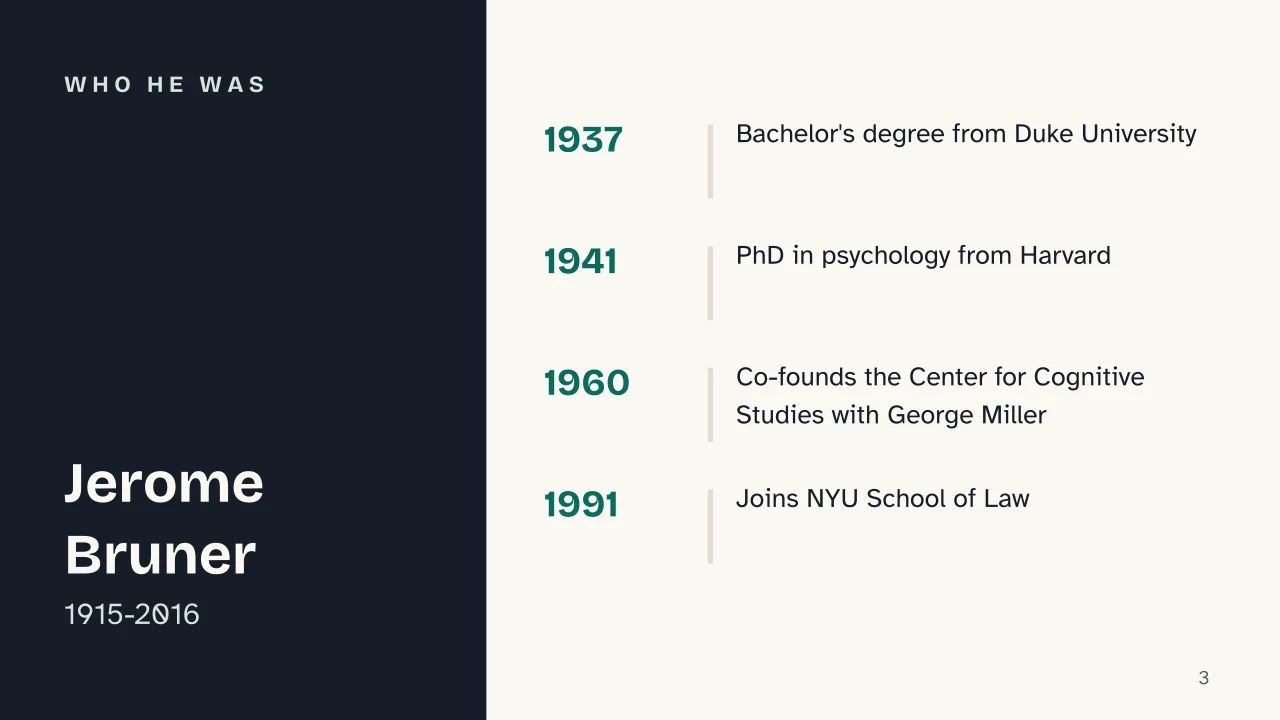
    Jerome Bruner was born on October 1, 1915, and died on June 5, 2016, at age 100. He earned a bachelor’s degree from Duke University in 1937 and a PhD in psychology from Harvard in 1941. He went on to teach at Harvard and at Oxford, served as president of the American Psychological Association and, according to NYU School of Law, sat on the President’s Science Advisory Committee under the Kennedy and Johnson administrations, credited as one of the forces behind the federal Head Start program. In 1991 he joined New York University School of Law as Meyer Visiting Professor, became University Professor in 1998, and stayed on the faculty for ten years in all. A colleague at NYU Law, quoted on the school’s tribute page, called him the “Pied Piper of interdisciplinary wonder” for the way he wove psychology, literature, philosophy and anthropology into the teaching of law, exploring the intersections of law and culture. Among the honors NYU Law lists are the International Balzan Prize, the CIBA Gold Medal and the American Psychological Association’s Distinguished Scientific Award.

    The cognitive revolution

    In the 1940s and 1950s, Bruner carried out pioneering work on perception known as the New Look: according to the Association for Psychological Science, that research showed that perception is controlled by the mind as well as by the senses. A colleague quoted by the same source credits the New Look, and Bruner’s later research on how people form concepts, with ushering in psychology’s “cognitive revolution” — the shift from a field centered on observable behavior to one interested in mental processes. In 1960, Bruner co-founded the Harvard Center for Cognitive Studies with George Miller and served as its director.

    That same year he published The Process of Education, the book that introduced the spiral curriculum. According to the Association for Psychological Science, its central claim is that “complex ideas could be taught at any age” through discovery, returning again and again to the same key ideas with increasing depth at each pass.

    Three modes of representation: Bruner’s cognitive development theory

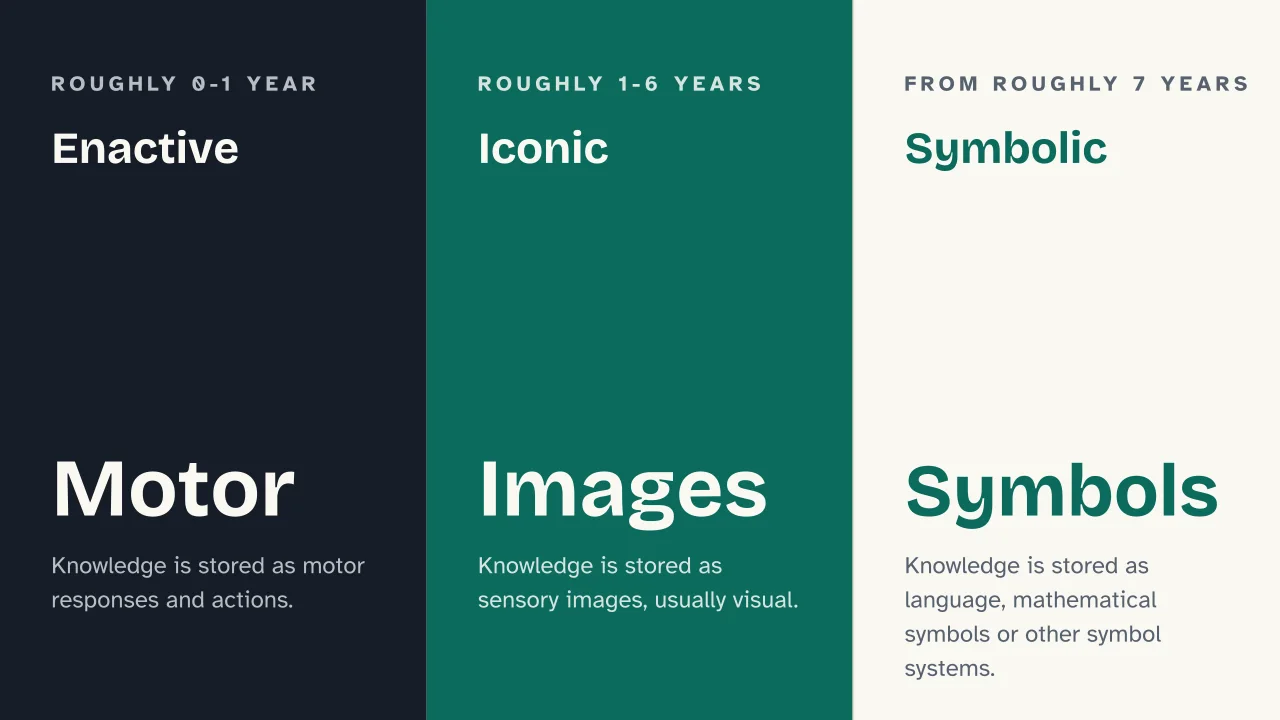
    The Association for Psychological Science credits Bruner with identifying three modes in which knowledge is represented in the mind: enactive, iconic and symbolic. Per the summary from Simply Psychology, in the enactive mode knowledge is stored as motor responses, in the iconic mode as sensory images (usually visual), and in the symbolic mode as language, mathematical symbols or other symbol systems, including music.

    ModeHow knowledge is representedApproximate age range (Simply Psychology)
    EnactiveActions and motor responsesRoughly 0-1 year
    IconicSensory images, mostly visualRoughly 1-6 years
    SymbolicLanguage, mathematical symbols, other symbol systemsFrom roughly 7 years

    The age ranges are a synthesis from the popular sources consulted: a rough order of magnitude, drawn from popular summaries rather than Bruner’s original clinical texts.

    Practical example: a student learning to ride a bike moves from the enactive mode (the body finding balance while pedaling) to the iconic mode (picturing the route from a map) and on to the symbolic mode, once they can explain the rules of the road in words. For Bruner, all three modes coexist even in adults, depending on the task at hand.

    Discovery learning and the spiral curriculum

    According to Simply Psychology, Bruner argued that “students learn best when they find things out for themselves” through active exploration, and that “learners of any age can master any material, given appropriately organized instruction.” That is the basis of discovery learning, which ties directly into the spiral curriculum: students return to a topic again and again, going deeper with every pass. Readers who want to understand why this approach is still debated in cognitive science can turn to the Recap on cognitive load theory, which looks at the limits of working memory when a topic is presented all at once.

    Scaffolding: Bruner’s theory of tutoring

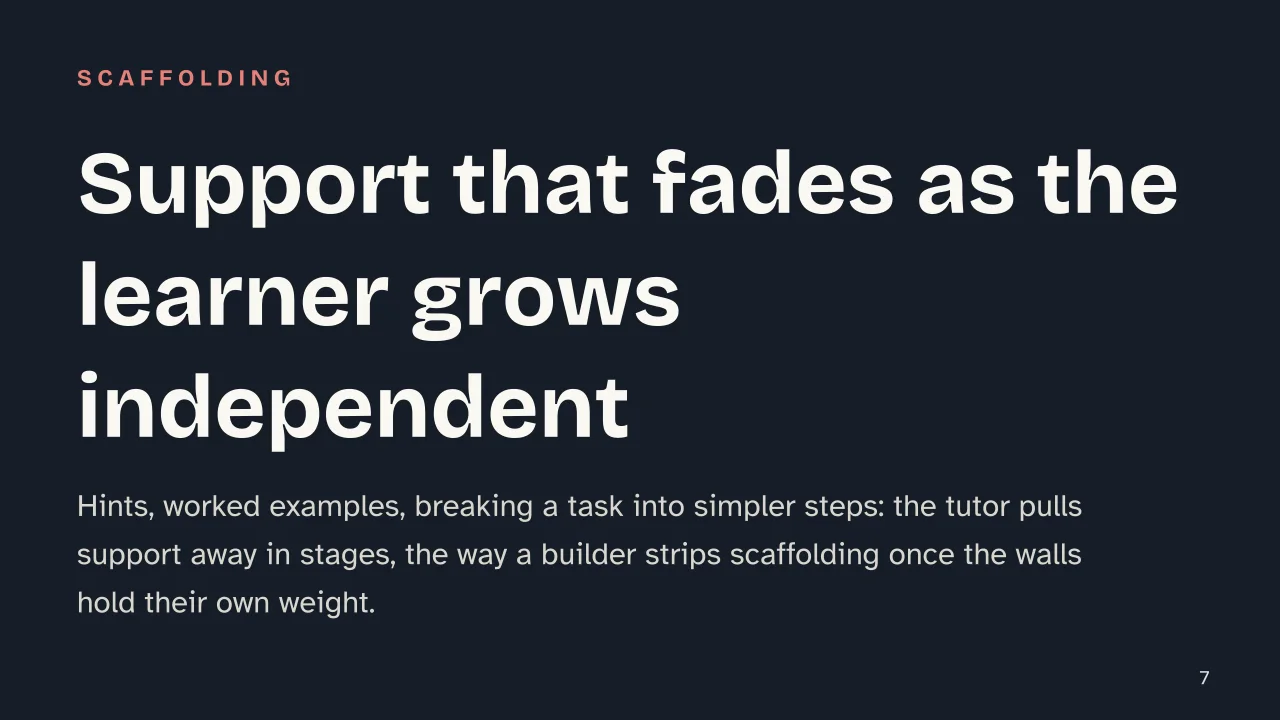
    Bruner developed the concept of scaffolding together with David Wood and Gail Ross in the 1976 paper “The Role of Tutoring in Problem Solving,” according to the bibliographic record consulted on Europe PMC. The Association for Psychological Science describes scaffolding as “the structuring experts provide to see that learners ever advance”; Simply Psychology calls it “temporary support that helps learners tackle new challenges,” delivered through hints and by breaking a task into simpler steps, with support that goes “gradually reducing… as the learner becomes more independent.”

    The full text of the 1976 paper is not available in open access on Europe PMC/PubMed Central: what follows here is the bibliographic record (authors, year, title), not direct quotations from the original article.

    Culture, cognitive development, and the comparison with Piaget

    For Bruner, learning was never just an individual matter: Simply Psychology writes that “culture and language drive this growth,” as children return to basic concepts at increasing levels of complexity and abstraction. This is where his theory of cognitive development diverges most clearly from Jean Piaget’s. According to the Association for Psychological Science, Bruner held that cognitive development depends on schooling and cultural context, not on age alone — in contrast with Piaget’s stage theory. Simply Psychology reports that Bruner rejected the idea of fixed developmental stages, holding instead that “the right way of presentation and explanation will enable a child to grasp a concept usually only understood by an adult.”

    Jean PiagetJerome Bruner
    Driver of developmentStages tied to ageCulture, language, schooling
    Role of teachingFollows the child’s maturationCan move understanding forward
    ProgressionA sequence of stagesRepeated returns, each deeper (spiral)

    Practical example: in a classroom following Piaget’s stage theory, an abstract concept would wait until children reach the appropriate operational stage. In Bruner’s view, the same concept can be introduced earlier, with language and examples suited to the age, then revisited and deepened several times across the school years.

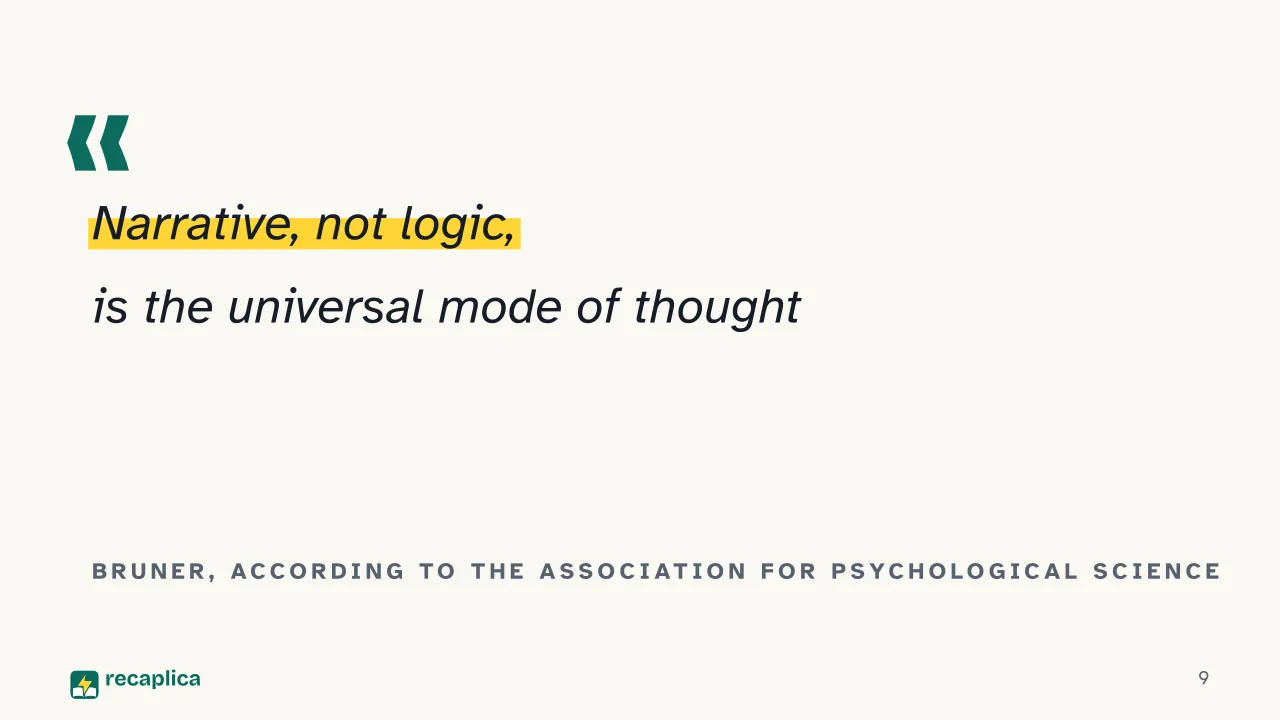
    In work that followed his developmental theory, according to the Association for Psychological Science, Bruner came to argue that “narrative, not logic, is the universal mode of thought”: people, in his view, make sense of their experience mainly by telling it as a story. That interest in meaning and cultural context put Bruner’s thinking close to other psychologists who studied development as a social process, among them Lev Vygotsky and his Mind in Society.

    Readers who want to place Bruner’s theory within the broader field of scientific psychology can start with the Recap on psychological science: what it is and how it differs from common sense, or compare it with the other major schools of thought covered in the Recaps on behaviorism and cognitivism, of which Bruner is considered one of the founders.

    Slide deck

    Slides ready to download and make your own in PowerPoint or Google Slides, with speaker notes. Pick the Flash cut or the Full one.

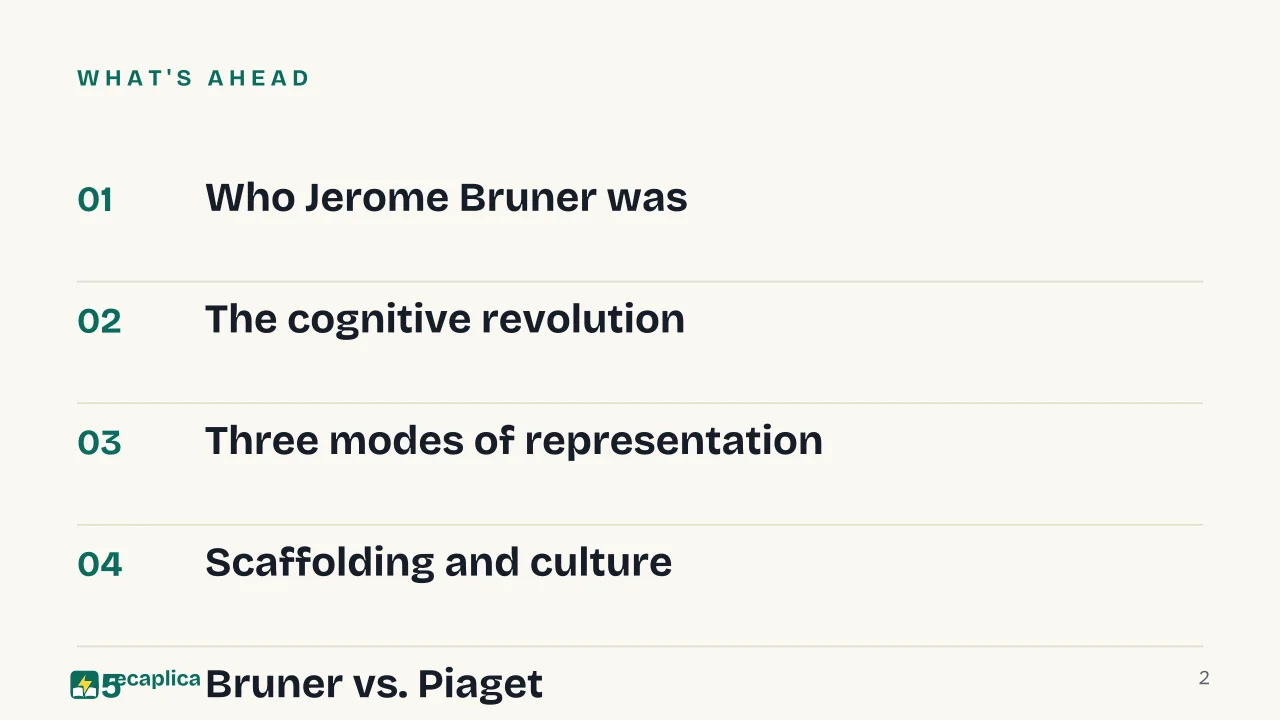
    Slide 1 of the presentation on Jerome Bruner: Jerome BrunerSlide 2 of the presentation on Jerome Bruner: What's aheadSlide 3 of the presentation on Jerome Bruner: Who he wasSlide 4 of the presentation on Jerome Bruner: Chapter 01: The cognitive revolutionSlide 5 of the presentation on Jerome Bruner: Enactive · Iconic · SymbolicSlide 6 of the presentation on Jerome Bruner: Chapter 02: Scaffolding and cultureSlide 7 of the presentation on Jerome Bruner: Support that fades as the learner grows independentSlide 8 of the presentation on Jerome Bruner: Bruner vs. PiagetSlide 9 of the presentation on Jerome Bruner: Bruner, according to the Association for Psychological ScienceSlide 10 of the presentation on Jerome Bruner: The full Recap
    Flash10 slidesThe essential thread, to present in classFull10 slidesEvery chapter and the deeper detail

    Common myths

    • ✗ Myth Bruner's theory of cognitive development says the same thing as Piaget's.

      ✓ Reality According to the Association for Psychological Science, Bruner held that cognitive development depends on schooling and cultural context, not on age alone as in Piaget's stage theory: Simply Psychology reports that Bruner rejected the idea of fixed developmental stages, arguing that the right way of presenting a concept can let a child grasp something usually understood only by an adult.

    • ✗ Myth Bruner is remembered only for scaffolding.

      ✓ Reality Scaffolding, developed in 1976 with David Wood and Gail Ross, is one of his contributions, not the only one: Bruner is also tied to the cognitive revolution of the 1960s, the three modes of representing knowledge, the spiral curriculum and, in later work, the idea of narrative as a universal mode of thought.

    • ✗ Myth The spiral curriculum means repeating the same topics the same way.

      ✓ Reality According to Simply Psychology, the idea is that students keep returning to the same key ideas throughout their education, going a little deeper into the same material each time they revisit it.

    Mind map

    Drag the background to move around and the nodes to reposition them; use − and + to collapse and expand branches.
    Customize
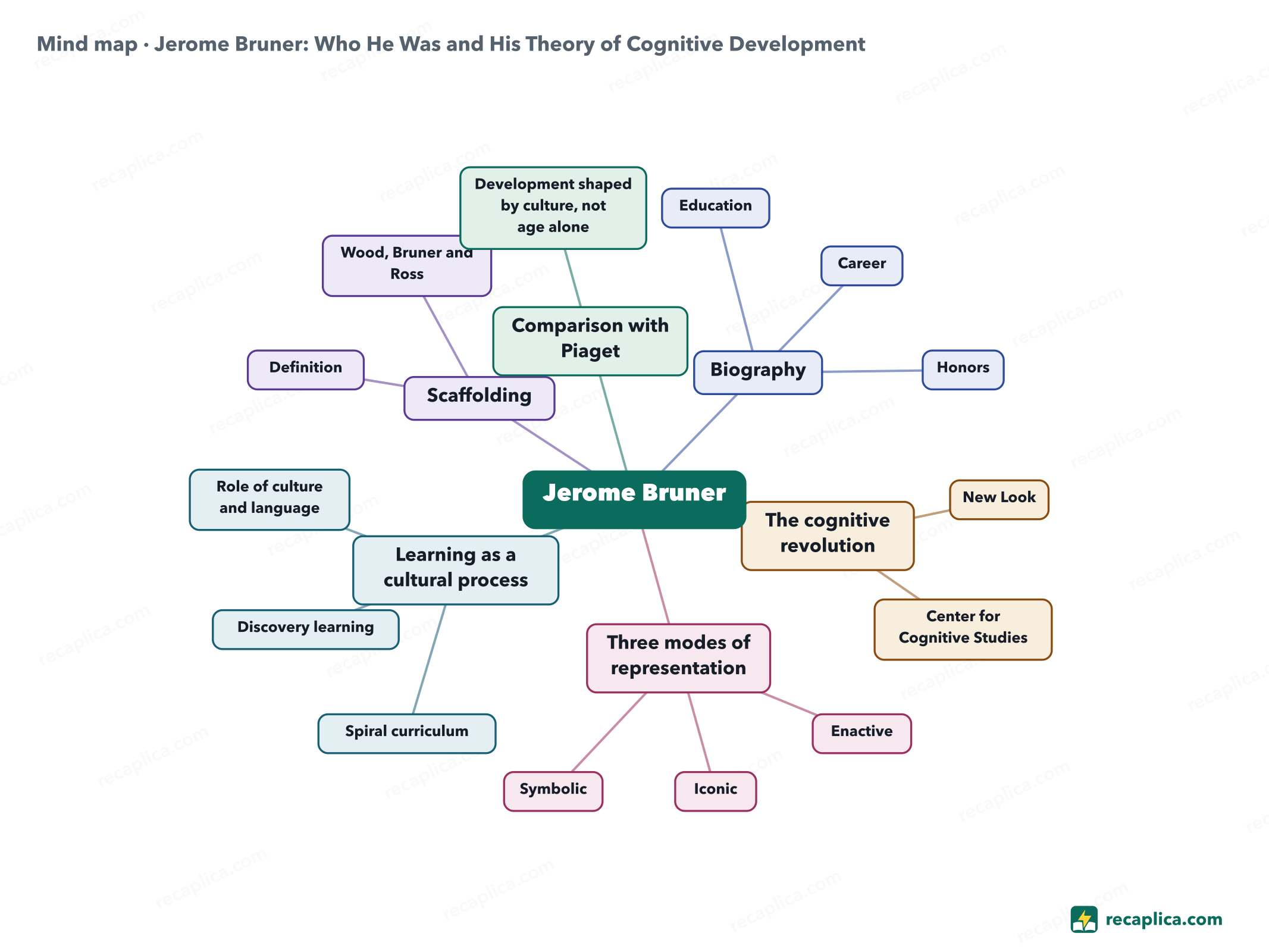
    Mind map: Jerome Bruner: Who He Was and His Theory of Cognitive Development
    • Jerome Bruner
      • Biography
        • Education bachelor's degree from Duke University in 1937, PhD in psychology from Harvard in 1941
        • Career Harvard, Oxford, then NYU School of Law from 1991
        • Honors International Balzan Prize, CIBA Gold Medal, APA Distinguished Scientific Award
      • The cognitive revolution
        • New Look research on perception, 1940s-1950s
        • Center for Cognitive Studies co-founded with George Miller in 1960
      • Three modes of representation
        • Enactive
        • Iconic
        • Symbolic
      • Learning as a cultural process
        • Spiral curriculum
        • Discovery learning
        • Role of culture and language
      • Scaffolding
        • Definition temporary support that fades as the learner gains independence
        • Wood, Bruner and Ross 1976 paper
      • Comparison with Piaget
        • Development shaped by culture, not age alone

    Quiz: test yourself

    Answer the questions to check what you have learned: you get instant feedback and a short explanation.

    Grade 0/10 0/5
    1 In what year was Jerome Bruner born?

    According to NYU School of Law and the Association for Psychological Science, Bruner was born on October 1, 1915, and died on June 5, 2016.

    2 Which 1960 book introduced the spiral curriculum?

    The Process of Education (1960) is the book where Bruner argues that complex ideas can be taught at any age, revisited repeatedly with growing depth.

    3 What are Bruner's three modes of representing knowledge?

    For Bruner, knowledge is represented enactively (through motor actions), iconically (through images) and symbolically (through language and other symbol systems); the other triads listed belong to different authors.

    4 True or false: according to Bruner, cognitive development depends only on age, as in Piaget's stage theory.

    False: according to the Association for Psychological Science, Bruner held that development also depends on schooling and cultural context, in contrast with Piaget's age-linked stage theory.

    5 Who co-authored Bruner's 1976 paper on scaffolding?

    "The Role of Tutoring in Problem Solving" (1976) is signed by Wood, Bruner and Ross, as recorded in the Europe PMC bibliographic entry.

    Answers: 1-A · 2-A · 3-A · 4-B · 5-A

    Flashcards

    Tap the card to flip it and check whether you remember the answer, then move to the next one.

    1 / 8

    Explain it in your own words

    The ultimate test: if you can explain it in simple words, you've truly understood it. Write your explanation, then compare it with the Recap.

    Your explanation is saved only on this device.

    Jerome Bruner (1915-2016) was an American psychologist and one of the central figures of the cognitive revolution of the 1960s. He argued that knowledge is built through three modes of representation — enactive, iconic and symbolic — and that learning is shaped as much by culture and language as by a child's age. With David Wood and Gail Ross, in 1976 he developed the concept of scaffolding: the support a tutor gives a learner, gradually withdrawn as the learner becomes independent. From the spiral curriculum to discovery learning, Bruner's theory of cognitive development remains a reference point in education and developmental psychology.

    Frequently asked questions

    Who was Jerome Bruner?

    Jerome Bruner (1915-2016) was an American psychologist and one of the central figures of the cognitive revolution of the 1960s: he taught at Harvard, at Oxford and, from 1991, at New York University School of Law.

    What is scaffolding in Bruner's theory?

    It is the temporary support a tutor gives a learner tackling a new task, through hints and simpler steps, progressively withdrawn as the learner becomes independent. Bruner developed it in 1976 with David Wood and Gail Ross — this is what «bruner scaffolding theory» refers to.

    What are Bruner's three modes of representing knowledge?

    Enactive (knowledge stored as motor responses), iconic (sensory images) and symbolic (language, mathematical symbols and other symbol systems).

    How does Bruner's cognitive development theory differ from Piaget's?

    Piaget described cognitive development as a sequence of age-linked stages; for Bruner, development also depends on schooling and cultural context, and the right presentation can make a concept understandable much earlier.

    What is the spiral curriculum?

    A way of organizing teaching in which students return repeatedly to the same key ideas throughout their education, going deeper at each pass: it is the central idea of The Process of Education (1960).

    Sources

    • In Memoriam: Jerome Bruner — NYU School of Law
    • Remembering Jerome Bruner — Association for Psychological Science (Observer)
    • Jerome Bruner Theory of Cognitive Development — Simply Psychology
    • Wood, D., Bruner, J. S., & Ross, G. (1976), The Role of Tutoring in Problem Solving — Europe PMC

    Every Recap goes through an independent review before publication.

    Every evening, the day's new Recaps on our Telegram channel. Join the channel →

    Keep learning

    • Science Mind in Society: Vygotsky's Book on Higher Psychological Processes Mind in Society: The Development of Higher Psychological Processes is the 1978 book that introduced Lev Vygotsky's ideas to English-speaking readers. The Soviet psychologist had died of tuberculosis in 1934. Vygotsky never wrote it as a single work: according to psychology historian Anton Yasnitsky, the volume is a compilation of fragments drawn from different texts, put together and translated by editors Michael Cole, Vera John-Steiner, Sylvia Scribner, and Ellen Souberman. It gathers eight essays on topics ranging from tools and symbols in child development to memory, research method, and the relationship between learning and development, including the zone of proximal development. Published by Harvard University Press, it remains the standard English-language reference for Vygotsky's sociocultural theory. Read the Recap →
    • Science Bandura's Social Learning Theory: Observation and Self-Efficacy Albert Bandura's social learning theory describes how people acquire behaviors, attitudes and emotional reactions by observing and imitating others in a social context, not only through direct reinforcement. Bandura set it out in a 1977 book, putting the observer's active role at the center of whether a behavior gets imitated. Modeling runs through four processes, attention, retention, motor reproduction and motivation, and the 1961 Bobo doll experiment showed that children imitate an observed adult's aggression. In 1986 Bandura renamed the theory "social cognitive theory", adding self-efficacy and reciprocal determinism between person, behavior and environment. Read the Recap →
    • Science Kepler's Laws of Planetary Motion, Explained Kepler's laws are three rules that describe how the planets move around the sun. Johannes Kepler worked them out from Tycho Brahe's observations, publishing the first two in 1609 and the third in 1619. They say that orbits are ellipses with the sun at one of the two foci, that a planet speeds up when it's close to the sun and slows down when it's far away, and that the square of the orbital period is proportional to the cube of the average distance from the sun. Before Kepler, orbits were assumed to be perfect circles, as in Copernicus's model. Read the Recap →

    recaplica

    Clear in 30 seconds, yours in 10 minutes.

    Recaps Mind maps Request a Recap Telegram channel Mind map maker Our method About Privacy & cookies Legal notes & terms of use

    © 2026 Recaplica · A project by Curi S.r.l. — VAT IT05472000750

    Statistics, only if you say so

    To learn which Recaps help most we would use Google Analytics, with aggregate, anonymous data. It starts only with your OK, and you can change your mind anytime. Privacy policy