Skip to content
recaplica

    One moment: security check

    Cloudflare wants to make sure you're not a robot. Tick the box below and your search will continue on its own.

    IT
    recaplica Carlo Goldoni: The Playwright Who Rewrote Italian Comedy
    © 2026 Recaplica · recaplica.com — All rights reserved
    Home › Literature

    Carlo Goldoni: The Playwright Who Rewrote Italian Comedy

    By Recaplica Newsroom · Updated on September 24, 2026

    What to print

    Page numbers appear when printing with default margins.

    Slides

    Choose a cut

    Flash10 slidesThe essential thread, to present in classFull16 slidesEvery chapter and the deeper detail

    Both come with speaker notes.

    Telegram channel
    recaplica Clear in 30 seconds, yours in 10 minutes.
    In 30 seconds Key points Figures Deep dive Slides Myths Mind map Quiz Flashcards FAQ

    In 30 seconds quick read

    Carlo Goldoni was born in Venice in 1707 and died in Paris in 1793, after training as a lawyer in Padua and practicing law in Venice. Before him, Italian comic theater relied mostly on commedia dell'arte: unscripted scenarios and fixed stock characters such as Harlequin. Goldoni moved the genre toward fully written plays with characters drawn from real life instead of stereotypes, a shift that begins with "La donna di garbo" ("The Woman of Good Sense") and spreads through his work in the 1750s. The change happened gradually: some transitional plays kept only three or four fully scripted scenes per act, with the rest still improvised.

    Key Points

    • Carlo Goldoni was born in Venice on February 25, 1707, and died in Paris on February 6, 1793.
    • He earned a law degree from the University of Padua and worked as a lawyer in Venice before turning to theater full time.
    • The earlier commedia dell'arte relied on unscripted scenarios and fixed stock characters such as Harlequin.
    • According to Treccani, 'La donna di garbo' opened the new type of fully written comedy that Goldoni pursued.
    • In the preface to his 1750 collection of plays, Goldoni names the World and the Theater as the two 'books' he studied most.
    • Between 1753 and 1757 he wrote fifty comedies, according to the Dizionario Biografico degli Italiani (Treccani).

    Key figures

    • 50 Comedies Carlo Goldoni wrote between 1753 and 1757, according to the Dizionario Biografico degli Italiani (Treccani); the entry gives no total for his entire output. Source: Treccani, Dizionario Biografico degli Italiani

    Deep Dive

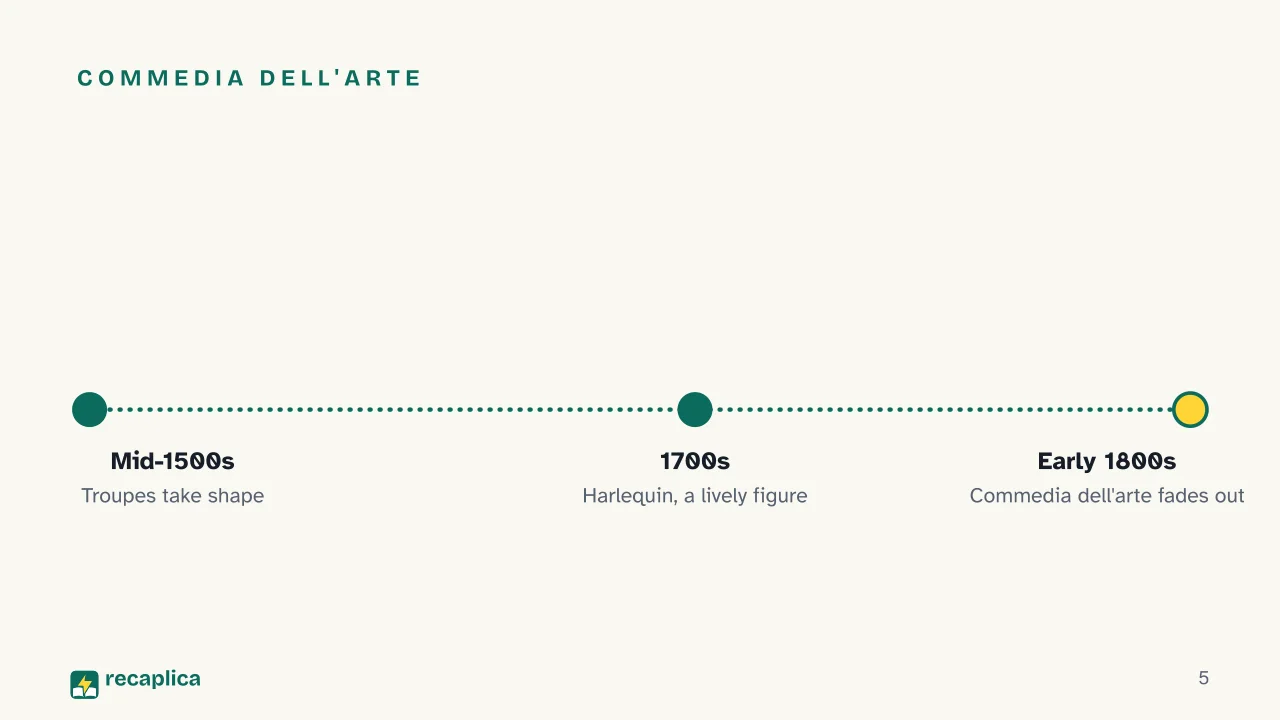
    Before Goldoni, Italian comic theater relied mostly on commedia dell’arte: actors did not perform a written text but developed a canovaccio, an outline of the plot, on the spot. According to Treccani, commedia dell’arte was “performed, for the first time in Europe, by regularly established troupes of actors who made their living from their craft” — professionals, not amateurs, who emerged around the middle of the 16th century and remained active into the early 19th.

    What commedia dell’arte actually was

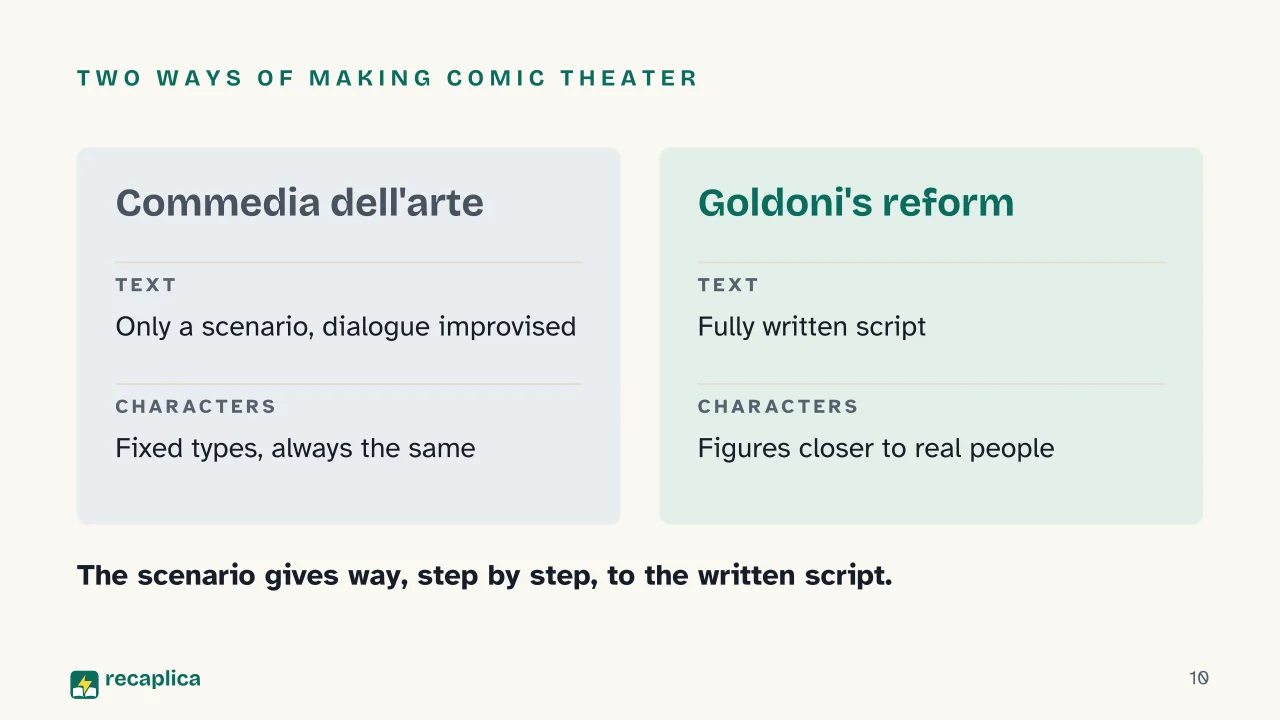
    In commedia dell’arte, Treccani writes, “only the outline, the plot, was written down, leaving the development of dialogue and stage business to improvisation.” That did not mean actors made everything up in the moment: each one built and memorized a personal “formulario,” a ready repertoire of lines adapted from performance to performance.

    The most recognizable feature of the genre was its fixed stock characters: types that a single actor played for an entire career, giving up the chance to take on different roles in order to specialize in just one. Harlequin is the best-known example: he first appeared on stage in the second half of the 16th century as a descendant of Hellequin, a comic devil figure from French medieval drama, and by the 18th century had become, in Treccani’s words, “one of the liveliest and most distinctive of the masks,” the cunning, none-too-bright servant packed into a costume of colored diamond patches.

    Goldoni’s reform: from scenario to script

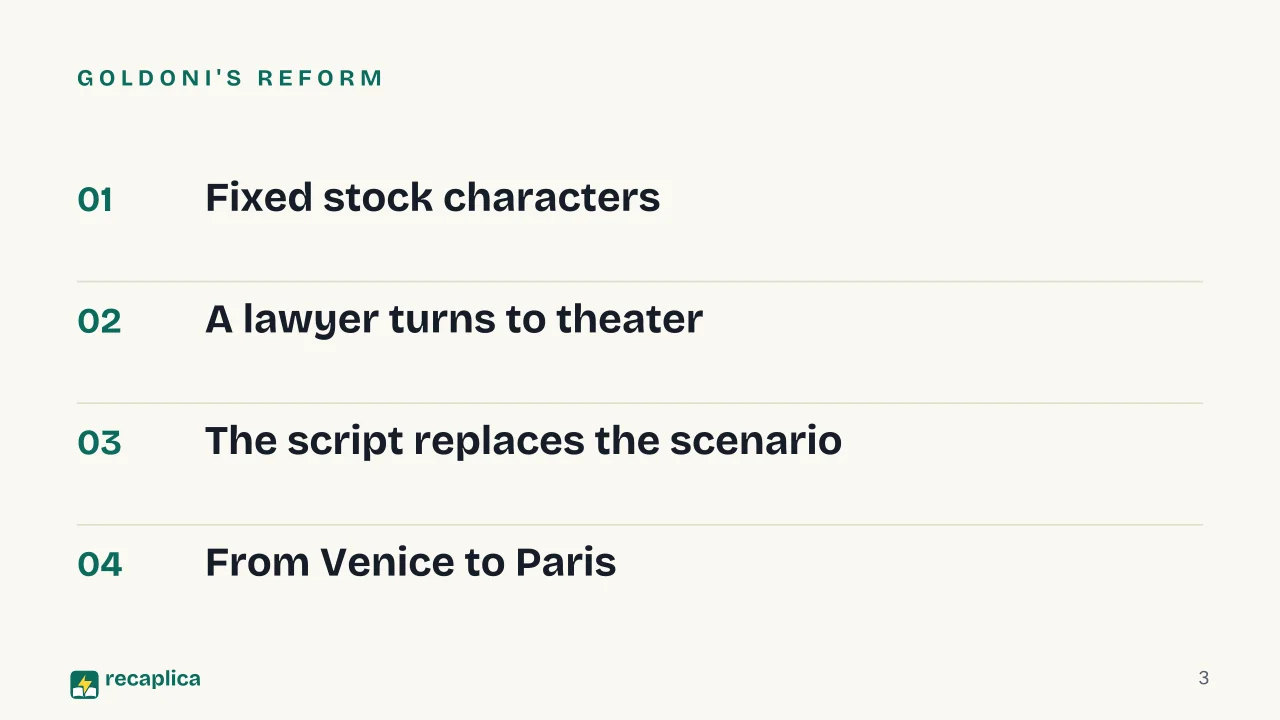
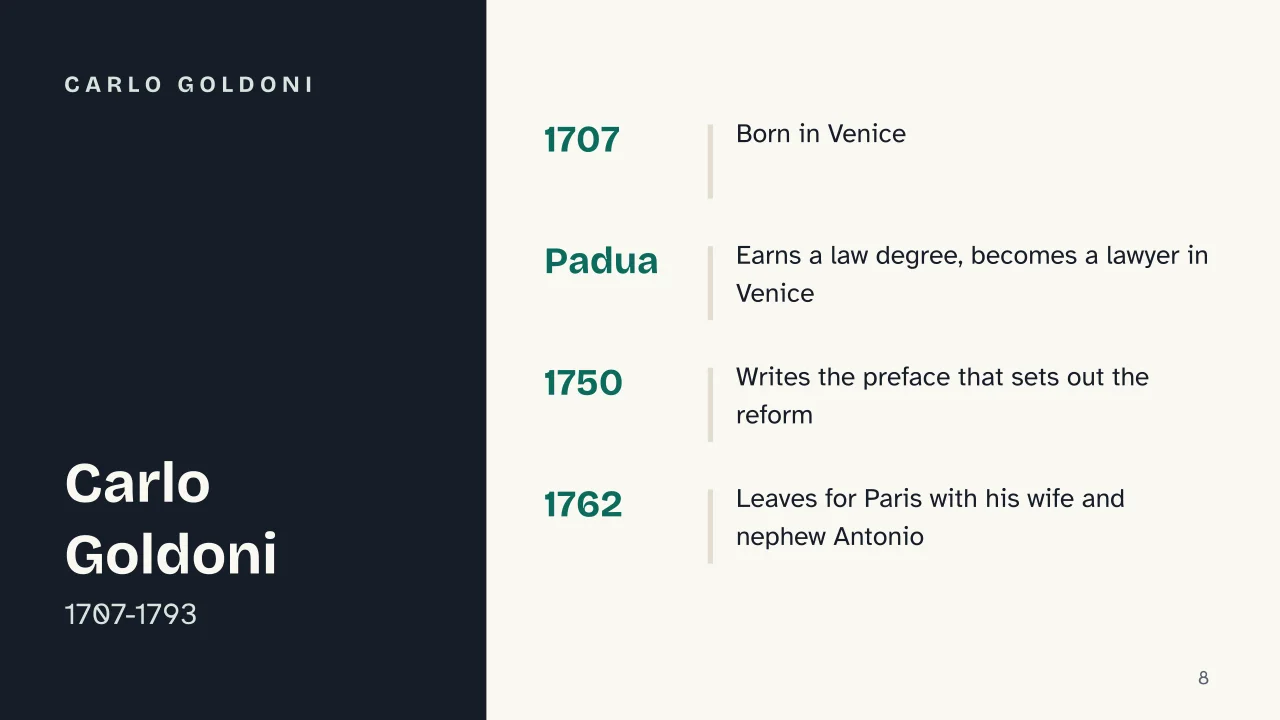
    Carlo Goldoni was born in Venice on February 25, 1707. He studied first with a private tutor, then in boarding school, and earned a law degree at the University of Padua, becoming a lawyer in Venice the following year. Only later did theater become his actual profession.

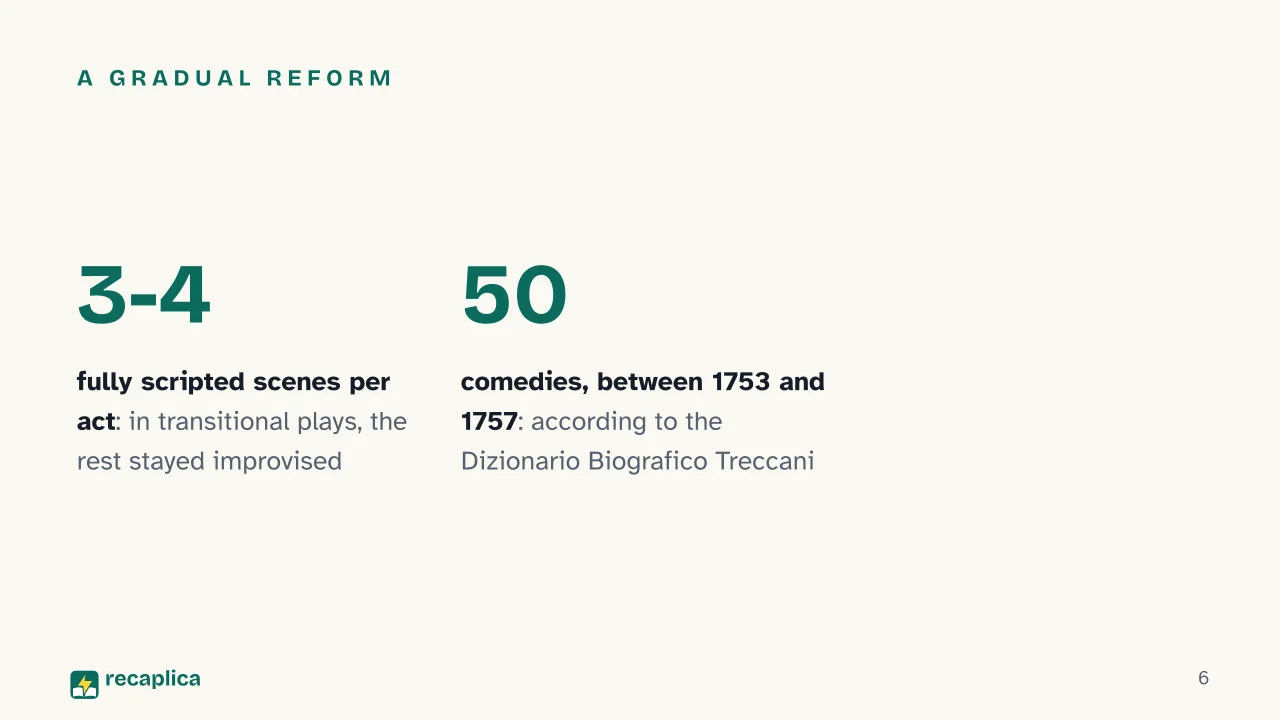
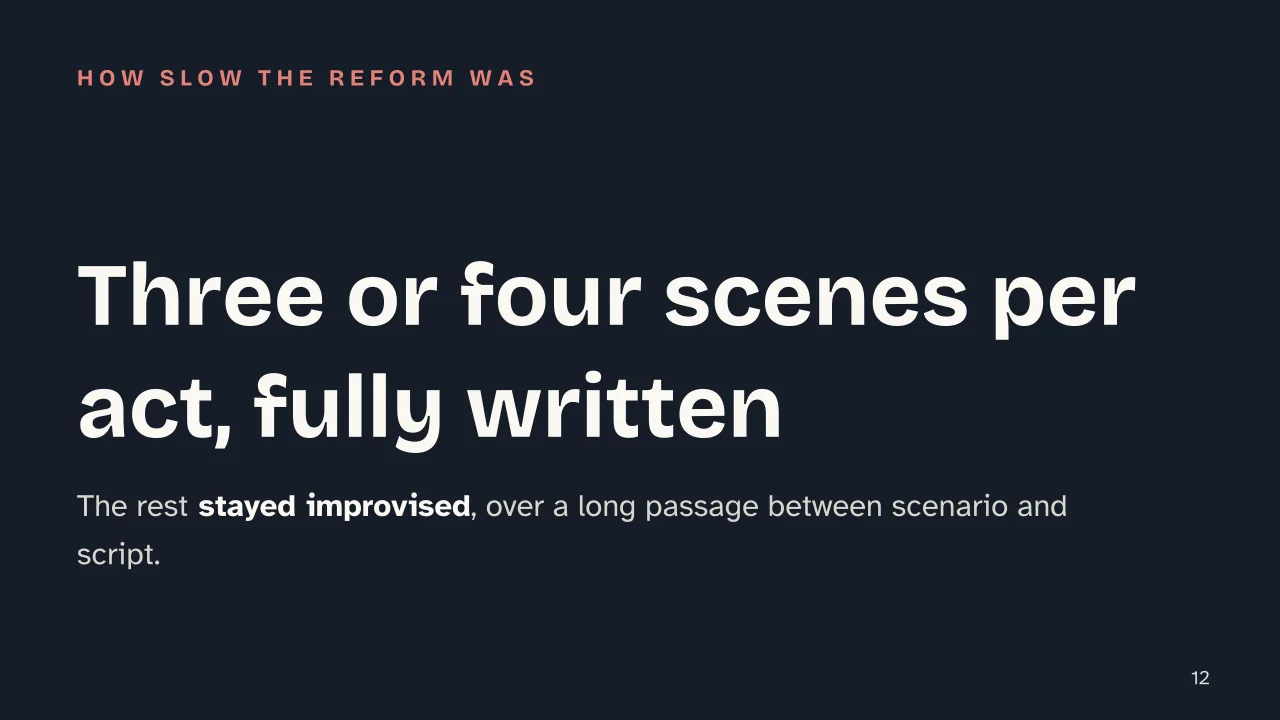
    According to Treccani, the comedy “La donna di garbo” marks “the new genre of comedy” that Goldoni took up: from that point on, he wrote plays conceived in full, rather than loose outlines meant for improvisation. The change was not immediate. Some transitional plays kept “three or four scenes per act” — the dramatically most important ones — fully written out, while the remaining scenes were still improvised. It was a gradual move of characters away from the stereotyped figures of commedia dell’arte, not a leap accomplished in a single play.

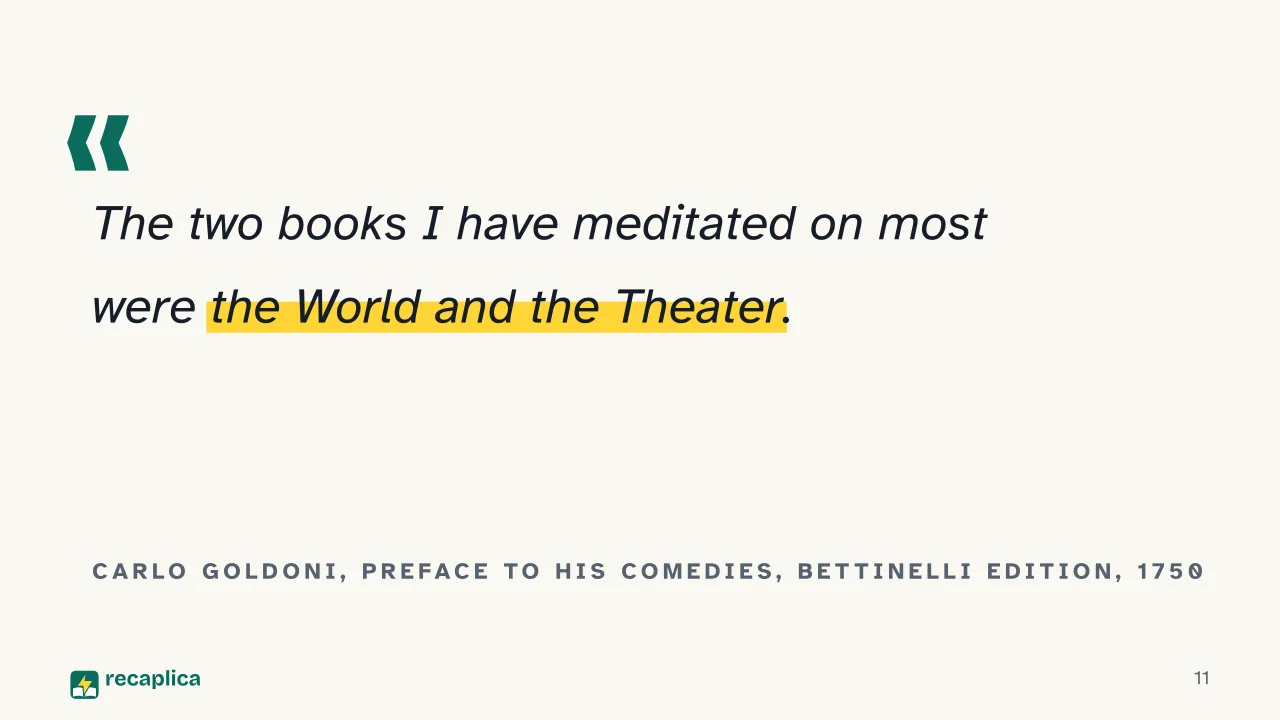
    Goldoni himself describes the method behind the reform in the preface to the first collection of his Comedies, Bettinelli edition, 1750: “the two books I have meditated on most… were the World and the Theater.” Watching real people, alongside reading the classics, became his source for new characters. The comedy “Il teatro comico” then puts the core ideas of this reform literally on stage: it works as the reform’s own staged manifesto.

    Practical example: “La Locandiera” (1752), “Il servitore di due padroni” (A Servant of Two Masters), and “Il bugiardo” (The Liar) are three mature Goldoni comedies, fully written, with characters far removed from fixed stock types: Mirandolina, the innkeeper of La Locandiera, represents, according to the critics cited by Treccani, one of the high points of Goldoni’s art.

    The reform in practice

    Between 1753 and 1757 Goldoni wrote fifty comedies, according to the Dizionario Biografico degli Italiani (Treccani) — a figure covering those five years, not a total for his entire output.

    The realistic characters of Goldoni’s mature plays, built on his observation of everyday life in Venice, echo in part the attention to ordinary people that Giovanni Verga’s Verismo would push to its extreme more than a century later, with a different method and in a different form, the novel.

    From Venice to Paris

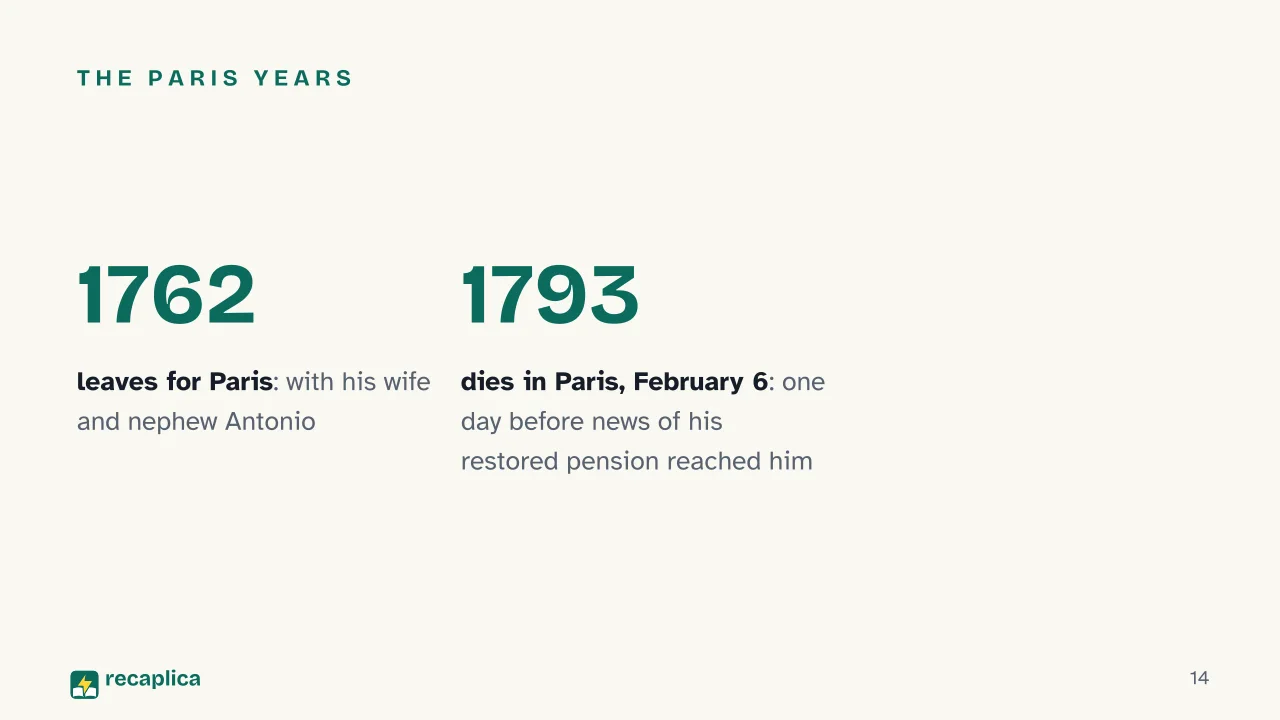
    Goldoni stayed in Venice, aside from a few short trips, until his departure for Paris on April 22, 1762, together with his wife and his nephew Antonio. In Paris he became, in 1765, teacher of Italian to Princess Maria Adelaide, and in 1775 tutor of Italian to the two sisters of Louis XVI, a post he held until 1780. He died in Paris on February 6, 1793: his pension, revoked during the Revolution, was restored after a formal appeal, but word of it arrived on February 7, the day after his death.

    Slide deck

    Slides ready to download and make your own in PowerPoint or Google Slides, with speaker notes. Pick the Flash cut or the Full one.

    Slide 1 of the presentation on Carlo Goldoni: Carlo GoldoniSlide 2 of the presentation on Carlo Goldoni: How did a comic actor perform before Goldoni?Slide 3 of the presentation on Carlo Goldoni: Goldoni's reformSlide 4 of the presentation on Carlo Goldoni: Chapter 01: Fixed stock charactersSlide 5 of the presentation on Carlo Goldoni: Commedia dell'arteSlide 6 of the presentation on Carlo Goldoni: A gradual reformSlide 7 of the presentation on Carlo Goldoni: Chapter 02: A lawyer turns to theaterSlide 8 of the presentation on Carlo Goldoni: Carlo GoldoniSlide 9 of the presentation on Carlo Goldoni: Chapter 03: The script replaces the scenarioSlide 10 of the presentation on Carlo Goldoni: Two ways of making comic theaterSlide 11 of the presentation on Carlo Goldoni: Carlo Goldoni, preface to his Comedies, Bettinelli edition, 1750Slide 12 of the presentation on Carlo Goldoni: Three or four scenes per act, fully writtenSlide 13 of the presentation on Carlo Goldoni: Chapter 04: From Venice to ParisSlide 14 of the presentation on Carlo Goldoni: The Paris yearsSlide 15 of the presentation on Carlo Goldoni: Which play does Treccani identify as the start of Goldoni's new genre?Slide 16 of the presentation on Carlo Goldoni: Keep reading
    Flash10 slidesThe essential thread, to present in classFull16 slidesEvery chapter and the deeper detail

    Common myths

    • ✗ Myth Many people assume commedia dell'arte actors improvised everything on the spot, with no preparation at all.

      ✓ Reality According to Treccani, each actor kept a personal 'formulario,' a repertoire of lines learned by heart: the improvisation was built on material already prepared, not invented from nothing on stage.

    • ✗ Myth It is often assumed that Goldoni switched overnight from improvised, scenario-based comedy to fully written plays.

      ✓ Reality According to Treccani, the shift was a gradual move of characters away from stereotyped figures: transitional plays kept only three or four fully scripted scenes per act, with the rest still improvised, not a clean break from one day to the next.

    • ✗ Myth Many picture Harlequin as a character invented specifically for Goldoni's plays.

      ✓ Reality Harlequin had already appeared on stage in the second half of the 16th century, according to Treccani, a century and a half before Goldoni's birth in 1707: in the 18th century the character simply gained a higher profile.

    Mind map

    Drag the background to move around and the nodes to reposition them; use − and + to collapse and expand branches.
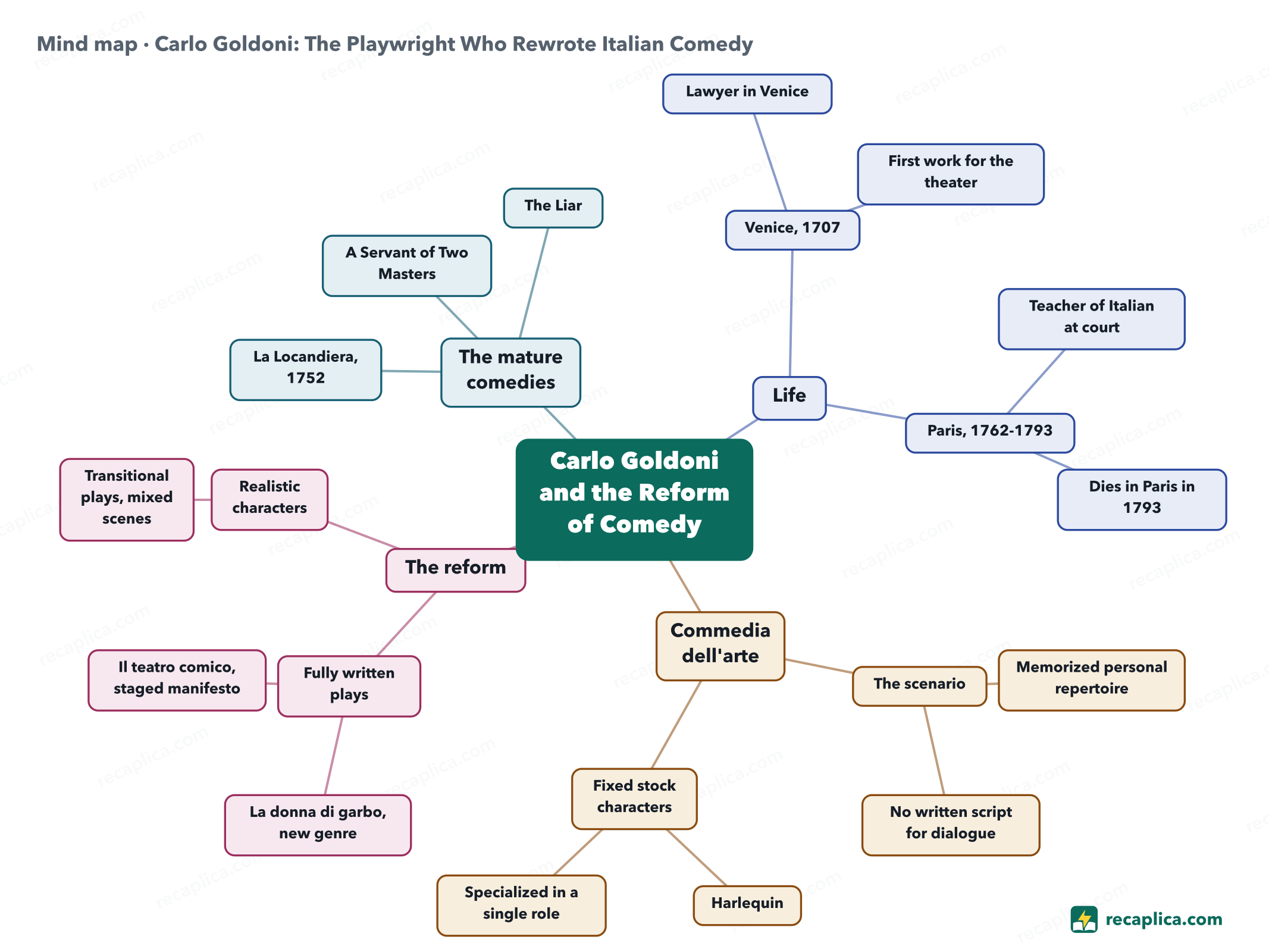
    Customize
    Mind map: Carlo Goldoni: The Playwright Who Rewrote Italian Comedy
    • Carlo Goldoni and the Reform of Comedy
      • Life
        • Venice, 1707 Birth and education, law degree in Padua
          • Lawyer in Venice
          • First work for the theater
        • Paris, 1762-1793 Move to France and final years
          • Teacher of Italian at court
          • Dies in Paris in 1793
      • Commedia dell'arte
        • The scenario Only the plot written down, dialogue improvised
          • Memorized personal repertoire
          • No written script for dialogue
        • Fixed stock characters One character type for an entire career
          • Harlequin
          • Specialized in a single role
      • The reform
        • Fully written plays Set out in the 1750 preface
          • La donna di garbo, new genre
          • Il teatro comico, staged manifesto
        • Realistic characters Gradual move away from stereotyped types
          • Transitional plays, mixed scenes
      • The mature comedies
        • La Locandiera, 1752
        • A Servant of Two Masters
        • The Liar

    Quiz: test yourself

    Answer the questions to check what you have learned: you get instant feedback and a short explanation.

    Grade 0/10 0/5
    1 In what year was Carlo Goldoni born?

    Goldoni was born in Venice on February 25, 1707, according to the Dizionario Biografico degli Italiani (Treccani).

    2 What was a scenario (canovaccio) in commedia dell'arte?

    Treccani describes commedia dell'arte as comedy for which only the outline, the plot, was written down, leaving the dialogue and stage business to improvisation.

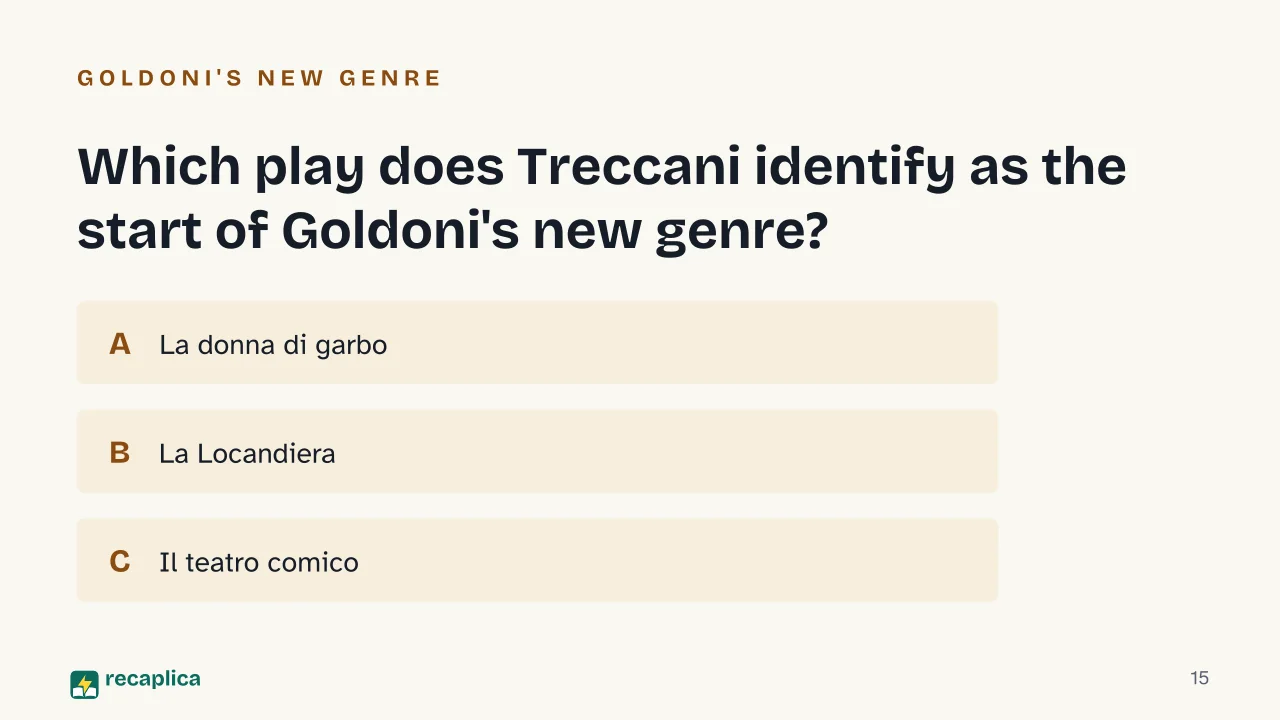
    3 Which play does Treccani identify as the start of Goldoni's new genre?

    According to Treccani, the comedy 'La donna di garbo' marks the new genre of comedy that Goldoni took up.

    4 In the preface to his 1750 collection of plays, which two 'books' does Goldoni say he studied most?

    In the preface, Bettinelli edition, 1750, Goldoni writes that the two books he meditated on most were the World and the Theater.

    5 True or false: Goldoni's reform was a sudden change, from one day to the next.

    Transitional plays had only three or four fully scripted scenes per act: the reform advanced gradually, according to the Dizionario Biografico Treccani.

    Answers: 1-A · 2-B · 3-A · 4-A · 5-B

    Flashcards

    Tap the card to flip it and check whether you remember the answer, then move to the next one.

    1 / 8

    Explain it in your own words

    The ultimate test: if you can explain it in simple words, you've truly understood it. Write your explanation, then compare it with the Recap.

    Your explanation is saved only on this device.

    Carlo Goldoni was born in Venice in 1707 and died in Paris in 1793, after training as a lawyer in Padua and practicing law in Venice. Before him, Italian comic theater relied mostly on commedia dell'arte: unscripted scenarios and fixed stock characters such as Harlequin. Goldoni moved the genre toward fully written plays with characters drawn from real life instead of stereotypes, a shift that begins with "La donna di garbo" ("The Woman of Good Sense") and spreads through his work in the 1750s. The change happened gradually: some transitional plays kept only three or four fully scripted scenes per act, with the rest still improvised.

    Frequently asked questions

    What is commedia dell'arte?

    According to Treccani, it is the comic theater performed by professional troupes who made their living from acting, built on a canovaccio, meaning only the plot was written down, while the dialogue came from improvisation. Even so, each actor carried a personal repertoire of ready-made lines, memorized in advance.

    What did Goldoni's theater reform consist of?

    It was a shift from scenario-based comedies, improvised around a written outline, to fully scripted plays, with characters moving gradually away from fixed stock types toward more realistic figures. Goldoni set out the idea in the preface to his 1750 collection of plays and staged it directly in the comedy 'Il teatro comico.'

    What are some of Goldoni's mature comedies?

    Among the best known are 'La Locandiera' (1752), widely regarded by critics as one of the high points of Goldoni's art, 'Il servitore di due padroni' (A Servant of Two Masters), and 'Il bugiardo' (The Liar): each has its own dedicated Recap on Recaplica.

    Why is Harlequin linked to commedia dell'arte rather than to Goldoni's reform?

    Because Harlequin is a fixed stock character, a type that one actor performed for an entire career: he first appeared on stage in the second half of the 16th century, a century and a half before Goldoni, and is exactly the kind of stereotyped figure that the reform gradually moved comedy away from.

    Where and when did Carlo Goldoni live?

    In Venice, where he was born in 1707, and later in Paris, where he moved in 1762 and died in 1793: his life was split between the two cities.

    Sources

    • Treccani, Dizionario Biografico degli Italiani, "Carlo Goldoni"
    • Treccani, Enciclopedia Italiana, "Commedia dell'arte"
    • Casa di Carlo Goldoni, Fondazione Musei Civici di Venezia
    • Treccani, Enciclopedia Italiana, "Arlecchino"

    Every Recap goes through an independent review before publication.

    Every evening, the day's new Recaps on our Telegram channel. Join the channel →

    Keep learning

    • Literature Death Will Come and Will Have Your Eyes: Cesare Pavese's Poetry Collection "Death Will Come and Will Have Your Eyes" is the poetry collection Cesare Pavese dedicated to the American actress Constance Dowling. Einaudi published the book posthumously in 1951, edited by Massimo Mila and Italo Calvino; it brings together nineteen poems in all: the ten from 1950 that give the collection its title, written between March 11 and April 11 of that year, and nine more written in 1945. Treccani reads the book as Pavese's return to Leopardi's two themes, love and death. In a letter dated April 17, 1950, Pavese wrote: "The poems came to you, and they go away with you." Read the Recap →
    • Literature The Path to the Spider's Nests by Italo Calvino The Path to the Spider's Nests is Italo Calvino's debut novel, published by Einaudi in the autumn of 1947. It tells the story of the Italian Resistance through Pin, a boy who steals a pistol from a sailor and hides it in a place only he knows. Calvino wrote it in about twenty days, at 23, to meet a literary prize deadline of December 31, 1946 — the same young man who had joined the partisans in 1944 under the nom de guerre Santiago. The novel is the book critics point to when they introduce Calvino's early phase, known as fantastic neorealism: a war told through a child's fable-like gaze rather than a direct, adult account. Read the Recap →
    • Literature The Moon and the Bonfires by Cesare Pavese: Summary, Characters and Themes «The Moon and the Bonfires» is the last novel Cesare Pavese finished. He wrote it between September and November 1949, and Einaudi published it in 1950. The narrator is a foundling known only by his nickname, Anguilla — «Eel» in English — who comes home to the village that raised him after making money in the United States, and finds a place the war has reworked. The book is laid out as episodes that look unconnected, and what ties them together is the narrator's own remembering. The critic Silverio Novelli, writing for Treccani, argues that the homecoming never gives Anguilla back the identity he is after: it sharpens his sense of belonging nowhere. Read the Recap →

    recaplica

    Clear in 30 seconds, yours in 10 minutes.

    Recaps Mind maps Request a Recap Telegram channel Mind map maker Our method About Privacy & cookies Legal notes & terms of use

    © 2026 Recaplica · A project by Curi S.r.l. — VAT IT05472000750

    Statistics, only if you say so

    To learn which Recaps help most we would use Google Analytics, with aggregate, anonymous data. It starts only with your OK, and you can change your mind anytime. Privacy policy