|
recaplica
INPS Contributions Under Italy's Regime Forfettario, How They Work | ||||||||||||||||||||||||||||||
| © 2026 Recaplica · recaplica.com — All rights reserved | ||||||||||||||||||||||||||||||
INPS Contributions Under Italy's Regime Forfettario, How They WorkWhat to print Page numbers appear when printing with default margins. SlidesChoose a cut Flash10 slidesThe essential thread, to present in classFull15 slidesEvery chapter and the deeper detailBoth come with speaker notes. In 30 seconds quick readAnyone with a VAT number under Italy's regime forfettario still owes INPS contributions, and where they go depends on the activity: freelancers without a trade association of their own pay into the Gestione Separata, while tradespeople and shopkeepers pay into the Artigiani e Commercianti schemes. The two schemes charge different rates but share the same base, the flat-rate taxable income. Tradespeople and shopkeepers can also apply for an optional 35% contribution reduction, which lowers the amount credited toward their future pension as well. Key Points
Key figures
Deep DiveWhich INPS scheme applies under the regime forfettarioRegistering a VAT number under Italy’s regime forfettario doesn’t remove the obligation to pay social security contributions: only the destination changes, and the choice depends on the type of activity, not the tax regime. A freelancer with no trade association of their own (such as lawyers or chartered accountants, who fall outside INPS) enrolls in the Gestione Separata. A tradesperson or shopkeeper instead enrolls in the Tradespeople and Shopkeepers schemes, two distinct self-employed schemes with their own rules. Within the Gestione Separata, the position shifts again depending on the individual’s situation. INPS, in Circular no. 8 of 3 February 2026, states that “for 2026 the rates set for self-employed workers holding a VAT position, enrolled in the Gestione Separata and not insured under other mandatory pension schemes nor retired” add up to 26.07%, the sum of a 25% pension rate, a 0.72% additional rate and a 0.35% rate for ISCRO, the extraordinary allowance for income and operating continuity. Anyone already covered by another mandatory pension scheme, or already retired, pays a lower rate: the same circular confirms it at 24% for 2026. For tradespeople and shopkeepers the reference is instead INPS Circular no. 14 of 9 February 2026, which sets “the contribution rates funding the pension schemes … at 24% for all titleholders and collaborators,” with an additional 0.48% for shopkeepers only, funding compensation for those who close their activity without meeting the requirements for an old-age pension: the result, for 2026, is a 24% rate for tradespeople and 24.48% for shopkeepers.
The general mechanism of the regime forfettario stays the same for everyone: what changes, on the INPS side, is only the destination scheme. How the contribution is calculated on flat-rate taxable incomeIn both schemes, the rate applies to the same flat-rate taxable income used for tax purposes. According to Italy’s Revenue Agency, that income comes from applying “a profitability coefficient that varies by ATECO code” to the revenue or fees collected during the year, and mandatory social security contributions “are deducted from the income determined on a flat-rate basis.” INPS Circular no. 8/2026 confirms that, for the Gestione Separata, “the contribution is applied to self-employment income … using the same criteria set for personal income tax purposes.” Both schemes also set a reference threshold. For 2026, INPS sets an income floor of 18,808 euros: anyone with flat-rate taxable income at or below that figure still pays a contribution calculated on that threshold (for the Gestione Separata at the 24% rate, the minimum contribution comes to 4,513.92 euros a year). For tradespeople and shopkeepers, the same floor produces a minimum contribution of 4,521.36 euros for tradespeople and 4,611.64 euros for shopkeepers, maternity contribution included. Anyone above the floor pays the contribution on the full income, up to a ceiling: for 2026 it’s 122,295 euros for those with no prior contribution history in the scheme, the typical case for someone registering a new flat-rate VAT number today.
The INPS rate shouldn’t be confused with the 15% substitute tax (or 5% in the first years of activity, under certain conditions) charged on the same flat-rate taxable income for tax purposes: it’s a separate calculation, covered in its own dedicated Recap on the costs of Italy’s regime forfettario. The 35% contribution reduction for tradespeople and shopkeepersTradespeople and shopkeepers who stay under the regime forfettario have access to a specific contribution reduction, introduced by INPS Circular no. 35 of 19 February 2016 and confirmed every year since, including 2026, by Circular no. 14/2026. The 2016 circular describes it this way: “for the purposes of determining the contribution owed to the tradespeople and shopkeepers schemes … the taxable base is the flat-rate income determined for tax purposes. The change from the previous regime is that the contribution owed, both on income up to the floor and on any income above it, is reduced by 35%.” The reduction applies only to the Tradespeople and Shopkeepers schemes: there’s no equivalent contribution benefit for freelancers enrolled in the Gestione Separata. Nor is it automatic: Circular no. 14/2026 states it applies “to those who already benefited from the tax and contribution relief scheme in 2025 and … have not formally waived it,” while anyone who opened a new activity in 2025 and wants the benefit for 2026 “must notify their enrollment by the strict deadline of 28 February 2026.” The maternity contribution, 0.62 euros a month in 2026, remains due either way.
The reduction applies “both on income up to the floor and on any income above it,” so it also lowers, proportionally, the amount credited toward the future pension. Smaller contributions paid today mean, for the same number of years worked, a smaller pension credit: a factor to weigh when moving from payroll employment into the self-employed labor market. What differs between the two schemes, in summaryThe two paths — the Gestione Separata for those with no trade fund of their own, the Tradespeople and Shopkeepers schemes for those in that line of work — use the same flat-rate taxable income as their calculation base. The rate, the reference thresholds and the 35% reduction change from one scheme to the other. The regime forfettario simplifies the tax calculation; the obligation to pay social security contributions stays. Slide deckSlides ready to download and make your own in PowerPoint or Google Slides, with speaker notes. Pick the Flash cut or the Full one.     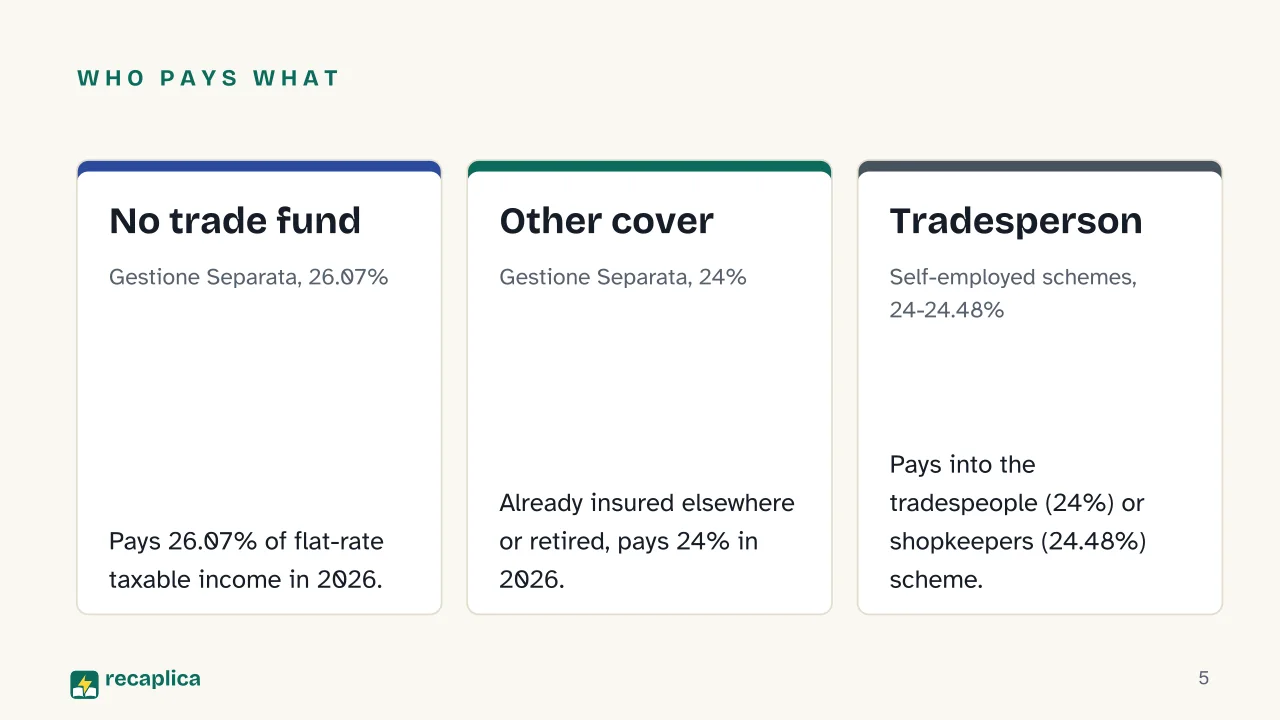 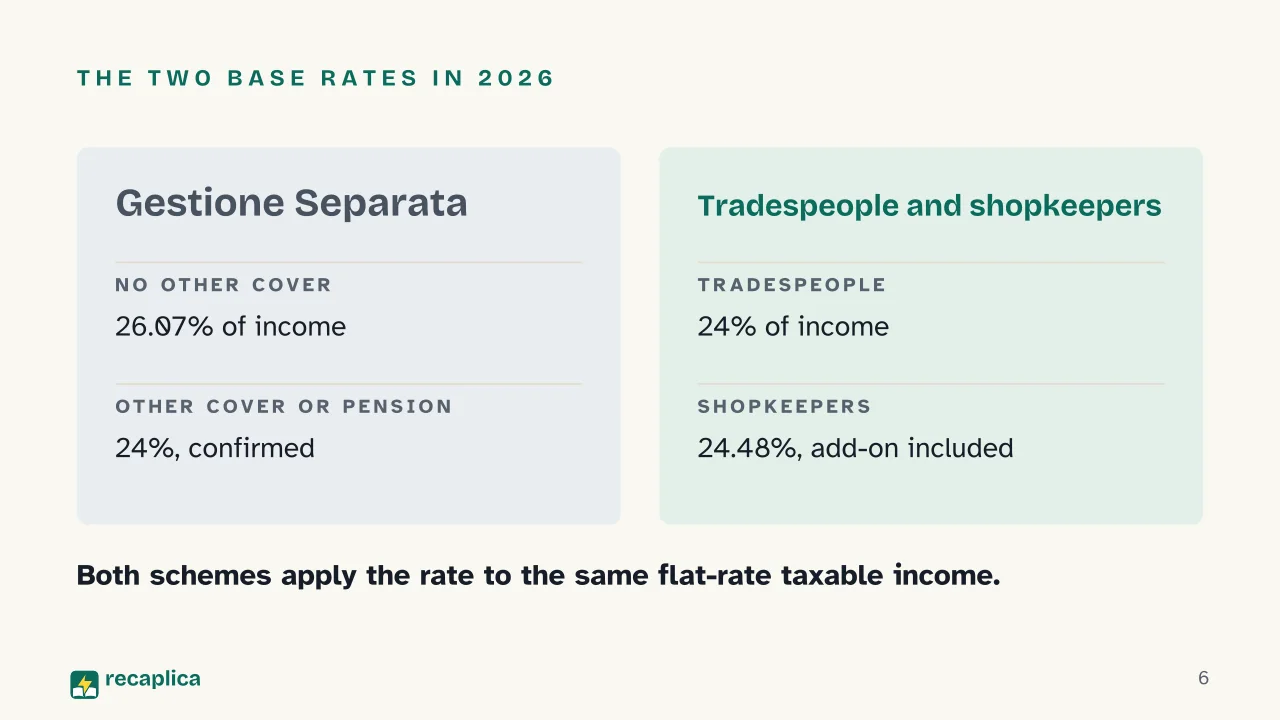  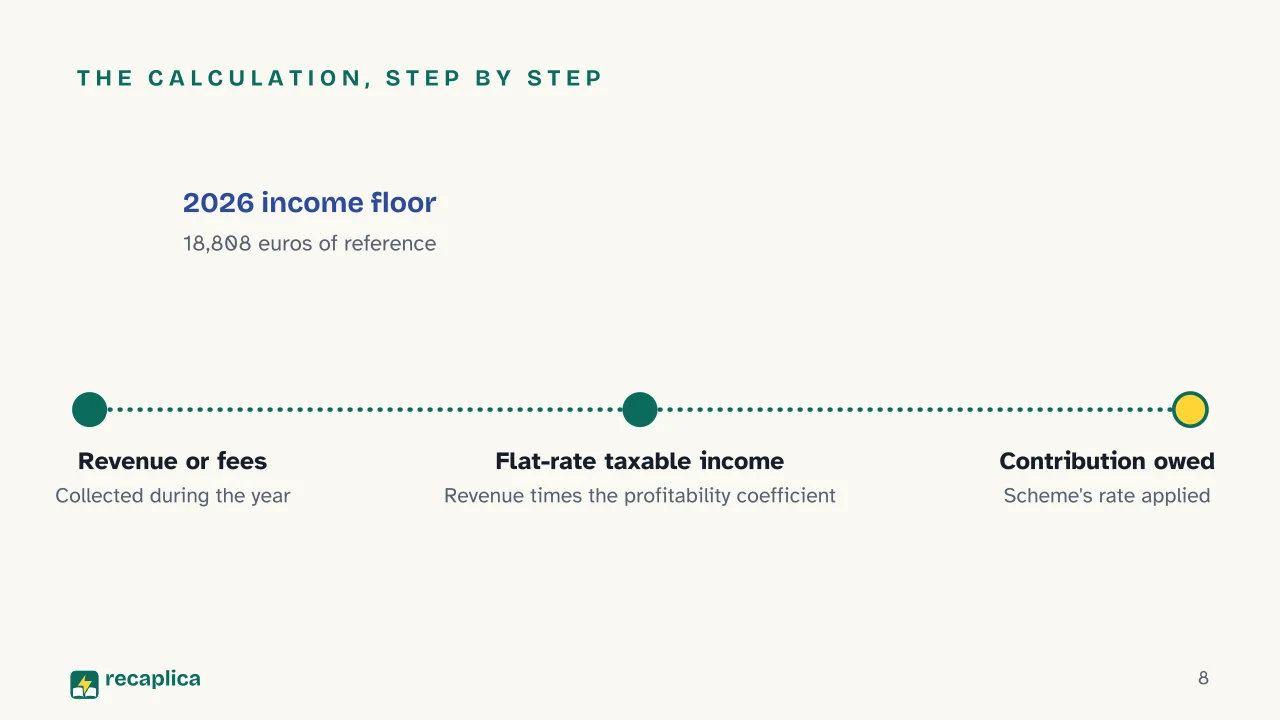 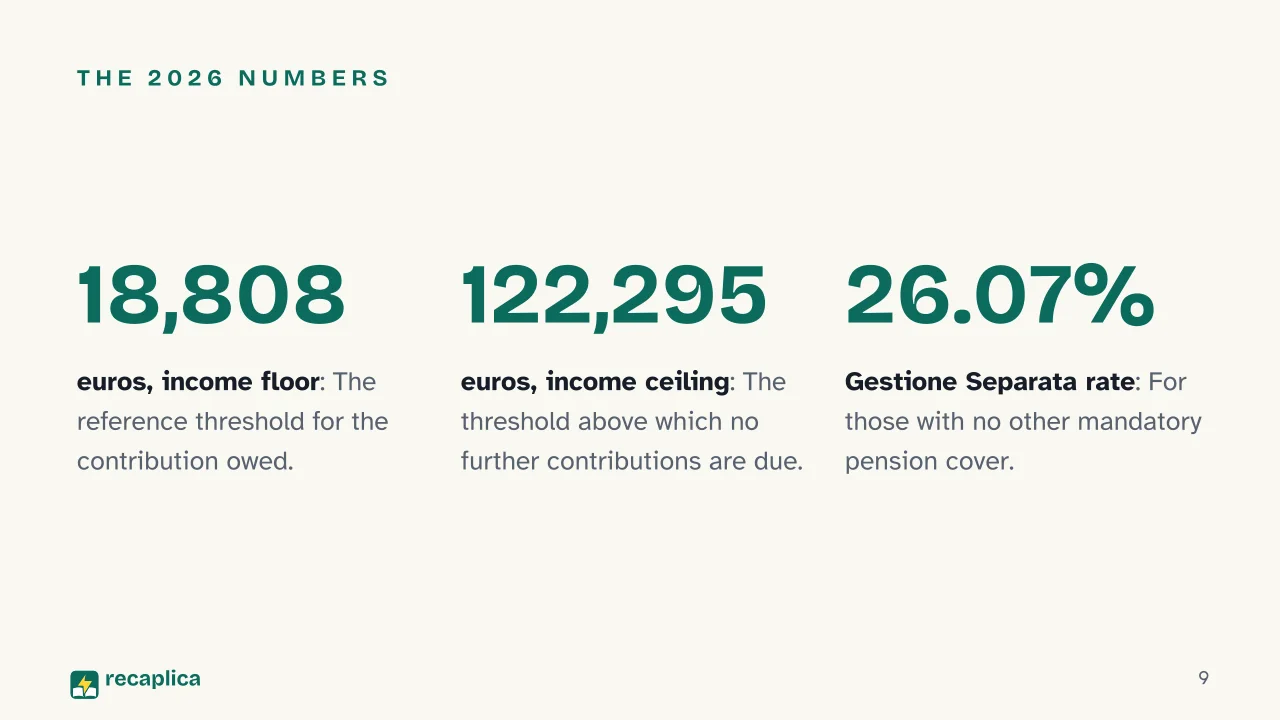  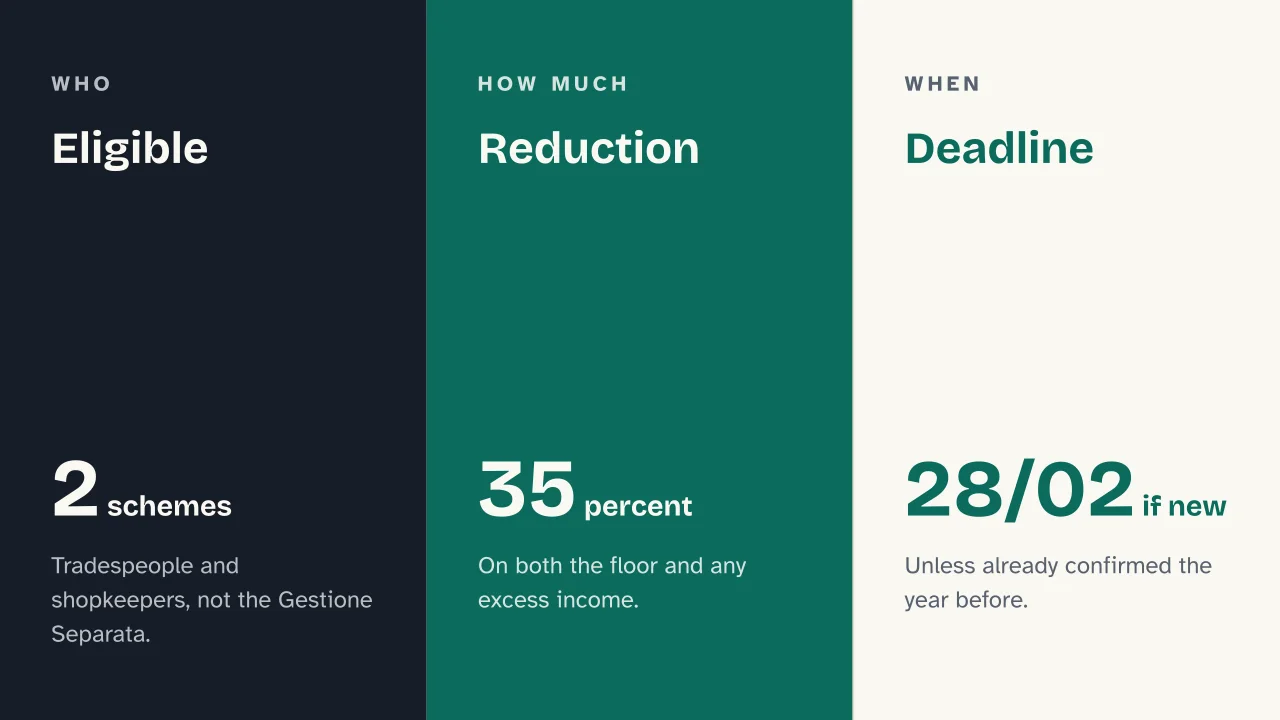 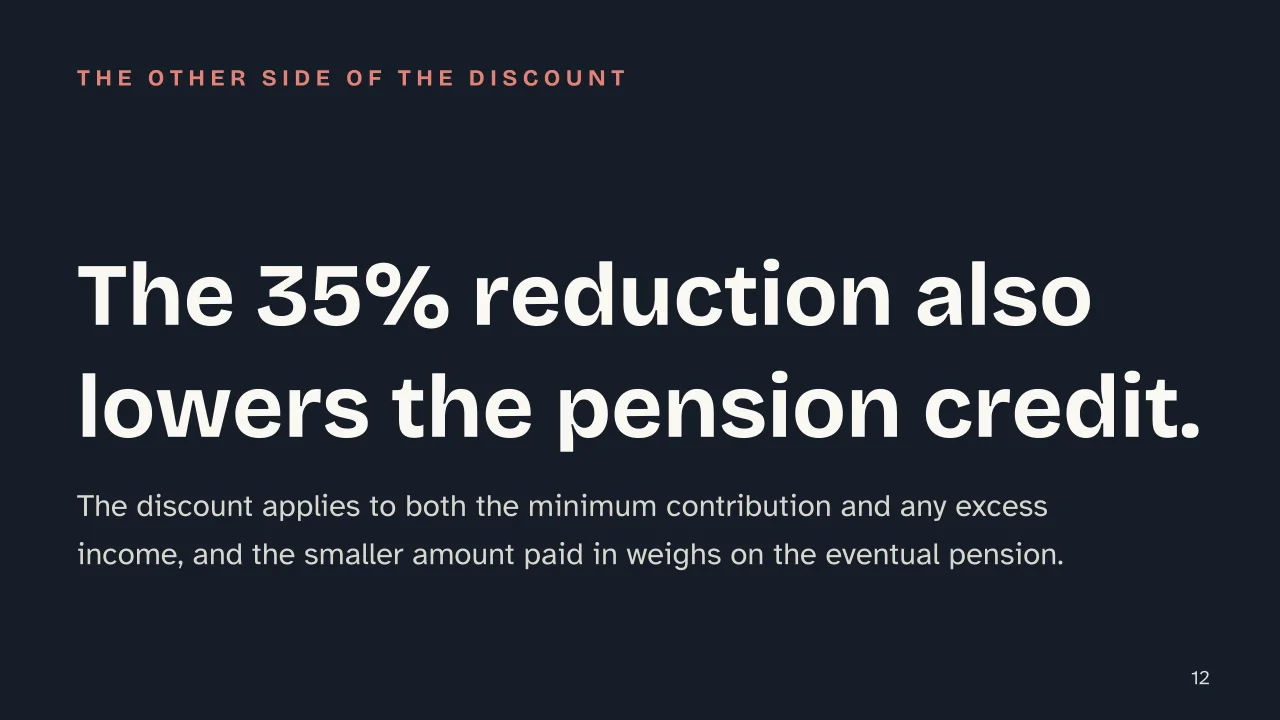  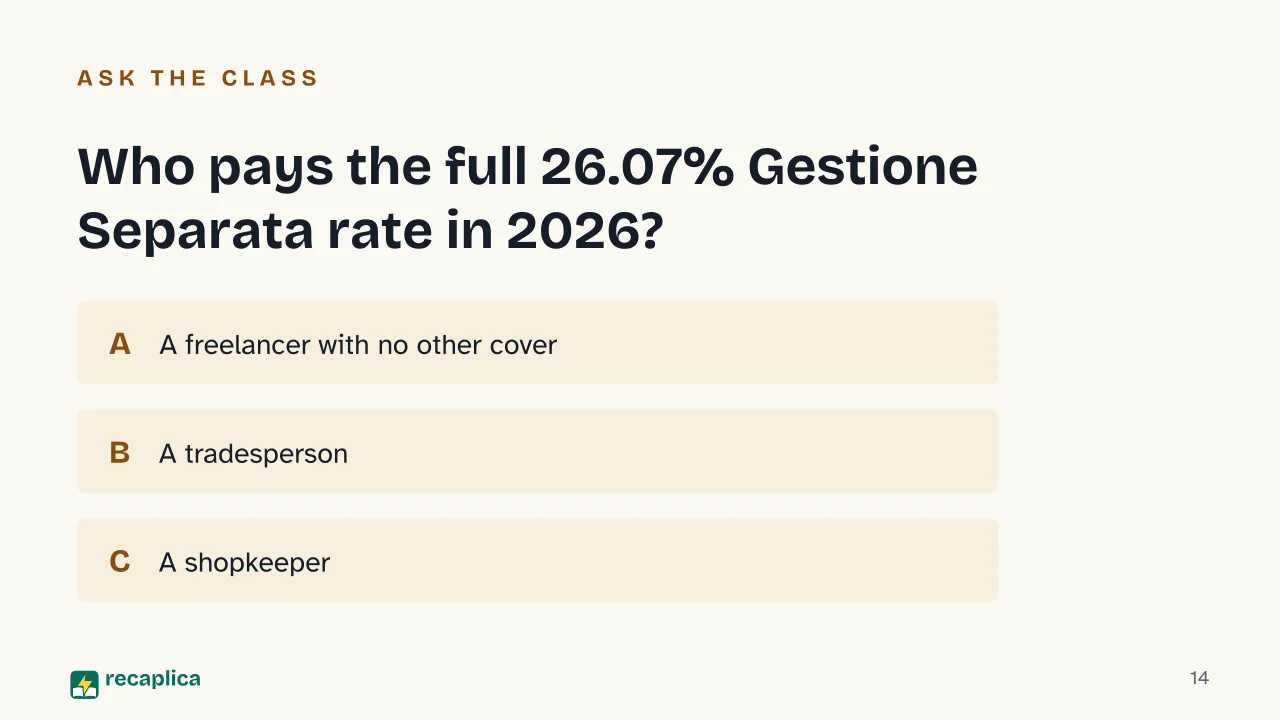  Common myths
Mind mapDrag the background to move around and the nodes to reposition them; use − and + to collapse and expand branches. 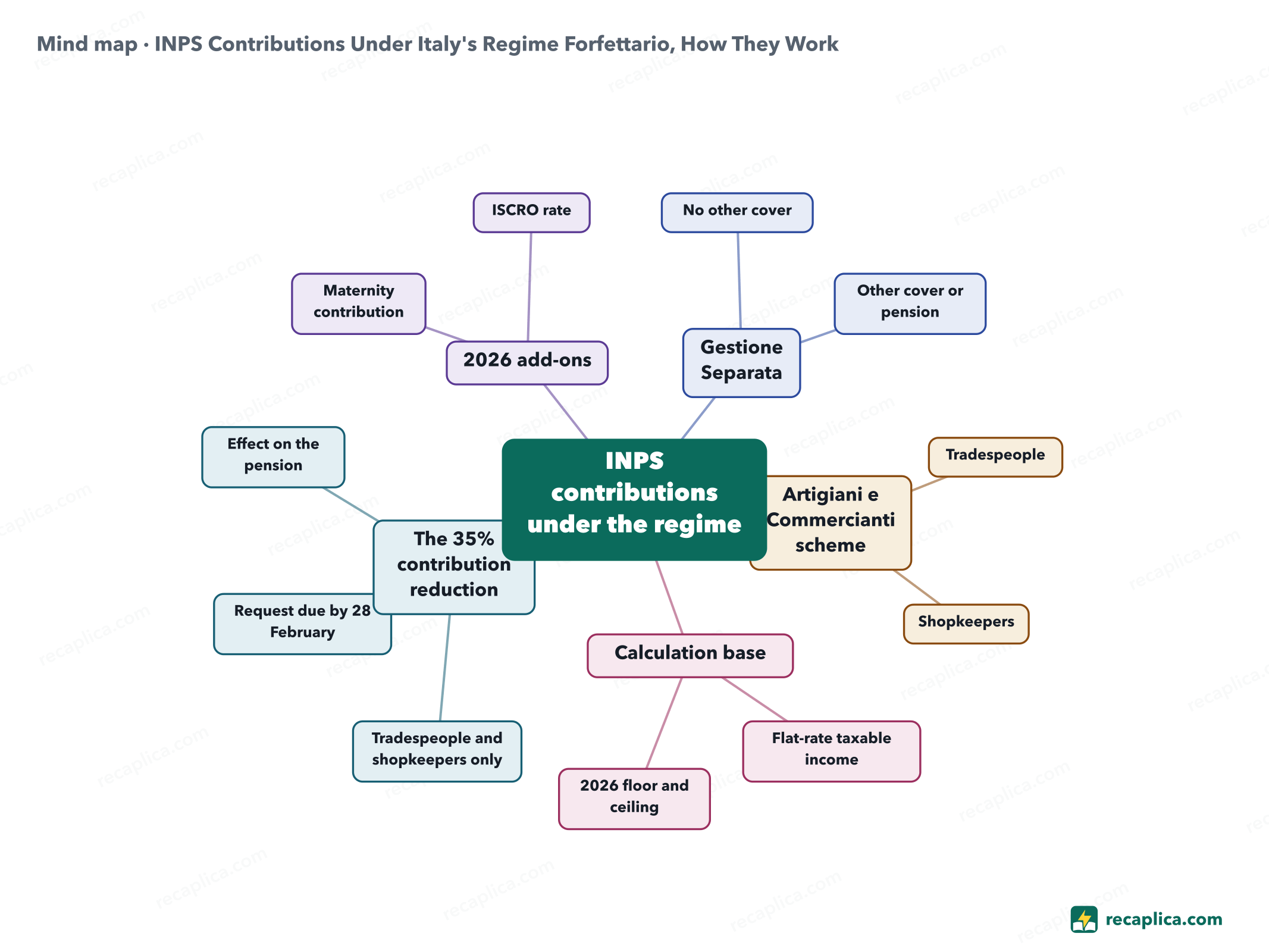
Quiz: test yourselfAnswer the questions to check what you have learned: you get instant feedback and a short explanation. Grade 0/10 0/5
FlashcardsTap the card to flip it and check whether you remember the answer, then move to the next one. 1 / 8 Explain it in your own wordsThe ultimate test: if you can explain it in simple words, you've truly understood it. Write your explanation, then compare it with the Recap. Your explanation is saved only on this device.
Frequently asked questionsHow much do you pay in INPS contributions under the regime forfettario?It depends on the scheme: a freelancer with no other cover pays 26.07% of flat-rate taxable income in 2026 to the Gestione Separata, while a tradesperson pays 24% and a shopkeeper 24.48% to their own scheme, on the same type of income. How much do INPS contributions under the regime forfettario count toward the pension?They count for exactly what gets paid in: if a tradesperson or shopkeeper requests the 35% reduction, the amount credited toward their future pension is lower, because the discount applies to both the minimum contribution and any income above it. Which INPS scheme does someone with no other pension cover join under the regime forfettario?A freelancer with a VAT number and no other mandatory pension scheme or existing pension enrolls in the Gestione Separata, at a 2026 rate of 26.07% of flat-rate taxable income. Does the 35% contribution reduction have a deadline?Yes: those who already had the reduction and want to keep it for 2026 just need to not have formally waived it, while those opening a new activity and requesting it for the first time must do so by 28 February 2026. Every Recap goes through an independent review before publication. |