Skip to content
recaplica

    One moment: security check

    Cloudflare wants to make sure you're not a robot. Tick the box below and your search will continue on its own.

    IT
    recaplica Labor Market: How Supply, Demand and Unemployment Work
    © 2026 Recaplica · recaplica.com — All rights reserved
    Home › Economics

    Labor Market: How Supply, Demand and Unemployment Work

    By Recaplica Newsroom · Updated on September 24, 2026

    What to print

    Page numbers appear when printing with default margins.

    Slides

    Choose a cut

    Flash10 slidesThe essential thread, to present in classFull16 slidesEvery chapter and the deeper detail

    Both come with speaker notes.

    Telegram channel
    recaplica Clear in 30 seconds, yours in 10 minutes.
    In 30 seconds Key points Figures Deep dive Slides Myths Mind map Quiz Flashcards FAQ

    In 30 seconds quick read

    The labor market is where businesses that need workers to produce goods and services meet the people willing to work for them. In the textbook model, that meeting sets wages and employment levels the way any other market would, but imperfect information, bargaining power and legal rules push the real market away from pure competition. Those gaps are where unemployment comes from, and economists split it into frictional, structural, cyclical and technological types depending on the cause. Official statistics, such as Italy's ISTAT, measure it against the labor force — people employed plus people actively looking for work — not the whole population. As of July 2026, Italy's unemployment rate stood at 5.8%, provisional, against 6.4% for the euro area.

    Key Points

    • Labor demand comes from businesses hiring to produce goods and services, which is why economists call it 'derived demand.'
    • Labor supply comes from workers; at the macro level it matches the labor force, the share of the population employed or willing to work.
    • In practice the labor market departs from pure competition because of imperfect information, market power and institutional rigidities.
    • There are four types of unemployment — frictional, structural, cyclical and technological — each with its own cause.
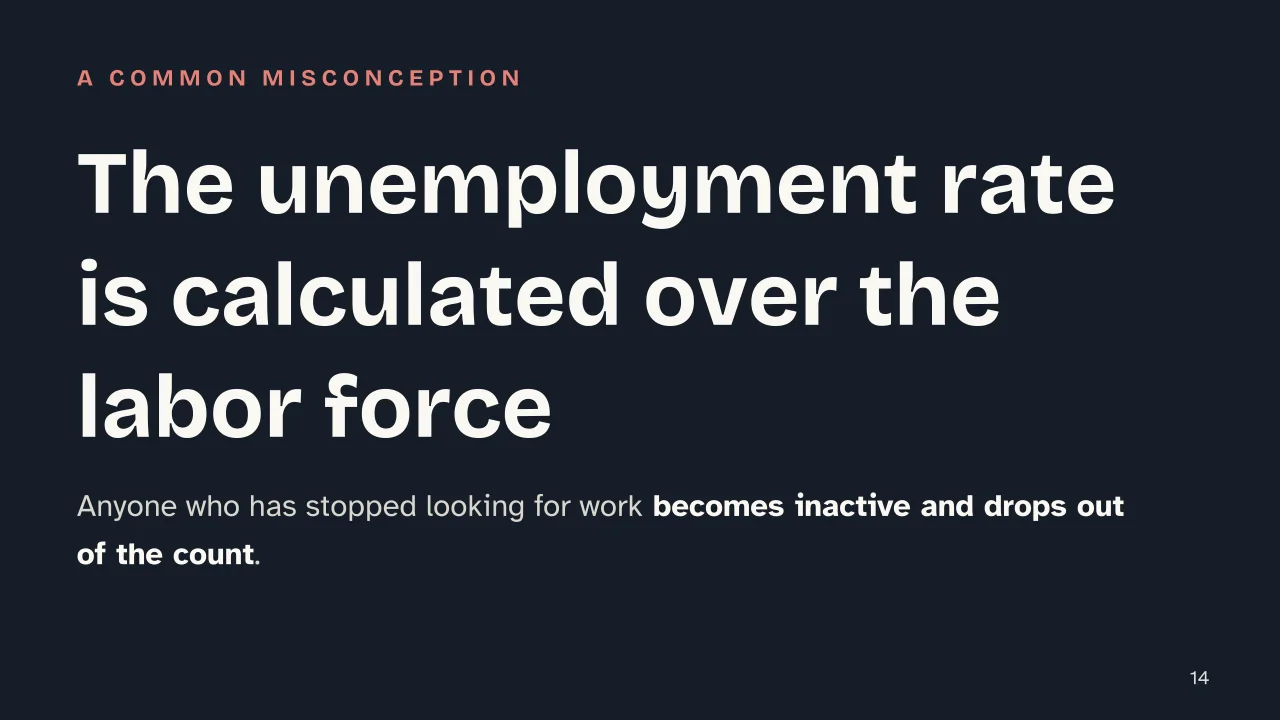
    • The unemployment rate is calculated over the labor force, not the total population: people who stop looking for work become inactive instead.
    • As of July 2026, the unemployment rate was 5.8% in Italy and 6.4% in the euro area (provisional ISTAT and Eurostat data).

    Key figures

    • 5.8% Italy's unemployment rate as of July 2026, provisional seasonally adjusted data, according to ISTAT and Eurostat. Source: ISTAT, Eurostat
    • 6.4% Euro area unemployment rate as of July 2026 (6.1% across the 27-country European Union), according to Eurostat. Source: Eurostat

    Deep Dive

    Labor Demand and Supply

    Treccani defines the labor market as the set of mechanisms that bring together businesses looking for workers and people looking for work, setting wage and employment levels between them. The two sides follow different logic.

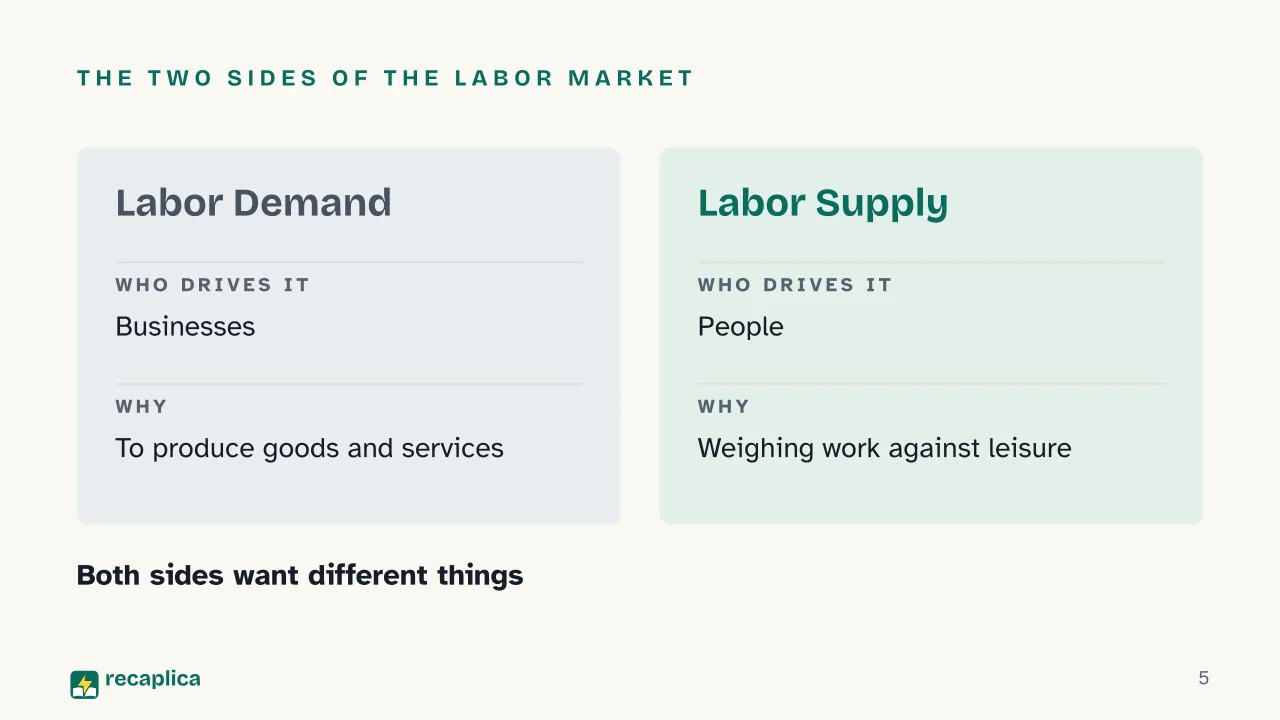
    Labor demand is the set of decisions businesses make about how much labor to use. Treccani calls it a “derived” demand: companies aren’t after labor for its own sake, they want it because it lets them produce goods and services, as part of maximizing profit. When demand for what a company sells drops, its demand for labor eventually drops too.

    Labor supply, on the other side, covers the work decisions of individuals and of the population as a whole. At the individual level, the standard neoclassical model frames it as a choice between work and leisure: each person weighs the wage on offer against the value of their own time. At the macro level, the active share of the population that supplies labor is the labor force — the same concept that official statistics later use to measure unemployment (more on that below).

    Example: an online retailer selling more needs more warehouse staff and more delivery drivers, so it hires accordingly to keep up with that extra service. That’s derived demand at work.

    Why the Real Market Differs from the Model

    In the basic model, labor demand and supply meet the way they would in any competitive market, settling on an equilibrium wage. But Treccani notes that the labor market often doesn’t follow competitive supply-and-demand rules.

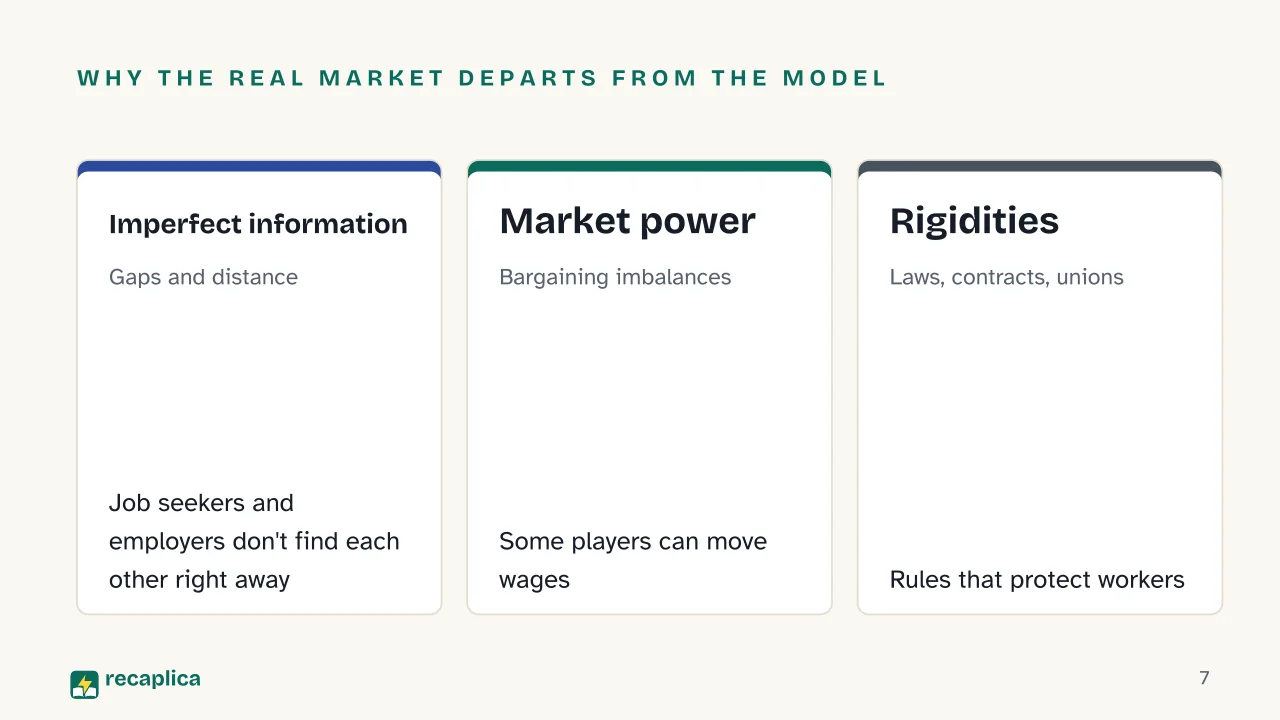
    Among the reasons for that gap: imperfect information (job seekers and employers don’t find each other right away), the market power of some players (large companies or unions that can move wages), and institutional rigidities — laws, collective contracts, worker protections — that govern employment more tightly than a typical sale of goods. The reason, Treccani explains, is that an employment relationship runs deep for the person involved: unlike other goods, labor is shaped by laws and organizations built to protect the people who supply it.

    These same gaps help explain why unemployment never quite disappears. It’s one of the places where the study of the labor market overlaps with microeconomics and macroeconomics, which look at departures from the perfect-competition model from different angles; the standard work-leisure choice model, for that matter, is a fixture of neoclassical economics.

    Four Types of Unemployment

    Treccani first separates voluntary unemployment — someone who won’t accept the market wage for their work — from involuntary unemployment, someone who would work at the going wage if a job were available but can’t find one. Involuntary unemployment breaks down into four types, each with a different cause.

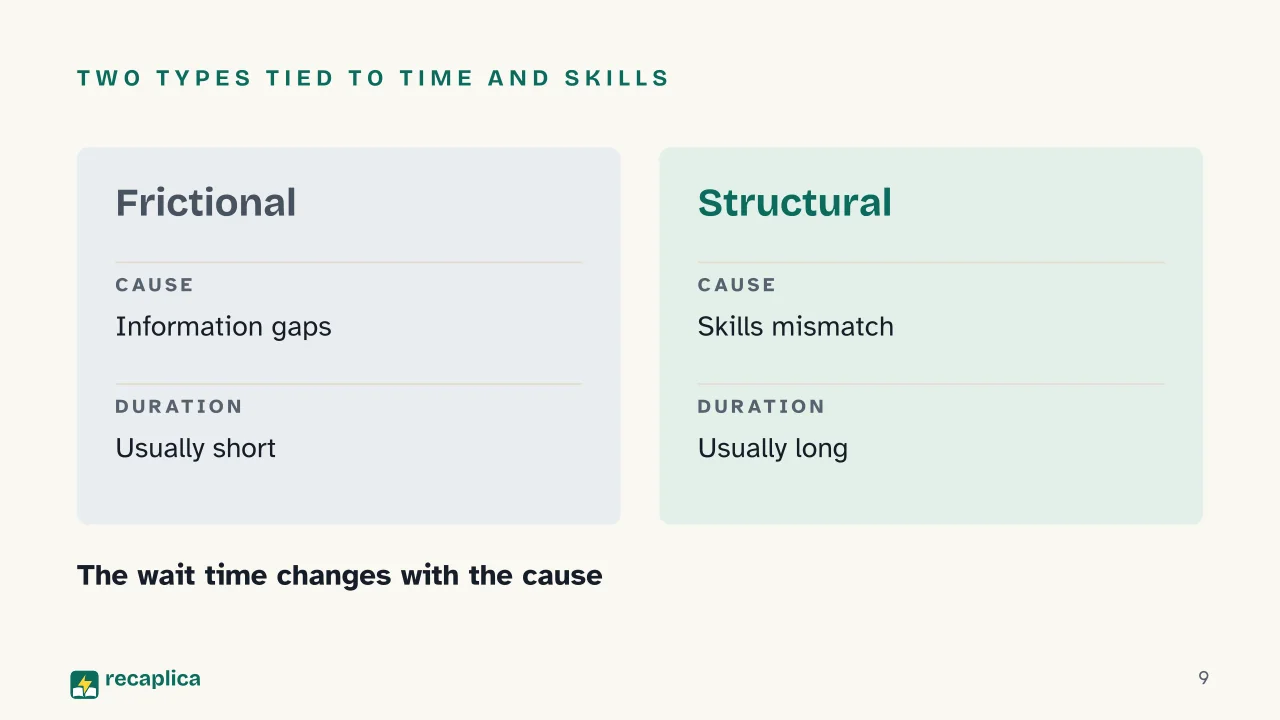
    Frictional unemployment comes from delays in matching labor demand and supply, caused by information gaps or geographic distance; it’s usually short, the time it naturally takes to find a suitable job. Structural unemployment, by contrast, comes from a structural mismatch between the skills job seekers have and what businesses need, and tends to last longer: people affected by it often have to retrain to get back into the market.

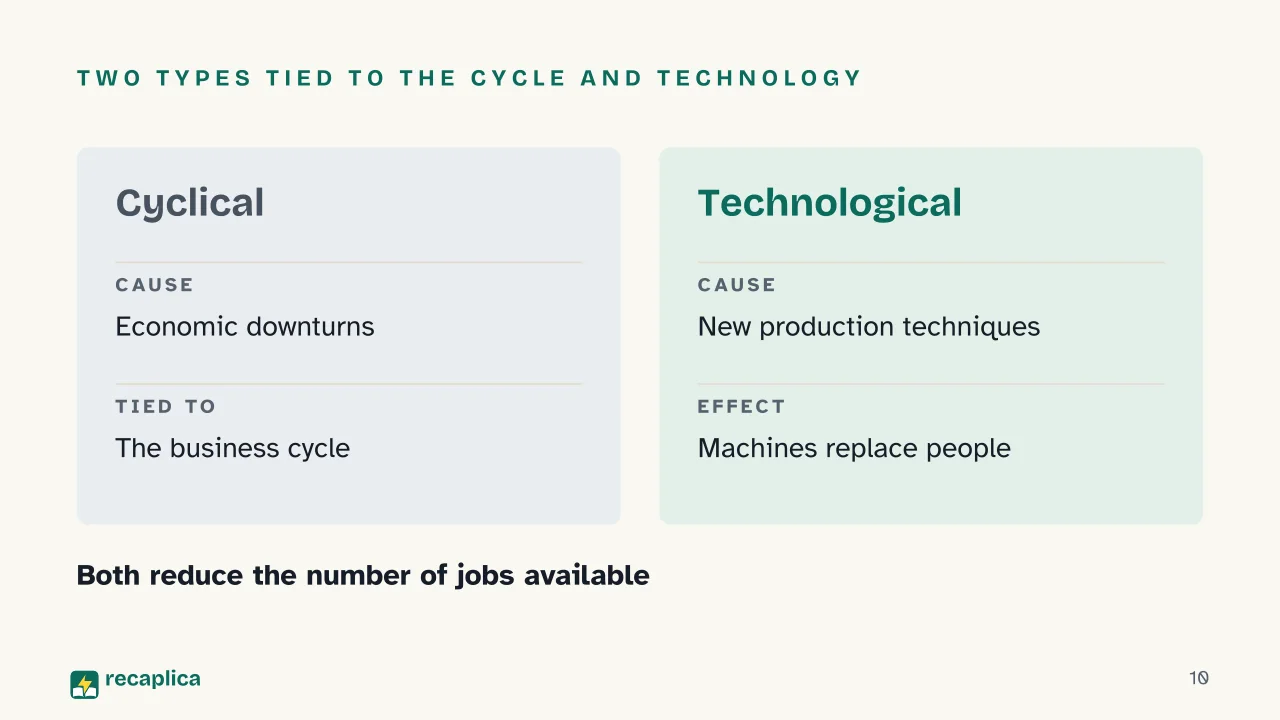
    Cyclical unemployment comes from an imbalance between the number of people looking for work and the number of jobs available, driven by downturns that shrink businesses’ demand for labor: it tracks the broader economy, the same ground covered by a Recap on recession or Keynesianism, the school of thought that put cyclical unemployment at the center of economic policy. Technological unemployment, finally, comes from new production techniques that replace human labor with machines.

    Among the other causes Treccani lists for unemployment, beyond these four categories, are downward wage rigidity, the efficiency wages businesses keep high to retain their best workers, insider-outsider dynamics in union bargaining, and skills mismatches between different sectors of the economy.

    TypeMain causeTypical duration
    FrictionalInformation gaps, geographic distanceShort
    StructuralMismatch between required and available skillsLong
    CyclicalDownturns, lower labor demandTied to the business cycle
    TechnologicalNew production techniques replace human laborVariable

    How Unemployment Is Measured

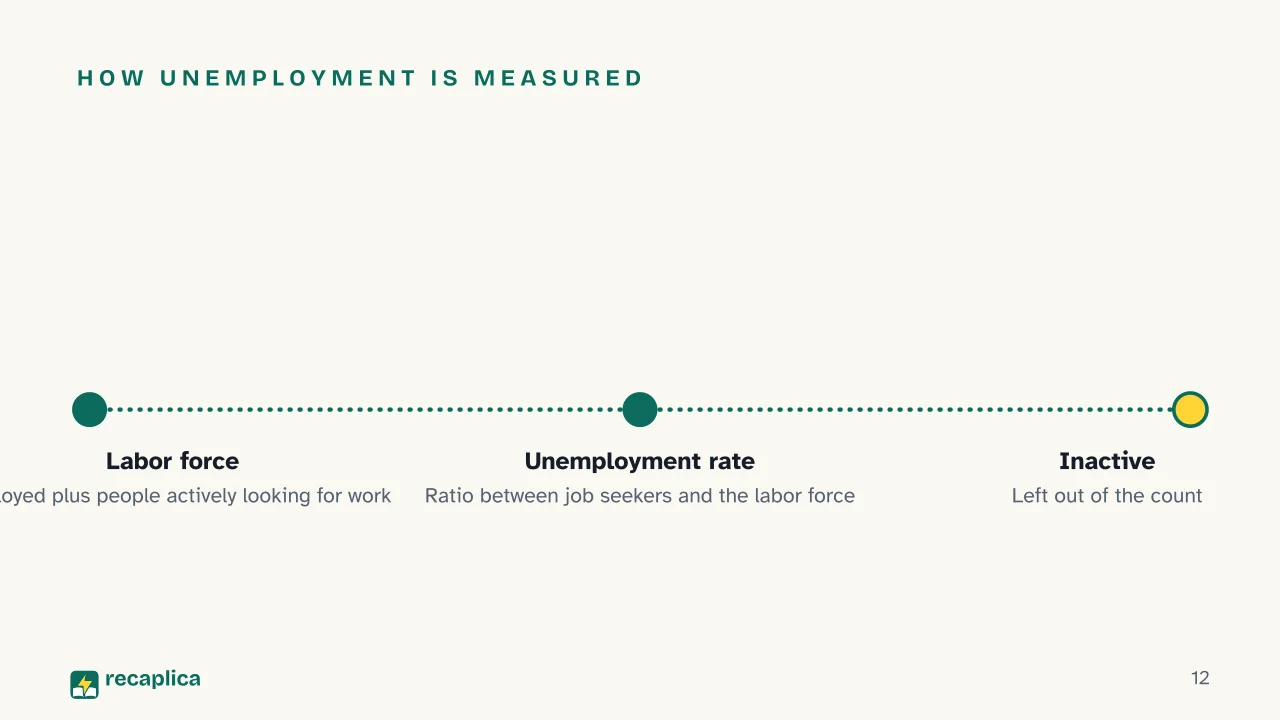
    Official Italian labor statistics follow the definitions in the ISTAT glossary for the labor force survey. The labor force includes people who are employed and those willing to work (or start a business) within the next two weeks: in other words, it’s labor supply as seen from the statistical side.

    For ISTAT, an unemployed person is someone aged 15 to 74, not employed, who has taken at least one active job-search action in the previous four weeks. The unemployment rate is the ratio between people seeking work and the corresponding labor force — not a country’s entire population. Anyone who isn’t working and isn’t actively searching doesn’t count as unemployed: they fall into the inactive category instead, people who aren’t part of the labor force because they’re classified as neither employed nor seeking work.

    The Unemployment Rate as of July 2026

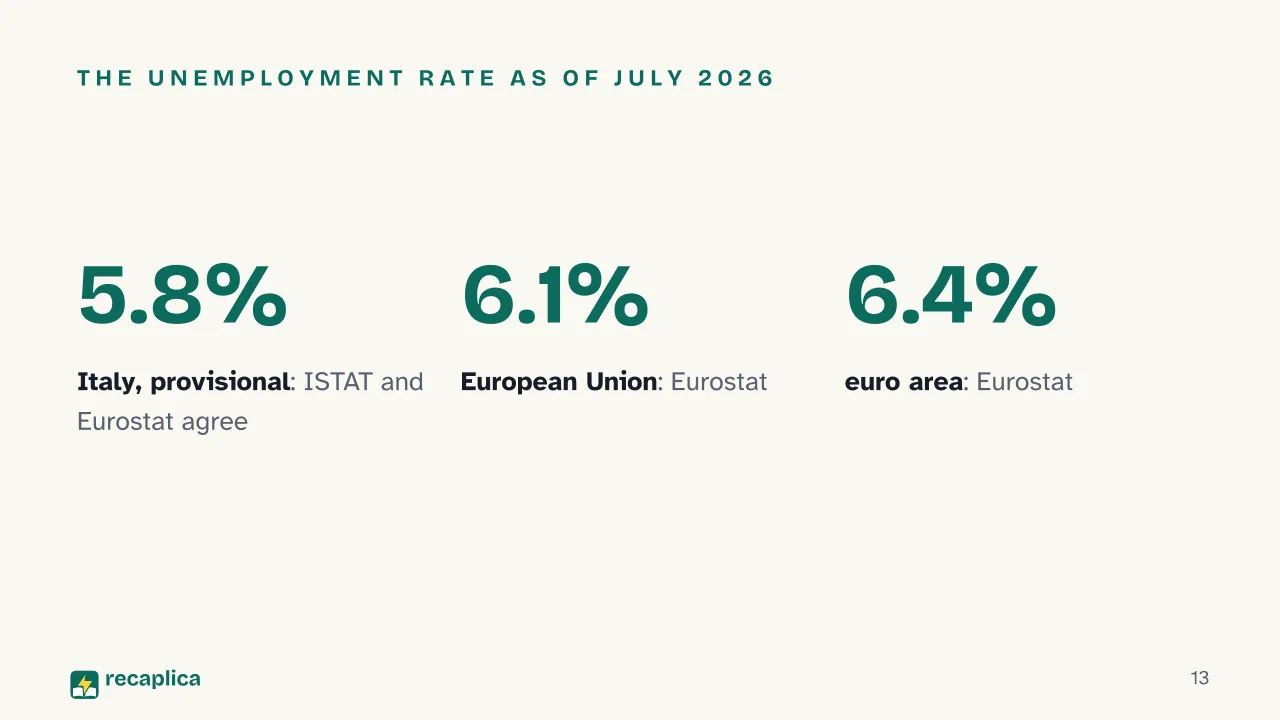
    As of July 2026, according to ISTAT’s provisional data release, Italy’s unemployment rate had fallen to 5.8%. In the same month, according to Eurostat, the seasonally adjusted euro area unemployment rate stood at 6.4%, and the 27-country European Union rate at 6.1%: the two sources agree on the Italian figure, which appears with the same value in both releases.

    AreaUnemployment rateMonth
    Italy5.8% (provisional)July 2026
    Euro area6.4%July 2026
    European Union (27 countries)6.1%July 2026

    A lower unemployment rate than the euro area doesn’t, on its own, mean a labor market without problems: the same figure can hide different shares of frictional, structural, cyclical and technological unemployment, which the aggregate statistics don’t break out. GDP for the same period comes from the same recessions and expansions that drive cyclical unemployment up and down.

    Slide deck

    Slides ready to download and make your own in PowerPoint or Google Slides, with speaker notes. Pick the Flash cut or the Full one.
    Slide 1 of the presentation on Labor Market: The Labor MarketSlide 2 of the presentation on Labor Market: Why doesn't unemployment ever hit zero, even in a healthy economy?Slide 3 of the presentation on Labor Market: What's aheadSlide 4 of the presentation on Labor Market: Chapter 01: How Demand and Supply MeetSlide 5 of the presentation on Labor Market: The two sides of the labor marketSlide 6 of the presentation on Labor Market: Chapter 02: Why the Real Market DepartsSlide 7 of the presentation on Labor Market: Why the real market departs from the model: Imperfect information, Market power, RigiditiesSlide 8 of the presentation on Labor Market: Chapter 03: The Four Types of UnemploymentSlide 9 of the presentation on Labor Market: Two types tied to time and skillsSlide 10 of the presentation on Labor Market: Two types tied to the cycle and technologySlide 11 of the presentation on Labor Market: Chapter 04: How Unemployment Is MeasuredSlide 12 of the presentation on Labor Market: How unemployment is measuredSlide 13 of the presentation on Labor Market: The unemployment rate as of July 2026Slide 14 of the presentation on Labor Market: The unemployment rate is calculated over the labor forceSlide 15 of the presentation on Labor Market: What population does the ISTAT glossary use to calculate the unemployment rate?Slide 16 of the presentation on Labor Market: The full Recap
    Flash10 slidesThe essential thread, to present in classFull16 slidesEvery chapter and the deeper detail

    Common myths

    • ✗ Myth Zero unemployment would be the sign of a perfectly healthy economy.

      ✓ Reality According to Treccani, frictional unemployment — the time it physically takes to match job seekers with openings — isn't something economies are meant to eliminate: information gaps and geographic distance mean someone is always between jobs. A rate of exactly zero doesn't happen in practice.

    • ✗ Myth Being unemployed means someone chose not to work.

      ✓ Reality Treccani separates voluntary unemployment, when someone won't accept the going wage for their line of work, from involuntary unemployment, when someone would take a job at the current wage but can't find one. Official statistics, like ISTAT's, only count people who are actively searching as unemployed — choosing to stay out of the labor force is a different category.

    • ✗ Myth The unemployment rate is calculated over a country's entire population.

      ✓ Reality The ISTAT glossary defines the unemployment rate as the ratio between people seeking work and the corresponding labor force, not the total population: anyone who isn't working and isn't actively searching becomes inactive and falls outside that count.

    Mind map

    Drag the background to move around and the nodes to reposition them; use − and + to collapse and expand branches.
    Customize
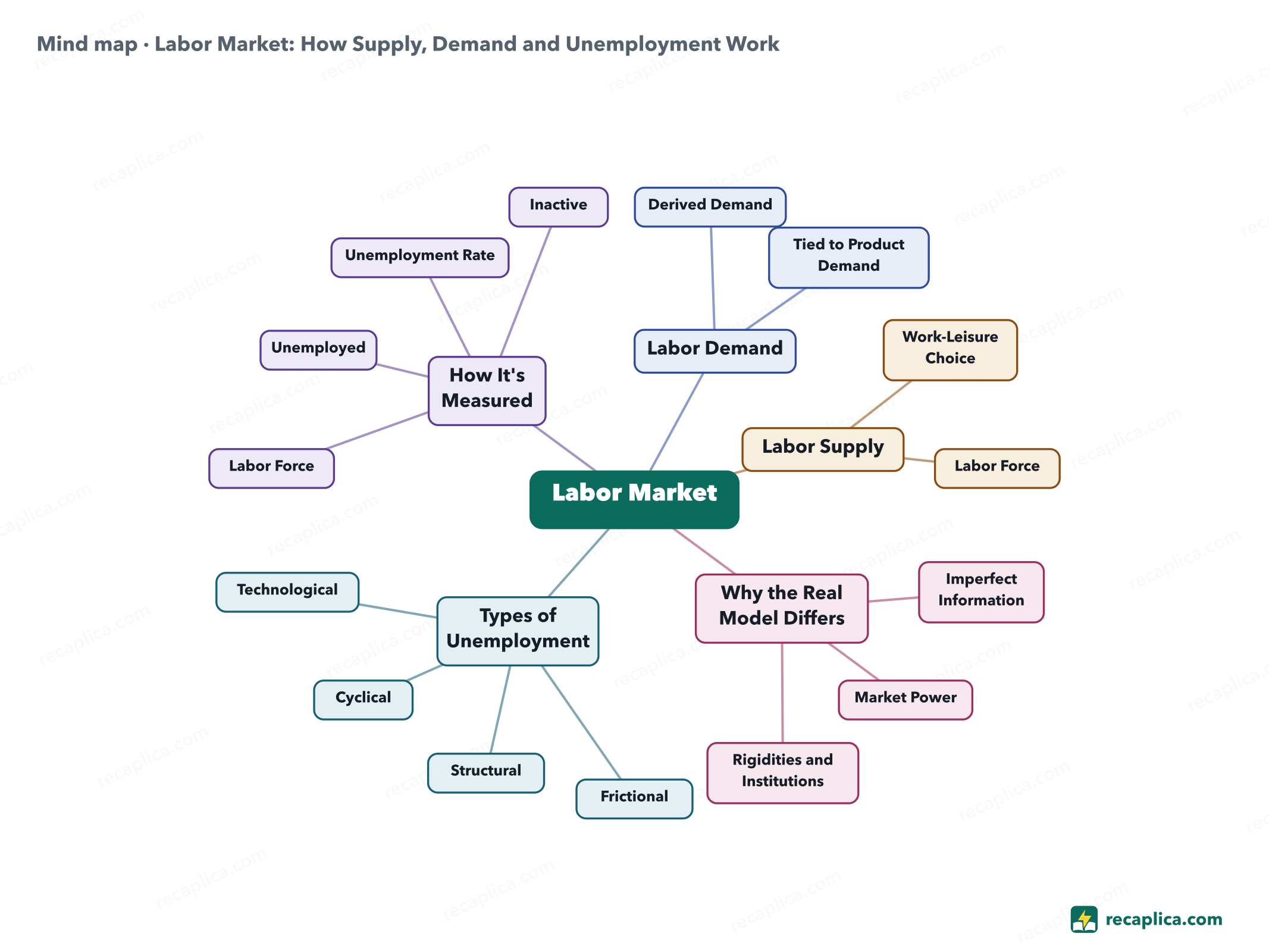
    Mind map: Labor Market: How Supply, Demand and Unemployment Work
    • Labor Market
      • Labor Demand Business decisions, derived demand
        • Derived Demand Businesses hire to produce goods and services
        • Tied to Product Demand Rises and falls with company sales
      • Labor Supply Individual work decisions
        • Work-Leisure Choice Neoclassical model, at the individual level
        • Labor Force Labor supply at the macro level
      • Why the Real Model Differs
        • Imperfect Information Job seekers and employers don't find each other right away
        • Market Power Some players influence wages
        • Rigidities and Institutions Laws, contracts, labor protections
      • Types of Unemployment
        • Frictional Delays in matching supply and demand
        • Structural Mismatch between required and available skills
        • Cyclical Recessions, less demand for labor
        • Technological New techniques replace human labor
      • How It's Measured
        • Labor Force Employed plus people actively looking for work
        • Unemployed Active job search in the past four weeks
        • Unemployment Rate Ratio over the labor force, not the population
        • Inactive Outside the labor force

    Quiz: test yourself

    Answer the questions to check what you have learned: you get instant feedback and a short explanation.

    Grade 0/10 0/5
    1 Why is business demand for labor called 'derived demand'?

    According to Treccani, labor demand is 'derived' because businesses use labor to produce goods and services as part of maximizing profit.

    2 What separates frictional unemployment from structural unemployment?

    According to Treccani, frictional unemployment stems from information gaps or geographic distance and is usually short-lived; structural unemployment comes from a mismatch between workers' skills and what businesses need, and tends to last longer.

    3 Which type of unemployment is tied to new production techniques that replace human labor with machines?

    Treccani defines technological unemployment as the kind caused by new production techniques that replace human labor with machines.

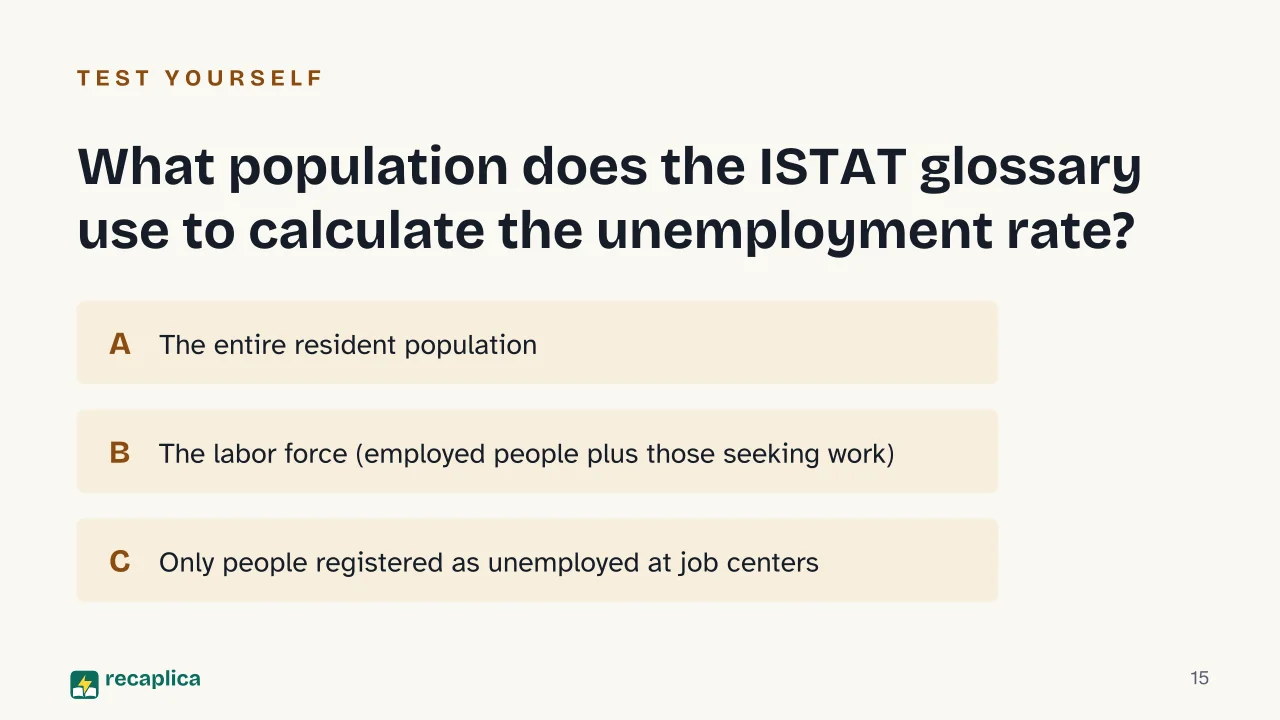
    4 What population does the ISTAT glossary use to calculate the unemployment rate?

    The ISTAT glossary defines the unemployment rate as the ratio between people seeking work and the corresponding labor force, not the entire population.

    5 True or false: someone who has stopped actively looking for work and isn't employed counts as 'unemployed' in ISTAT statistics.

    False: according to the ISTAT glossary, an unemployed person must have taken at least one active job-search action in the previous four weeks. Someone who has stopped looking falls into the inactive category instead.

    Answers: 1-A · 2-A · 3-C · 4-B · 5-B

    Flashcards

    Tap the card to flip it and check whether you remember the answer, then move to the next one.

    1 / 8

    Explain it in your own words

    The ultimate test: if you can explain it in simple words, you've truly understood it. Write your explanation, then compare it with the Recap.

    Your explanation is saved only on this device.

    The labor market is where businesses that need workers to produce goods and services meet the people willing to work for them. In the textbook model, that meeting sets wages and employment levels the way any other market would, but imperfect information, bargaining power and legal rules push the real market away from pure competition. Those gaps are where unemployment comes from, and economists split it into frictional, structural, cyclical and technological types depending on the cause. Official statistics, such as Italy's ISTAT, measure it against the labor force — people employed plus people actively looking for work — not the whole population. As of July 2026, Italy's unemployment rate stood at 5.8%, provisional, against 6.4% for the euro area.

    Frequently asked questions

    What is the labor market?

    According to Treccani, it's the set of mechanisms that bring together businesses looking for workers and people looking for work, setting wage and employment levels between them.

    What is unemployment?

    Unemployment is what happens when people who would work at the going wage can't find a job — Treccani calls this involuntary unemployment, as opposed to voluntary unemployment, when someone turns down the market wage for their own work.

    How does unemployment work — why does it exist?

    Because the real labor market doesn't behave like a perfectly competitive one: Treccani points to imperfect information, market power and institutional rigidities as the reasons demand and supply for labor don't always meet instantly or completely, which produces different forms of unemployment (frictional, structural, cyclical, technological).

    What's the difference between unemployed and inactive people?

    Unemployed people are actively searching for work; inactive people aren't. According to the ISTAT glossary, inactive people are those outside the labor force, classified as neither employed nor seeking work.

    What is Italy's unemployment rate?

    As of July 2026 Italy's unemployment rate was 5.8% (provisional), according to ISTAT and Eurostat; that same month the euro area rate was 6.4% and the European Union rate was 6.1%.

    Sources

    • Treccani, Dictionary of Economics and Finance — labor market
    • Treccani, Dictionary of Economics and Finance — labor demand
    • Treccani, Dictionary of Economics and Finance — labor supply
    • Treccani, Dictionary of Economics and Finance — unemployment
    • ISTAT — Glossary of the Labor Force Survey
    • ISTAT — Employment and unemployment (provisional data), July 2026
    • Eurostat — Euro area unemployment at 6.4%

    Every Recap goes through an independent review before publication.

    Every evening, the day's new Recaps on our Telegram channel. Join the channel →

    Keep learning

    • Economics Biggest Economies in the World: The Ranking by GDP, Explained In 2024, according to World Bank data, the United States remains the country with the highest nominal GDP in the world, ahead of China. Measured instead at purchasing power parity (PPP), which accounts for differences in price levels between countries, the ranking flips and China moves into first place. Nominal GDP reflects the weight of an economy on international markets in current dollars; PPP GDP reflects the domestic purchasing power of a country's residents. The two measures tell different stories, which is why the same economy can rank differently depending on which one you check. Read the Recap →
    • Economics Welfare State: What It Is and How It Works A welfare state is the set of public policies through which a state provides social protection to its citizens across the different stages of life, from healthcare to old age. It began in Germany in the 1880s, when Chancellor Otto von Bismarck pushed through three laws insuring workers against sickness, workplace accidents, and invalidity and old age. In the United Kingdom, the Beveridge Report, presented to parliament in November 1942, laid the groundwork for a more universal model, extended to the whole population. The International Labour Organization frames welfare policy around four functions: healthcare, support for children and education, income security for working-age adults, and pensions. Public social spending has grown sharply across OECD countries, from under 10% of GDP in 1960 to over 30% in France and Italy in 2022. Read the Recap →
    • Economics Poverty: Definition and How It Differs from Inequality and Underdevelopment Poverty is the condition of lacking the minimum resources needed to live, and it can be measured in more than one way depending on the yardstick used. Absolute poverty is set against a fixed threshold, such as the basket of essential goods ISTAT uses in Italy or the World Bank's international line of $3 a day, while relative poverty compares a household's spending with the average in its own country. It is a distinct phenomenon from economic inequality, which Eurostat measures with the Gini index on the distribution of income, and from underdevelopment, which the United Nations Development Programme assesses with the Human Development Index by looking beyond economic growth alone. According to the World Bank, 831 million people worldwide were living in extreme poverty in 2025. Read the Recap →

    recaplica

    Clear in 30 seconds, yours in 10 minutes.

    Recaps Mind maps Request a Recap Telegram channel Mind map maker Our method About Privacy & cookies Legal notes & terms of use

    © 2026 Recaplica · A project by Curi S.r.l. — VAT IT05472000750

    Statistics, only if you say so

    To learn which Recaps help most we would use Google Analytics, with aggregate, anonymous data. It starts only with your OK, and you can change your mind anytime. Privacy policy