Skip to content
recaplica

    One moment: security check

    Cloudflare wants to make sure you're not a robot. Tick the box below and your search will continue on its own.

    IT
    recaplica Microeconomics vs Macroeconomics: What's the Difference
    © 2026 Recaplica · recaplica.com — All rights reserved
    Home › Economics

    Microeconomics vs Macroeconomics: What's the Difference

    By Recaplica Newsroom · Updated on September 18, 2026

    What to print

    Page numbers appear when printing with default margins.

    Slides

    Choose a cut

    Flash10 slidesThe essential thread, to present in classFull14 slidesEvery chapter and the deeper detail

    Both come with speaker notes.

    Telegram channel
    recaplica Clear in 30 seconds, yours in 10 minutes.
    In 30 seconds Key points Figures Deep dive Slides Myths Mind map Quiz Flashcards FAQ

    In 30 seconds quick read

    Microeconomics and macroeconomics are two different lenses for looking at the economy. Microeconomics studies individual decision-makers, such as households and firms, and how prices form in a specific market. Macroeconomics studies the large aggregates that describe an entire country, such as national income, employment and the overall price level. The two fields did not emerge together: microeconomics traces back to the 1870s, while macroeconomics became a discipline of its own almost seventy years later. Knowing the difference makes it easier to follow an economics headline or a textbook chapter without mixing up the two levels.

    Key Points

    • Microeconomics studies the choices of consumers and firms and how individual markets work.
    • Macroeconomics studies the large aggregates of an entire country: national income, employment, the overall price level.
    • Microeconomics is traditionally traced back to Léon Walras, in the early 1870s.
    • Macroeconomics emerges as a separate discipline with Keynes's 1936 work, after decades in which the individual-level view had dominated.
    • The two fields overlap: macro-level totals are built from individual behavior, and macro policy decisions reshape micro-level choices.
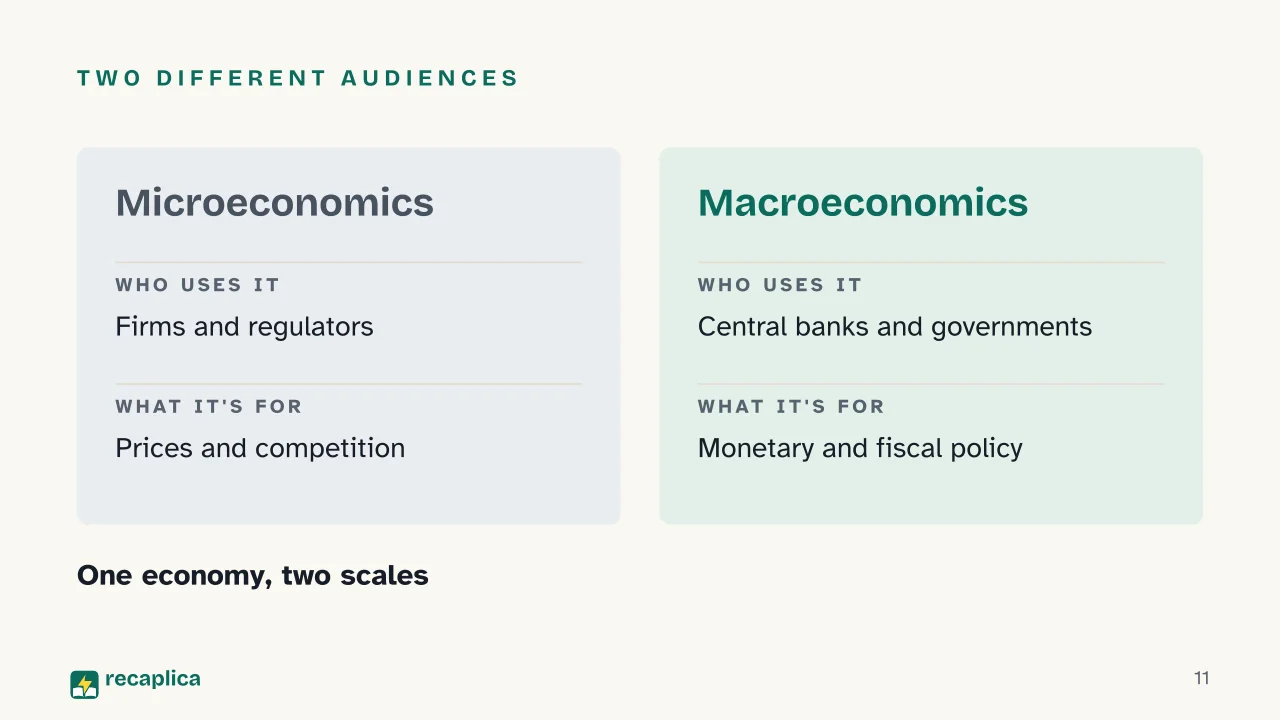
    • Central banks and governments rely mostly on macroeconomic analysis; firms and market regulators rely mostly on microeconomic analysis.

    Key figures

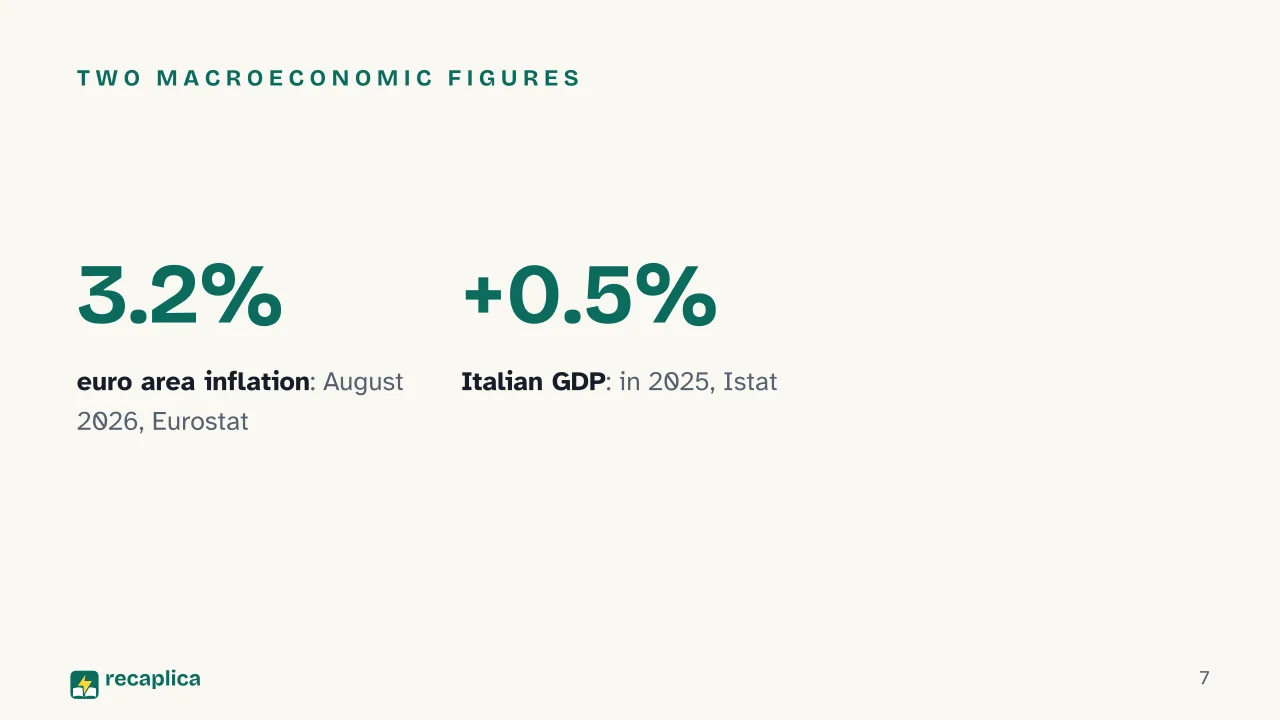
    • 3.2% Euro area inflation in August 2026, a macroeconomic figure that describes an entire currency area rather than a single market. Source: Eurostat
    • +0.5% Change in Italy's GDP in 2025, measured in chained volumes: another aggregate typical of macroeconomic analysis. Source: Istat

    Deep Dive

    What microeconomics studies

    According to Treccani, microeconomics is the branch of economic theory that deals with the behavior of individual economic agents: consumers and firms, both when they act on their own and when they interact with each other, typically through the market. Its field of view covers the allocation of goods among households, firms, individual industries and specific markets.

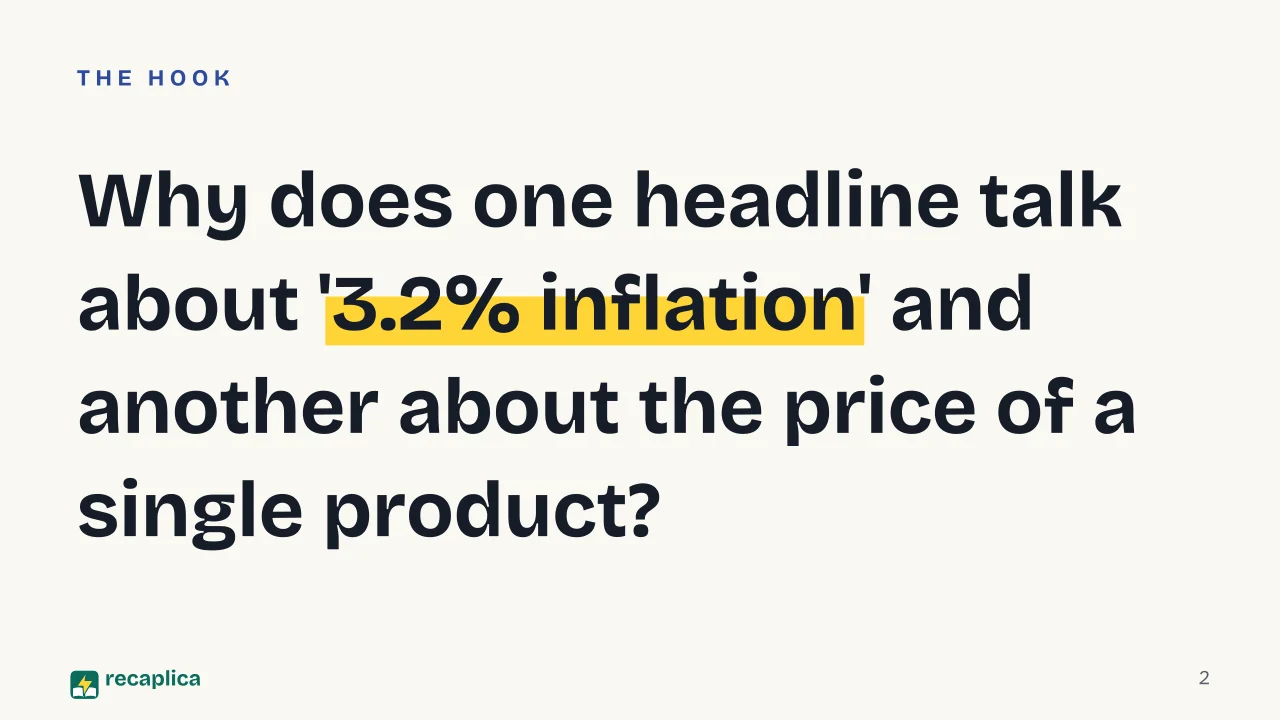
    In practical terms, microeconomics answers questions like: why does the price of a good rise when demand grows? How does a firm decide how much to produce? What happens to a market when a new competitor enters?

    Practical example: a grocery store raises the price of strawberries once the season ends and supply shrinks; shoppers buy fewer of them, and some switch to other fruit. It’s a textbook case of microeconomics: one market, one good, supply and demand adjusting to each other.

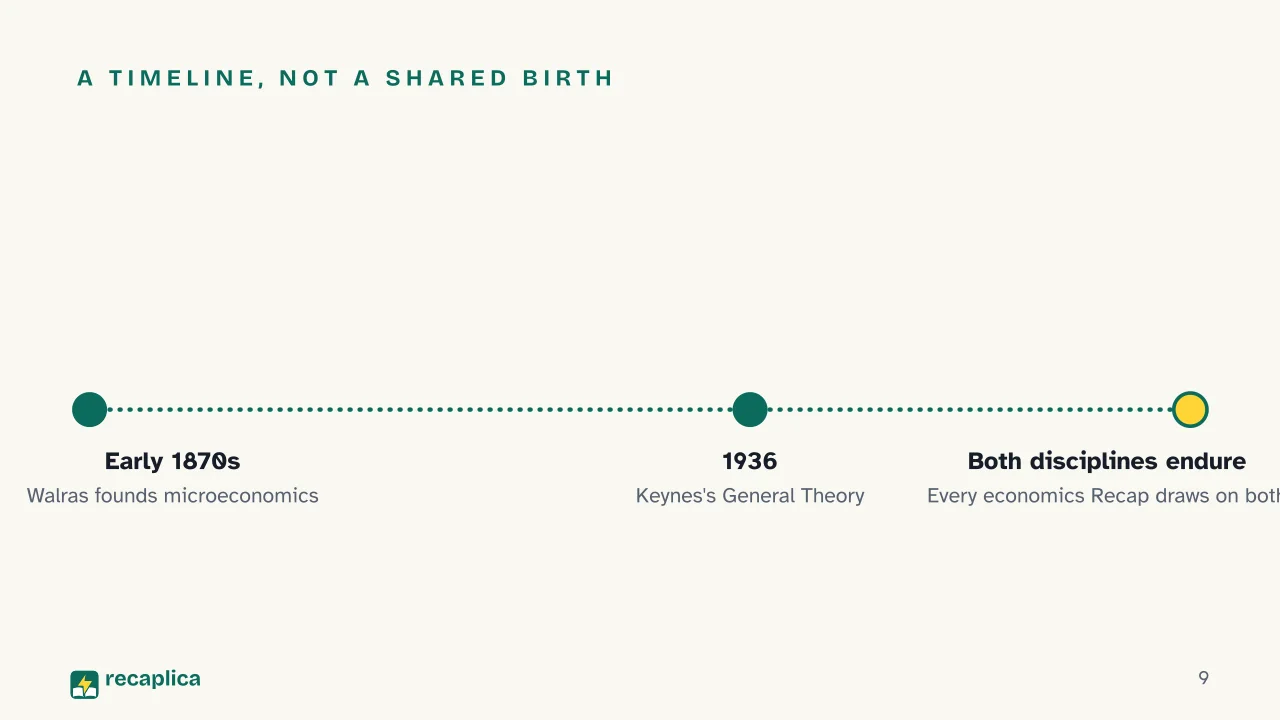
    Microeconomics is traditionally traced back to Léon Walras, in the early 1870s. Treccani notes that before then, and for several decades afterward under the classical and neoclassical schools, economists’ attention remained focused on individual-level phenomena: what we now call the microeconomic view was, quite simply, the only view available.

    What macroeconomics studies

    Macroeconomics, Treccani continues, is concerned with identifying the equilibrium values of the large aggregates: national income, overall employment, the general price level. Among the variables it analyzes are also aggregate demand (public and private consumption, investment, the trade balance), monetary and fiscal policy, unemployment and inflation.

    The historical reference point that encyclopedias cite for the birth of the discipline is the General Theory of Employment, Interest and Money, published by John Maynard Keynes in 1936. With that book, according to Treccani, the state took on “a decisive role” in supporting economic growth through public spending, an effect textbooks call the income multiplier: public spending generates an increase in national income that is more than proportional to the initial outlay. According to Treccani, this same moment also marks the birth of economic policy as its own scientific discipline, dedicated to studying the effects of state intervention.

    A Recap on inflation or one on GDP are, in this sense, direct examples of macroeconomic topics: they describe an entire country or currency area, not a single store or a single product.

    When the two disciplines split

    Almost seventy years separate the founding of microeconomics (early 1870s) from the birth of macroeconomics as a distinct discipline (1936). According to Treccani, the shift wasn’t sudden: it was specifically the Keynesian literature of the interwar years that gradually pushed the analysis of individual-level processes aside in favor of the large aggregates. Before Keynes, other economists, from Quesnay to Malthus, from Say to Marx, had already touched on topics we would now call macroeconomic, but without building a separate discipline around them, with its own name and its own method.

    Historically, microeconomics remains the one that took shape as an independent field of study first.

    Micro and macro economics: how they connect in practice

    Large macroeconomic quantities don’t exist in the abstract: Treccani says as much when it describes aggregates as sets built from countless individual quantities. National income is the sum of what millions of households and firms earn; overall employment is the sum of individual hires; inflation tracks how the prices of thousands of goods and services, set every day in individual markets, change on average.

    The link runs the other way too: a decision made at the macroeconomic level reshapes the choices of individual agents. When a central bank raises interest rates, a mortgage becomes more expensive: households put off buying a home, firms rethink an investment plan.

    MicroeconomicsMacroeconomics
    Subject of studyIndividual agents and marketsAggregates of the whole economy
    Typical exampleThe price of a goodNational income, inflation
    Main usersFirms, market regulatorsCentral banks, governments
    Founded as a disciplineEarly 1870s (Walras)1936 (Keynes)

    A recession, for instance, is a phenomenon observed at the macroeconomic level, a country’s GDP contracting for at least two consecutive quarters, but its causes and effects almost always run through microeconomic choices: firms cutting output, households trimming spending, a labor market hiring less. A recession, then, lines up both levels at once: individual stores and households on one side, a country’s GDP on the other.

    Slide deck

    Slides ready to download and make your own in PowerPoint or Google Slides, with speaker notes. Pick the Flash cut or the Full one.
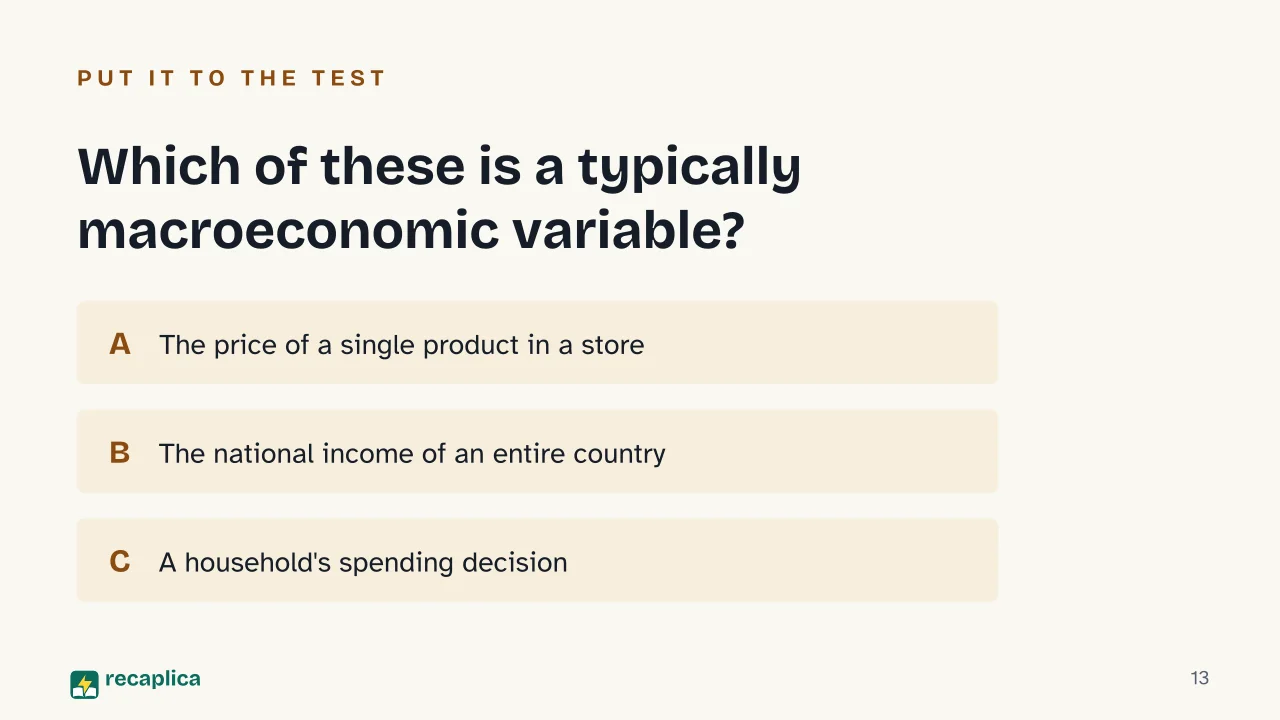
    Slide 1 of the presentation on Microeconomics vs Macroeconomics: Microeconomics and macroeconomicsSlide 2 of the presentation on Microeconomics vs Macroeconomics: Why does one headline talk about '3.2% inflation' and another about the price of a single product?Slide 3 of the presentation on Microeconomics vs Macroeconomics: The routeSlide 4 of the presentation on Microeconomics vs Macroeconomics: Chapter 01: What microeconomics studiesSlide 5 of the presentation on Microeconomics vs Macroeconomics: What microeconomics looks atSlide 6 of the presentation on Microeconomics vs Macroeconomics: Chapter 02: Macroeconomic aggregatesSlide 7 of the presentation on Microeconomics vs Macroeconomics: Two macroeconomic figuresSlide 8 of the presentation on Microeconomics vs Macroeconomics: Chapter 03: When the two disciplines splitSlide 9 of the presentation on Microeconomics vs Macroeconomics: A timeline, not a shared birthSlide 10 of the presentation on Microeconomics vs Macroeconomics: Chapter 04: How they connect, who uses themSlide 11 of the presentation on Microeconomics vs Macroeconomics: Two different audiencesSlide 12 of the presentation on Microeconomics vs Macroeconomics: Adding up markets doesn't give you macroeconomics.Slide 13 of the presentation on Microeconomics vs Macroeconomics: Which of these is a typically macroeconomic variable?Slide 14 of the presentation on Microeconomics vs Macroeconomics: The full Recap
    Flash10 slidesThe essential thread, to present in classFull14 slidesEvery chapter and the deeper detail

    Common myths

    • ✗ Myth The split between microeconomics and macroeconomics has always existed in economic thought.

      ✓ Reality Until the early twentieth century, economists worked almost entirely within what we would now call the microeconomic view: Treccani notes that it was specifically the Keynesian literature of the interwar years that gradually shifted attention toward aggregate phenomena. The split into two disciplines is therefore a twentieth-century development, not a boundary that was there from the start.

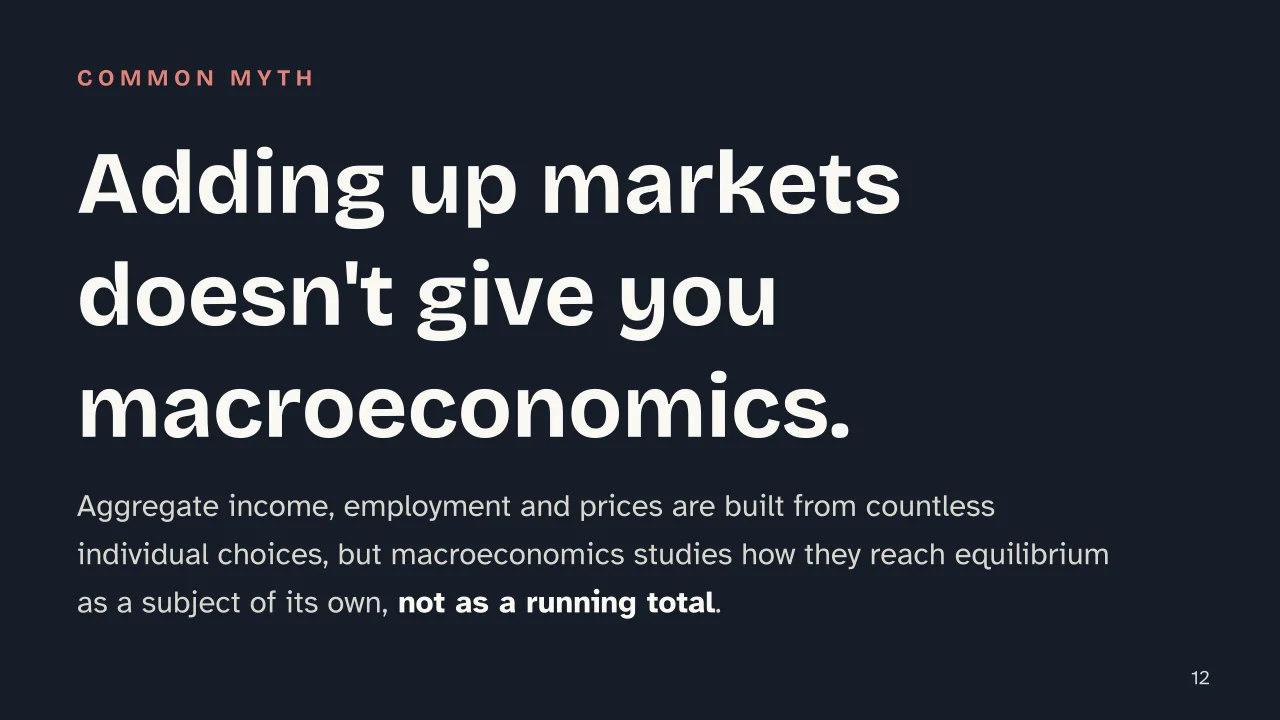
    • ✗ Myth Macroeconomics is just microeconomics added up.

      ✓ Reality Treccani defines macroeconomics as the study of equilibrium values for large aggregates: those aggregates are indeed built from countless individual quantities, but the discipline treats their equilibrium as its own object of study, with its own theories and tools, rather than as a simple sum of individual cases.

    • ✗ Myth Microeconomics and macroeconomics cover completely separate ground, with no overlap.

      ✓ Reality Both fields share concepts such as supply and demand, applied at different scales: a single market in microeconomics, the whole economy in macroeconomics. A macro-level decision, such as a change in interest rates, reshapes the micro-level choices of households and firms.

    Mind map

    Drag the background to move around and the nodes to reposition them; use − and + to collapse and expand branches.
    Customize
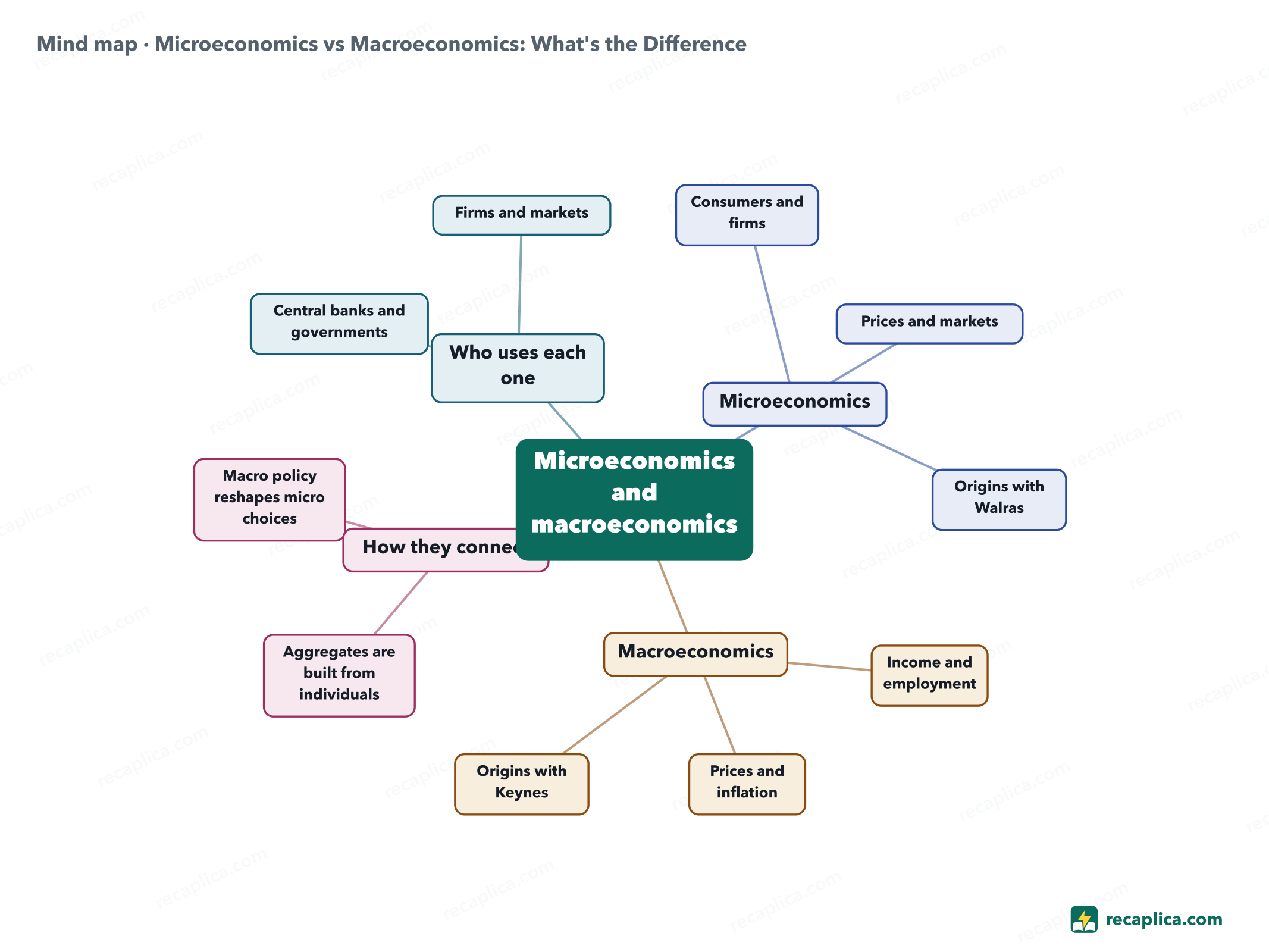
    Mind map: Microeconomics vs Macroeconomics: What's the Difference
    • Microeconomics and macroeconomics
      • Microeconomics How individual economic agents behave
        • Consumers and firms Individual choices and market interactions
        • Prices and markets Supply and demand for a single good
        • Origins with Walras Traced back to the early 1870s
      • Macroeconomics Equilibrium values of the large aggregates
        • Income and employment National income and overall employment
        • Prices and inflation The general price level across the economy
        • Origins with Keynes The General Theory, published in 1936
      • How they connect
        • Aggregates are built from individuals Macro totals contain sets of micro quantities
        • Macro policy reshapes micro choices A higher interest rate, for instance
      • Who uses each one
        • Central banks and governments Monetary and fiscal policy
        • Firms and markets Prices, output, competition

    Quiz: test yourself

    Answer the questions to check what you have learned: you get instant feedback and a short explanation.

    Grade 0/10 0/5
    1 What does microeconomics study, in general?

    According to Treccani, microeconomics deals with the behavior of individual economic agents, typically households, firms and the markets for single goods.

    2 Which of these is a typically macroeconomic variable?

    National income is one of the large aggregates that, according to Treccani, macroeconomics tracks in equilibrium; the price of a good and a household's decision belong instead to microeconomics.

    3 Who is traditionally credited with founding microeconomics?

    Treccani traditionally credits Léon Walras with founding microeconomics, in the early 1870s.

    4 Which work is generally cited as the birth of macroeconomics as a separate discipline?

    Keynes's General Theory of Employment, Interest and Money, published in 1936, is the work Treccani links to the birth of macroeconomics as a theory of economic policy.

    5 True or false: macroeconomics is simply the sum of many microeconomics.

    False: aggregate quantities are built from sets of individual quantities, but according to Treccani macroeconomics studies them with its own theories and tools, built for the scale of the whole economy.

    Answers: 1-A · 2-B · 3-B · 4-C · 5-B

    Flashcards

    Tap the card to flip it and check whether you remember the answer, then move to the next one.

    1 / 8

    Explain it in your own words

    The ultimate test: if you can explain it in simple words, you've truly understood it. Write your explanation, then compare it with the Recap.

    Your explanation is saved only on this device.

    Microeconomics and macroeconomics are two different lenses for looking at the economy. Microeconomics studies individual decision-makers, such as households and firms, and how prices form in a specific market. Macroeconomics studies the large aggregates that describe an entire country, such as national income, employment and the overall price level. The two fields did not emerge together: microeconomics traces back to the 1870s, while macroeconomics became a discipline of its own almost seventy years later. Knowing the difference makes it easier to follow an economics headline or a textbook chapter without mixing up the two levels.

    Frequently asked questions

    What is the difference between microeconomics and macroeconomics?

    Microeconomics studies the behavior of individual economic agents (households, firms) and the markets for single goods; macroeconomics studies the large aggregates of the whole economy, such as national income, employment and the price level.

    What does macroeconomics mean, exactly?

    Macroeconomics is the branch of economics that studies the equilibrium of an entire economy's large aggregates: national income, overall employment, the general price level, aggregate demand, and the effects of monetary and fiscal policy. It looks at a country, or a currency area, as a whole rather than at a single market.

    Which came first, microeconomics or macroeconomics?

    Microeconomics: its foundation is traditionally traced to Léon Walras in the early 1870s. Macroeconomics became a separate discipline later, with Keynes's General Theory in 1936.

    Do micro economics and macro economics share any concepts?

    Yes. Both use concepts such as supply and demand, but applied at different scales: a single market in microeconomics, the whole economy in macroeconomics. Macro-level decisions, like interest rate changes, then reshape the micro-level choices of households and firms.

    Why does the distinction between microeconomics and macroeconomics matter in practice?

    It helps identify which level a statement belongs to: the price of a single product or its sales figures are microeconomic questions, while a country's inflation rate or GDP growth are macroeconomic ones, each with its own tools and its own main actors, firms on one side, central banks and governments on the other.

    Sources

    • Treccani, Enciclopedia — Microeconomia (Dizionario di Economia e Finanza)
    • Treccani, Enciclopedia — Macroeconomia (Dizionario di Economia e Finanza)
    • Treccani, Enciclopedia Italiana — Macro- e microeconomia
    • Eurostat — Euro area annual inflation up to 3.2% in August 2026
    • Istat — GDP and general government net borrowing, years 2023-2025

    Every Recap goes through an independent review before publication.

    Every evening, the day's new Recaps on our Telegram channel. Join the channel →

    Keep learning

    • Economics Biggest Economies in the World: The Ranking by GDP, Explained In 2024, according to World Bank data, the United States remains the country with the highest nominal GDP in the world, ahead of China. Measured instead at purchasing power parity (PPP), which accounts for differences in price levels between countries, the ranking flips and China moves into first place. Nominal GDP reflects the weight of an economy on international markets in current dollars; PPP GDP reflects the domestic purchasing power of a country's residents. The two measures tell different stories, which is why the same economy can rank differently depending on which one you check. Read the Recap →
    • Economics Welfare State: What It Is and How It Works A welfare state is the set of public policies through which a state provides social protection to its citizens across the different stages of life, from healthcare to old age. It began in Germany in the 1880s, when Chancellor Otto von Bismarck pushed through three laws insuring workers against sickness, workplace accidents, and invalidity and old age. In the United Kingdom, the Beveridge Report, presented to parliament in November 1942, laid the groundwork for a more universal model, extended to the whole population. The International Labour Organization frames welfare policy around four functions: healthcare, support for children and education, income security for working-age adults, and pensions. Public social spending has grown sharply across OECD countries, from under 10% of GDP in 1960 to over 30% in France and Italy in 2022. Read the Recap →
    • Economics Poverty: Definition and How It Differs from Inequality and Underdevelopment Poverty is the condition of lacking the minimum resources needed to live, and it can be measured in more than one way depending on the yardstick used. Absolute poverty is set against a fixed threshold, such as the basket of essential goods ISTAT uses in Italy or the World Bank's international line of $3 a day, while relative poverty compares a household's spending with the average in its own country. It is a distinct phenomenon from economic inequality, which Eurostat measures with the Gini index on the distribution of income, and from underdevelopment, which the United Nations Development Programme assesses with the Human Development Index by looking beyond economic growth alone. According to the World Bank, 831 million people worldwide were living in extreme poverty in 2025. Read the Recap →

    recaplica

    Clear in 30 seconds, yours in 10 minutes.

    Recaps Mind maps Request a Recap Telegram channel Mind map maker Our method About Privacy & cookies Legal notes & terms of use

    © 2026 Recaplica · A project by Curi S.r.l. — VAT IT05472000750

    Statistics, only if you say so

    To learn which Recaps help most we would use Google Analytics, with aggregate, anonymous data. It starts only with your OK, and you can change your mind anytime. Privacy policy