Skip to content
recaplica

    One moment: security check

    Cloudflare wants to make sure you're not a robot. Tick the box below and your search will continue on its own.

    IT
    recaplica How Many Days Do You Need to Visit a City, a Method to Decide
    © 2026 Recaplica · recaplica.com — All rights reserved
    Home › Economics

    How Many Days Do You Need to Visit a City, a Method to Decide

    By Recaplica Newsroom · Updated on September 21, 2026

    What to print

    Page numbers appear when printing with default margins.

    Slides

    Choose a cut

    Flash10 slidesThe essential thread, to present in classFull16 slidesEvery chapter and the deeper detail

    Both come with speaker notes.

    Telegram channel
    recaplica Clear in 30 seconds, yours in 10 minutes.
    In 30 seconds Key points Figures Deep dive Slides Myths Mind map Quiz Flashcards FAQ

    In 30 seconds quick read

    There is no single right number of days for a city, it depends on how many top attractions you want to cover, how much time getting around takes, and the pace you can actually keep up. Rick Steves, a travel guide writer active since the 1980s on European itineraries, uses a simple unit, two nights in one place to get one full day of sightseeing, so one-night stops get skipped. A study of 5,283 tourists in Fjord Norway (PLOS ONE, 2021) found that city trips tend to run shorter than nature-based holidays, a statistically significant effect. The practical method is to rank attractions by importance, count how many nights it takes to work through the list, and add one rest day every seven to absorb the unexpected.

    Key Points

    • Plan in nights, not days: getting one full sightseeing day in a city takes at least two nights there.
    • Skip one-night stops when you can, the time spent packing and unpacking eats into the sightseeing time you were trying to gain.
    • One rest day every seven absorbs fatigue and surprises, like a museum closed on the wrong day.
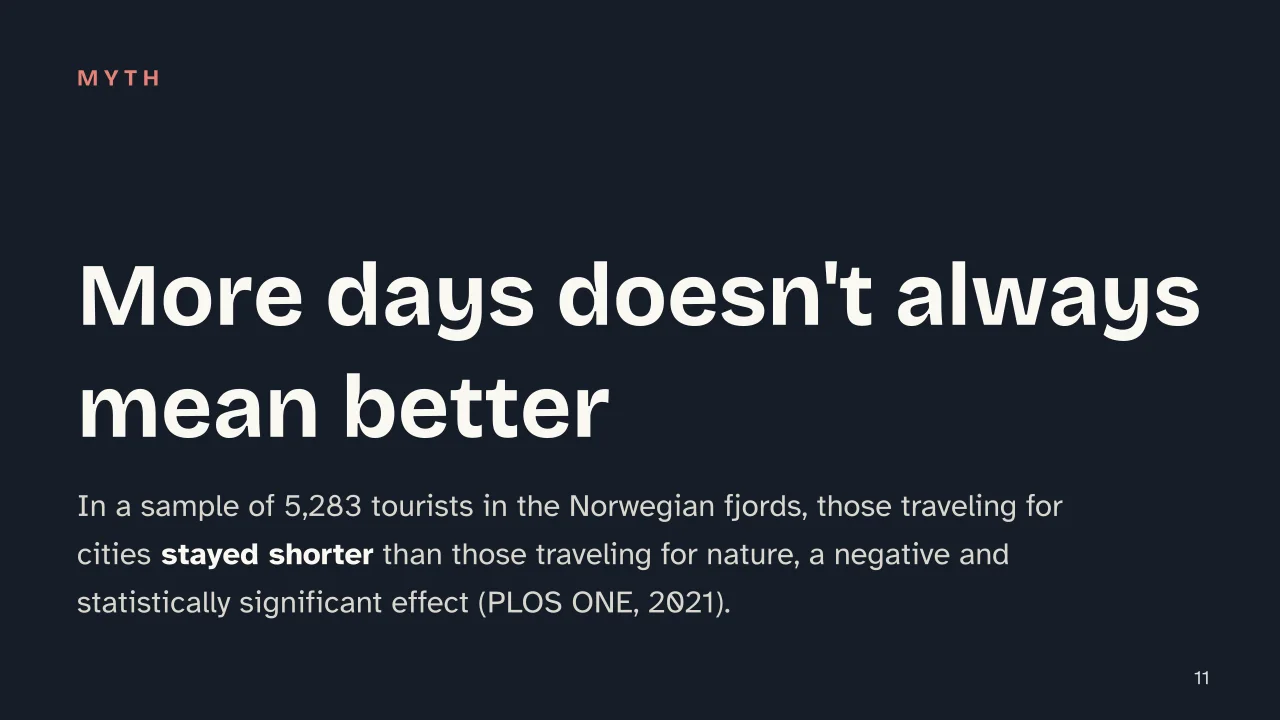
    • City trips run shorter on average than nature-based holidays, according to Oklevik and colleagues' study on Fjord Norway (PLOS ONE, 2021).
    • Ranking attractions from most to least essential lets you add or drop days without rebuilding the whole plan.
    • Opening hours and weekly closing days need checking before you fix the length of stay, they change how much a single day actually delivers.

    Key figures

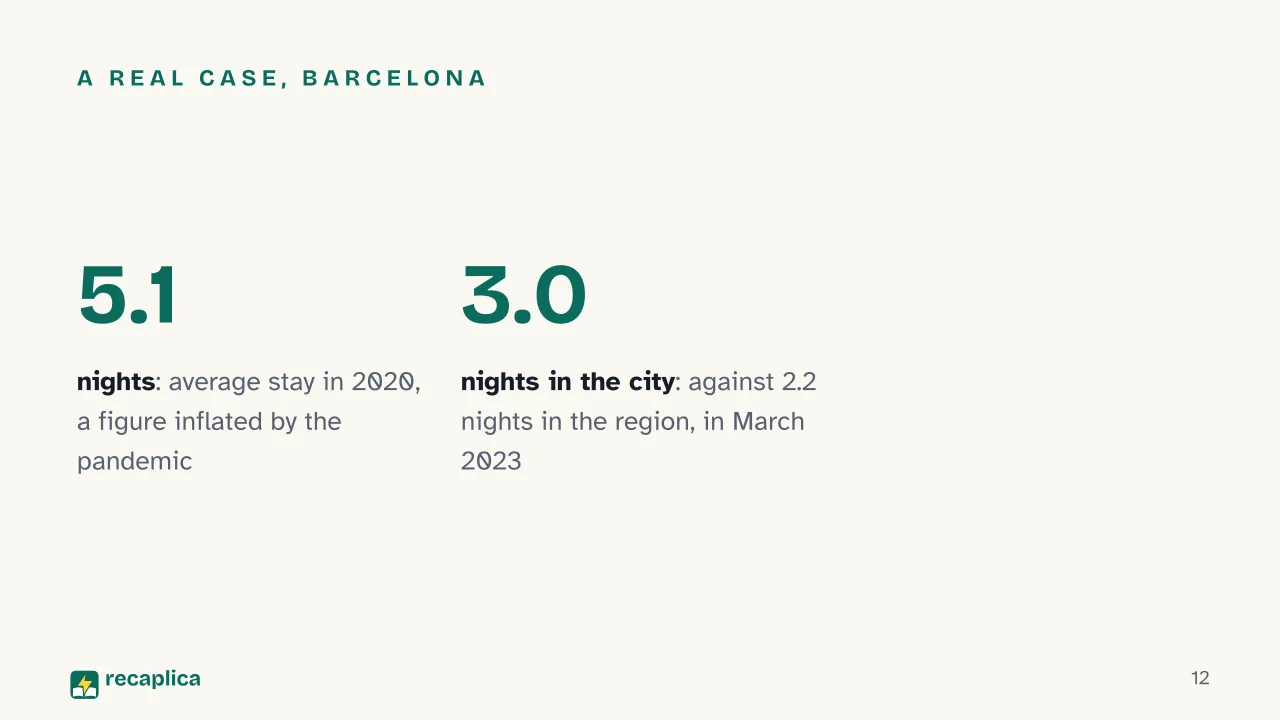
    • 5.1 nights Average length of stay in Barcelona in 2020, a figure inflated by the collapse in travel during the pandemic. Source: Observatori del Turisme a Barcelona
    • 3.0 nights Average length of a visit to the city of Barcelona in March 2023, against 2.2 nights in the surrounding region. Source: Observatori del Turisme a Barcelona
    • 19.7% Share of tourists in Fjord Norway in 2016 who chose a 6-7 day stay, the most common pattern the study found. Source: Oklevik and colleagues, PLOS ONE, 2021

    Deep Dive

    Plan in nights, not days

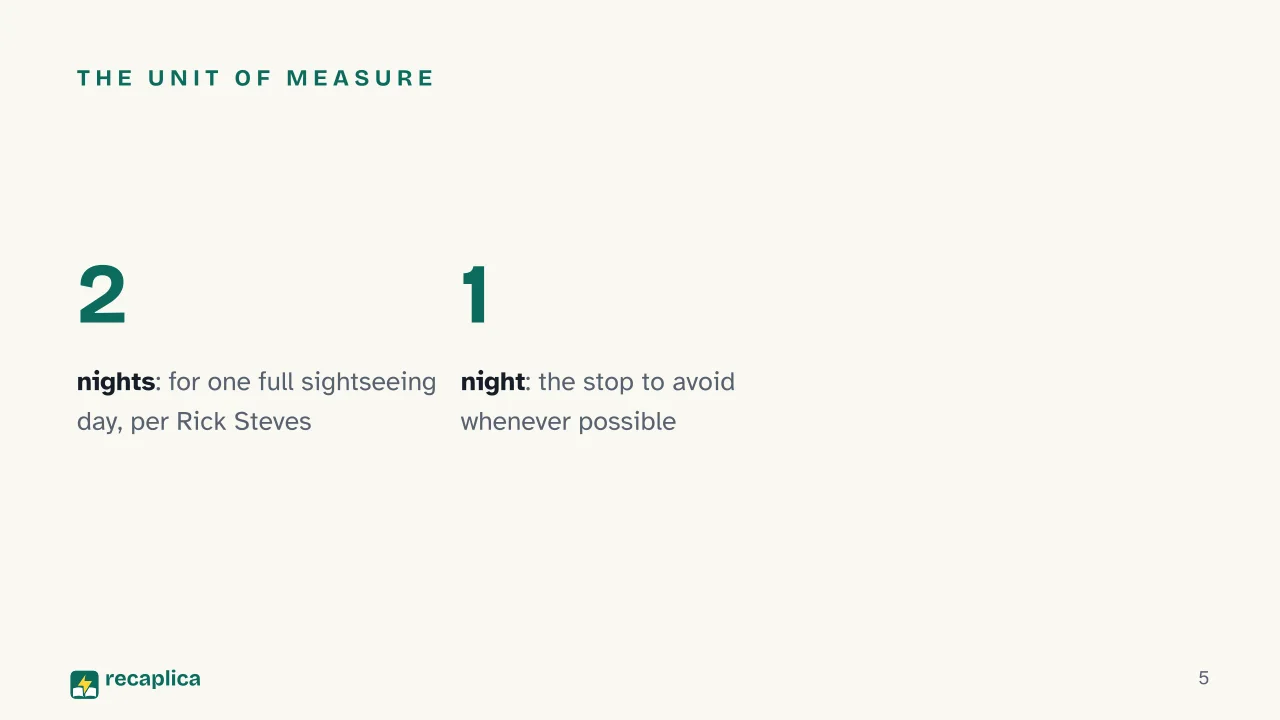
    The most practical rule comes from Rick Steves, a European travel guide publisher active since the 1980s: getting one full sightseeing day in a city takes two nights there, not one. The first night covers arrival and settling in, the second covers departure, leaving a whole day free in between for the things that matter. Skip one-night stops whenever you can, because the time spent packing and unpacking eats straight into the sightseeing hours you were trying to gain.

    Anyone hunting for cheap flights to reach a far-off city has one more reason not to chop a stay into half-days: a budget flight landing mid-afternoon already burns half of the first night, one more hour off the two-night minimum.

    Every hotel night carries another cost that’s easy to forget when planning. The tourist tax is charged per night and per person, so the two-nights-per-full-day math comes with a precise bill to multiply by the days chosen. The choice of hotel reservation also shifts with the number of nights: a flexible cancellation policy matters more on a short stay, where a single surprise can derail the whole plan.

    Rank the attractions by importance

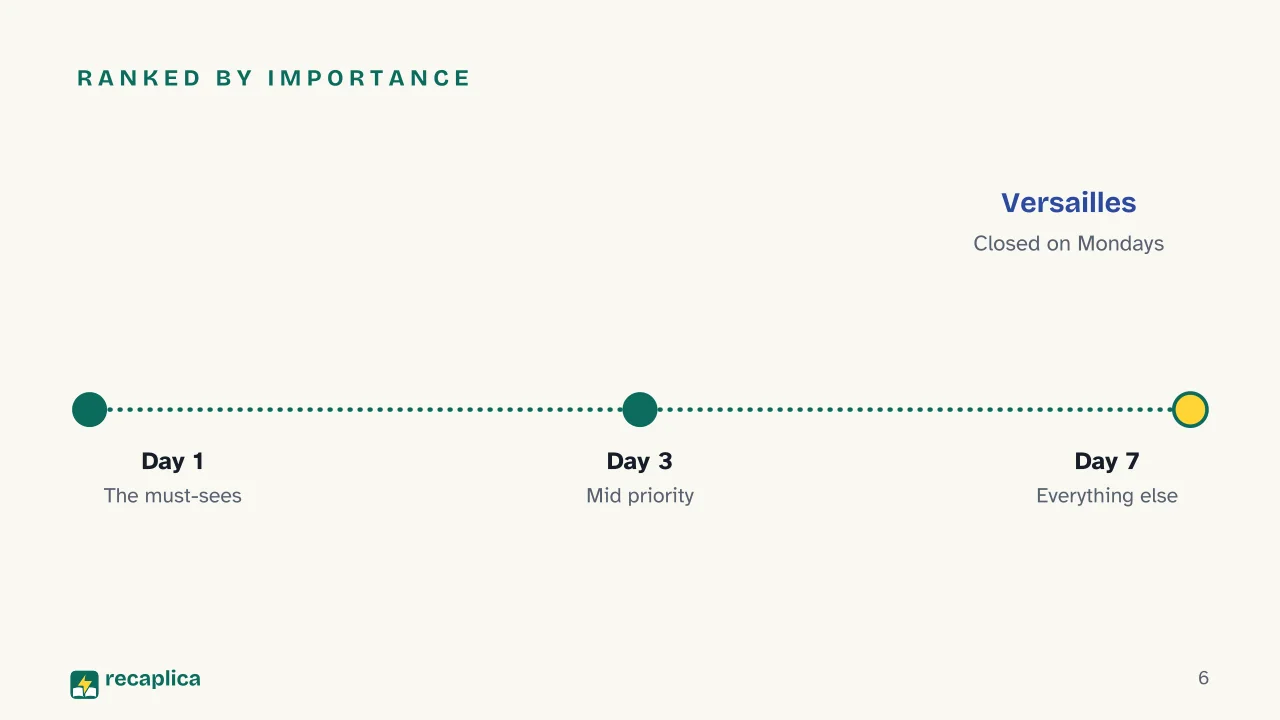
    The second method comes from a real case: Rick Steves’ published Paris itineraries list attractions in descending order of importance, for stays of one to seven days. With a single day you see the top item on the list, with three days the top three, and so on, the number of days gets decided by how many items you want to cover, not the other way around. The same source flags a calendar constraint worth checking before fixing dates: Versailles is closed on Mondays, and visitor numbers peak on Sundays and Tuesdays.

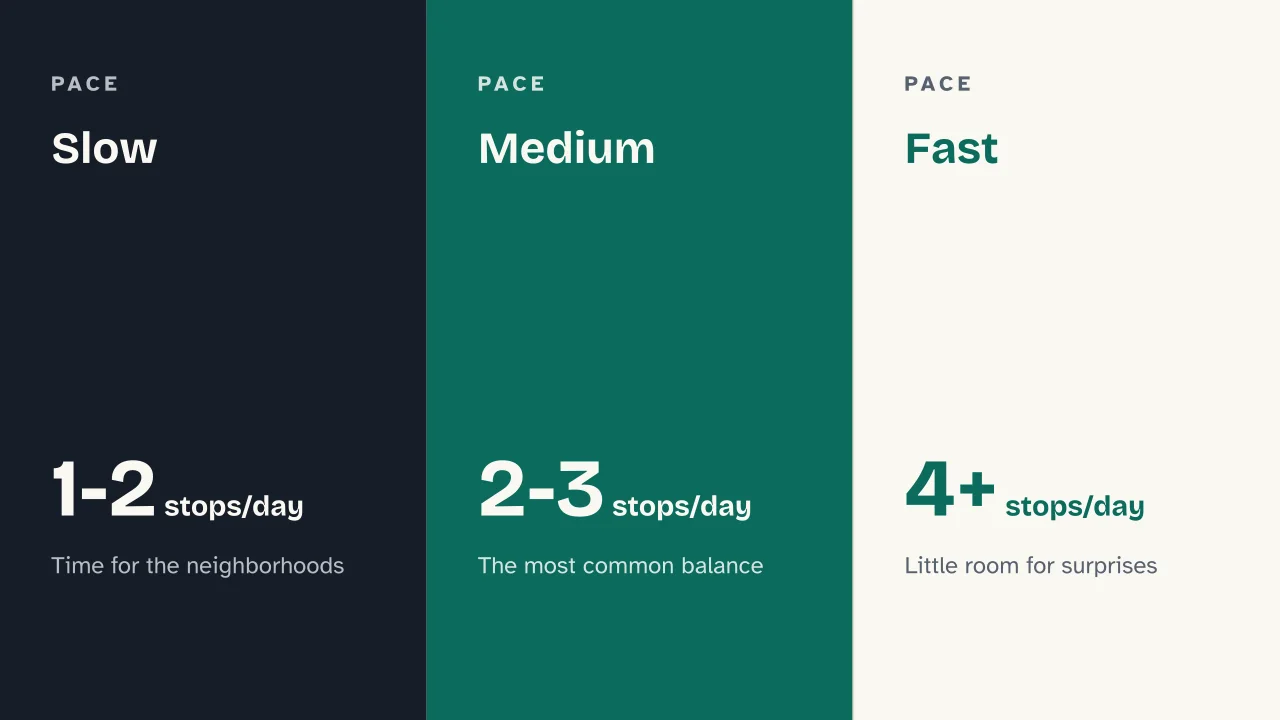
    PaceMain attractions covered per dayMargin for surprises
    Slow1-2Wide, time to wander neighborhoods off-plan
    Medium2-3Moderate
    Fast4 or moreThin, rest is the first thing to go

    A fast pace isn’t wrong in itself, it depends on how much time is available and how much margin you’re willing to give up.

    A rest day every seven

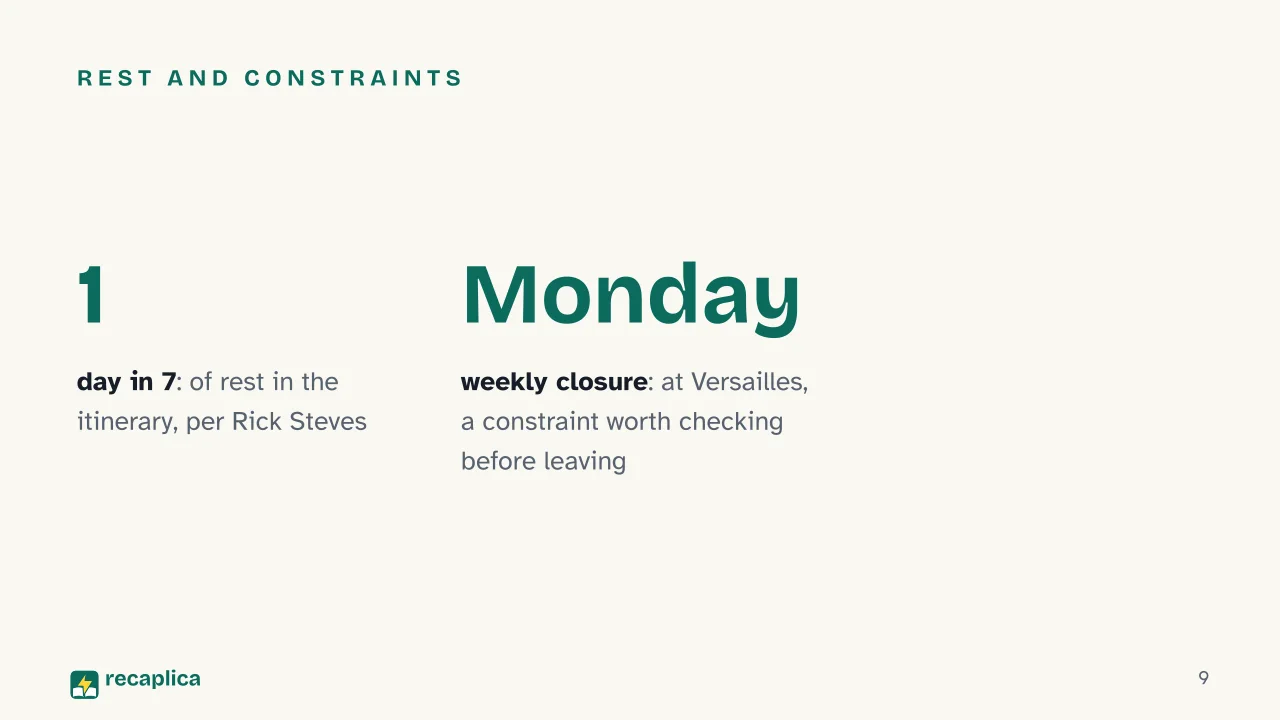
    Rick Steves recommends roughly one day off every seven in the itinerary: no early alarm, no sightseeing list, just time to absorb accumulated fatigue or a last-minute surprise like a site closed without warning. It looks like a wasted day at first glance, but in practice it keeps the final stretch of a long trip from turning into a rushed blur of museums.

    Practical example: a city with six attractions considered must-sees (a historic center, a major museum, two churches or monuments, a market, a scenic neighborhood) needs, at a medium pace of two to three stops a day, roughly three full days. With the two-nights rule that means four nights; on a trip with more stops after this city, it’s worth adding one rest night, for five nights total.

    The type of trip changes the length

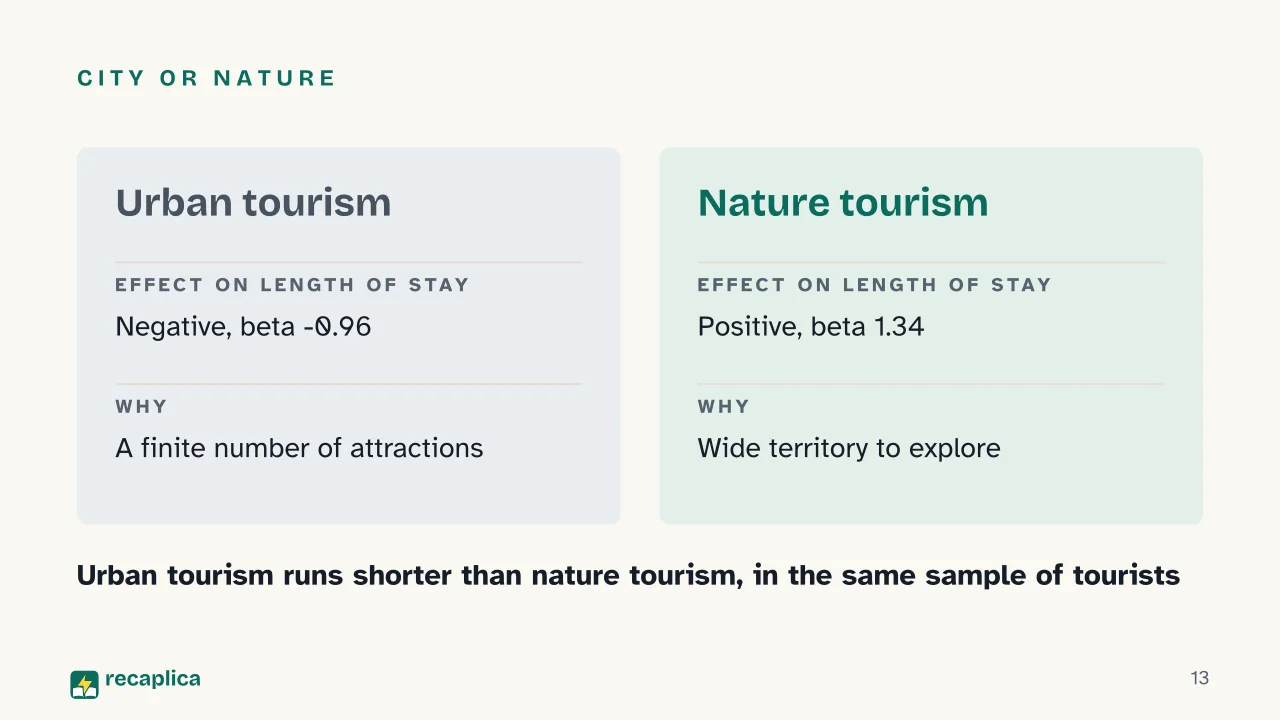
    A study published on December 7, 2021 in PLOS ONE (Oklevik, Kwiatkowski, Malchrowicz-Mośko, Ossowska and Janiszewska) surveyed 5,283 tourists in Fjord Norway between May 25 and September 15, 2016, looking at what stretches or shortens a stay. The most quotable finding: being an urban-based tourist has a negative and statistically significant effect on length of stay (beta -0.96, p<0.01), while being a nature-based tourist has a positive effect (beta 1.34, p<0.01). In the same sample, the most common length of stay was 6-7 days for 19.7% of tourists, and 26.8% had already left the area after one week. The study also found a role for age (positive effect, beta 0.07) and nationality: German and Dutch tourists stayed longer (beta 1.57 and 3.01), while US, Asian, British and domestic Norwegian tourists stayed shorter (beta between -2.27 and -4.14); gender and repeat visits showed no significant effect.

    Data from a real city points the same way. According to the Observatori del Turisme a Barcelona, the public body that has tracked city tourism since 1989, the average length of stay was 5.1 nights in 2020, a year when travel collapsed under the pandemic and inflated the average. The more recent, less distorted figure is from March 2023: 3.0 nights in the city of Barcelona, against 2.2 nights in the surrounding region, a level that in March 2023 stood above pre-pandemic March 2019 for the sixth month in a row.

    Getting around without wasting time

    Time lost finding your way around an unfamiliar city comes straight out of the attractions-per-day count above. Having offline maps of the city downloaded before leaving avoids burning precious minutes hunting for a data connection while moving between stops, especially in neighborhoods with weak signal.

    Slide deck

    Slides ready to download and make your own in PowerPoint or Google Slides, with speaker notes. Pick the Flash cut or the Full one.
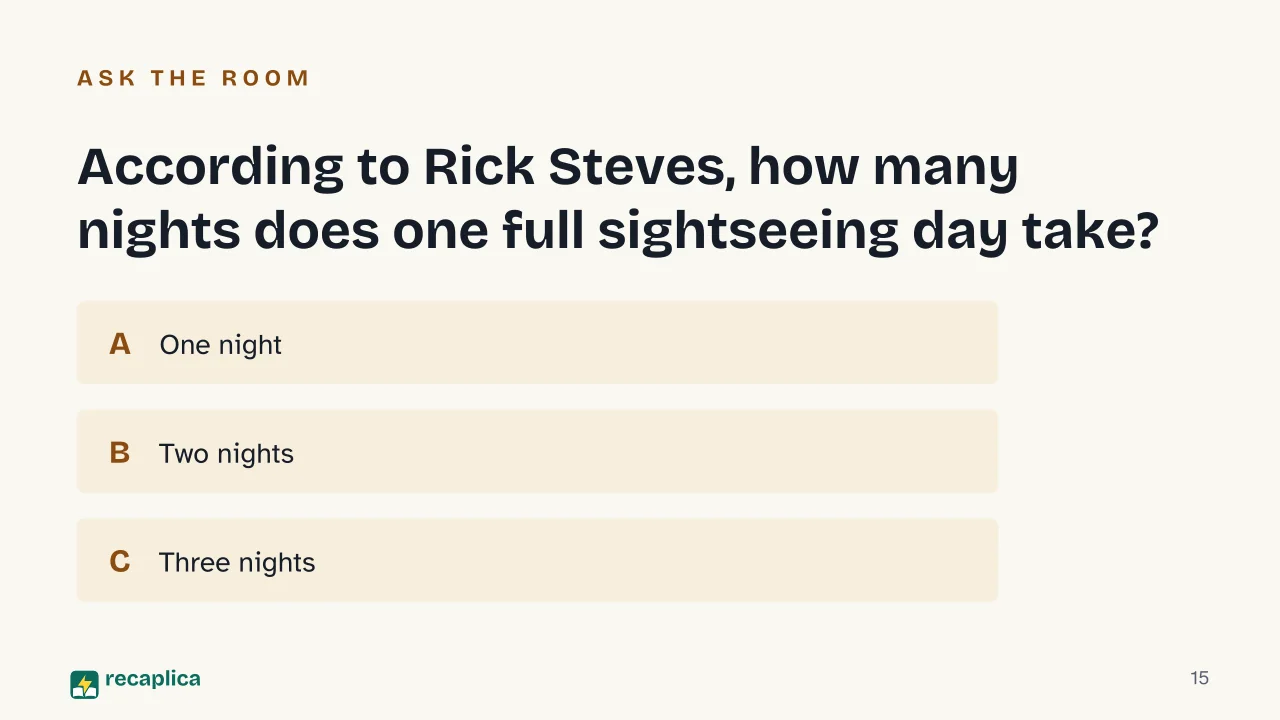
    Slide 1 of the presentation on How Many Days Do You Need to Visit a City, a Method to Decide: How many days for a city?Slide 2 of the presentation on How Many Days Do You Need to Visit a City, a Method to Decide: How many days do you actually need in this city?Slide 3 of the presentation on How Many Days Do You Need to Visit a City, a Method to Decide: The routeSlide 4 of the presentation on How Many Days Do You Need to Visit a City, a Method to Decide: Chapter 01: The nights calculationSlide 5 of the presentation on How Many Days Do You Need to Visit a City, a Method to Decide: The unit of measureSlide 6 of the presentation on How Many Days Do You Need to Visit a City, a Method to Decide: Ranked by importanceSlide 7 of the presentation on How Many Days Do You Need to Visit a City, a Method to Decide: Chapter 02: Attractions to seeSlide 8 of the presentation on How Many Days Do You Need to Visit a City, a Method to Decide: Slow · Medium · FastSlide 9 of the presentation on How Many Days Do You Need to Visit a City, a Method to Decide: Rest and constraintsSlide 10 of the presentation on How Many Days Do You Need to Visit a City, a Method to Decide: Chapter 03: Pace and restSlide 11 of the presentation on How Many Days Do You Need to Visit a City, a Method to Decide: More days doesn't always mean betterSlide 12 of the presentation on How Many Days Do You Need to Visit a City, a Method to Decide: A real case, BarcelonaSlide 13 of the presentation on How Many Days Do You Need to Visit a City, a Method to Decide: City or natureSlide 14 of the presentation on How Many Days Do You Need to Visit a City, a Method to Decide: Chapter 04: Closures and crowdsSlide 15 of the presentation on How Many Days Do You Need to Visit a City, a Method to Decide: According to Rick Steves, how many nights does one full sightseeing day take?Slide 16 of the presentation on How Many Days Do You Need to Visit a City, a Method to Decide: The full Recap
    Flash10 slidesThe essential thread, to present in classFull16 slidesEvery chapter and the deeper detail

    Common myths

    • ✗ Myth The more days you spend in a city, the better, no matter what.

      ✓ Reality Oklevik and colleagues' study (PLOS ONE, 2021) on Fjord Norway found that the type of trip matters more than raw duration: being an urban-based tourist has a negative and statistically significant effect on length of stay (beta -0.96) compared with a nature-based holiday. One possible explanation is that a city offers a finite number of top attractions, so each extra day delivers less once those are done.

    • ✗ Myth A good itinerary leaves no gaps, every day should be booked solid with sightseeing.

      ✓ Reality Rick Steves, after decades of guiding European itineraries, recommends roughly one rest day every seven; accumulated tiredness and surprises (a long queue, a closed museum) end up costing more time than a packed schedule ever gains.

    • ✗ Myth The right number of days depends only on how big the city is.

      ✓ Reality Seasonality and opening hours matter as much as size: in Paris, Versailles is closed on Mondays and visitor numbers peak on Sundays and Tuesdays, so the same itinerary performs differently depending on which day of the week it lands on.

    Mind map

    Drag the background to move around and the nodes to reposition them; use − and + to collapse and expand branches.
    Customize
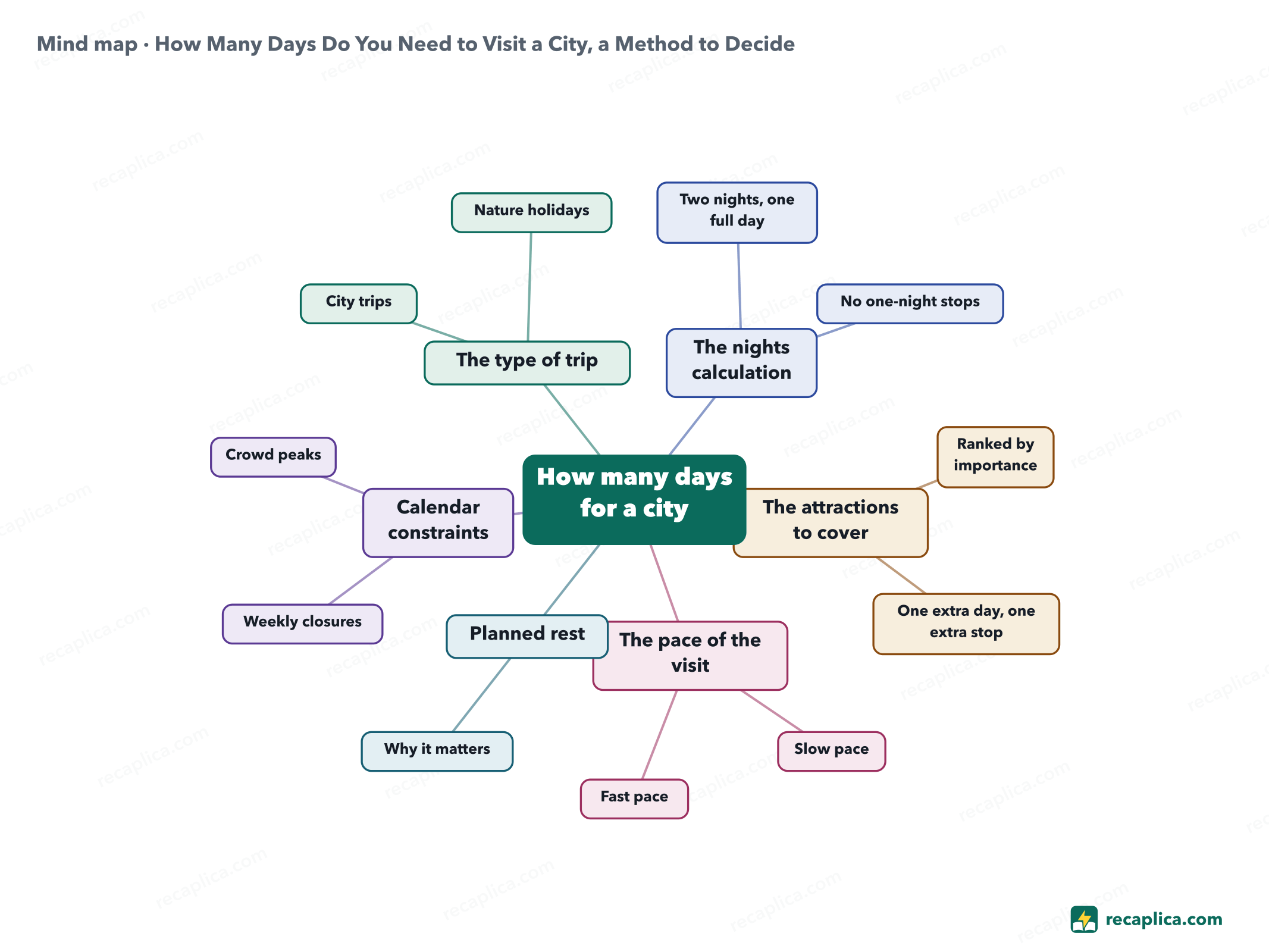
    Mind map: How Many Days Do You Need to Visit a City, a Method to Decide
    • How many days for a city
      • The nights calculation The base criterion for estimating length
        • Two nights, one full day A full sightseeing day needs two nights on the ground
        • No one-night stops Changing lodging too often costs sightseeing time
      • The attractions to cover The Paris one-to-seven-day method
        • Ranked by importance List places from must-see to optional
        • One extra day, one extra stop Each added day covers the next item on the list
      • The pace of the visit How much you can really see in a day
        • Slow pace Few stops, time to wander a neighborhood
        • Fast pace Many stops, little room for surprises
      • Planned rest One rest day every seven in the itinerary
        • Why it matters Absorbs fatigue and surprises like a closed museum
      • Calendar constraints Opening hours and closing days change what each day delivers
        • Weekly closures Some sites close on a fixed day, like Versailles on Mondays
        • Crowd peaks Certain weekdays draw more visitors than others
      • The type of trip Cities and nature have different average lengths of stay
        • City trips Tend to run shorter, a negative effect in the Fjord Norway study
        • Nature holidays Tend to run longer in the same sample of tourists

    Quiz: test yourself

    Answer the questions to check what you have learned: you get instant feedback and a short explanation.

    Grade 0/10 0/5
    1 According to Rick Steves' rule of thumb, how many nights does it take to get one full sightseeing day in a city?

    Rick Steves' unit is two nights per full sightseeing day: the first night covers arrival, the second covers departure, leaving one whole day free in between for actual visiting.

    2 According to Oklevik and colleagues' study (PLOS ONE, 2021), what effect does being an urban-based tourist have on length of stay, compared with a nature-based tourist?

    The study reports a negative and statistically significant coefficient (beta -0.96, p<0.01) for urban tourists, a sign that city visits tend to run shorter than nature-based holidays in the same sample.

    3 Why is it worth ranking a city's attractions by importance before deciding how many days to stay?

    This is the method used for Paris in its one-to-seven-day itineraries: you see the top items first, and every extra day adds the next one on the list, with no need to rebuild the plan from scratch.

    4 What does Rick Steves recommend to absorb fatigue and surprises in a travel itinerary?

    The guide suggests roughly one day off from the trip every seven, to leave room for surprises like a closed site or accumulated tiredness.

    5 Which calendar constraint is flagged for Paris as an example of a factor that limits how much a visit day actually delivers?

    The Paris itinerary notes that Versailles is closed on Mondays and that crowds peak on Sundays and Tuesdays; planning without checking these constraints can cost a whole day.

    Answers: 1-B · 2-B · 3-B · 4-B · 5-A

    Flashcards

    Tap the card to flip it and check whether you remember the answer, then move to the next one.

    1 / 8

    Explain it in your own words

    The ultimate test: if you can explain it in simple words, you've truly understood it. Write your explanation, then compare it with the Recap.

    Your explanation is saved only on this device.

    There is no single right number of days for a city, it depends on how many top attractions you want to cover, how much time getting around takes, and the pace you can actually keep up. Rick Steves, a travel guide writer active since the 1980s on European itineraries, uses a simple unit, two nights in one place to get one full day of sightseeing, so one-night stops get skipped. A study of 5,283 tourists in Fjord Norway (PLOS ONE, 2021) found that city trips tend to run shorter than nature-based holidays, a statistically significant effect. The practical method is to rank attractions by importance, count how many nights it takes to work through the list, and add one rest day every seven to absorb the unexpected.

    Frequently asked questions

    How many days do you generally need to visit a city?

    The number depends on how many top attractions you want to cover, the pace of the visit and the closing days of the sites. A practical starting point is two nights per full sightseeing day, plus one rest day every seven.

    Is it worth doing one-night stops to see more cities?

    Travel guides advise against one-night stops whenever you can avoid them: the time spent arriving, settling in and leaving cuts into the actual sightseeing time, especially on multi-city itineraries.

    Why does a city deliver less tourism value, day after day, than a nature trip?

    In Oklevik and colleagues' study (PLOS ONE, 2021), urban tourism has a negative, significant effect on length of stay, against a positive effect for nature-based tourism. One possible reason is that a city's top attractions are limited in number.

    How do you check for calendar surprises before leaving?

    By checking in advance the weekly closing days of the main museums and sites, for example Versailles is closed on Mondays, and the days with the heaviest crowds, so the itinerary doesn't lose a whole day to an avoidable surprise.

    What is the real average length of a visit to a major European tourist city?

    In Barcelona, according to the Observatori del Turisme, the average length of stay in March 2023 was 3.0 nights in the city (against 2.2 nights in the region), lower than the 2020 figure (5.1 nights), which was inflated by the collapse in travel during the pandemic.

    Sources

    • European Itinerary Tips, Rick Steves
    • Planning Your Time in Paris, Paris in One to Seven Days, Rick Steves
    • Determinants of tourists' length of stay, PLOS ONE, 2021
    • Report on the Profile and Habits of Tourists in Barcelona city 2020, Observatori del Turisme a Barcelona
    • The increase in the average length of stay is consolidated in March at Destination Barcelona, Observatori del Turisme a Barcelona

    Every Recap goes through an independent review before publication.

    Every evening, the day's new Recaps on our Telegram channel. Join the channel →

    Keep learning

    • Economics Biggest Economies in the World: The Ranking by GDP, Explained In 2024, according to World Bank data, the United States remains the country with the highest nominal GDP in the world, ahead of China. Measured instead at purchasing power parity (PPP), which accounts for differences in price levels between countries, the ranking flips and China moves into first place. Nominal GDP reflects the weight of an economy on international markets in current dollars; PPP GDP reflects the domestic purchasing power of a country's residents. The two measures tell different stories, which is why the same economy can rank differently depending on which one you check. Read the Recap →
    • Economics How Much Does Italy's Regime Forfettario Really Cost? Keeping a VAT number under Italy's regime forfettario doesn't cost the same for everyone. Taxable income carries a substitute tax of 15%, cut to 5% for the first five years for those who meet certain conditions. The taxable base comes from applying a profitability coefficient to revenue that varies by activity, from 40% for trade up to 86% for construction: at the same revenue, a higher coefficient means a bigger tax bill. On top of that come social security contributions, with separate rates for tradespeople and shopkeepers and a reduction for those who stay in the scheme, plus a few recurring fixed costs that exist but carry no single amount set by any official source. Read the Recap →
    • Economics INPS Contributions Under Italy's Regime Forfettario, How They Work Anyone with a VAT number under Italy's regime forfettario still owes INPS contributions, and where they go depends on the activity: freelancers without a trade association of their own pay into the Gestione Separata, while tradespeople and shopkeepers pay into the Artigiani e Commercianti schemes. The two schemes charge different rates but share the same base, the flat-rate taxable income. Tradespeople and shopkeepers can also apply for an optional 35% contribution reduction, which lowers the amount credited toward their future pension as well. Read the Recap →

    recaplica

    Clear in 30 seconds, yours in 10 minutes.

    Recaps Mind maps Request a Recap Telegram channel Mind map maker Our method About Privacy & cookies Legal notes & terms of use

    © 2026 Recaplica · A project by Curi S.r.l. — VAT IT05472000750

    Statistics, only if you say so

    To learn which Recaps help most we would use Google Analytics, with aggregate, anonymous data. It starts only with your OK, and you can change your mind anytime. Privacy policy