Skip to content
recaplica

    One moment: security check

    Cloudflare wants to make sure you're not a robot. Tick the box below and your search will continue on its own.

    IT
    recaplica Hotel Reservation Explained: How Payment, Cancellation and Rates Work
    © 2026 Recaplica · recaplica.com — All rights reserved
    Home › Economics

    Hotel Reservation Explained: How Payment, Cancellation and Rates Work

    By Recaplica Newsroom · Updated on September 20, 2026

    What to print

    Page numbers appear when printing with default margins.

    Slides

    Choose a cut

    Flash10 slidesThe essential thread, to present in classFull16 slidesEvery chapter and the deeper detail

    Both come with speaker notes.

    Telegram channel
    recaplica Clear in 30 seconds, yours in 10 minutes.
    In 30 seconds Key points Figures Deep dive Slides Myths Mind map Quiz Flashcards FAQ

    In 30 seconds quick read

    A hotel reservation becomes valid as soon as there's an agreement on price and dates — no deposit required. Cancelling it is a separate matter, governed by whatever conditions were chosen at booking: deposits, non-refundable rates, and, within the EU, the exclusion of the usual 14-day right to change your mind. Rates shift depending on how much flexibility a guest wants to keep until the last moment, and the room price can come with extra fees worth checking before confirming.

    Key Points

    • A hotel reservation is valid even without a deposit: the guest is still committed to paying the agreed price.
    • In the EU, hotel bookings tied to a specific date fall outside the usual 14-day cooling-off period for distance purchases.
    • A forfeitable deposit only costs you the advance payment; a binding deposit can cost you the entire stay.
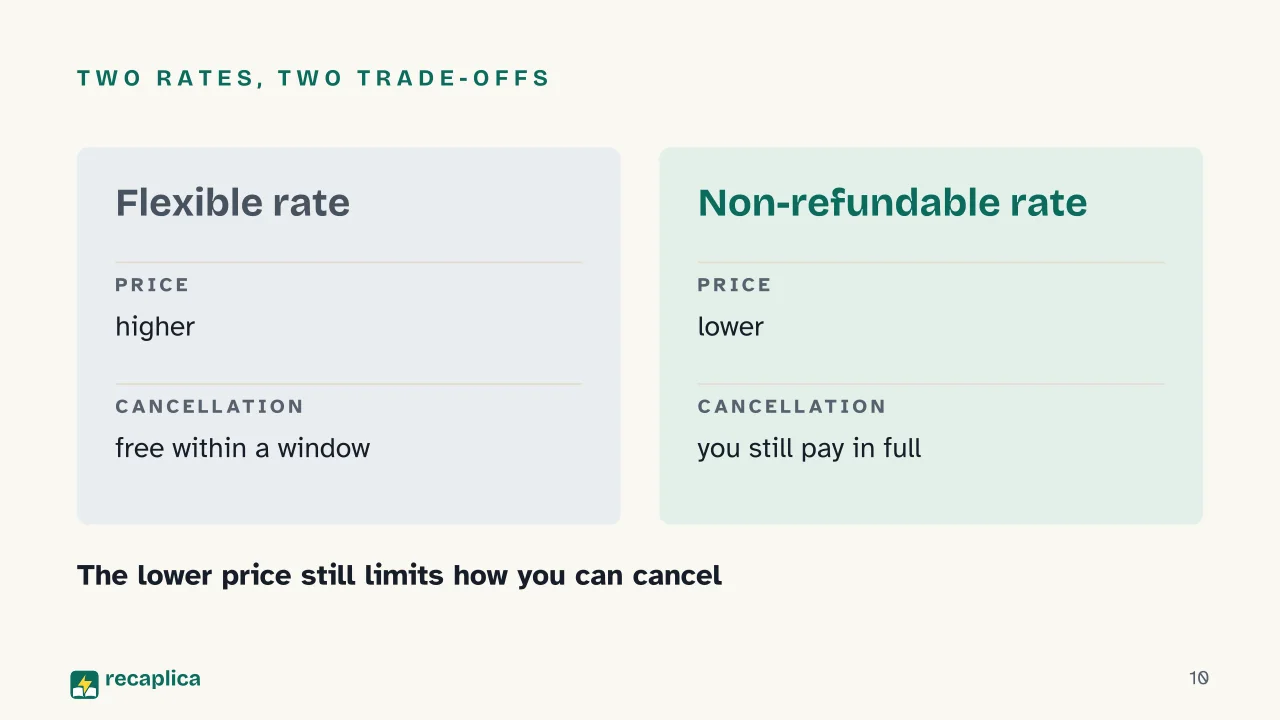
    • Flexible rates cost more but allow free cancellation within a set window; non-refundable rates cost less but commit you to paying regardless.
    • Beyond the room price, extra fees and, in many places, a local tourist tax can add to the final bill.
    • Meal plans and room upgrades are worth checking item by item before booking, since terms vary by property.

    Key figures

    • May 12, 2025 In the United States, a Federal Trade Commission rule took effect on this date requiring hotels and short-term rentals to disclose the total price upfront, including mandatory fees such as the so-called resort fee. It is a US regulation, not applicable in Italy or elsewhere. Source: Federal Trade Commission (FTC)

    Deep Dive

    How payment works for a hotel reservation

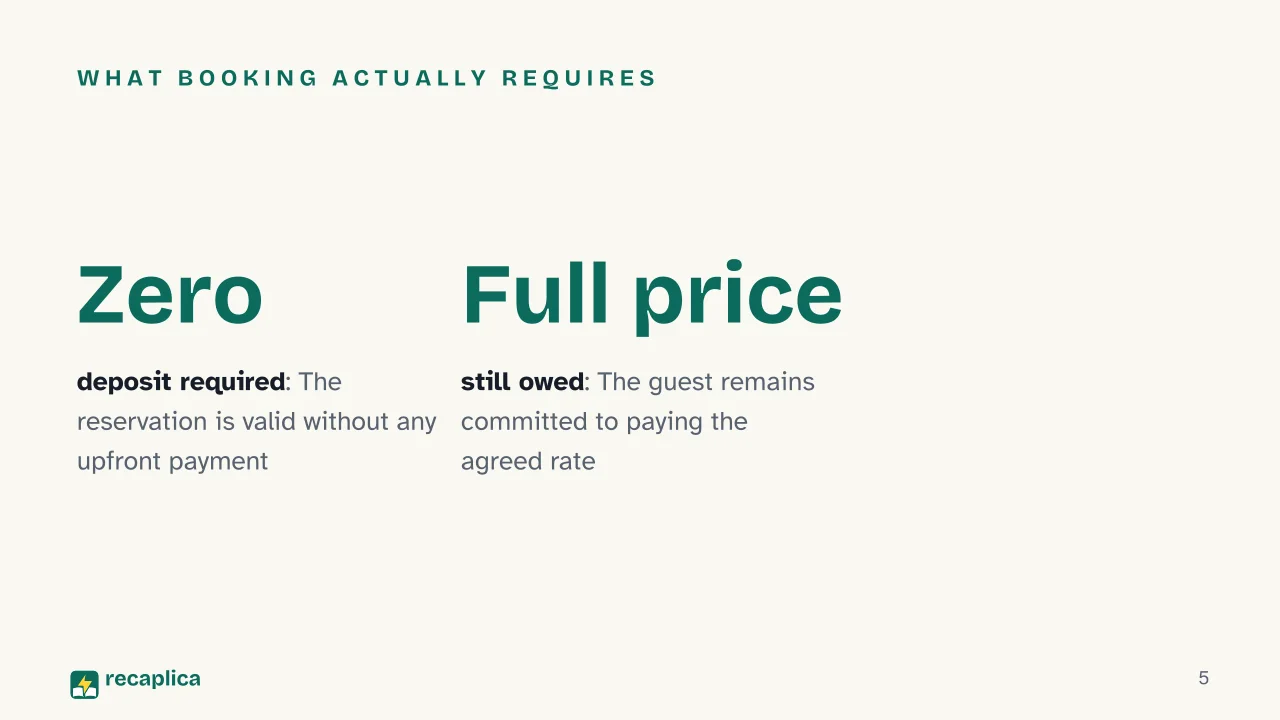
    According to the network of European Consumer Centres, a hotel reservation is legally valid even without any upfront payment: an agreement between the parties on price and dates is enough. No deposit, no down payment, no card charged immediately. That doesn’t mean the stay is free until arrival: the guest still owes the agreed amount, under whatever conditions were set out at the time of booking.

    Many properties still ask for card details as a guarantee, but that’s a common business practice, not a legal requirement for the contract to be valid.

    Anyone booking a hotel while organizing a wider trip often runs into other practical rules worth keeping in mind, like the ones covering carrying a power bank on a plane: small logistical details that add to, but don’t change, how the reservation itself actually works.

    Hotel cancellation policy: deposits, penalties and the missing cooling-off period

    Online purchases in the European Union usually come with a 14-day window to change your mind, no questions asked and no fee. That protection doesn’t extend to hotel reservations made at a distance: accommodation services tied to a specific date are excluded from the standard right of withdrawal. In Italy, for example, this exclusion is set out in Article 59 of the Consumer Code. Cancellation is still possible, but only under the conditions the property has set, and often with a penalty attached.

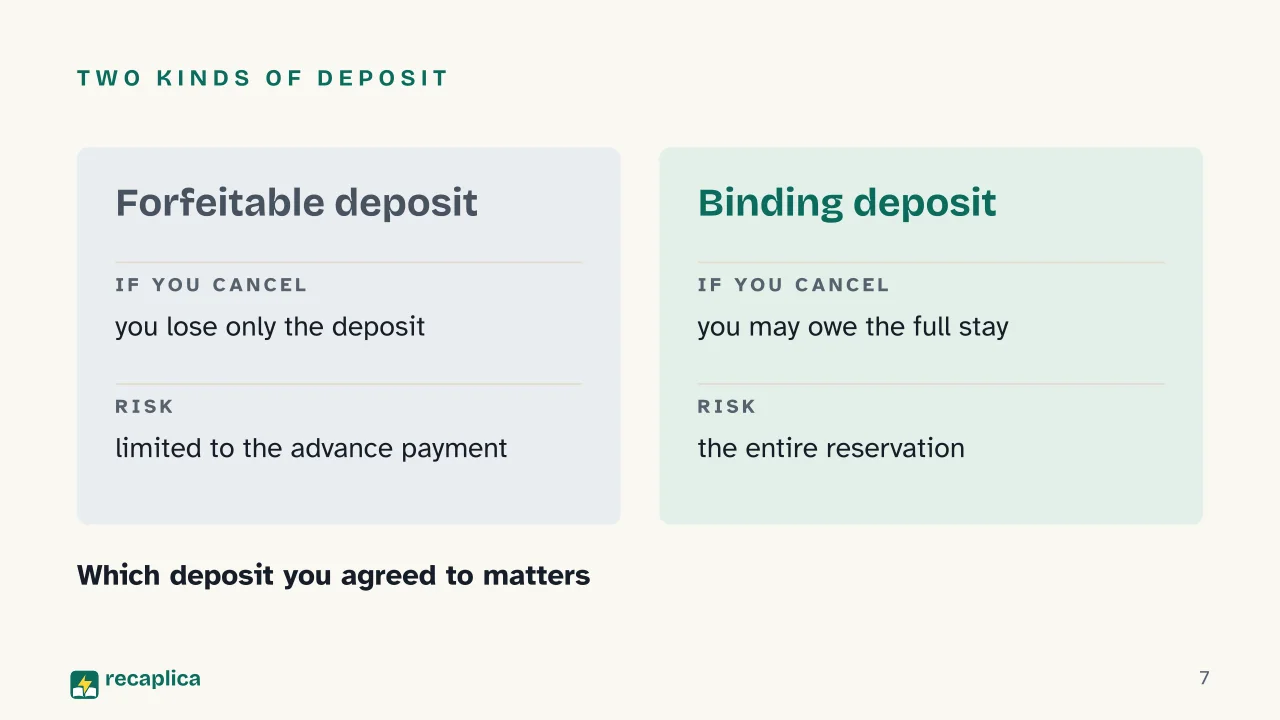
    If a deposit was paid when booking, the type of deposit matters a great deal. With a forfeitable deposit, cancelling means losing only the amount already paid: the hotel keeps it and the matter ends there. With a binding deposit, the hotel can keep that amount and also demand payment for the entire reserved stay.

    One exception protects the guest regardless of the written conditions: supervening impossibility. If the property becomes unreachable because of an exceptional event, such as a landslide cutting off the area, the guest can cancel without paying any penalty, since the service simply cannot be delivered.

    Rates: flexible, non-refundable and dynamic pricing

    The price of a room isn’t a fixed number: it shifts with when you book, how close the stay is, and which rate you choose — a supply-and-demand logic not unlike the one microeconomics uses to explain how prices form in general. Over time, hotel prices also move with the broader dynamics of inflation, which is part of why the same room can cost noticeably more a few years later.

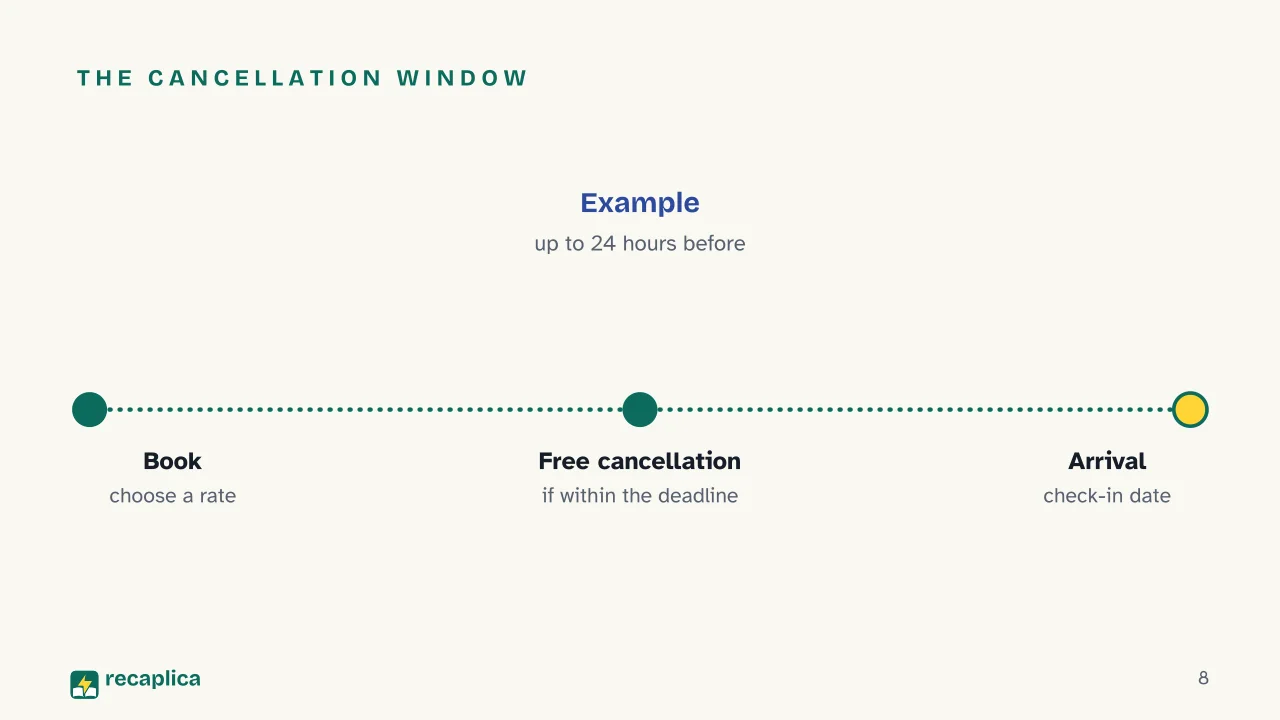
    According to the ECC-Net, some properties let guests book at a higher price in exchange for the option to cancel free of charge within a set window, in some cases up to 24 hours before arrival. The same source flags a practical inconsistency: if a guest cancels and has to pay the full price anyway, unused ancillary services, like breakfast, should in principle be deducted from the amount charged. In practice, though, many hotels refuse a partial refund when the guest chose a cheaper non-refundable rate, since that guest explicitly accepted paying regardless of cancellation.

    Practical example: two guests book the same room for the same weekend. The first chooses the flexible rate and pays $140, with free cancellation up to two days before arrival. The second chooses the non-refundable rate and pays $110. If plans change at the last minute, the first guest gets a full refund; the second doesn’t, having already accepted that condition at the time of purchase.

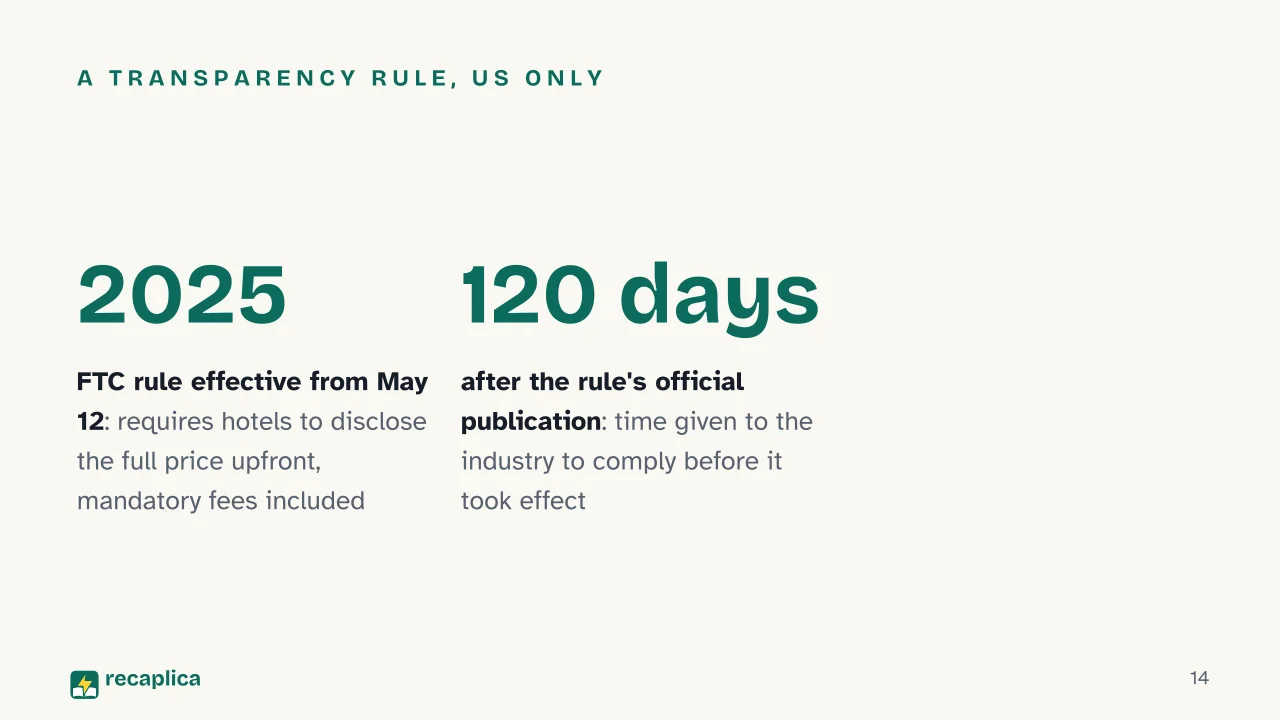
    In the United States, the Federal Trade Commission tackled a related problem: fees added on top of the price shown at first, such as so-called resort fees or convenience fees. Since May 12, 2025, a rule has required hotels and vacation rentals to disclose the full price, mandatory fees included, every time it’s advertised. It’s a US regulation, not applicable in Italy or elsewhere.

    Extras and add-ons: what gets added to your stay

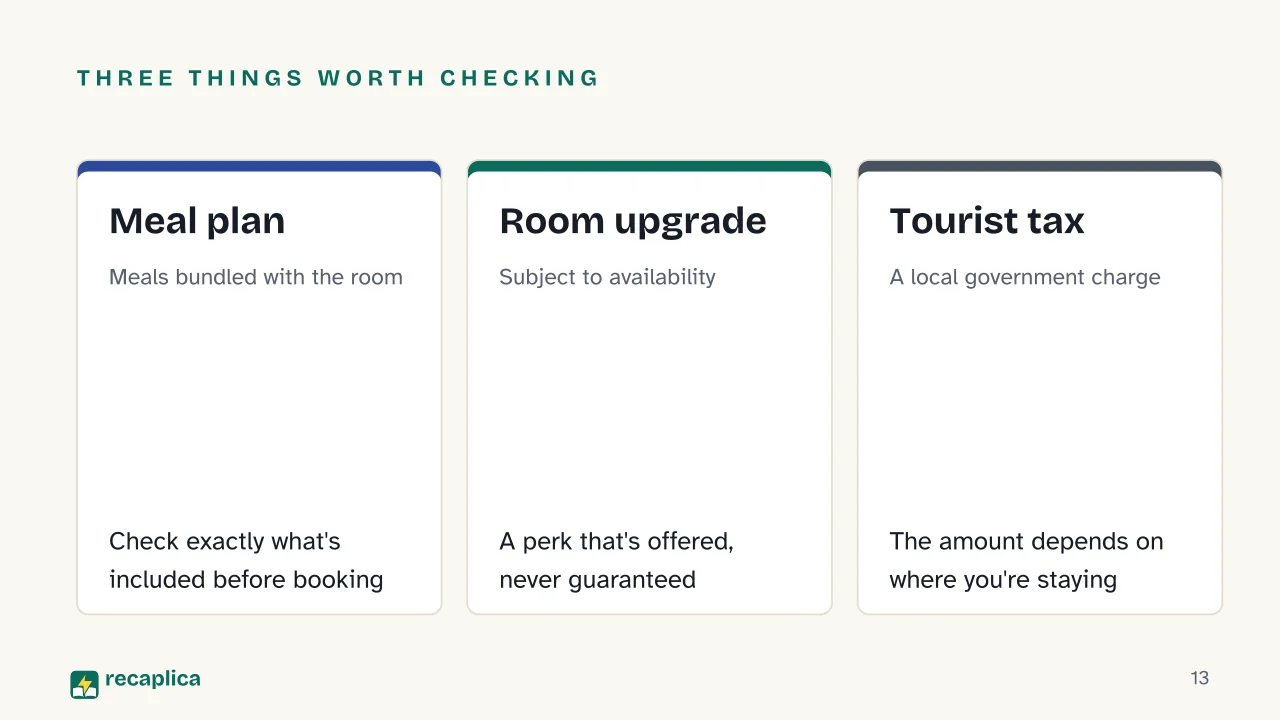
    A booking can include more than just the room. Full board typically covers all main meals, half board usually covers breakfast and dinner, and a bed-and-breakfast booking is limited to the room plus breakfast. These are common industry terms worth checking item by item on the property’s listing before confirming.

    Room upgrades are never guaranteed. They depend on availability at check-in, even when offered in advance.

    In many places, local governments add a tourist tax to the final bill, a local charge that varies from one municipality or authority to another and is usually disclosed at the time of booking or at check-in.

    Slide deck

    Slides ready to download and make your own in PowerPoint or Google Slides, with speaker notes. Pick the Flash cut or the Full one.

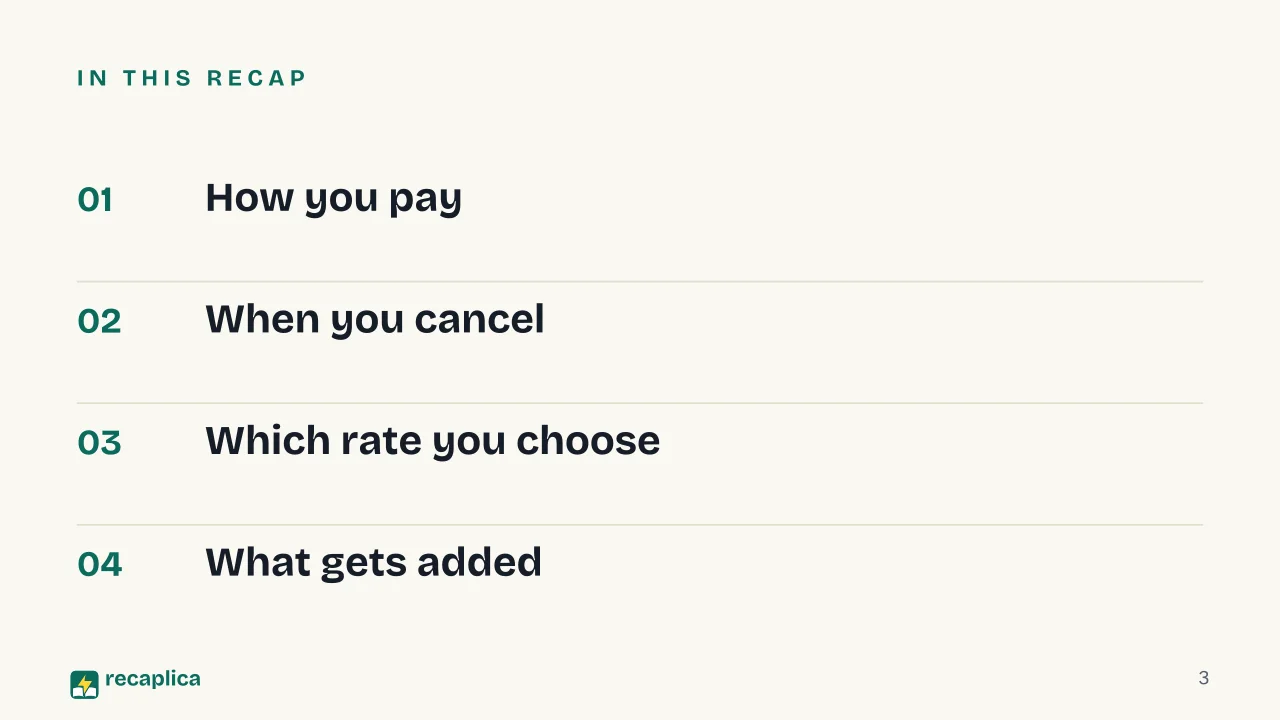
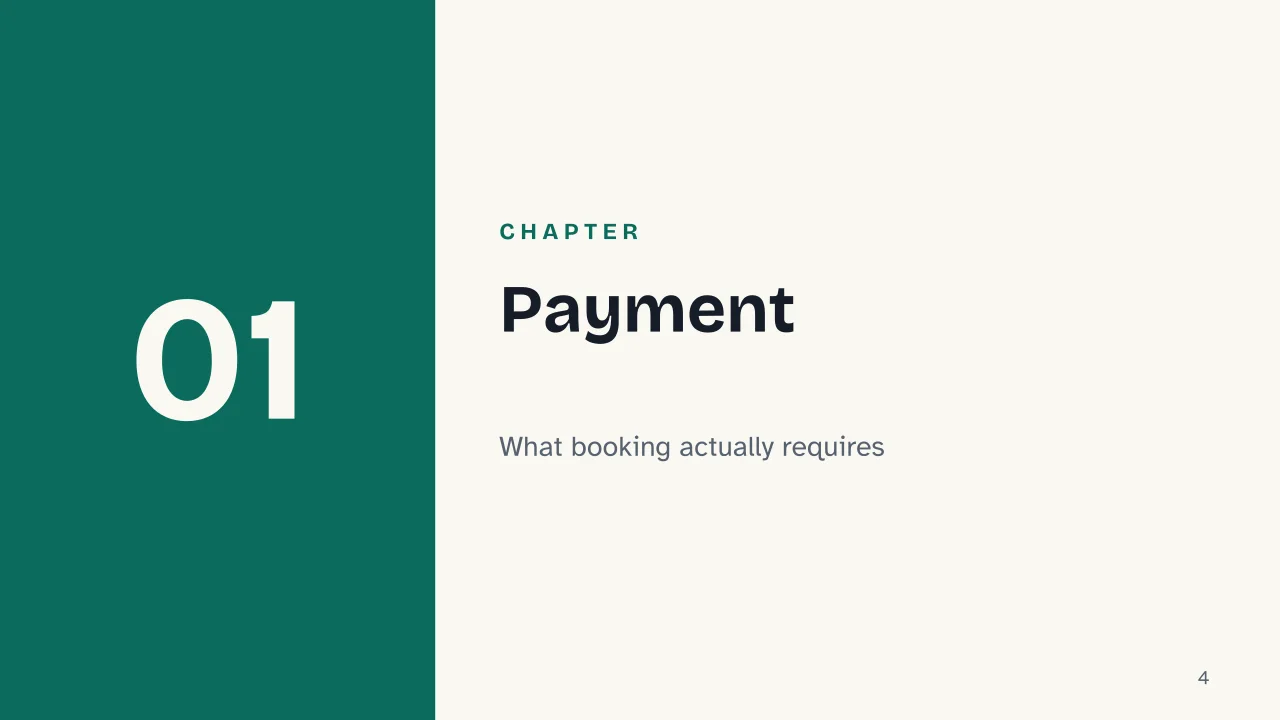
    Slide 1 of the presentation on Hotel Reservation Explained: Hotel ReservationSlide 2 of the presentation on Hotel Reservation Explained: Is a deposit required to book a room?Slide 3 of the presentation on Hotel Reservation Explained: In this RecapSlide 4 of the presentation on Hotel Reservation Explained: Chapter 01: PaymentSlide 5 of the presentation on Hotel Reservation Explained: What booking actually requiresSlide 6 of the presentation on Hotel Reservation Explained: Chapter 02: CancellationSlide 7 of the presentation on Hotel Reservation Explained: Two kinds of depositSlide 8 of the presentation on Hotel Reservation Explained: The cancellation windowSlide 9 of the presentation on Hotel Reservation Explained: Chapter 03: RatesSlide 10 of the presentation on Hotel Reservation Explained: Two rates, two trade-offsSlide 11 of the presentation on Hotel Reservation Explained: The cheapest rate is not always the better dealSlide 12 of the presentation on Hotel Reservation Explained: Chapter 04: ExtrasSlide 13 of the presentation on Hotel Reservation Explained: Three things worth checking: Meal plan, Room upgrade, Tourist taxSlide 14 of the presentation on Hotel Reservation Explained: A transparency rule, US onlySlide 15 of the presentation on Hotel Reservation Explained: Why does a non-refundable rate usually cost less than a flexible one?Slide 16 of the presentation on Hotel Reservation Explained: Recaplica
    Flash10 slidesThe essential thread, to present in classFull16 slidesEvery chapter and the deeper detail

    Common myths

    • ✗ Myth You always have to leave a deposit to book a hotel room

      ✓ Reality European consumer rules make clear that a reservation is valid without any upfront payment: an agreement on price and dates is enough. The guest still has to pay the agreed amount eventually.

    • ✗ Myth The cheapest rate is always the best choice

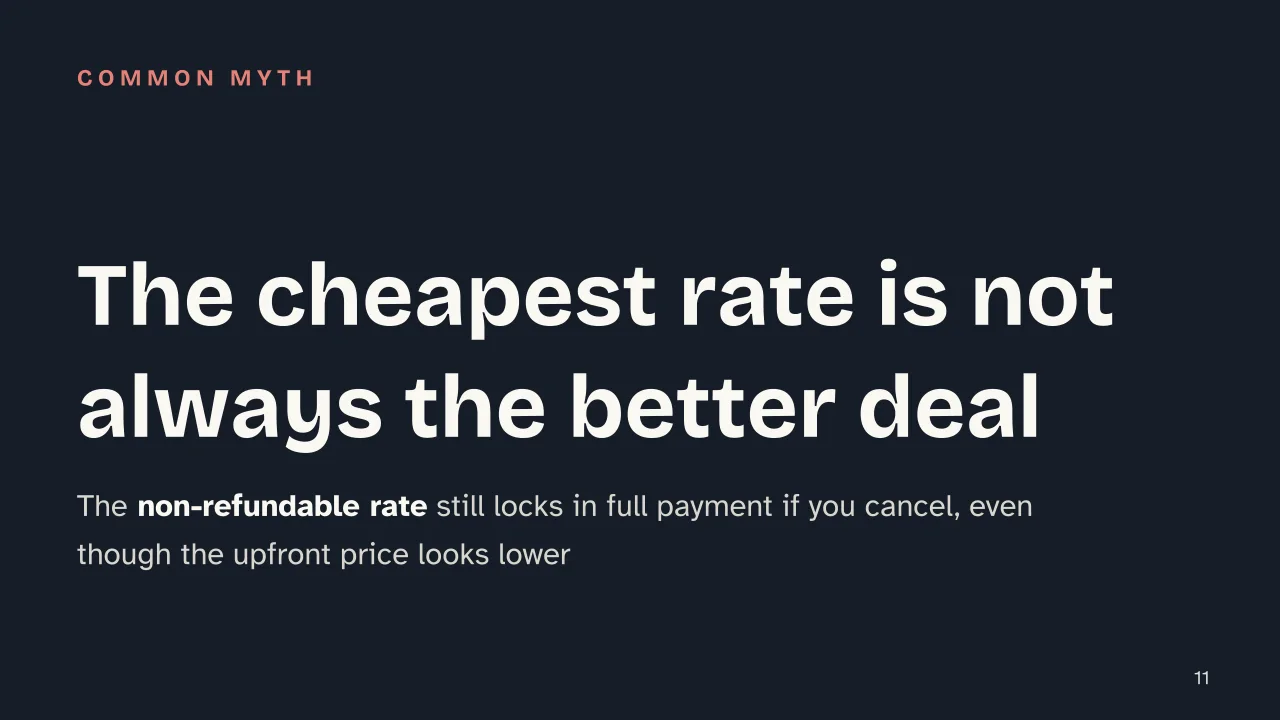
      ✓ Reality The lowest price is often a non-refundable rate: choosing it means agreeing to pay for the full stay even after cancelling, while a pricier flexible rate leaves a window to cancel without penalty.

    • ✗ Myth Booking a hotel from a distance always gives you 14 days to change your mind, like any other online purchase

      ✓ Reality In the EU, accommodation tied to a specific date is excluded from the standard right of withdrawal: cancellation follows only the conditions set by the property, including whatever penalties apply.

    Mind map

    Drag the background to move around and the nodes to reposition them; use − and + to collapse and expand branches.
    Customize
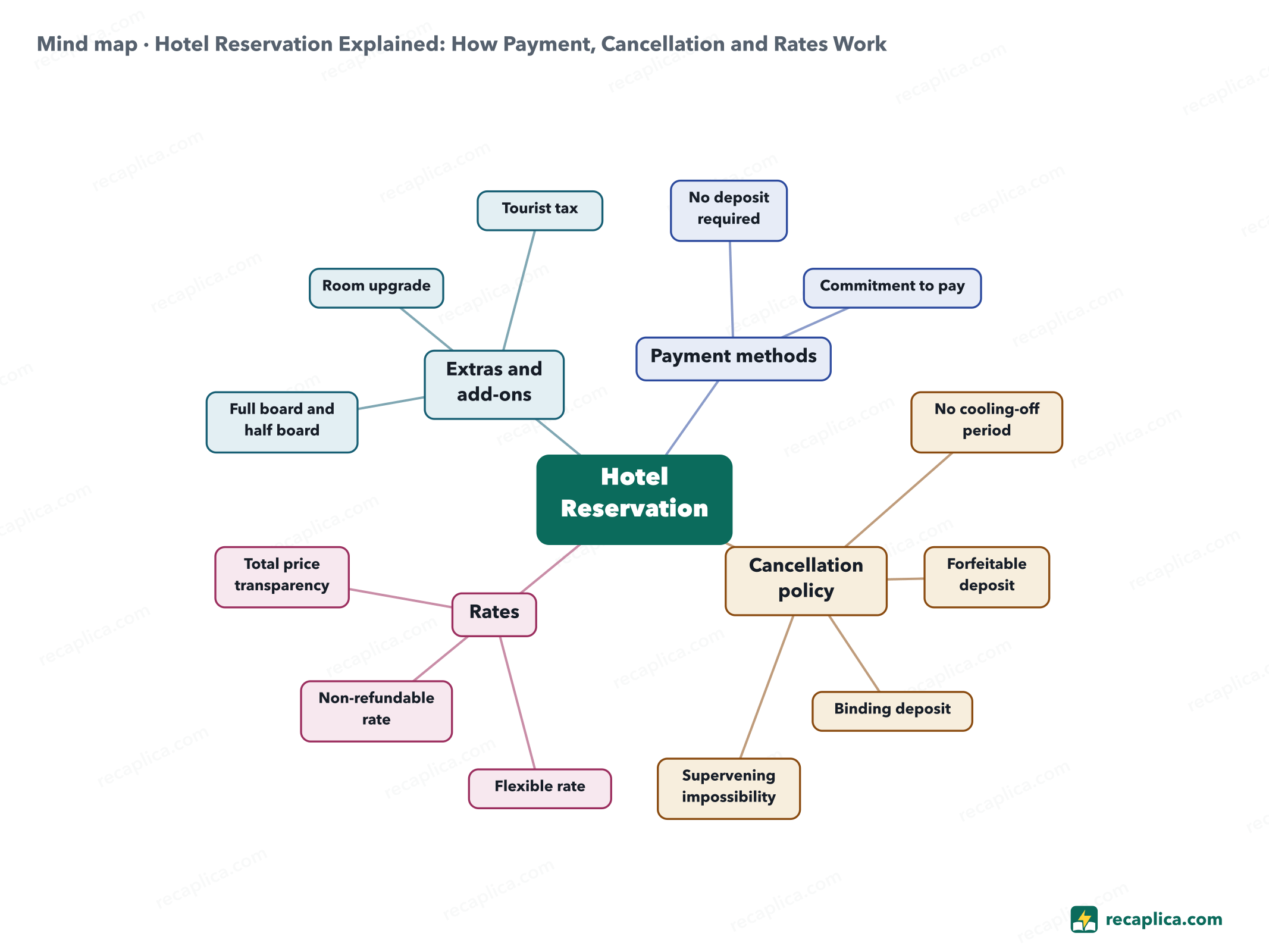
    Mind map: Hotel Reservation Explained: How Payment, Cancellation and Rates Work
    • Hotel Reservation
      • Payment methods
        • No deposit required An agreement on price and dates is enough to make the reservation valid
        • Commitment to pay The guest still owes the agreed price
      • Cancellation policy
        • No cooling-off period Excluded for accommodation tied to a specific date, in the EU
        • Forfeitable deposit Only the advance payment is lost
        • Binding deposit The full stay may need to be paid
        • Supervening impossibility Cancellation without penalty if the property becomes unreachable
      • Rates
        • Flexible rate Higher price, free cancellation within a window
        • Non-refundable rate Lower price, payment due even if you cancel
        • Total price transparency US rule on mandatory fee disclosure
      • Extras and add-ons
        • Full board and half board
        • Room upgrade Not guaranteed, depends on availability
        • Tourist tax Local charge, amount set by each municipality

    Quiz: test yourself

    Answer the questions to check what you have learned: you get instant feedback and a short explanation.

    Grade 0/10 0/5
    1 Do you always need to pay a deposit to make a hotel reservation valid?

    According to European Consumer Centres, no upfront payment is required for a reservation to be valid: an agreement between the parties is enough, and the guest still owes the agreed price.

    2 In the European Union, why can't you usually cancel a hotel reservation for free within 14 days, the way you could with many online purchases?

    European consumer rules exclude accommodation services linked to a specific date from the standard 14-day right of withdrawal; cancellation is only possible under the terms set by the property, as reflected for example in Italy's Consumer Code, Article 59.

    3 What's the practical difference between a forfeitable deposit and a binding deposit if you cancel?

    With a forfeitable deposit the hotel simply keeps the advance payment; with a binding deposit it can also demand payment for the entire reserved stay.

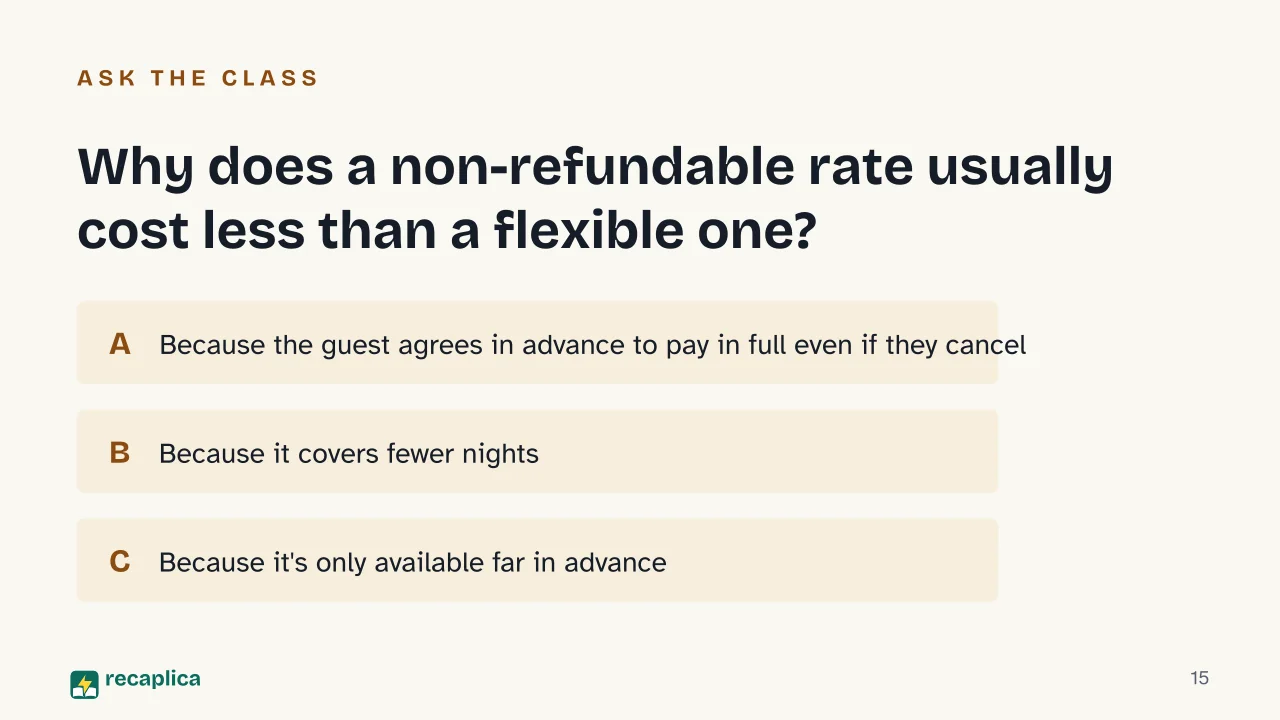
    4 Why does a non-refundable rate usually cost less than a flexible rate?

    A non-refundable rate is cheaper because the guest explicitly accepts paying the full amount even after cancelling; a flexible rate costs more precisely because it doesn't come with that restriction.

    5 True or false: the tourist tax is the same amount everywhere.

    The tourist tax is a local charge: the amount varies from one municipality or local authority to another, depending on each one's own decisions.

    Answers: 1-A · 2-A · 3-A · 4-A · 5-A

    Flashcards

    Tap the card to flip it and check whether you remember the answer, then move to the next one.

    1 / 8

    Explain it in your own words

    The ultimate test: if you can explain it in simple words, you've truly understood it. Write your explanation, then compare it with the Recap.

    Your explanation is saved only on this device.

    A hotel reservation becomes valid as soon as there's an agreement on price and dates — no deposit required. Cancelling it is a separate matter, governed by whatever conditions were chosen at booking: deposits, non-refundable rates, and, within the EU, the exclusion of the usual 14-day right to change your mind. Rates shift depending on how much flexibility a guest wants to keep until the last moment, and the room price can come with extra fees worth checking before confirming.

    Frequently asked questions

    Do I have to pay in advance to book a hotel room?

    No. A reservation is legally valid once there's an agreement on price and dates: the guest still owes the agreed amount, but paying a deposit isn't a legal requirement for the contract to be valid.

    What does a hotel cancellation policy usually cover?

    It sets out the deadlines and any penalties for cancelling, whether a deposit is forfeitable or binding, and what happens under a non-refundable rate. Reading it before booking is the only way to know exactly what you're agreeing to.

    What's the difference between a flexible rate and a non-refundable rate?

    A flexible rate costs more but lets you cancel for free within a window set by the property. A non-refundable rate costs less, but the guest agrees to pay for the full stay even if they end up cancelling.

    What are the extra fees that sometimes appear in a hotel's final price?

    These are charges like so-called resort fees or service fees, added on top of the initially displayed price. In the United States, the Federal Trade Commission introduced a rule, effective from May 12, 2025, requiring the full price, including these fees, to be disclosed from the start.

    Is the tourist tax the same at every hotel?

    No. It's a local charge set by each municipality or local authority, so the amount varies by destination.

    Sources

    • Euroconsumatori (European Consumer Centre Italy) — Cancelling a hotel reservation
    • European Consumer Centre Netherlands — What are my rights when booking a hotel?
    • European Consumer Centres Network — Hotels
    • Federal Trade Commission — FTC Announces Rule Banning Junk Ticket and Hotel Fees

    Every Recap goes through an independent review before publication.

    Every evening, the day's new Recaps on our Telegram channel. Join the channel →

    Keep learning

    • Economics Biggest Economies in the World: The Ranking by GDP, Explained In 2024, according to World Bank data, the United States remains the country with the highest nominal GDP in the world, ahead of China. Measured instead at purchasing power parity (PPP), which accounts for differences in price levels between countries, the ranking flips and China moves into first place. Nominal GDP reflects the weight of an economy on international markets in current dollars; PPP GDP reflects the domestic purchasing power of a country's residents. The two measures tell different stories, which is why the same economy can rank differently depending on which one you check. Read the Recap →
    • Economics How Much Does Italy's Regime Forfettario Really Cost? Keeping a VAT number under Italy's regime forfettario doesn't cost the same for everyone. Taxable income carries a substitute tax of 15%, cut to 5% for the first five years for those who meet certain conditions. The taxable base comes from applying a profitability coefficient to revenue that varies by activity, from 40% for trade up to 86% for construction: at the same revenue, a higher coefficient means a bigger tax bill. On top of that come social security contributions, with separate rates for tradespeople and shopkeepers and a reduction for those who stay in the scheme, plus a few recurring fixed costs that exist but carry no single amount set by any official source. Read the Recap →
    • Economics INPS Contributions Under Italy's Regime Forfettario, How They Work Anyone with a VAT number under Italy's regime forfettario still owes INPS contributions, and where they go depends on the activity: freelancers without a trade association of their own pay into the Gestione Separata, while tradespeople and shopkeepers pay into the Artigiani e Commercianti schemes. The two schemes charge different rates but share the same base, the flat-rate taxable income. Tradespeople and shopkeepers can also apply for an optional 35% contribution reduction, which lowers the amount credited toward their future pension as well. Read the Recap →

    recaplica

    Clear in 30 seconds, yours in 10 minutes.

    Recaps Mind maps Request a Recap Telegram channel Mind map maker Our method About Privacy & cookies Legal notes & terms of use

    © 2026 Recaplica · A project by Curi S.r.l. — VAT IT05472000750

    Statistics, only if you say so

    To learn which Recaps help most we would use Google Analytics, with aggregate, anonymous data. It starts only with your OK, and you can change your mind anytime. Privacy policy