Skip to content
recaplica

    One moment: security check

    Cloudflare wants to make sure you're not a robot. Tick the box below and your search will continue on its own.

    IT
    recaplica Scienze della Formazione Primaria Test: How Italy's Primary Teaching Degree Entrance Exam Works
    © 2026 Recaplica · recaplica.com — All rights reserved
    Home › Civics

    Scienze della Formazione Primaria Test: How Italy's Primary Teaching Degree Entrance Exam Works

    By Recaplica Newsroom · Updated on September 22, 2026

    What to print

    Page numbers appear when printing with default margins.

    Slides

    Choose a cut

    Flash10 slidesThe essential thread, to present in classFull16 slidesEvery chapter and the deeper detail

    Both come with speaker notes.

    Telegram channel
    recaplica Clear in 30 seconds, yours in 10 minutes.
    In 30 seconds Key points Figures Deep dive Slides Myths Mind map Quiz Flashcards FAQ

    In 30 seconds quick read

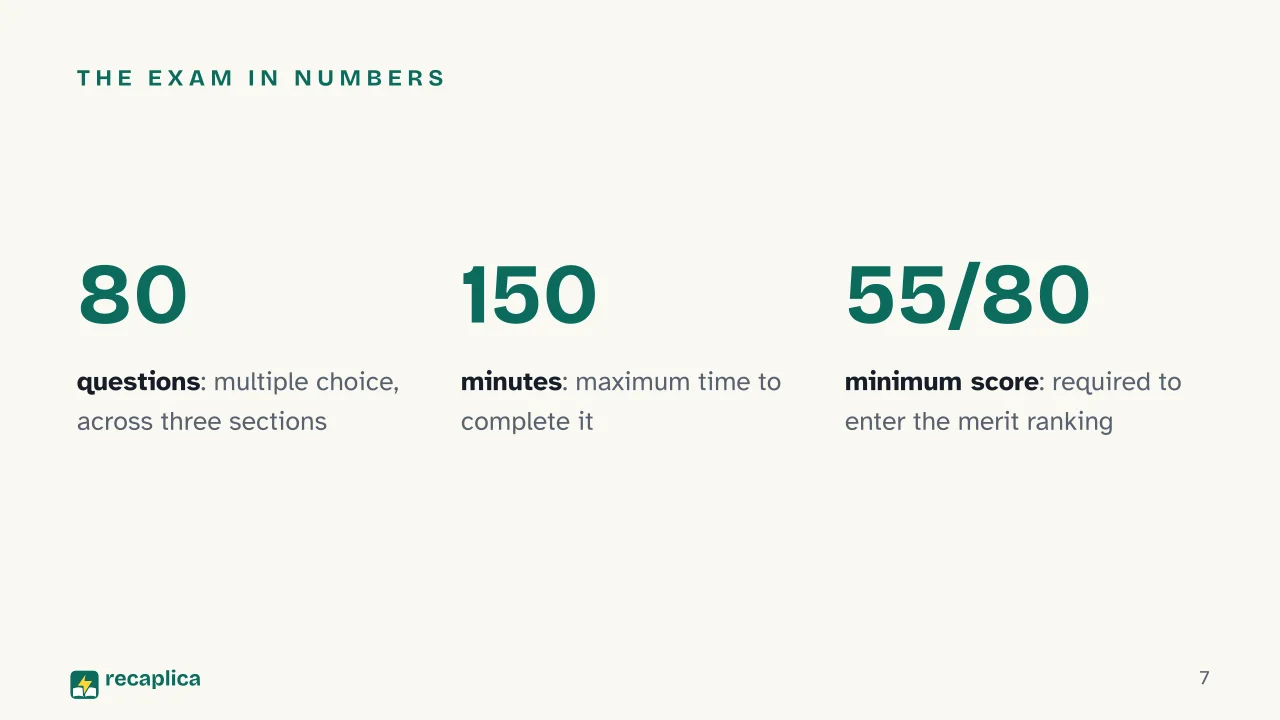
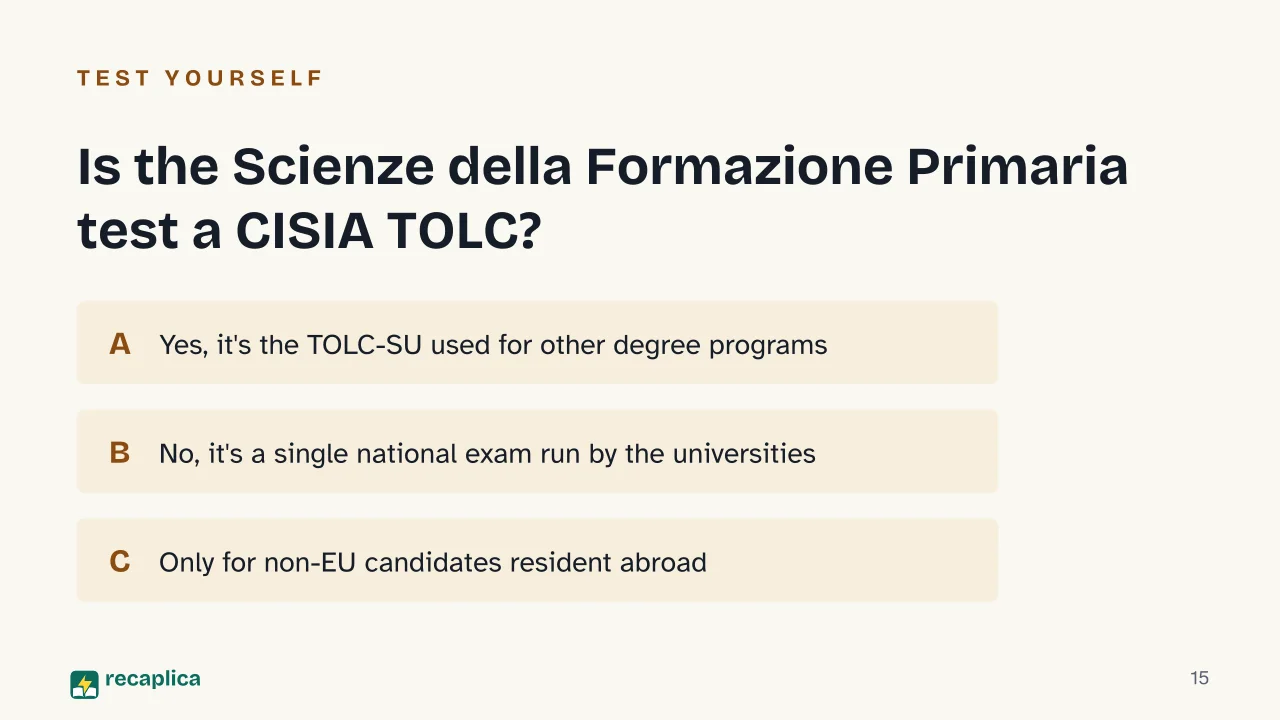
    The Scienze della Formazione Primaria test is the entrance exam for Italy's single-cycle master's degree in Primary Education (LM-85 bis), which qualifies graduates to teach in preschool and primary school. For the 2026/2027 academic year it consists of 80 multiple-choice questions covering language and logical reasoning, literary and social-historical culture, and mathematical-scientific culture, to be completed in 150 minutes; a minimum score of 55 out of 80 is required to enter the merit ranking. Italy's Ministry of University and Research allocated 11,937 places for 2026/2027, 115 more than the 11,822 places of 2025/2026. It is not a CISIA TOLC: it is a single national exam, with different questions at each university, run locally through each university's own admission notice.

    Key Points

    • It is the entrance exam for the single-cycle master's degree in Primary Education (LM-85 bis), a five-year program that qualifies graduates to teach in preschool and primary school.
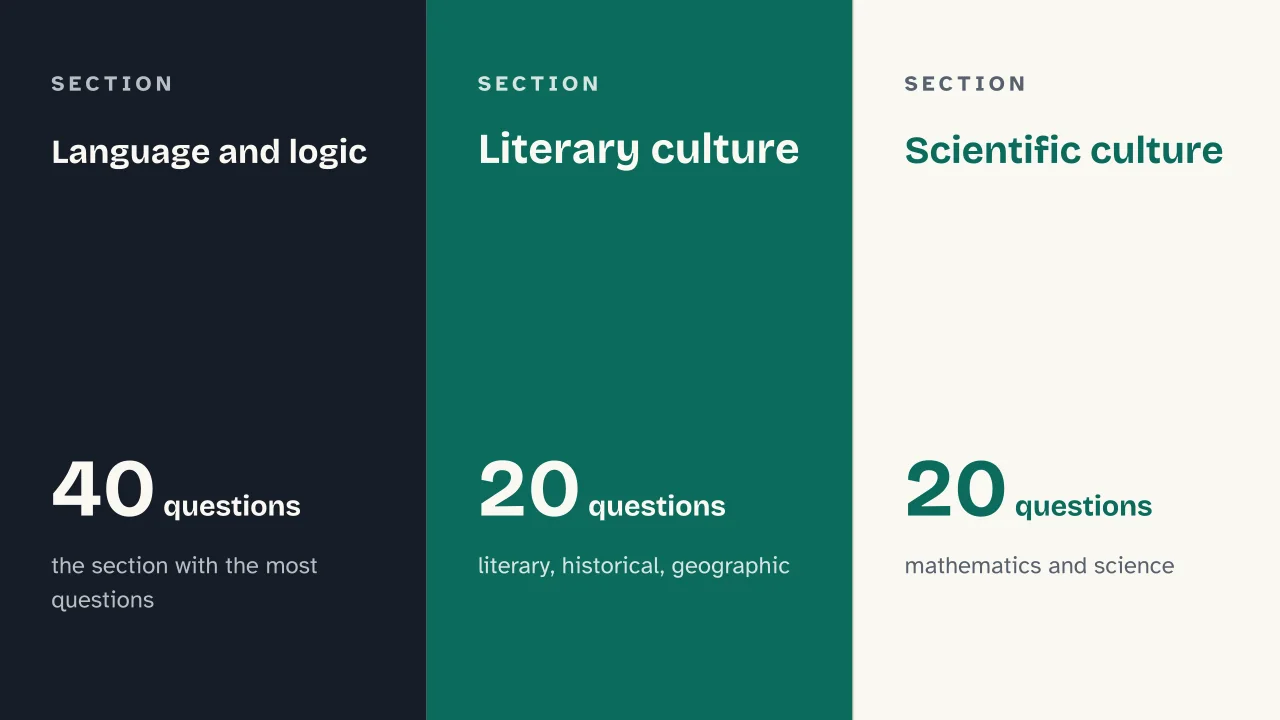
    • For 2026/2027 the exam has 80 multiple-choice questions in 150 minutes: 40 on language competence and logical reasoning, 20 on literary, historical and social culture, 20 on mathematical-scientific culture.
    • A minimum score of 55 out of 80 is required to enter the merit ranking for the 2026/2027 academic year.
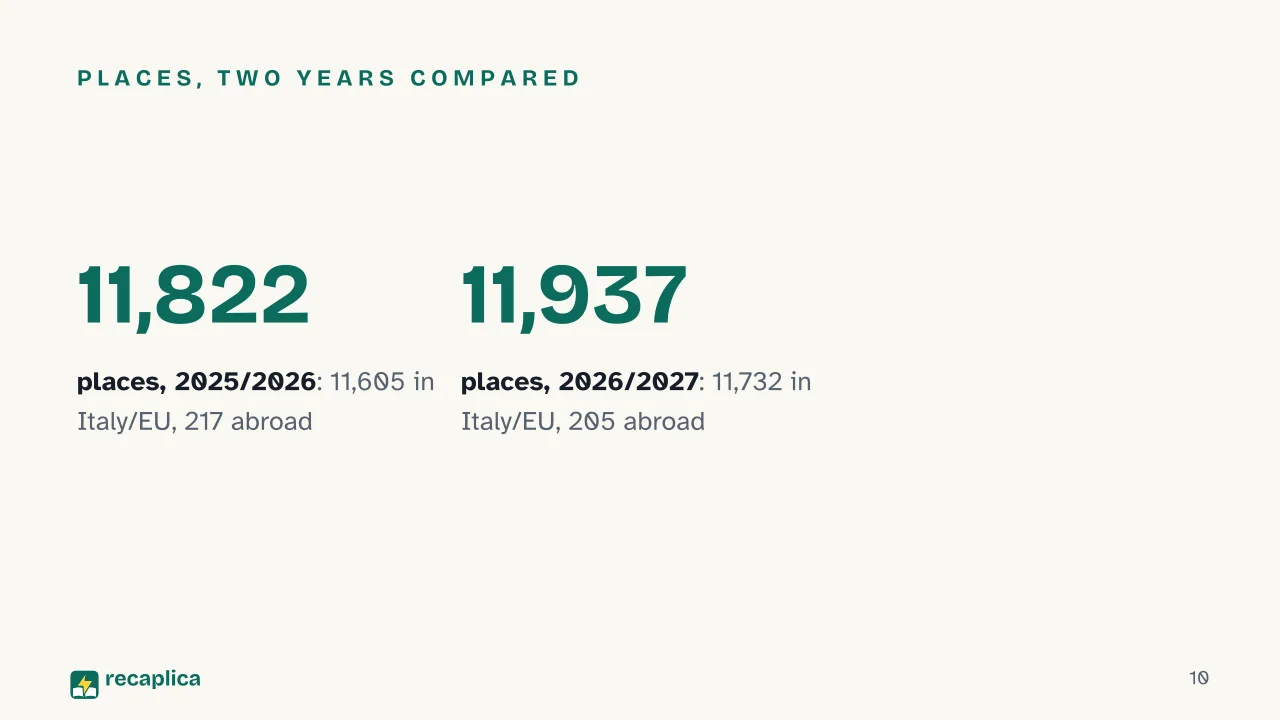
    • Italy's Ministry of University and Research allocated 11,937 places for 2026/2027, 115 more than the 11,822 places of 2025/2026.
    • The exam is national and held on the same fixed date across Italy, with different questions from university to university: each university runs it through its own admission notice, not CISIA through a TOLC.
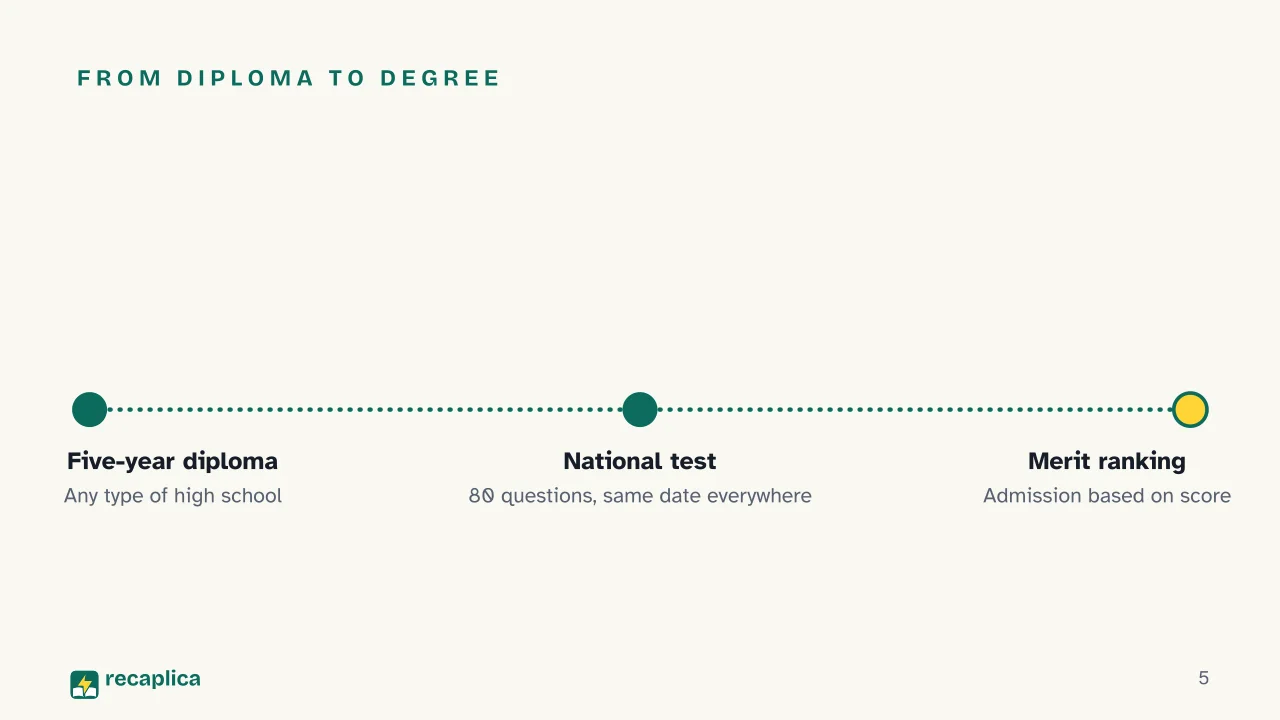
    • Any five-year upper-secondary school diploma gives access to the exam; no specific type of high school is required.

    Key figures

    • 11,937 places allocated for the degree for the 2026/2027 academic year (11,732 for EU and non-EU candidates resident in Italy, 205 for non-EU candidates resident abroad) Source: MUR, ministerial decree no. 992 of 3 August 2026, reported by Edunews24
    • 55/80 minimum score required to enter the merit ranking, 2026/2027 academic year Source: newsistruzione.it, 2026/2027 academic year
    • +115 additional places compared with the 2025/2026 academic year (from 11,822 to 11,937 total places) Source: Edunews24

    Deep Dive

    Every year, on the same day, at every Italian university offering the program, thousands of candidates sit the same exam to enroll in Scienze della Formazione Primaria: the single-cycle master’s degree (LM-85 bis) that qualifies graduates to teach in preschool and primary school. It is not an exam decided by each individual university, but a single national test, with content set by a decree from Italy’s Ministry of University and Research (MUR).

    A single ministerial test, not a TOLC

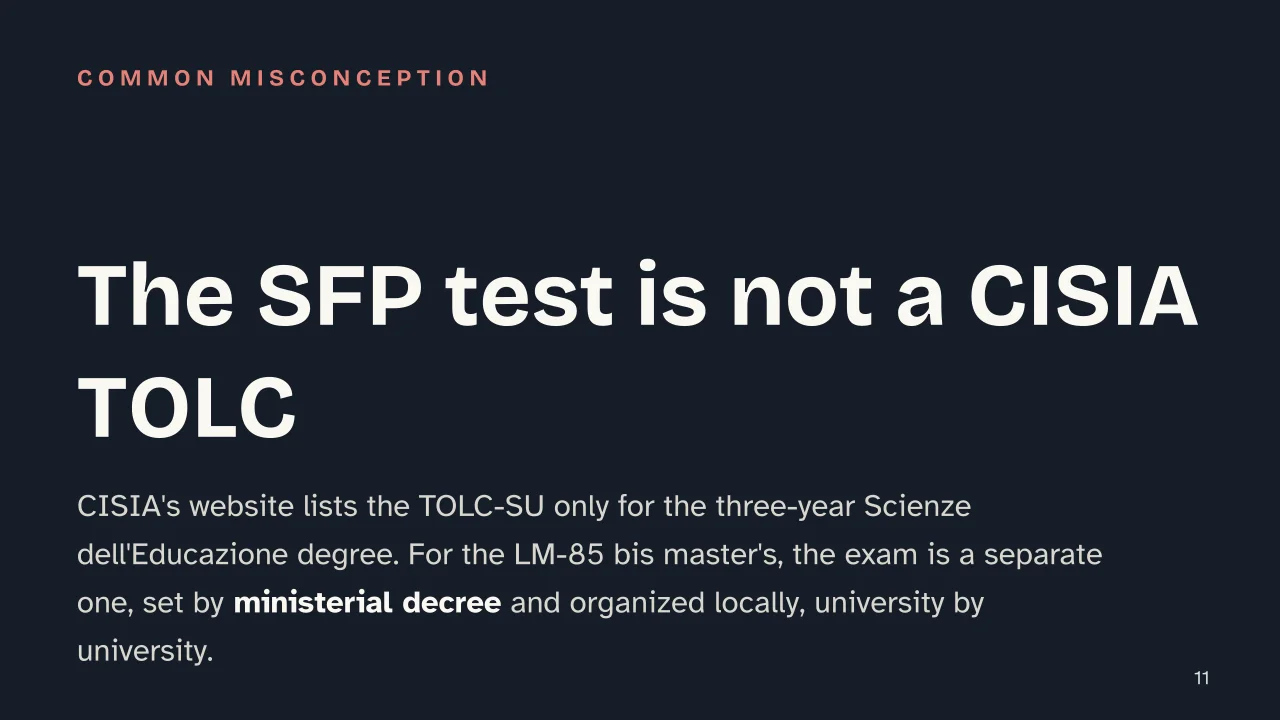
    Online searches about this exam often get tangled up with TOLC, the family of tests run by CISIA (the Interuniversity Consortium for Integrated Access Systems). On the consortium’s official website, the TOLC-SU (Humanities Sciences) is described as required by some universities for admission to humanities-area degree programs; these include the three-year Scienze dell’Educazione degree (class L-19), a different program from the single-cycle master’s this Recap covers. No CISIA page mentions the TOLC-SU for the LM-85 bis degree.

    The sources consulted for this Recap instead describe, for Primary Education, a written test held on a single national date, with different questions from university to university but the same structure everywhere, set by ministerial decree and run directly by each university through its own admission notice. This is the channel through which students enter the degree.

    The structure of the exam, 2026/2027

    Ministerial decree no. 931 of 3 July 2026 sets the format of the exam for the 2026/2027 academic year: 80 multiple-choice questions, four options per question, to be completed in 150 minutes. That year’s exam took place on Friday, 11 September 2026, from 11:00 to 13:30. The questions are split as follows:

    SectionQuestions (2026/2027)
    Language competence and logical reasoning40
    Literary, historical and social culture20
    Mathematical-scientific culture20
    Total80

    Entering the merit ranking at the university where the exam was taken requires a minimum score of 55 points out of 80. A separate decree from the one on the exam format, ministerial decree no. 992 of 3 August 2026, sets how many places each university offers: the two measures regulate different things, one the running of the exam, the other the number of places.

    Comparing 2025/2026 and 2026/2027

    The exam’s structure is not new: for 2025/2026 too, the test consisted of 80 questions in 150 minutes, held on 12 September 2025, with the same three-section breakdown. What changes most from one year to the next is the number of places on offer:

    Element2025/20262026/2027
    Total places11,82211,937
    Places, Italy/EU11,60511,732
    Places, non-EU candidates abroad217205
    Exam questions8080
    Time allowed150 minutes150 minutes

    Practical example: a candidate registering for the 2026/2027 exam finds 115 more places than the previous edition (11,937 versus 11,822), but the exam format they will face, 80 questions in 150 minutes across the same three sections, is the same one already seen in 2025/2026: it is worth practicing with past papers from both editions, since the exam format stays the same from one year to the next.

    Entry requirements and the degree path

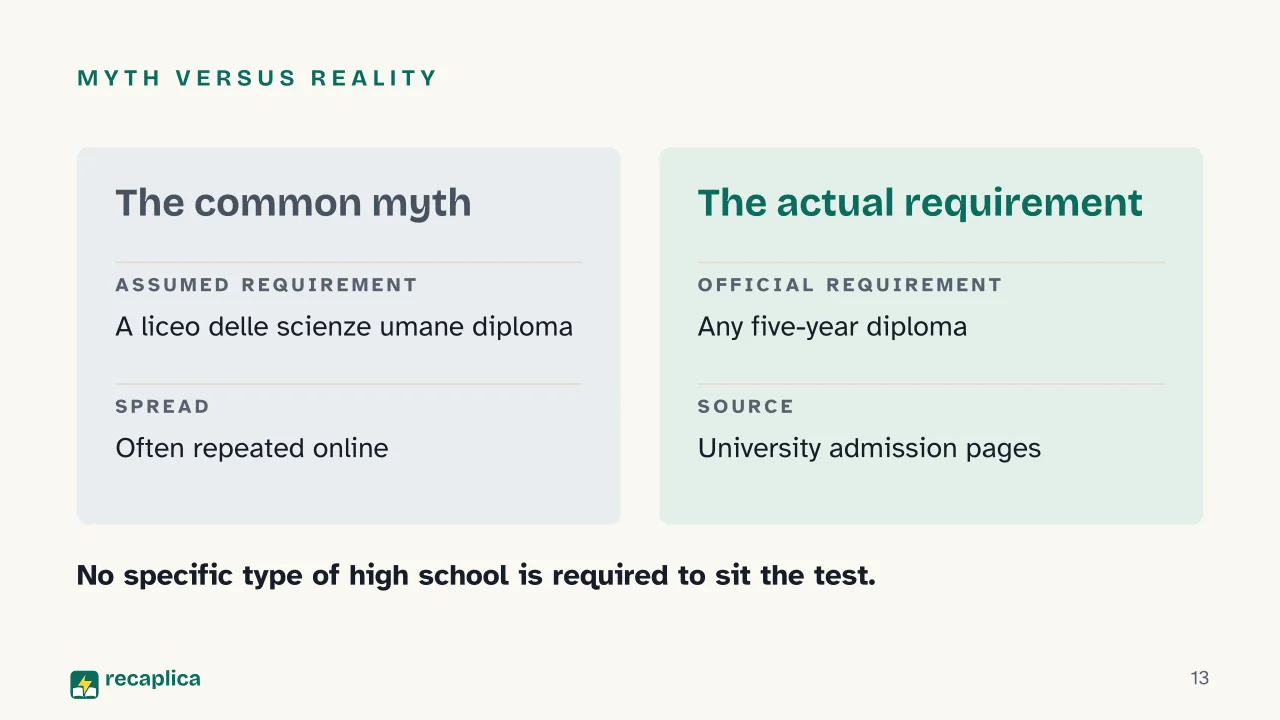
    Registering for the exam only requires a five-year upper-secondary school diploma, or an equivalent qualification earned abroad: any type of high school qualifies, not only the liceo delle scienze umane (humanities-focused high school). Once admitted, the degree lasts five years and includes 30 exams overall and 600 hours of school placement, starting in the second year at accredited preschool and primary institutions. Those who also want to qualify for special-needs teaching must complete, after graduation, an additional 60-credit specialization course: it is not included in the base five-year path.

    Someone who already holds a degree in Scienze dell’Educazione (L-19) may, depending on how the university recognizes prior credits, be admitted to a later year of the Primary Education degree: this remains a case-by-case situation to check with the individual university, not a general exemption from the entrance test. For a comparison with the rules of other Italian admission tests, see the Recap on university entrance exams in Italy, and readers also preparing for a health-area test can check the Recap on Italy’s health professions admission test.

    The merit ranking and tie-break criteria

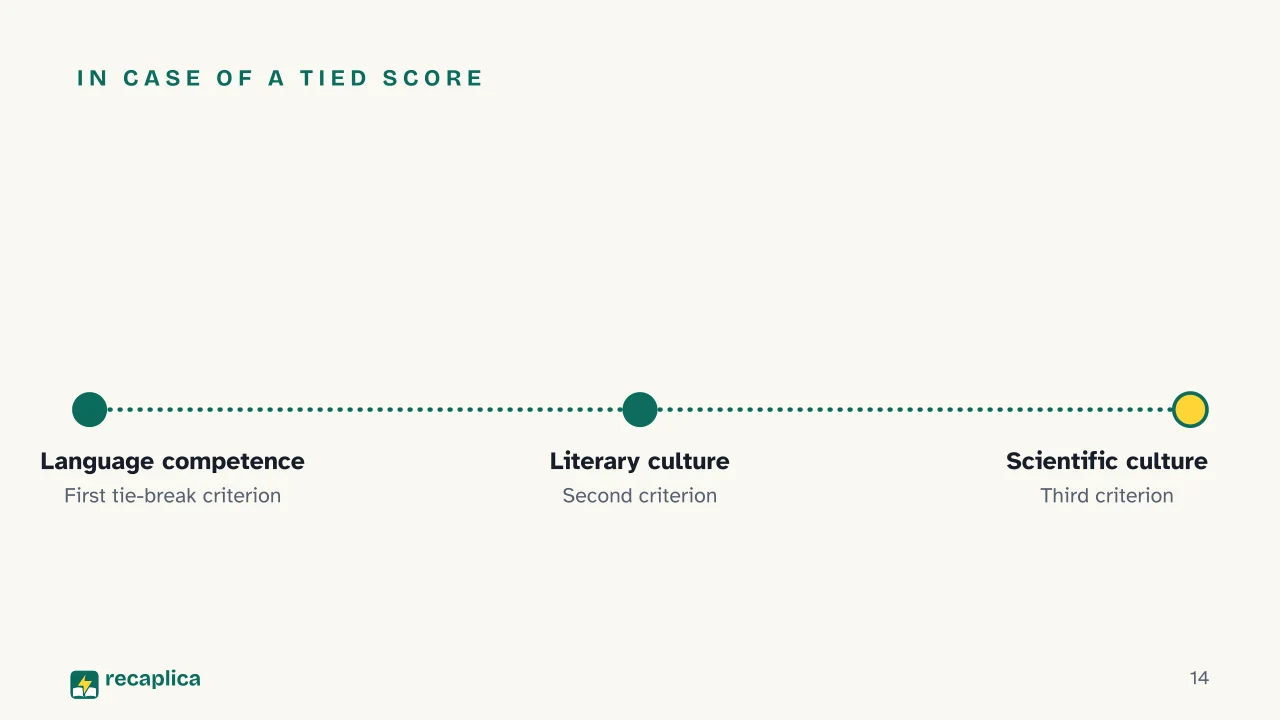
    Clearing the minimum score of 55/80 does not by itself guarantee a place: admission depends on a candidate’s position in the university’s merit ranking, based on their score, relative to the places available at that university. In case of a tied score, the ranking applies tie-break criteria in order: first the score in language competence, then the score in literary culture, then the score in mathematical-scientific culture, then the diploma grade, and finally the candidate’s age.

    How to prepare

    The exam’s sections cover different areas: command of the Italian language and text analysis for the language section, literary genres and historical chronology for the literary-historical section, number systems, algebra, probability and evolutionary biology for the scientific section. Timed practice tests remain the most direct way to get used to the exam’s pace, 80 questions in 150 minutes; when sorting through sources found online while preparing, the method described in the Recap on evaluating credible sources for research can also help distinguish a ministerial decree from a generic page that only repeats some of its figures.

    Slide deck

    Slides ready to download and make your own in PowerPoint or Google Slides, with speaker notes. Pick the Flash cut or the Full one.
    Slide 1 of the presentation on Scienze della Formazione Primaria Test: Scienze della Formazione PrimariaSlide 2 of the presentation on Scienze della Formazione Primaria Test: Is the Scienze della Formazione Primaria test a TOLC?Slide 3 of the presentation on Scienze della Formazione Primaria Test: In this RecapSlide 4 of the presentation on Scienze della Formazione Primaria Test: Chapter 01: What the test isSlide 5 of the presentation on Scienze della Formazione Primaria Test: From diploma to degreeSlide 6 of the presentation on Scienze della Formazione Primaria Test: Chapter 02: The exam, 2026/2027Slide 7 of the presentation on Scienze della Formazione Primaria Test: The exam in numbersSlide 8 of the presentation on Scienze della Formazione Primaria Test: Language and logic · Literary culture · Scientific cultureSlide 9 of the presentation on Scienze della Formazione Primaria Test: Chapter 03: The places availableSlide 10 of the presentation on Scienze della Formazione Primaria Test: Places, two years comparedSlide 11 of the presentation on Scienze della Formazione Primaria Test: The SFP test is not a CISIA TOLCSlide 12 of the presentation on Scienze della Formazione Primaria Test: Chapter 04: How admission worksSlide 13 of the presentation on Scienze della Formazione Primaria Test: Myth versus realitySlide 14 of the presentation on Scienze della Formazione Primaria Test: In case of a tied scoreSlide 15 of the presentation on Scienze della Formazione Primaria Test: Is the Scienze della Formazione Primaria test a CISIA TOLC?Slide 16 of the presentation on Scienze della Formazione Primaria Test: The Recap continues on the site
    Flash10 slidesThe essential thread, to present in classFull16 slidesEvery chapter and the deeper detail

    Common myths

    • ✗ Myth The Scienze della Formazione Primaria entrance test is a CISIA TOLC, like the TOLC-SU used for other degree programs.

      ✓ Reality CISIA's own website lists the TOLC-SU as a test required by some universities for humanities-area degrees, including the three-year Scienze dell'Educazione program (L-19), but never mentions it for the single-cycle master's in Primary Education (LM-85 bis). The sources on this exam instead describe a single national test, set by ministerial decree, with different questions at each university and run by each university through its own admission notice.

    • ✗ Myth Only students who attended a liceo delle scienze umane (humanities-focused high school) can sit the test.

      ✓ Reality As stated on the official pages of the universities that offer this degree, the entry requirement is any five-year upper-secondary school diploma, or an equivalent qualification earned abroad: any type of high school qualifies, not only the liceo delle scienze umane.

    Mind map

    Drag the background to move around and the nodes to reposition them; use − and + to collapse and expand branches.
    Customize
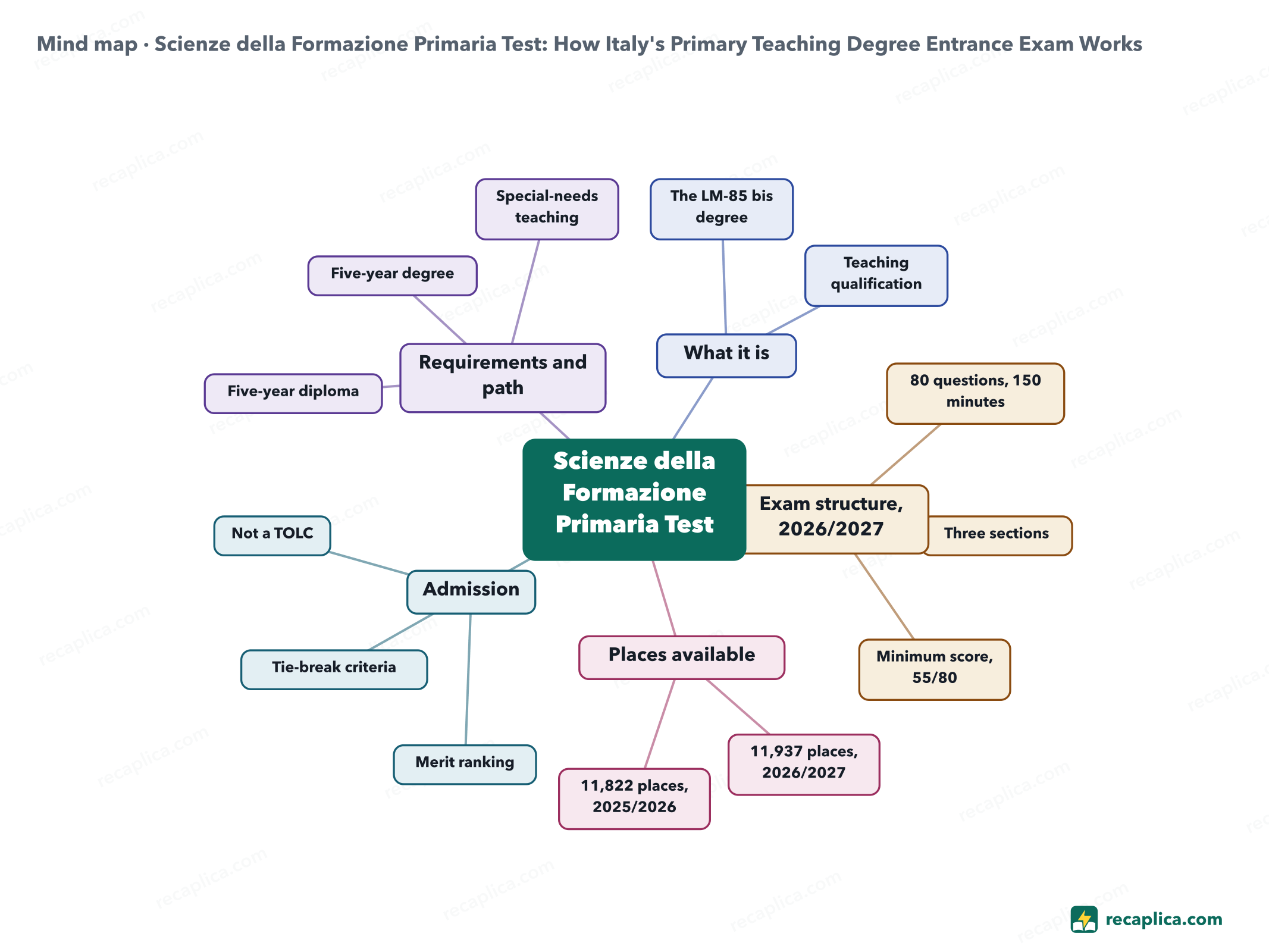
    Mind map: Scienze della Formazione Primaria Test: How Italy's Primary Teaching Degree Entrance Exam Works
    • Scienze della Formazione Primaria Test
      • What it is
        • The LM-85 bis degree Single-cycle, five years
        • Teaching qualification Preschool and primary school
      • Exam structure, 2026/2027
        • 80 questions, 150 minutes
        • Three sections Language and logic, literary, mathematical-scientific
        • Minimum score, 55/80
      • Places available
        • 11,937 places, 2026/2027
        • 11,822 places, 2025/2026
      • Admission
        • Merit ranking
        • Tie-break criteria Score per section, diploma grade, age
        • Not a TOLC A common misconception online
      • Requirements and path
        • Five-year diploma Any type of high school
        • Five-year degree 600 hours of placement from year two
        • Special-needs teaching Requires an extra qualification after graduation

    Quiz: test yourself

    Answer the questions to check what you have learned: you get instant feedback and a short explanation.

    Grade 0/10 0/5
    1 Which degree program does the Scienze della Formazione Primaria test give access to?

    The test gives access to the single-cycle master's degree LM-85 bis, which qualifies graduates to teach in preschool and primary school; the three-year Scienze dell'Educazione degree (L-19) is a different program.

    2 How many questions does the exam have for the 2026/2027 academic year?

    Under ministerial decree no. 931 of 3 July 2026, the 2026/2027 exam has 80 multiple-choice questions, to be completed in 150 minutes.

    3 What is the minimum score to enter the merit ranking for 2026/2027?

    For the 2026/2027 academic year, the minimum score to enter the merit ranking is 55 points out of 80.

    4 The Scienze della Formazione Primaria test is a TOLC run by CISIA.

    CISIA lists the TOLC-SU as required by some universities for the three-year Scienze dell'Educazione degree (L-19), a different program from the LM-85 bis master's this test covers.

    5 What type of diploma is needed to sit the test?

    The entry requirement is a five-year upper-secondary school diploma, regardless of which type of high school it was earned at.

    Answers: 1-A · 2-C · 3-B · 4-B · 5-B

    Flashcards

    Tap the card to flip it and check whether you remember the answer, then move to the next one.

    1 / 8

    Explain it in your own words

    The ultimate test: if you can explain it in simple words, you've truly understood it. Write your explanation, then compare it with the Recap.

    Your explanation is saved only on this device.

    The Scienze della Formazione Primaria test is the entrance exam for Italy's single-cycle master's degree in Primary Education (LM-85 bis), which qualifies graduates to teach in preschool and primary school. For the 2026/2027 academic year it consists of 80 multiple-choice questions covering language and logical reasoning, literary and social-historical culture, and mathematical-scientific culture, to be completed in 150 minutes; a minimum score of 55 out of 80 is required to enter the merit ranking. Italy's Ministry of University and Research allocated 11,937 places for 2026/2027, 115 more than the 11,822 places of 2025/2026. It is not a CISIA TOLC: it is a single national exam, with different questions at each university, run locally through each university's own admission notice.

    Frequently asked questions

    What happens in case of a tied score in the Scienze della Formazione Primaria test?

    The merit ranking applies tie-break criteria in order: first the score in language competence, then the score in literary culture, then the score in mathematical-scientific culture, then the diploma grade, and finally the candidate's age.

    Can graduates skip years of the degree if they already hold a related qualification?

    Someone who already holds a degree in Scienze dell'Educazione (L-19) may, depending on how the university recognizes prior credits, be admitted to a later year of the Primary Education degree: this remains a case-by-case decision at each university, not a general exemption from the entrance test for someone starting from scratch.

    Is the Scienze della Formazione Primaria test a CISIA TOLC?

    No. CISIA lists the TOLC-SU as required by some universities for the three-year Scienze dell'Educazione degree (L-19). The single-cycle master's in Primary Education (LM-85 bis) instead has its own exam, set by ministerial decree and run by each university through its own admission notice.

    What diploma is needed to register for the Scienze della Formazione Primaria test?

    A five-year upper-secondary school diploma, or an equivalent qualification earned abroad: any type of high school qualifies, not only the liceo delle scienze umane.

    How many places are available for Scienze della Formazione Primaria in 2026/2027?

    11,937 places nationwide, of which 11,732 are for EU and non-EU candidates resident in Italy and 205 for non-EU candidates resident abroad: 115 more than the 11,822 places of 2025/2026.

    Sources

    • MUR, Ministerial Decree no. 931 of 03-07-2026
    • newsistruzione.it, Test Scienze della Formazione Primaria 2026: prova nazionale
    • Orizzonte Scuola, Scienze della formazione primaria 2025/26, sono 11.822 i posti a disposizione
    • Edunews24, Scienze della formazione primaria: il MUR autorizza 11.937 posti
    • CISIA, What is the TOLC
    • Università degli Studi di Torino, Scienze della Formazione Primaria
    • Skuola.net, guida al test scienze della formazione primaria 2026

    Every Recap goes through an independent review before publication.

    Every evening, the day's new Recaps on our Telegram channel. Join the channel →

    Keep learning

    • Civics ARAN, Italy's public-sector collective bargaining agency ARAN is the agency that negotiates Italy's public-sector employment contracts on behalf of every public administration in the country. It was set up in 1993 as a technical agency under public law, and its role was later confirmed by two further laws, in 2001 and 2009. Public administrations, through sector committees, give ARAN its mandate for the negotiation. And a contract ARAN negotiates only takes effect once Italy's Court of Auditors has certified that it is financially sustainable. Read the Recap →
    • Civics Civil Service: What It Is and How It Works in Italy The civil service is both the activity of running public affairs and the set of bodies that carry it out: ministries and agencies, public bodies, independent authorities, state-owned enterprises, and local government such as regions, provinces and municipalities. In Italy, the Constitution's Articles 97 and 98 require sound administration and impartiality, entry to public jobs through open competitive exams, and service to the Nation rather than to any government or party. Part of this machinery — state bodies such as ministries — has no legal personality of its own, because it coincides with the state itself; another part, public bodies, has its own separate legal personality. In 2022, Italy's statistics agency ISTAT counted 12,776 active public institutions, employing more than 3.4 million people. Read the Recap →
    • Civics Federalism Explained: Who Decides What, and at Which Level Federalism is the general idea that a country's power is shared out among several levels of government, with a constitution fixing who holds which piece. Subsidiarity is the rule that decides where a task lands: it starts at the level closest to people and only moves up when a wider scale is genuinely needed. Italy uses subsidiarity heavily, spelled out in Article 118 of its Constitution, and Article 117 divides lawmaking power between the national government and the regions. Even so, Treccani's entry on Italian regional law is explicit that Italy remains a variant of the unitary state, not a federation in the technical sense used for countries like Germany, the United States or Switzerland, because judicial power in Italy stays with the central government alone. Read the Recap →

    recaplica

    Clear in 30 seconds, yours in 10 minutes.

    Recaps Mind maps Request a Recap Telegram channel Mind map maker Our method About Privacy & cookies Legal notes & terms of use

    © 2026 Recaplica · A project by Curi S.r.l. — VAT IT05472000750

    Statistics, only if you say so

    To learn which Recaps help most we would use Google Analytics, with aggregate, anonymous data. It starts only with your OK, and you can change your mind anytime. Privacy policy