|
recaplica
Florentine Renaissance: Brunelleschi, Ghiberti, Masaccio, Donatello | ||||||||||||||||||||
| © 2026 Recaplica · recaplica.com — All rights reserved | ||||||||||||||||||||
Florentine Renaissance: Brunelleschi, Ghiberti, Masaccio, DonatelloWhat to print Page numbers appear when printing with default margins. SlidesChoose a cut Flash10 slidesThe essential thread, to present in classFull15 slidesEvery chapter and the deeper detailBoth come with speaker notes. In 30 seconds quick readThe Florentine Renaissance is the moment when Italian art breaks, step by step, with the Gothic style and turns back toward the classical world. In Florence, in the first half of the fifteenth century, four names mark that shift: Filippo Brunelleschi, who builds linear perspective into his architecture; Lorenzo Ghiberti, who wins the 1401 competition for the Baptistery doors; Masaccio, who brings naturalism into painting; and Donatello, who brings it into sculpture and becomes a reference point for the city's artists. Their work, often paid for by craft guilds or the Medici family, changes how painters, sculptors and architects work. Key Points
Key figures
Deep DiveIn the first half of the fifteenth century, Florence changes how buildings, sculptures and paintings are made. Treccani places the birth of Renaissance art right there, in an environment “contrassegnato sensibilmente dall’attività di figure quali Donatello, Masaccio, F. Brunelleschi” — shaped, in other words, by the work of Donatello, Masaccio and Brunelleschi. The source calls it “una progressiva rottura con gli stilemi dell’arte e dell’architettura del gotico”, a gradual break with Gothic conventions that opened the way to a language drawing ever more directly on the classical vocabulary. Brunelleschi and the invention of perspectiveFilippo Brunelleschi is the first to build his architecture on a new system: linear perspective with a single vanishing point. As the National Gallery in London puts it, “the ‘single point’ system (linear perspective) was invented by Brunelleschi in Florence in relation to his architecture.” It is a mathematical construction: parallel lines receding from the viewer appear to converge toward one point, the vanishing point. Florentine artists take up the system from the early decades of the fifteenth century; Leon Battista Alberti later sets it down in writing in his treatise De Pictura.
Brunelleschi also puts his ideas into real buildings. From 1417 he works on the dome of Santa Maria del Fiore, which Treccani calls “la più grande impresa fiorentina del tempo” — the largest undertaking in Florence at the time. In the same years he designs the portico of the Ospedale degli Innocenti, begun in 1419, and the Old Sacristy of the basilica of San Lorenzo, built between 1419 and 1428. The 1401 competition: Ghiberti beats BrunelleschiBefore turning to architecture, though, Brunelleschi enters a competition he does not win. In 1401 Florence holds the selection for the Baptistery’s second doors, with a mandatory subject for the trial panel: the Sacrifice of Isaac. Lorenzo Ghiberti wins it. Treccani states it plainly: “Dopo il concorso per la porta del Battistero, vinto dal Ghiberti” — after the competition for the Baptistery doors, won by Ghiberti — Brunelleschi turns to other pursuits. Among them, the source says, are perspective panels showing views of the Baptistery and the Palazzo dei Signori, now lost but described in detail by his biographer. Neither Treccani nor the museum sources say how the commission was finally settled on Ghiberti, and no date is added here. Masaccio, naturalism in paintingMasaccio applies to painting what Brunelleschi applies to architecture. The National Gallery in London calls him “the most revolutionary painter of the Early Renaissance”: he combines monumental figures, “sculpted by light”, with linear perspective to build a believable sense of space. The same source notes that Masaccio “was influenced by the advances in sculpture of his friend Donatello, which he then applied to painting.” Masaccio’s best-known work is the fresco cycle in the Brancacci Chapel, in the church of Santa Maria del Carmine in Florence, painted in the 1420s. His nickname, “Masaccio”, means something like clumsy or hulking Tom: his real name was Tommaso di ser Giovanni di Simone. He died probably of plague, in Rome, at 27; the National Gallery flags the uncertainty over the exact year, giving it as “1428/9?”. Donatello, guide to the city’s innovatorsAccording to the Bargello Museums, Donatello “con le sue opere sarà la guida, per tutta la prima metà del secolo, degli artisti più innovatori” of Florence — he becomes, through his work, the guide for the city’s most innovative artists across the whole first half of the century. His Saint George, carved for an outdoor niche at Orsanmichele, is described by the same source as “una delle prime raffigurazioni in assoluto dello spazio che si apre prospetticamente in profondità” in sculpture — one of the very first renderings of depth opening up in space. Another work, the bronze David, is made for the Medici family and described by the Bargello Museums as the “primo nudo a tutto tondo dopo la fine della classicità”, the first freestanding nude since the end of antiquity: the source gives no precise year for it. Orsanmichele, the building that houses the Saint George, was not a museum: its outdoor niches held statues of the patron saints of the Arti, Florence’s craft guilds, which paid for them. Each guild chose its own patron and commissioned the work representing it.
The Florentine Renaissance is not an isolated episode: it continues a path of political and cultural renewal already under way in the previous century, when the Italian medieval city-state had reshaped how Tuscan cities were governed, and it lays the ground for the Renaissance that spreads through the rest of Italy and Europe in the following decades. Readers who want to compare it with the period just before can start from the Middle Ages; those interested in the Florentine political thought that follows shortly after find a natural bridge in Machiavelli’s The Prince, written in Florence a century after the 1401 competition. Slide deckSlides ready to download and make your own in PowerPoint or Google Slides, with speaker notes. Pick the Flash cut or the Full one.     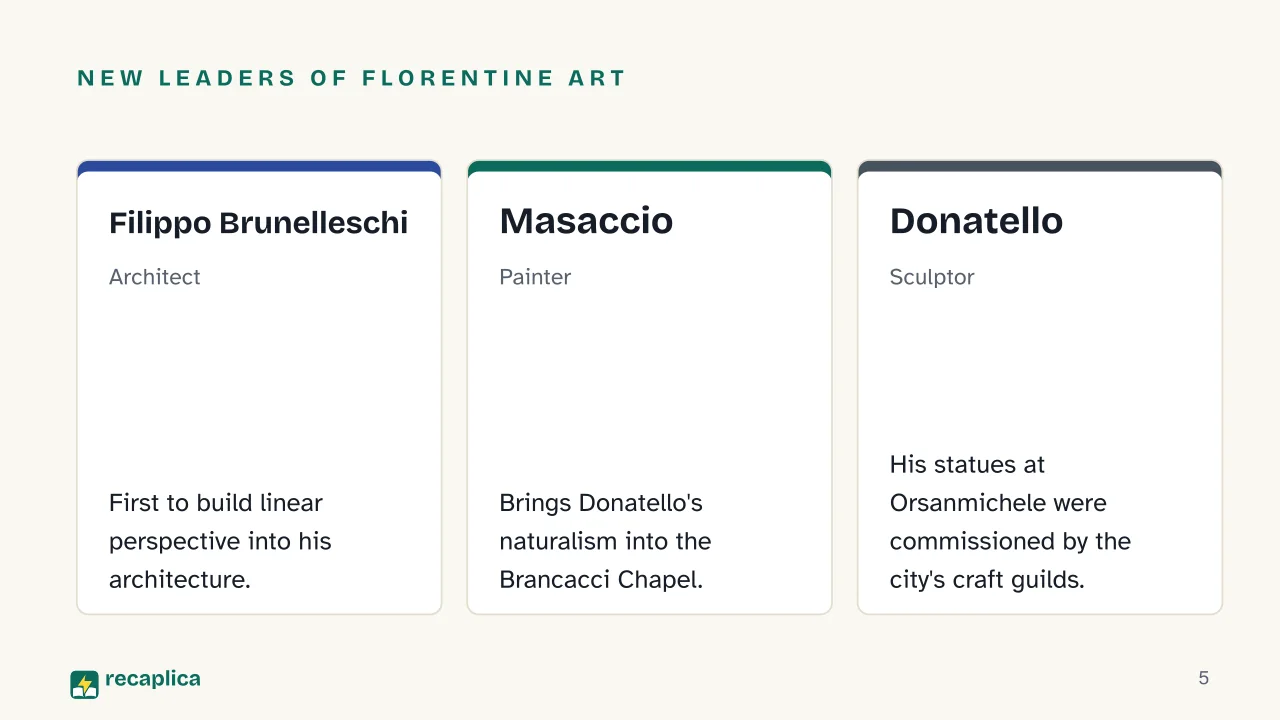  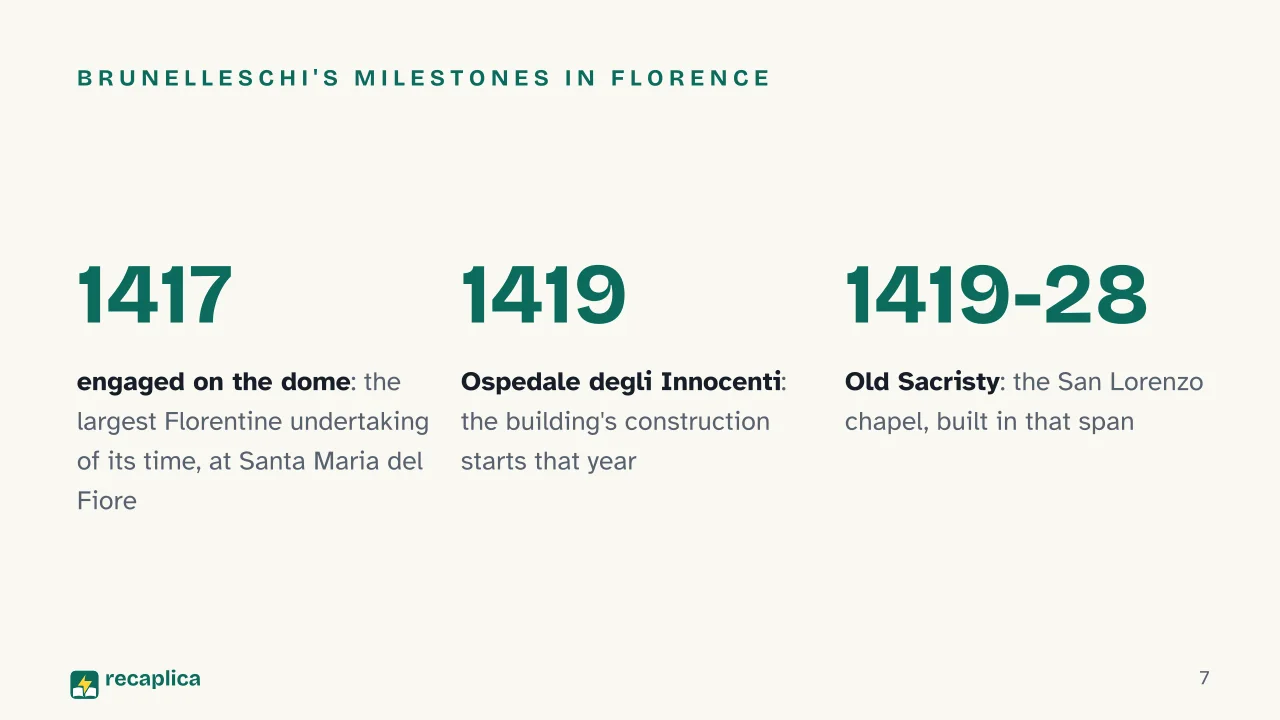 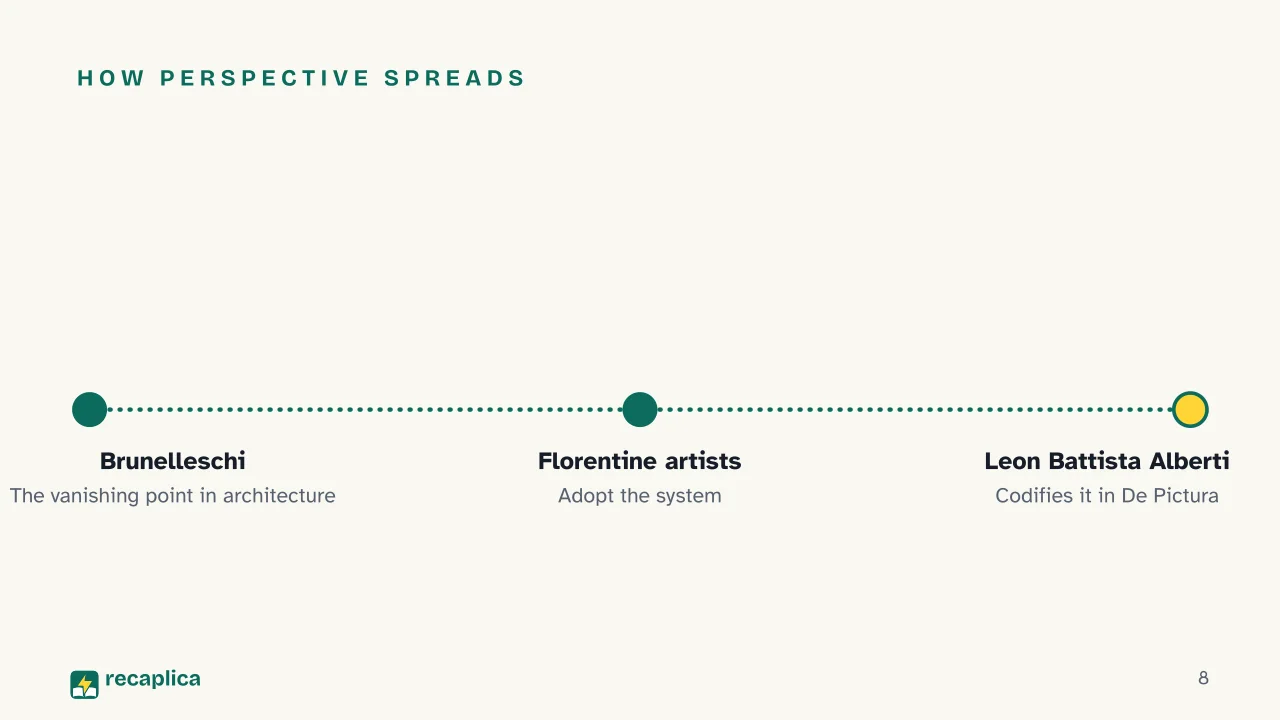  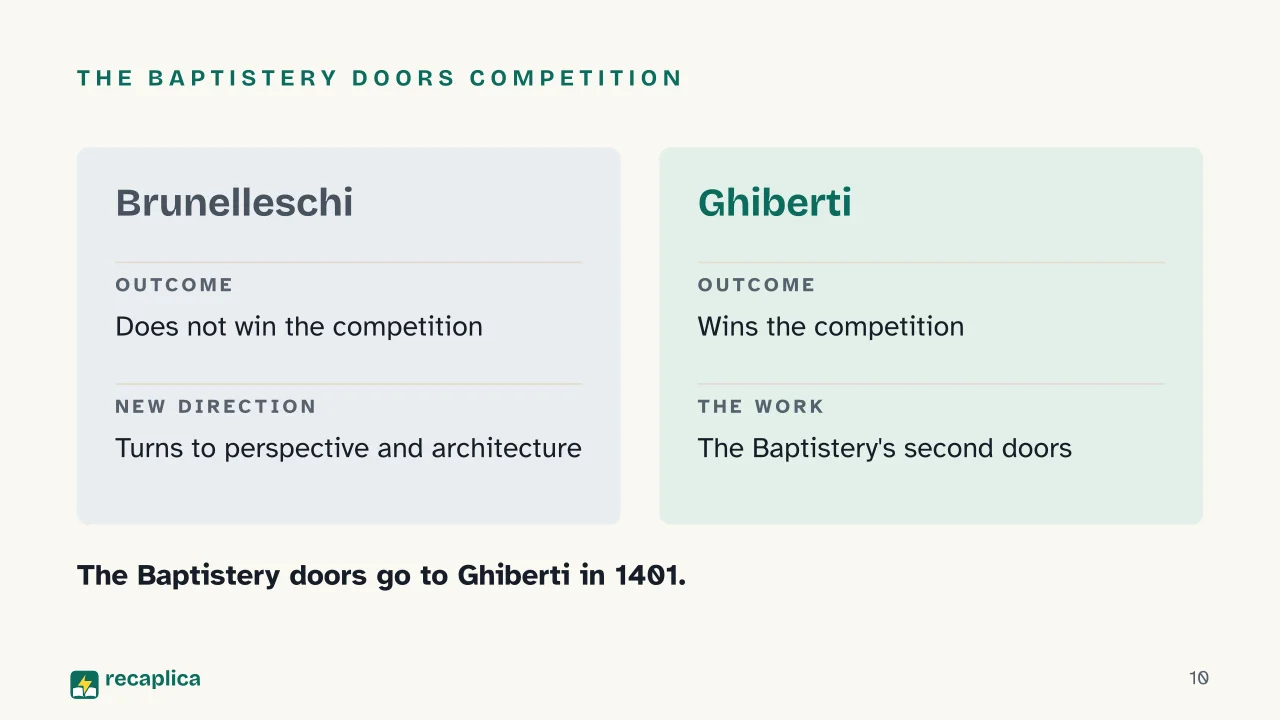  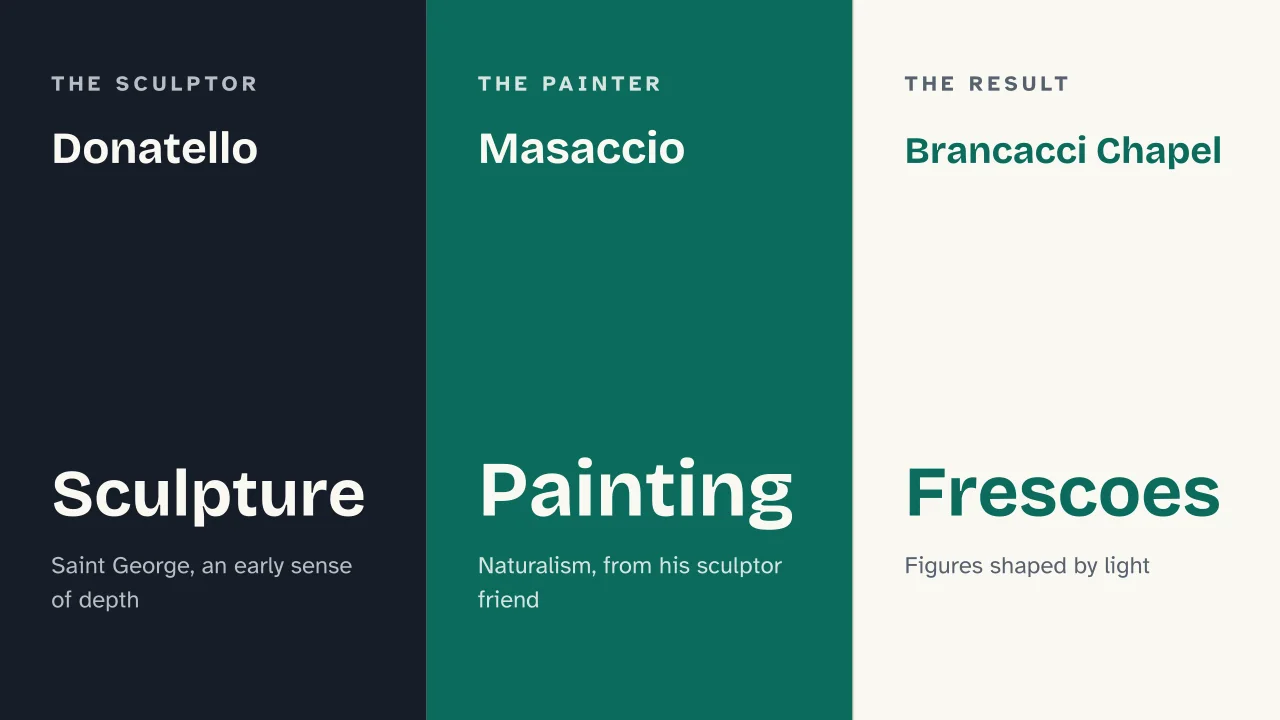 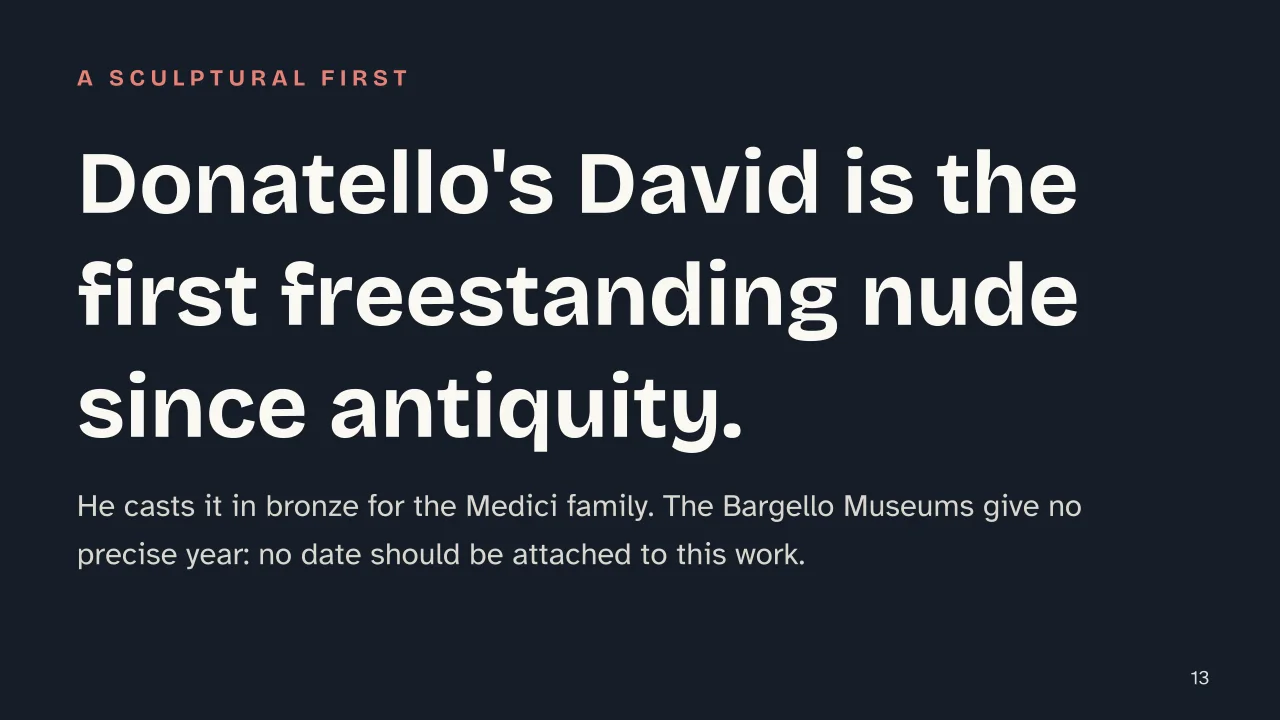   Common myths
Mind mapDrag the background to move around and the nodes to reposition them; use − and + to collapse and expand branches. 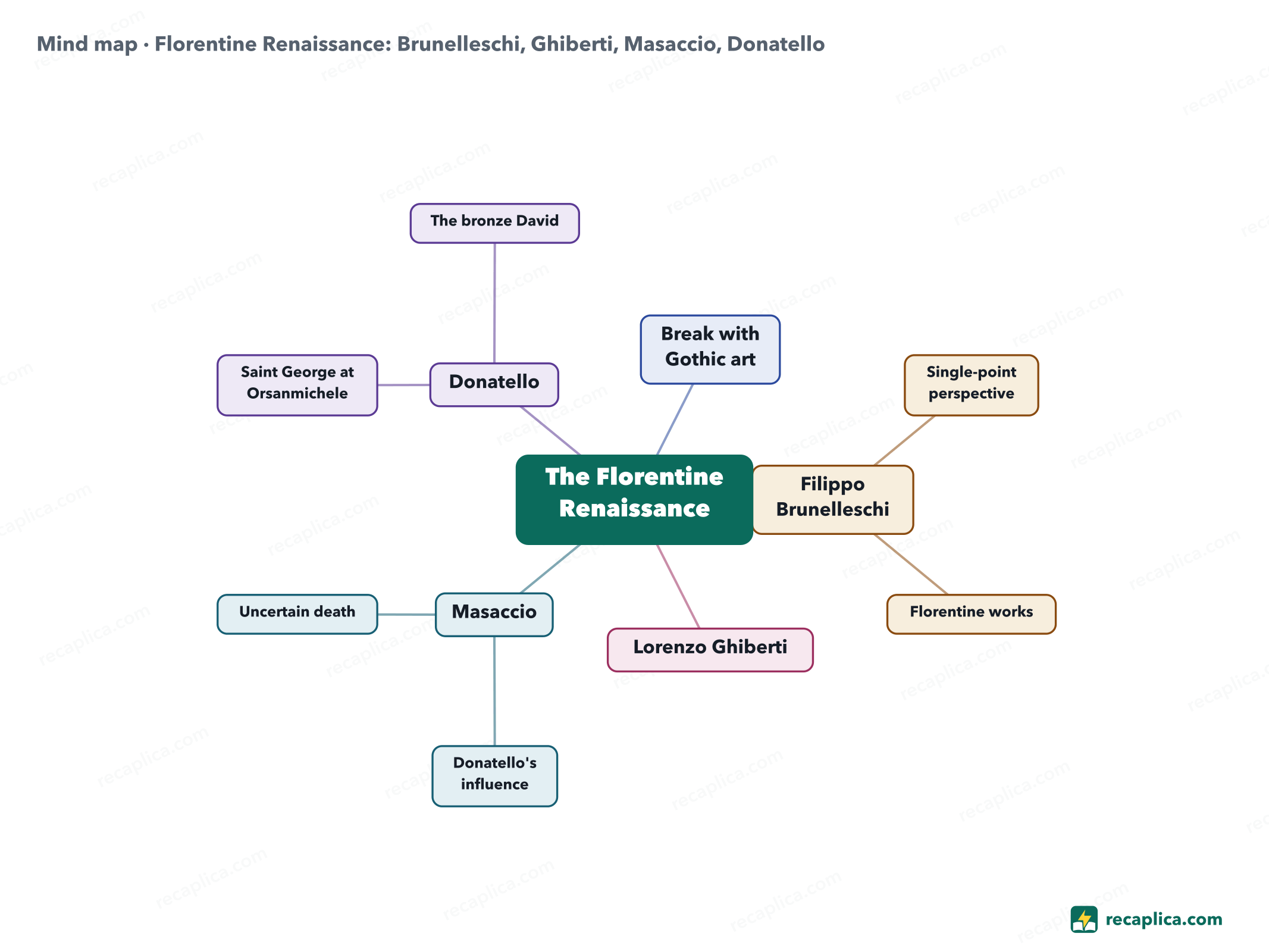
Quiz: test yourselfAnswer the questions to check what you have learned: you get instant feedback and a short explanation. Grade 0/10 0/5
FlashcardsTap the card to flip it and check whether you remember the answer, then move to the next one. 1 / 8 Explain it in your own wordsThe ultimate test: if you can explain it in simple words, you've truly understood it. Write your explanation, then compare it with the Recap. Your explanation is saved only on this device.
Frequently asked questionsWhat was the Florentine Renaissance?It was the period, in the first half of the fifteenth century, when Renaissance art took shape in Florence: according to Treccani, a language that gradually broke with Gothic conventions and drew increasingly on the classical vocabulary. Who are the leading figures of the Florentine Renaissance?The names most often cited for the period are Filippo Brunelleschi (architecture and perspective), Lorenzo Ghiberti (bronze sculpture), Masaccio (painting) and Donatello (sculpture). Who invented the perspective used in Renaissance painting?According to the National Gallery in London, the single-point system was invented by Brunelleschi in connection with his architecture, then adopted by Florentine artists and theorized in writing by Alberti. When did Masaccio die?The National Gallery in London gives the year of death as uncertain, between 1428 and 1429, probably from plague, in Rome. What was Orsanmichele?It is the Florentine building whose outdoor niches held statues of patron saints, commissioned by the Arti, the city's craft guilds: among them Donatello's Saint George. Every Recap goes through an independent review before publication. |