Skip to content
recaplica

    One moment: security check

    Cloudflare wants to make sure you're not a robot. Tick the box below and your search will continue on its own.

    IT
    recaplica Middle Ages: a summary of a thousand years of feudalism and crusades
    © 2026 Recaplica · recaplica.com — All rights reserved
    Home › History

    Middle Ages: a summary of a thousand years of feudalism and crusades

    By Recaplica Newsroom · Updated on September 16, 2026

    What to print

    Page numbers appear when printing with default margins.

    Slides

    Choose a cut

    Flash10 slidesThe essential thread, to present in classFull18 slidesEvery chapter and the deeper detail

    Both come with speaker notes.

    Telegram channel
    recaplica Clear in 30 seconds, yours in 10 minutes.
    In 30 seconds Key points Figures Deep dive Slides Myths Mind map Quiz Flashcards FAQ

    In 30 seconds quick read

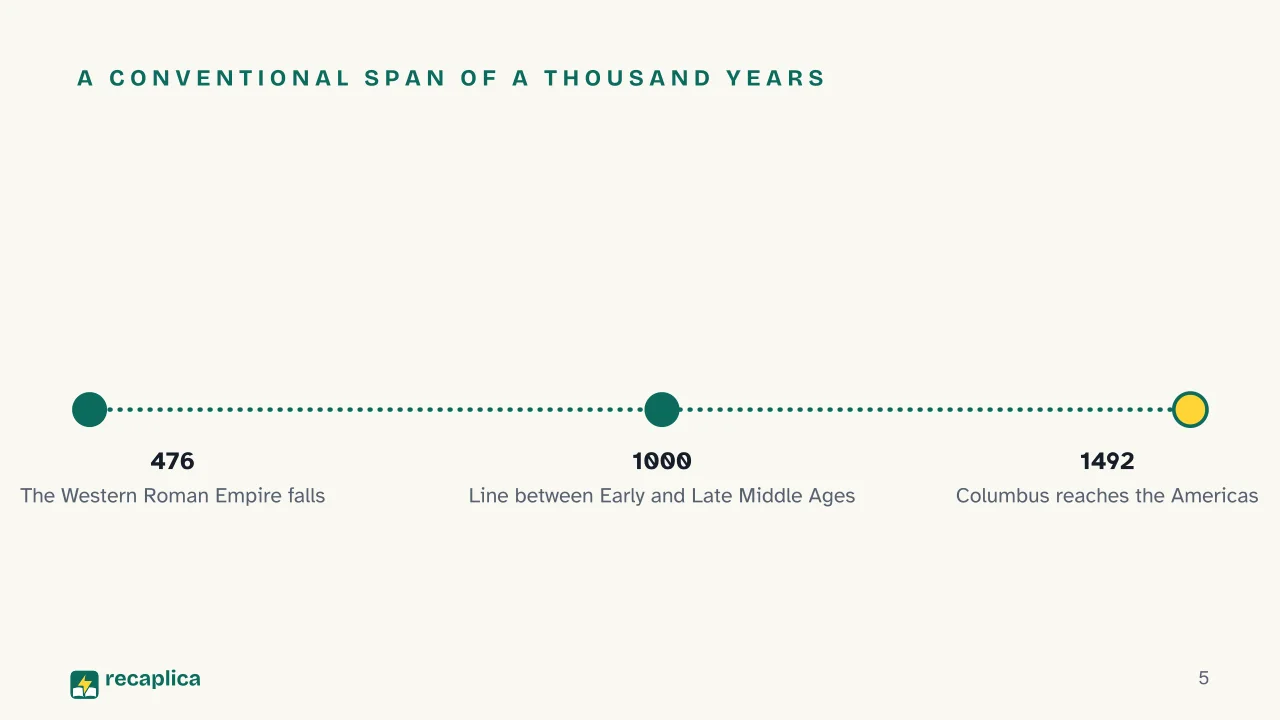
    The Middle Ages is the period historians conventionally place between 476, when the Western Roman Empire fell, and 1492, when Columbus reached the Americas: roughly ten centuries, split by another symbolic line, the year 1000, into the Early and Late Middle Ages. Feudalism and vassalage take shape during this span, a ruler like Charlemagne is crowned by the Church, eight major Crusades cross the Mediterranean toward the Holy Land, and the Black Death, between 1347 and 1352, kills millions across Europe. The opening and closing dates are not the only option: other historians, such as Christoph Cellarius in 1688, have argued for a different span. This Recap follows the main waypoints, from the fall of Rome to the edge of the modern era.

    Key Points

    • By convention, the Middle Ages run from 476, the fall of the Western Roman Empire, to 1492, when Columbus reached the Americas.
    • The year 1000 splits the Early Middle Ages, when feudalism emerges, from the Late Middle Ages of the Crusades and the Black Death.
    • Vassalage is the bond of loyalty between two free men; feudalism proper begins once that bond comes with the grant of a fief.
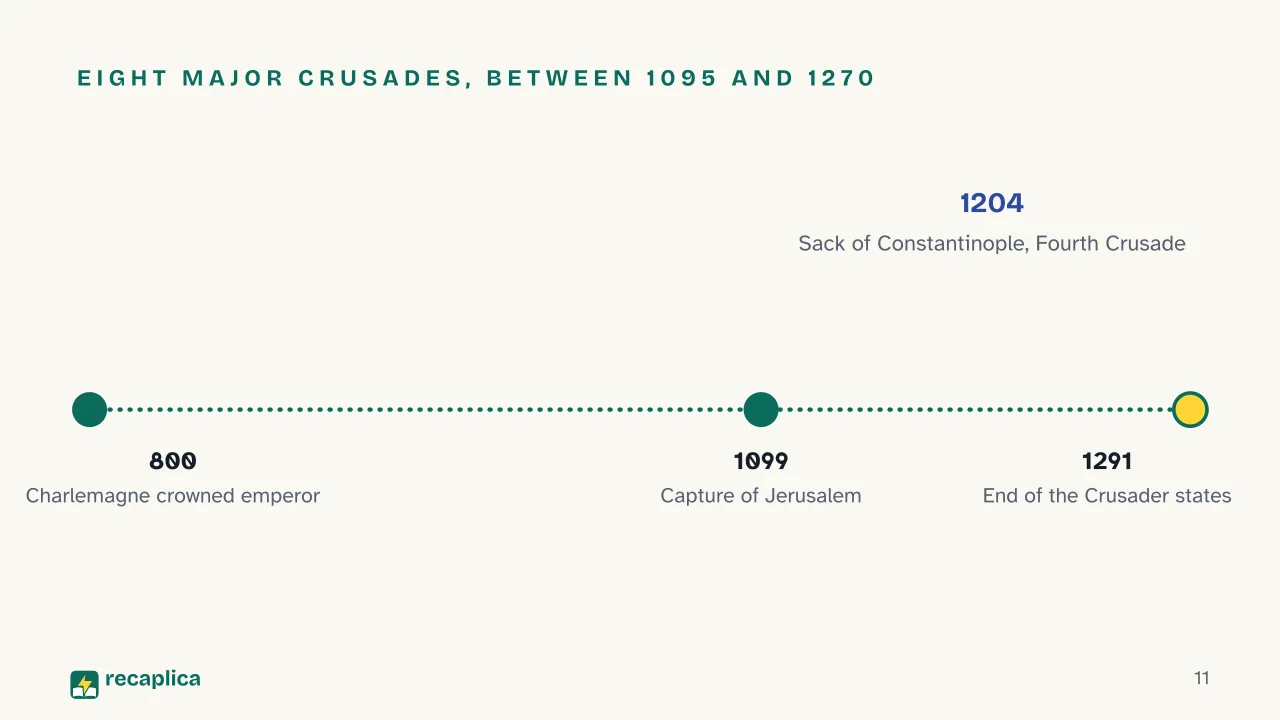
    • Charlemagne is crowned emperor on Christmas night in the year 800.
    • Eight major Crusades follow one another between 1095 and 1270, alongside smaller, unofficial expeditions.
    • The Black Death, between 1347 and 1352, is estimated to have killed 25 to 30 million people in Europe; the population does not recover until around 1550.

    Key figures

    • 25-30 million estimated deaths from the Black Death in Europe between 1347 and 1352 Source: World History Encyclopedia
    • 1550 the year Europe's population is estimated to have returned to its pre-1347 level Source: World History Encyclopedia
    • 800 the year Charlemagne was crowned emperor, on Christmas night Source: Treccani, Enciclopedia dei ragazzi

    Deep Dive

    An era with no official birth certificate

    476, the year the Western Roman Empire fell, is the date that, by convention, opens the Middle Ages. The conventional close is 1492, the year Columbus reached the Americas. In between, roughly ten centuries. It isn’t the only way to slice the timeline: readers curious about how the Roman Empire turned from a single state under one government into a patchwork of Germanic kingdoms will find there the starting point of this story.

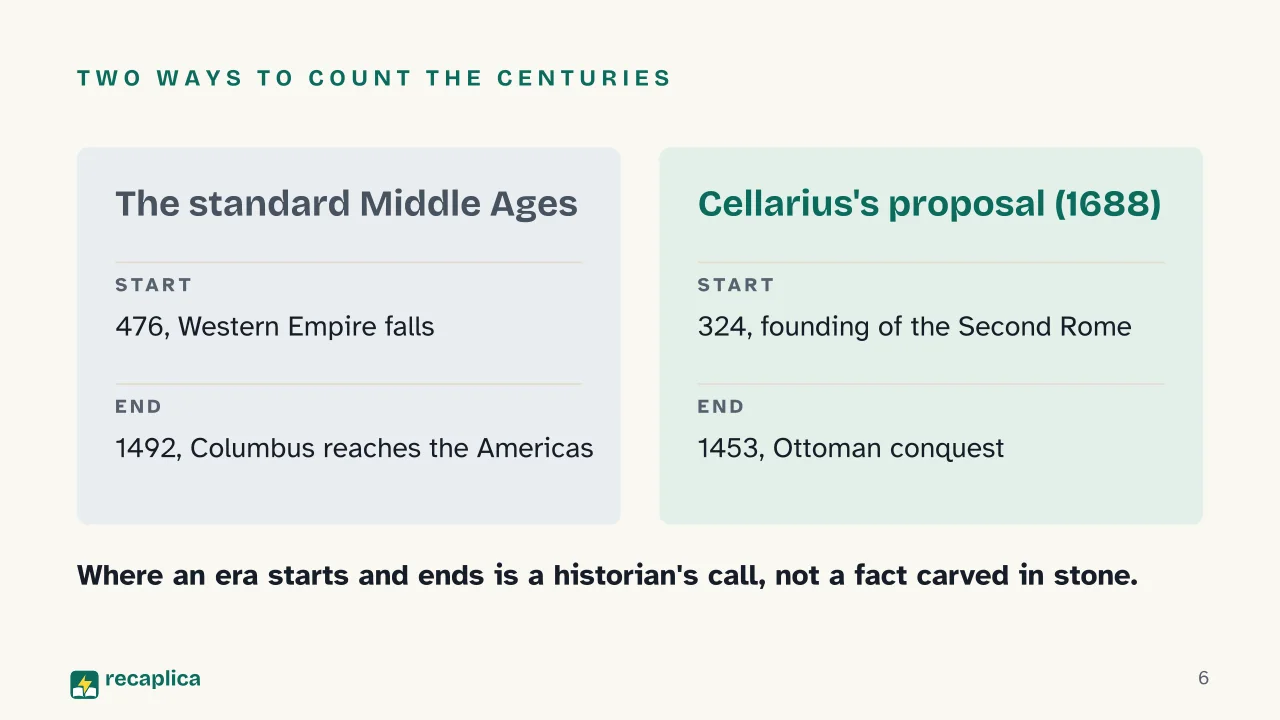
    The 476-1492 convention didn’t fall from the sky. It’s a choice made by Italian humanists in the mid-1400s, the first to treat those ten centuries as a period in its own right, distinct from classical antiquity and from the age opening in front of them. Other historians have proposed different spans: in 1688 Christoph Cellarius started the Middle Ages in 324, the year Constantinople was founded as the “Second Rome,” and closed it in 1453, when that same city fell to the Ottoman Turks — eleven centuries, not ten. The closing date has alternatives too: some point to around 1450, the invention of the movable-type printing press, instead of Columbus’s voyage.

    Within these thousand years, historians draw a line at the year 1000, separating the Early Middle Ages from the Late Middle Ages. It isn’t a sharp break marked by one clear event, but a convenient way to organize very different phenomena.

    Early Middle Ages (to 1000)Late Middle Ages (after 1000)
    FeudalismEmerges and spreads (8th-11th century)Reaches its mature form
    Political and religious powerCharlemagne crowned emperor (800)Crusades toward the Holy Land (1095-1291)
    Demographic events—Black Death (1347-1352)

    Practical example: a student asked “when does the Middle Ages end” can cite the most common answer, 1492, and add that a historian like Cellarius argued for 1453, the fall of Constantinople to the Ottomans — showing that the start and end dates of an era are choices made by historians, not facts everyone agrees on in the same way.

    Feudalism, a system built on a personal bond

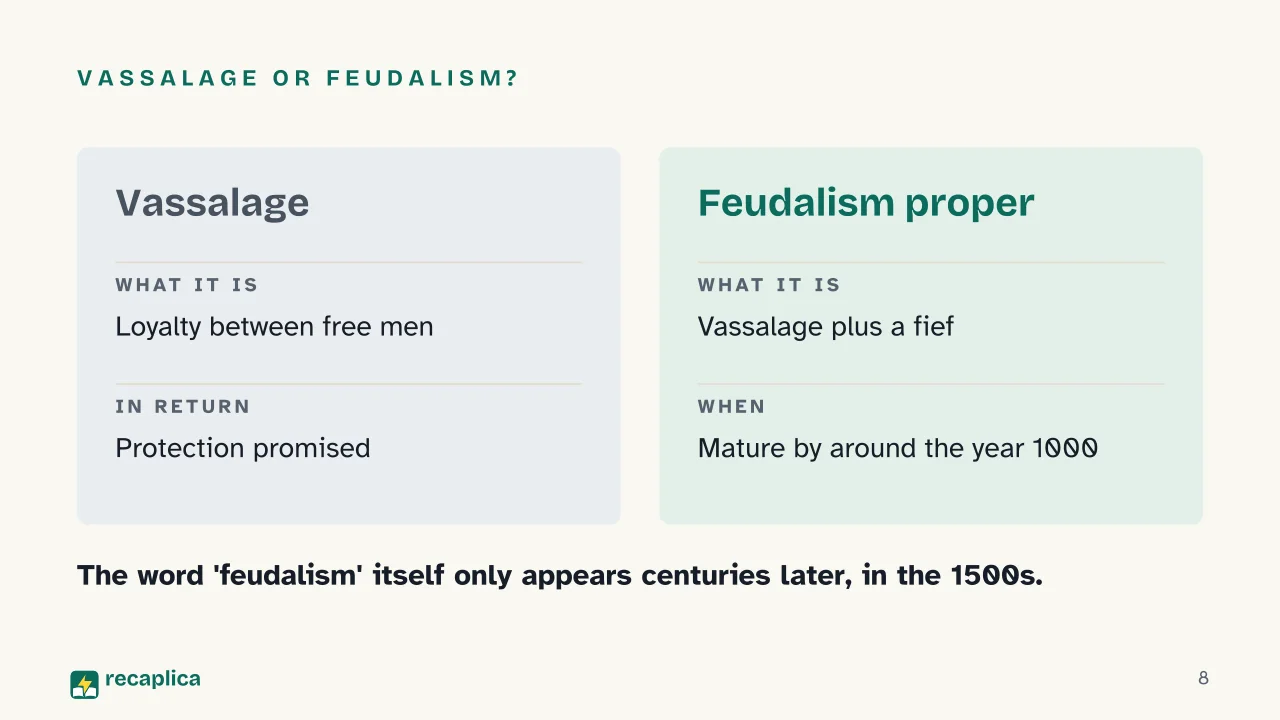
    Feudalism emerges in the Early Middle Ages as a form of military service that blends Roman, Germanic and Celtic legal and military traditions. At its base sits vassalage: the act by which a free man submits to another, pledging loyalty, and receives a promise of protection in return. It’s a bond between people, not yet an economic or territorial system.

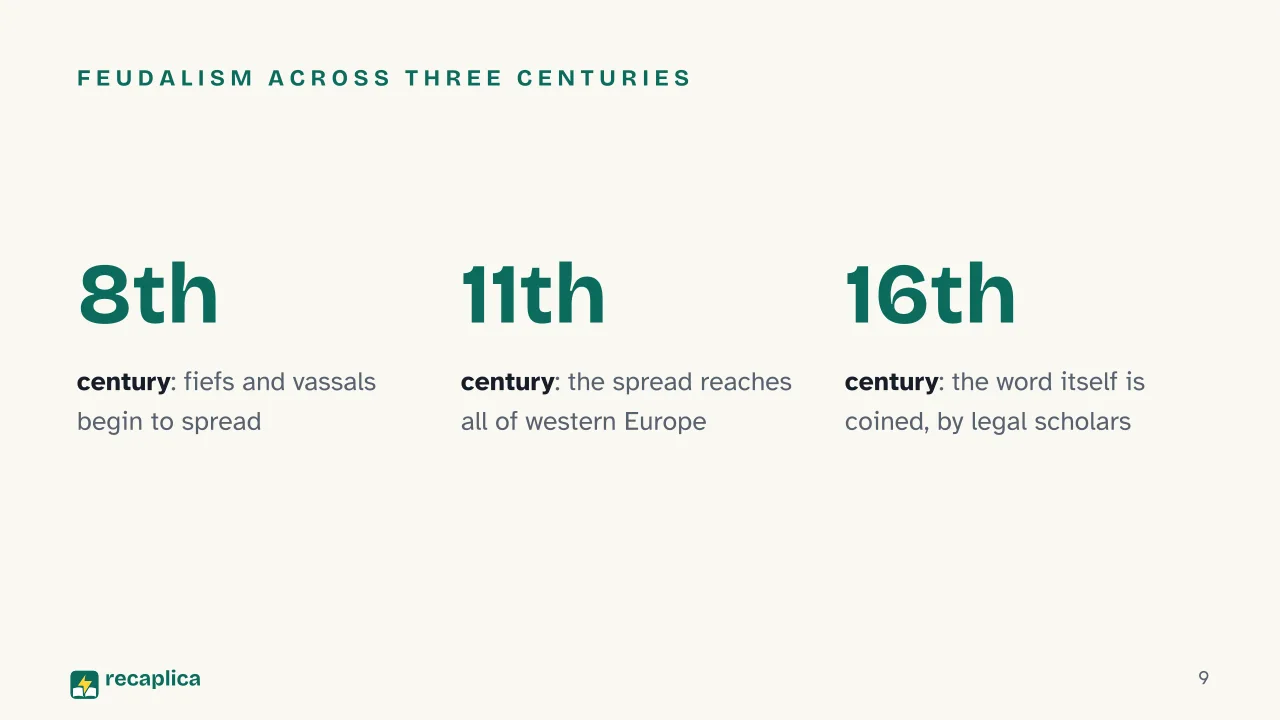
    Feudalism, in the full sense of the word, takes shape once that personal bond is joined by the grant of a temporary asset, the fief: from that point on, vassalage and land grant become a single institution. Most historians place this “mature feudalism” in the decades around the year 1000, the same line that separates the Early and Late Middle Ages. Fiefs and vassals spread across the whole of western Europe between the 8th and 11th centuries.

    One detail surprises people who come across it for the first time: the word “feudalism” didn’t exist during the Middle Ages. It’s a 16th-century coinage, invented by legal scholars to name, after the fact, that cluster of institutions; by the 17th and 18th centuries the term had also picked up a polemical edge, used by the rising middle class and other groups pushing back against noble power. Whoever actually lived under the feudal system, in the 8th or 10th century, simply didn’t call it that.

    Charlemagne and the tangle of empire and Church

    In the Early Middle Ages, while feudalism develops rapidly, Charlemagne marks one of the high points where political power and religious authority meet: he is crowned emperor on Christmas night in the year 800. The episode shows how, for Charlemagne, political power stayed bound up with the Church’s recognition.

    On the model of government Charlemagne actually built, the available dossier offers no further verified detail beyond the coronation date: a solid fact to build on, not the whole story of his reign.

    The Crusades, eight expeditions over two centuries

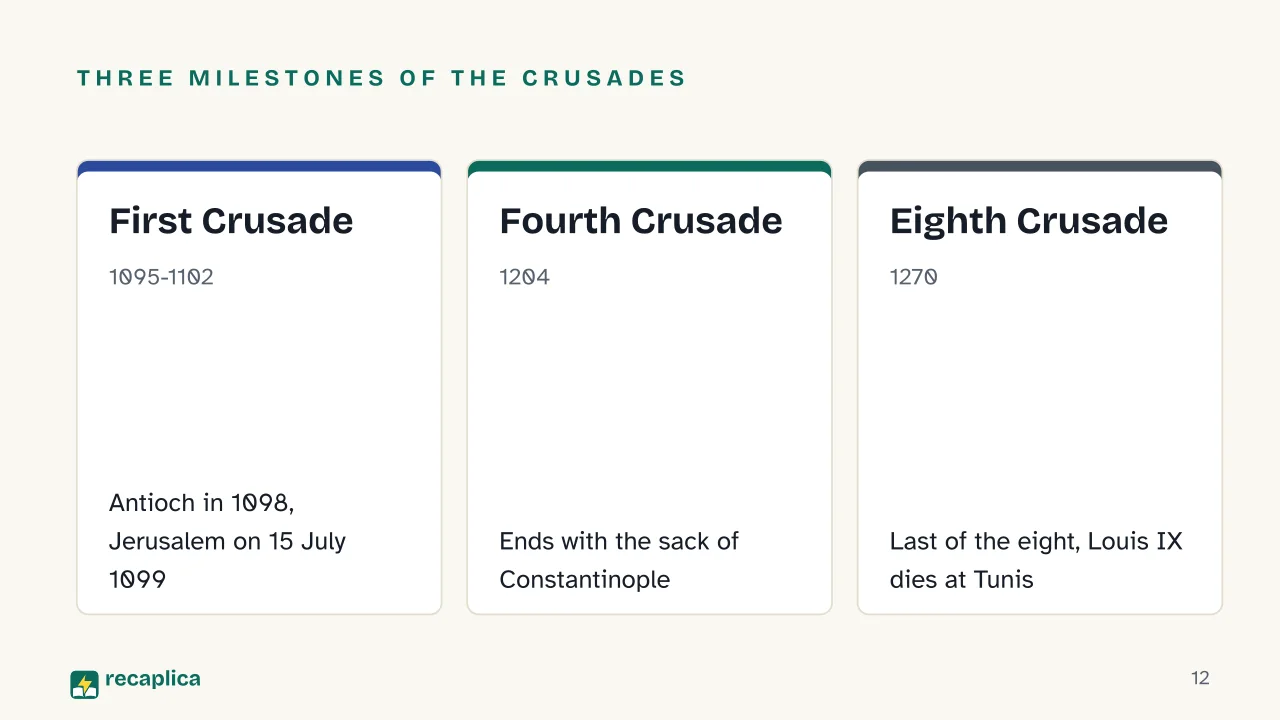
    Between 1095 and 1270, eight major official Crusades follow one another, joined by numerous smaller, unofficial expeditions. The First Crusade (1095-1102) takes Antioch in June 1098 and, a year later, on 15 July 1099, Jerusalem: an event that, historians argue, sets the mix of politics, religion and violence that will run through the entire crusading era from the start.

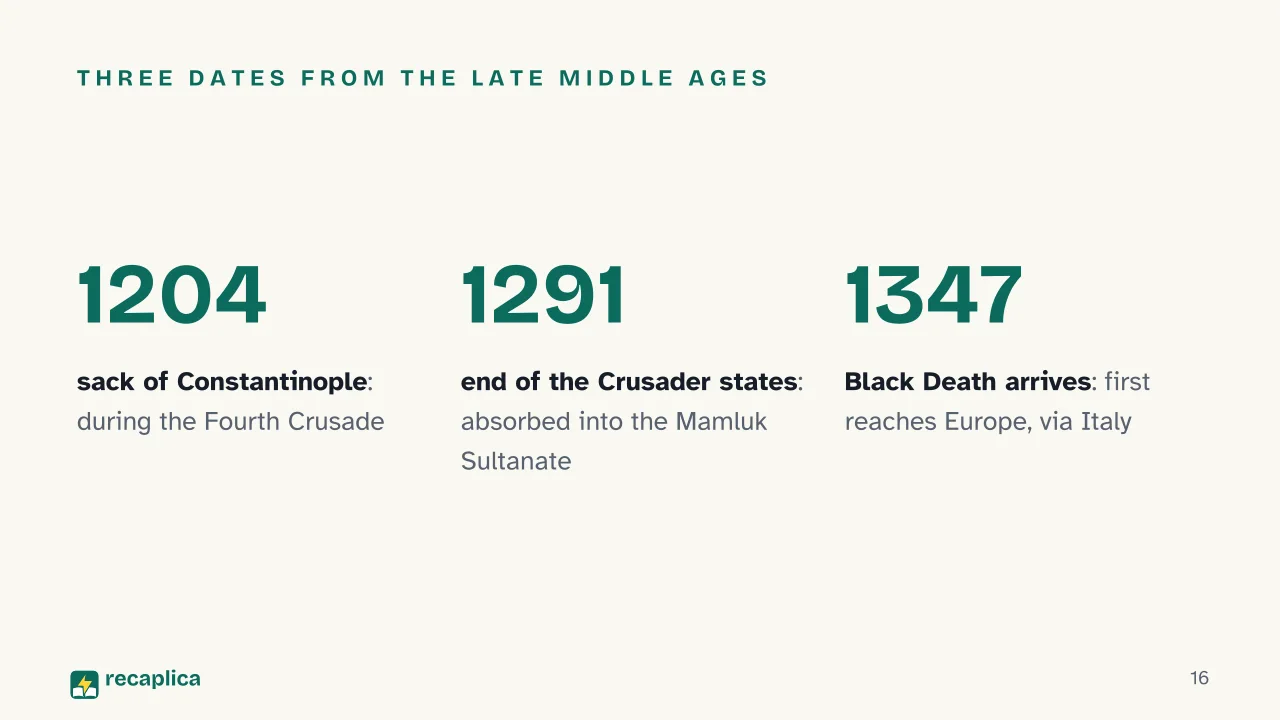
    Not every Crusade shares the same target. In 1204 the Fourth Crusade ends with the sack of Constantinople, capital of the Byzantine Empire — a Christian army against another Christian power, not a Muslim one. The last of the eight major Crusades, the Eighth, closes in 1270 with the death of the French king Louis IX, struck down by dysentery at Tunis on 25 August of that year. A Crusader presence in the Middle East lingers for another two decades: only by 1291 are the states the Crusaders founded absorbed into the Mamluk Sultanate. Between the “official” end of the major Crusades, in 1270, and the actual end of the Crusader presence in the Holy Land, in 1291, twenty-one years pass.

    The Black Death and a two-century recovery

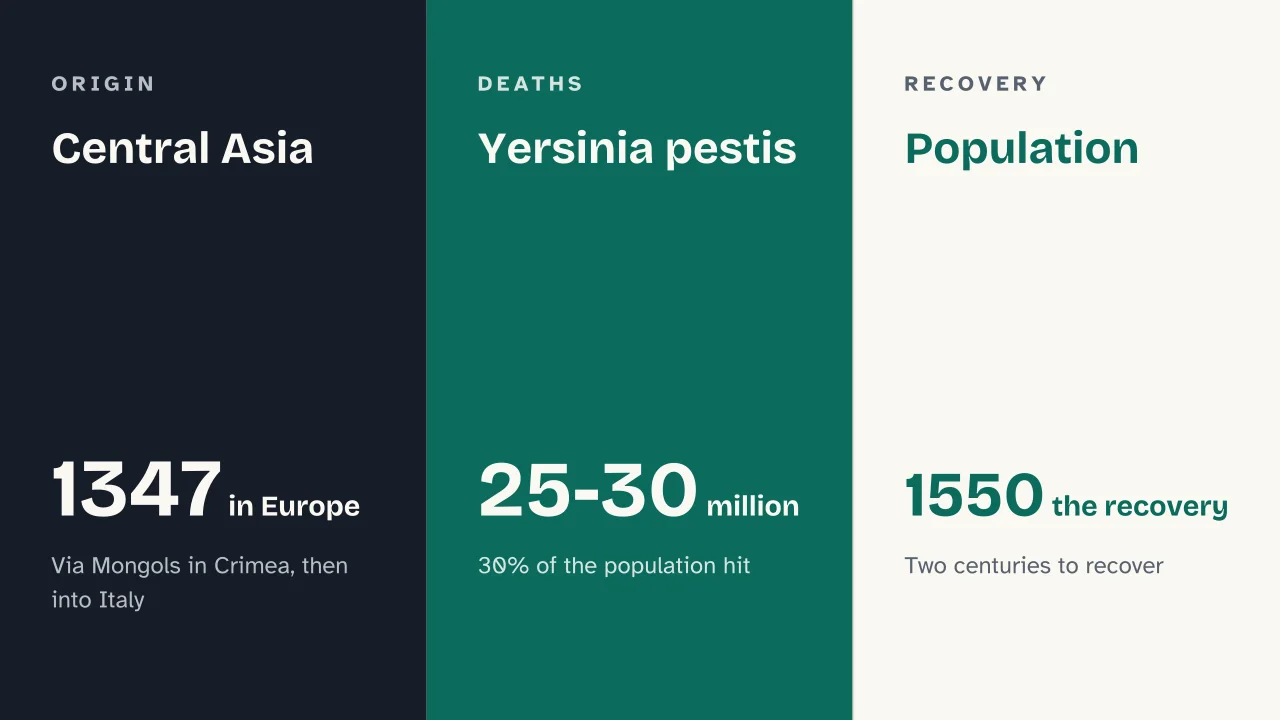
    Between 1347 and 1352 the Black Death devastated medieval Europe. The disease originates in central Asia and is carried to Crimea by Mongol warriors and traders; from there, four Genoese grain ships fleeing Caffa, on the Black Sea, carry it to Italy — likely via the rats or human parasites on board. The culprit is a bacterium, Yersinia pestis, spread by fleas living on rodents.

    The numbers, estimates rather than a census, give a sense of the scale: 25 to 30 million dead across Europe over five years, on average 30% of the population in affected areas, with local peaks reaching 50%. It took roughly two hundred years for Europe’s population to return to its pre-1347 level, a mark reached only around 1550.

    A demographic shock of this size reshapes economic and social balances that the Late Middle Ages carries all the way to the threshold of the modern era — the same threshold from which, centuries later, the French Revolution and the Industrial Revolution will set out.

    One era, more than one reading

    The Middle Ages taught in school as a single block, 476 to 1492, is really one convention among others. The Early and Late Middle Ages tell different stories: the birth of feudalism on one side, the Crusades and the Black Death on the other.

    Slide deck

    Slides ready to download and make your own in PowerPoint or Google Slides, with speaker notes. Pick the Flash cut or the Full one.
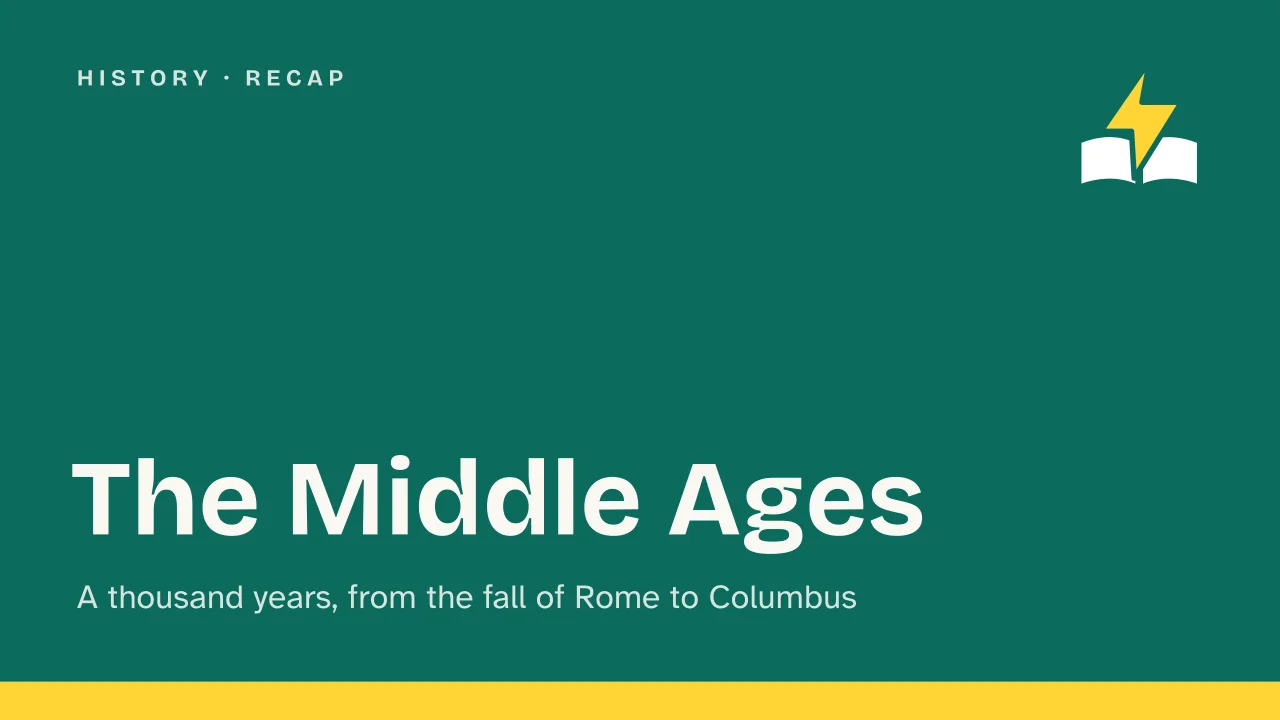
    Slide 1 of the presentation on Middle Ages: The Middle AgesSlide 2 of the presentation on Middle Ages: So when does an era actually begin?Slide 3 of the presentation on Middle Ages: What's aheadSlide 4 of the presentation on Middle Ages: Chapter 01: A thousand-year eraSlide 5 of the presentation on Middle Ages: A conventional span of a thousand yearsSlide 6 of the presentation on Middle Ages: Two ways to count the centuriesSlide 7 of the presentation on Middle Ages: Chapter 02: FeudalismSlide 8 of the presentation on Middle Ages: Vassalage or feudalism?Slide 9 of the presentation on Middle Ages: Feudalism across three centuriesSlide 10 of the presentation on Middle Ages: Chapter 03: Charlemagne and the CrusadesSlide 11 of the presentation on Middle Ages: Eight major Crusades, between 1095 and 1270Slide 12 of the presentation on Middle Ages: Three milestones of the Crusades: First Crusade, Fourth Crusade, Eighth CrusadeSlide 13 of the presentation on Middle Ages: Chapter 04: The Black Death and the closeSlide 14 of the presentation on Middle Ages: Central Asia · Yersinia pestis · PopulationSlide 15 of the presentation on Middle Ages: The Middle Ages were not one unchanging block for a thousand years.Slide 16 of the presentation on Middle Ages: Three dates from the Late Middle AgesSlide 17 of the presentation on Middle Ages: What sets vassalage apart from feudalism proper?Slide 18 of the presentation on Middle Ages: Now for the review
    Flash10 slidesThe essential thread, to present in classFull18 slidesEvery chapter and the deeper detail

    Common myths

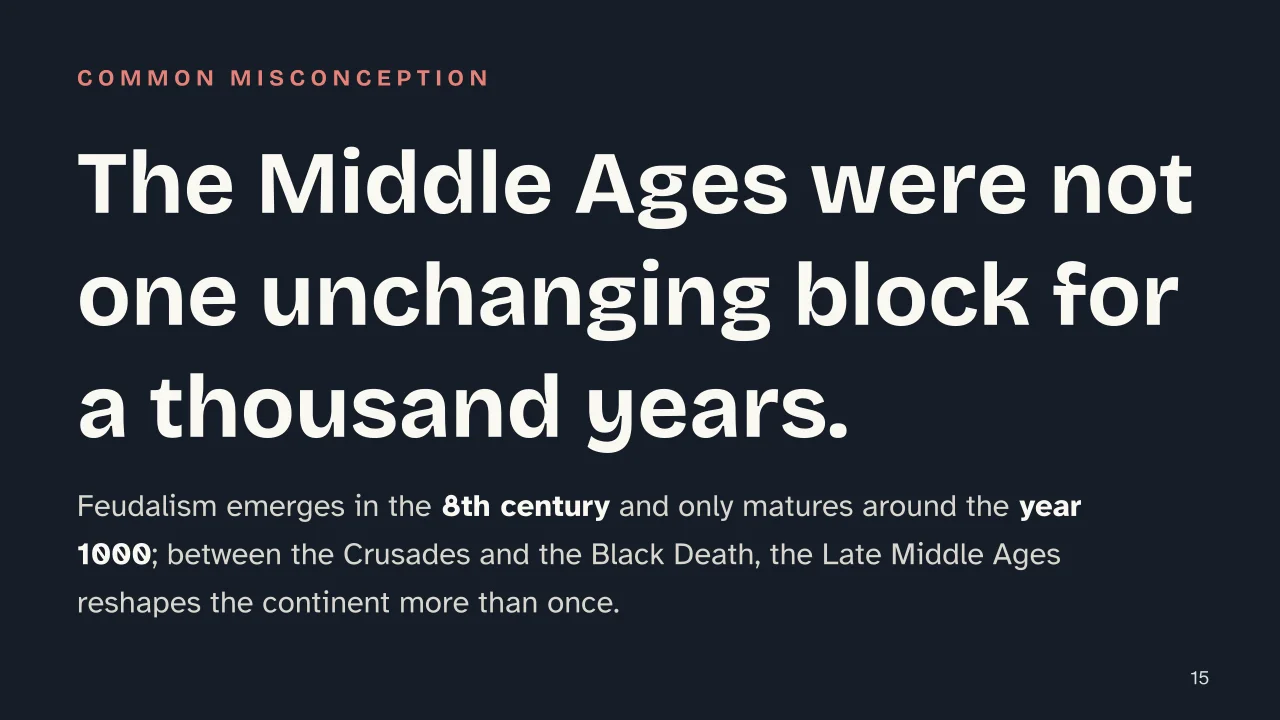
    • ✗ Myth The Middle Ages were one unchanging block, the same for a thousand years.

      ✓ Reality Historians split the period into Early and Late precisely because it changes more than once: feudalism forms and spreads between the 8th and 11th centuries but only reaches its mature shape around the year 1000, after which the continent goes through the Crusades and a pandemic that reshapes its population.

    • ✗ Myth Vassalage and feudalism are the same thing, just two names for it.

      ✓ Reality Vassalage is the act by which a free man pledges loyalty to another in exchange for protection: a personal bond. Feudalism is the wider system, and it only takes its mature form once that bond is joined to the grant of land, a fief — two distinct institutions that converge in the decades around the year 1000.

    • ✗ Myth The word 'feudalism' was already in use during the Middle Ages for the system of fiefs and vassals.

      ✓ Reality The term is a 16th-century coinage, invented by legal scholars to describe, after the fact, a cluster of medieval institutions; people living inside that system in the 8th or 10th century simply did not call it that.

    Mind map

    Drag the background to move around and the nodes to reposition them; use − and + to collapse and expand branches.
    Customize
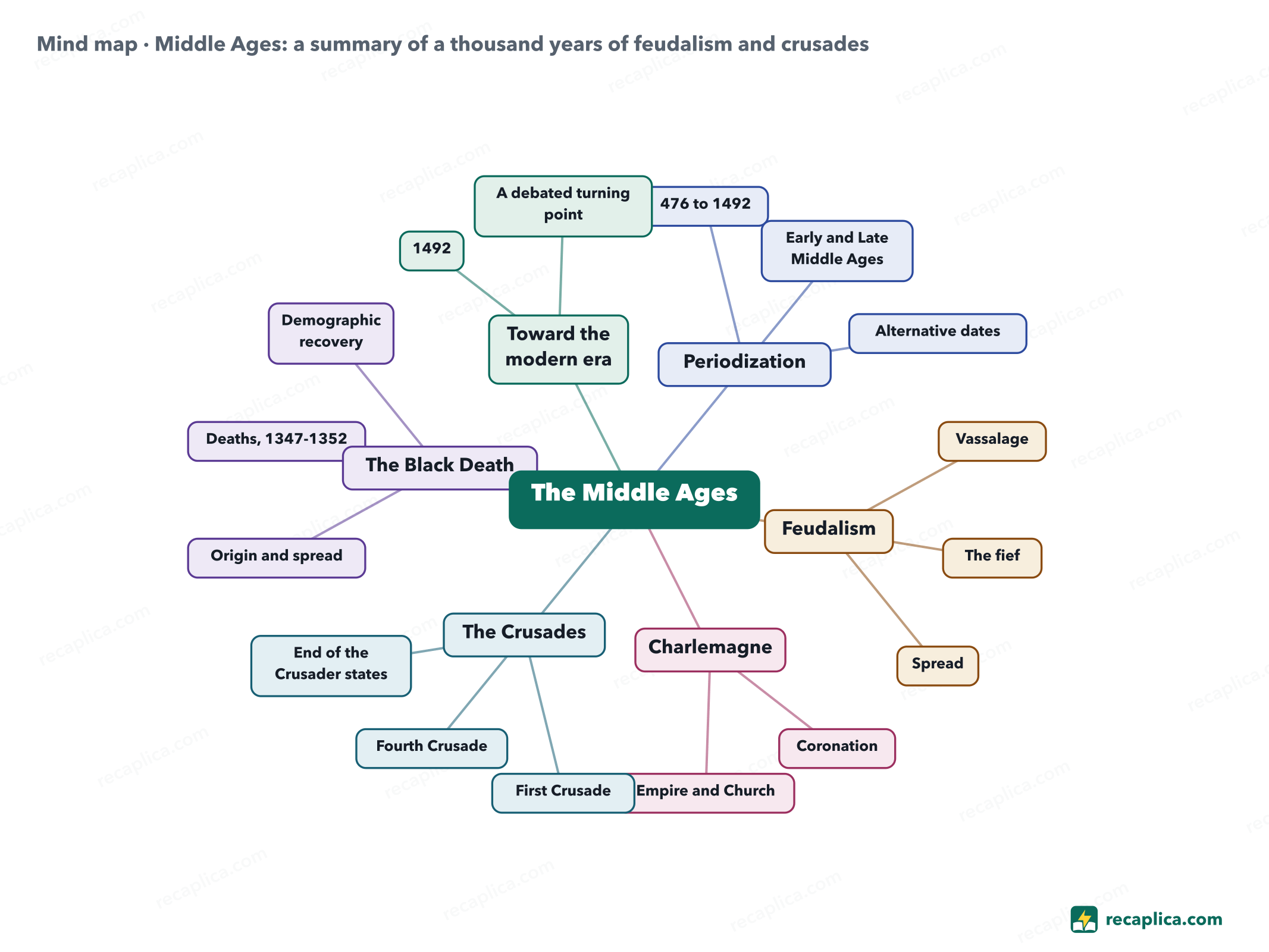
    Mind map: Middle Ages: a summary of a thousand years of feudalism and crusades
    • The Middle Ages
      • Periodization When it is conventionally said to start and end
        • 476 to 1492 Fall of the Western Roman Empire, Columbus reaches the Americas
        • Early and Late Middle Ages Conventional dividing line, the year 1000
        • Alternative dates E.g. Christoph Cellarius, 1688, proposes 324-1453
      • Feudalism
        • Vassalage Bond of loyalty between two free men
        • The fief The land grant that completes the system
        • Spread 8th to 11th century, across western Europe
      • Charlemagne
        • Coronation Christmas night in the year 800
        • Empire and Church Political power and religious authority intertwined
      • The Crusades
        • First Crusade 1095-1099, capture of Jerusalem on 15 July
        • Fourth Crusade 1204, sack of Constantinople
        • End of the Crusader states 1291, absorbed into the Mamluk Sultanate
      • The Black Death
        • Origin and spread Central Asia, then Crimea and Italy by sea
        • Deaths, 1347-1352 Estimated at 25-30 million in Europe
        • Demographic recovery Pre-plague levels reached around 1550
      • Toward the modern era
        • 1492 Columbus reaches the Americas, conventional close
        • A debated turning point Other historians propose different dates

    Quiz: test yourself

    Answer the questions to check what you have learned: you get instant feedback and a short explanation.

    Grade 0/10 0/5
    1 Which year marks the conventional fall of the Western Roman Empire, the opening date of the Middle Ages?

    476 is the conventional date for the fall of the Western Roman Empire, used to open the Middle Ages. 410 is the Visigothic sack of Rome, 529 the closing of the School of Athens, and 800 Charlemagne's coronation: real dates from the period, but not the opening one.

    2 The word 'feudalism' was already used during the Middle Ages to describe the system of fiefs and vassals.

    The word dates from the 16th century, coined by legal scholars to describe, after the fact, that cluster of institutions; people living in the 8th or 10th century did not use it.

    3 What is the conventional dividing line between the Early and Late Middle Ages?

    The year 1000 divides the Early Middle Ages, when feudalism takes shape and spreads, from the Late Middle Ages of the Crusades and the Black Death. 800 is Charlemagne's coronation, 1204 the sack of Constantinople, 1347 the arrival of the Black Death: all events from the period, not the halfway line.

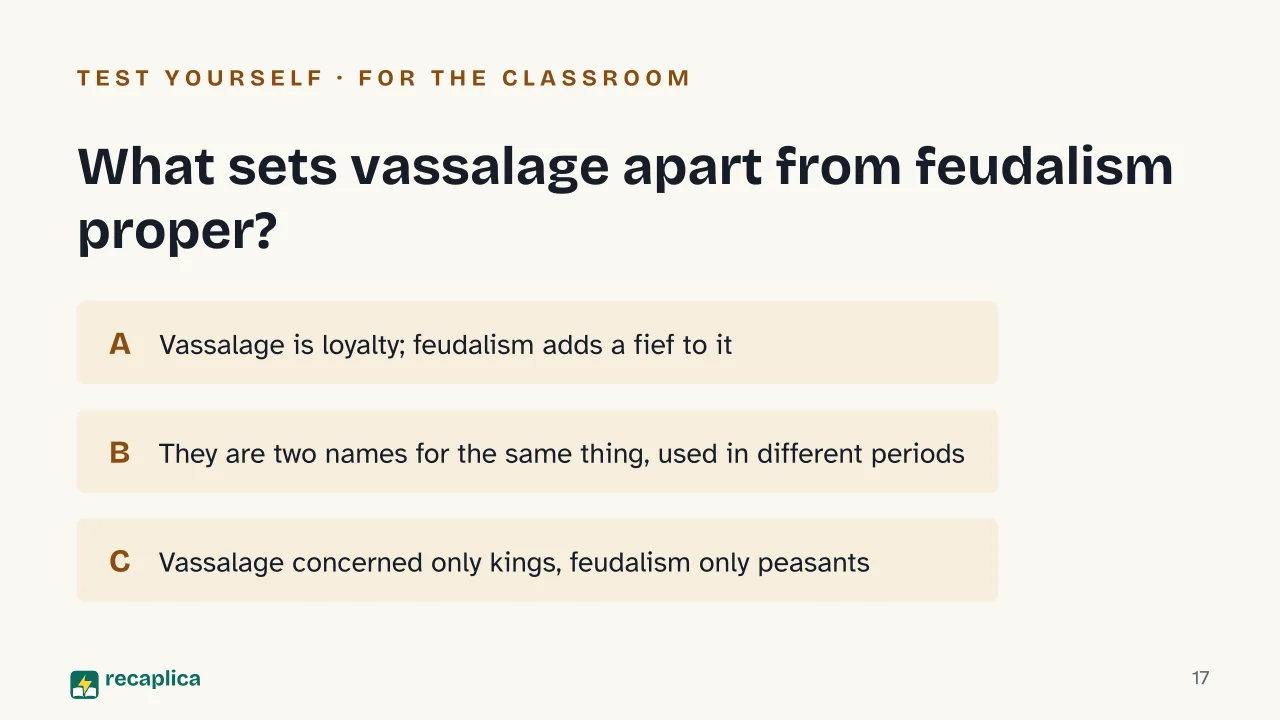
    4 What sets vassalage apart from feudalism proper?

    Vassalage is the act by which a free man pledges loyalty to another in exchange for protection; feudalism reaches its mature form when a grant of land, a fief, is added to that bond, in the decades around the year 1000.

    5 According to estimates, roughly what share of the population died in the areas hit by the Black Death between 1347 and 1352?

    Estimates put the average at 30% of the population in affected areas, with local peaks reaching 50%: a blow from which Europe took roughly two centuries to recover demographically.

    Answers: 1-B · 2-B · 3-B · 4-A · 5-B

    Flashcards

    Tap the card to flip it and check whether you remember the answer, then move to the next one.

    1 / 8

    Explain it in your own words

    The ultimate test: if you can explain it in simple words, you've truly understood it. Write your explanation, then compare it with the Recap.

    Your explanation is saved only on this device.

    The Middle Ages is the period historians conventionally place between 476, when the Western Roman Empire fell, and 1492, when Columbus reached the Americas: roughly ten centuries, split by another symbolic line, the year 1000, into the Early and Late Middle Ages. Feudalism and vassalage take shape during this span, a ruler like Charlemagne is crowned by the Church, eight major Crusades cross the Mediterranean toward the Holy Land, and the Black Death, between 1347 and 1352, kills millions across Europe. The opening and closing dates are not the only option: other historians, such as Christoph Cellarius in 1688, have argued for a different span. This Recap follows the main waypoints, from the fall of Rome to the edge of the modern era.

    Frequently asked questions

    How long did the Middle Ages last?

    Under the most common periodization, from 476 (fall of the Western Roman Empire) to 1492 (Columbus reaches the Americas): roughly ten centuries. It isn't the only option: the historian Christoph Cellarius, in 1688, proposed a different span, from 324 to 1453 — eleven centuries.

    What is the difference between the Early and Late Middle Ages?

    The Early Middle Ages run from 476 to the year 1000: the period when fiefs and vassals emerge and spread. The Late Middle Ages, after 1000, cover feudalism in its mature form, the Crusades and the Black Death, up to the edge of the modern era.

    What is feudalism?

    It's the system of institutions that emerges in the Early Middle Ages from the meeting of vassalage — the bond of loyalty between two free men — and the grant of a fief, land given in return for service. The term itself, though, is a later coinage, invented by 16th-century legal scholars to describe that cluster of institutions after the fact.

    How many Crusades were there?

    Eight major official Crusades followed one another between 1095 and 1270, alongside smaller unofficial expeditions. The first led to the capture of Jerusalem on 15 July 1099; the last, the eighth, ended in 1270 with the death of Louis IX at Tunis. The Crusader states in the Middle East survived until 1291, when they were absorbed into the Mamluk Sultanate.

    How many people did the Black Death kill?

    Estimates put the Black Death's death toll between 1347 and 1352 at 25 to 30 million people in Europe, on average 30% of the population in affected areas, with local peaks of 50%. Europe's population did not return to its earlier level until around 1550.

    Sources

    • Medioèvo — Vocabolario Treccani
    • Cosa si intende oggi per medioevo? — Dizionario di Storia, Treccani
    • Feudalesimo — Enciclopedia dei ragazzi, Treccani
    • I feudalesimi — Dizionario di Storia, Treccani
    • Il feudalesimo — Storia della civiltà europea a cura di Umberto Eco, Treccani
    • Black Death — World History Encyclopedia
    • Crusades — World History Encyclopedia

    Every Recap goes through an independent review before publication.

    Every evening, the day's new Recaps on our Telegram channel. Join the channel →

    Keep learning

    • History Florentine Renaissance: Brunelleschi, Ghiberti, Masaccio, Donatello The Florentine Renaissance is the moment when Italian art breaks, step by step, with the Gothic style and turns back toward the classical world. In Florence, in the first half of the fifteenth century, four names mark that shift: Filippo Brunelleschi, who builds linear perspective into his architecture; Lorenzo Ghiberti, who wins the 1401 competition for the Baptistery doors; Masaccio, who brings naturalism into painting; and Donatello, who brings it into sculpture and becomes a reference point for the city's artists. Their work, often paid for by craft guilds or the Medici family, changes how painters, sculptors and architects work. Read the Recap →
    • History Declaration of the Rights of Man: What It Is and What It Says The Declaration of the Rights of Man and of the Citizen is the text that France's National Constituent Assembly adopted on August 26, 1789, at the start of the French Revolution. Its preamble and 17 articles set out rights such as liberty, property, security and resistance to oppression, alongside principles like national sovereignty and the separation of powers. The Marquis de Lafayette put forward a personal first draft, which five deputies appointed by the Assembly then reworked before the final vote. It should not be confused with the Universal Declaration of Human Rights, adopted by the UN in 1948: a similar name, but a different document in era, authorship and content. Read the Recap →
    • History Trasformismo: What It Is and How Agostino Depretis Invented It Trasformismo is the political practice, born in Italy between late 1882 and early 1883, of building parliamentary majorities around individual politicians and short-term programs rather than along the line dividing right and left. Agostino Depretis started it: he had led the Historical Left since 1876, and in May 1883 he assembled a new majority out of the more moderate wings of both camps. The name comes from a line he delivered in Stradella on October 8, 1882, offering a place in his ranks to anyone willing to "transform" politically. The word has carried a critical edge in Italian politics ever since, and historians still argue over how to weigh it: some read it as a conservative retreat, others as a flawed but real answer to the fragility of a state that had only just been unified. Read the Recap →

    recaplica

    Clear in 30 seconds, yours in 10 minutes.

    Recaps Mind maps Request a Recap Telegram channel Mind map maker Our method About Privacy & cookies Legal notes & terms of use

    © 2026 Recaplica · A project by Curi S.r.l. — VAT IT05472000750

    Statistics, only if you say so

    To learn which Recaps help most we would use Google Analytics, with aggregate, anonymous data. It starts only with your OK, and you can change your mind anytime. Privacy policy