Skip to content
recaplica

    One moment: security check

    Cloudflare wants to make sure you're not a robot. Tick the box below and your search will continue on its own.

    IT
    recaplica Manorialism: what it is and how the early medieval manor worked
    © 2026 Recaplica · recaplica.com — All rights reserved
    Home › History

    Manorialism: what it is and how the early medieval manor worked

    By Recaplica Newsroom · Updated on September 18, 2026

    What to print

    Page numbers appear when printing with default margins.

    Telegram channel
    recaplica Clear in 30 seconds, yours in 10 minutes.
    In 30 seconds Key points Deep dive Myths Mind map Quiz Flashcards FAQ

    In 30 seconds quick read

    Manorialism was how large landed estates were organised in Carolingian Europe between the 8th and 9th centuries. The manor (or curtis) split into two parts: the demesne, farmed directly for the lord, and tenant land worked by peasant families in exchange for dues. Labour obligations, known as corvée, tied the two halves together. Historians now trace this model back to the Roman-era great estates. It is an economic system, distinct from feudalism, which is a political relationship between a lord and a vassal.

    Key Points

    • Manorialism organised the manor (or curtis) into two parts: the demesne, farmed directly for the landowner, and tenant land worked by peasant families.
    • It took hold between the 8th and 9th centuries across most of Carolingian Europe, with older roots in the Merovingian Frankish kingdom between the Loire and the Rhine.
    • Corvée, compulsory labour owed mainly at ploughing and harvest time, structurally linked the two parts of the manor.
    • Historians now connect the model to the great Roman estates of the imperial era, overturning the older idea that it came from Germanic tribal custom.
    • Manorialism is an economic arrangement for working the land, while feudalism is the political bond between a lord and a vassal; the two are distinct, though often mixed up.
    • From the 9th and 10th centuries, as public authority weakened, the manorial system gradually shifted into local lordship, without disappearing overnight.

    Deep Dive

    Manorialism is the name historians give to a specific way of organising land and peasant labour in the early Middle Ages. It was not a sudden invention: the model is now traced back to the great estates of the Roman imperial era. It took hold between the 8th and 9th centuries across most of Carolingian Europe, though its roots reach further back, into the Merovingian Frankish kingdom, particularly the region between the Loire and the Rhine.

    The manor: a nearly closed world

    At the centre of the system stood the manor, also called a curtis or villa. It functioned as a large, nearly self-contained economic unit and, at the same time, an administrative one under a single head. The manor typically carried tax and jurisdictional immunity, meaning it could operate largely outside the reach of public justice — a privilege that reinforced its independence from central authority.

    The manor was organised into two complementary parts: the demesne and the tenant land. Grasping this split is the simplest way into the whole system.

    DemesneTenant land
    Who farmed itDirectly for the landownerPeasant families, free or dependent
    What it heldLord’s residence, storehouses, workshops, quarters for household serfsThe mansi, small plots assigned to families
    How it was kept upFully supported by the landownerIn exchange for dues and labour service

    Worked example: the Polyptych of Irminon, compiled around 823 for the abbey of Saint-Germain-des-Prés near Paris, records the monastery’s holdings between the Seine and the Eure in close detail. The surviving manuscript lists more than 10,000 individuals across 25 villages, in twenty quires (at least four more are lost). It is one of the most detailed surviving pictures of how a Carolingian manor actually ran, family by family.

    Corvée: the tie that bound the two halves together

    The two parts of the manor did not operate in isolation. Corvée, compulsory labour that tenant families owed the lord on top of dues paid in kind or coin, is what linked them. This labour was demanded mainly “at times of particular need, such as ploughing or harvest,” when the demesne needed more hands than the household serfs permanently based there could supply.

    Not the same as feudalism

    Manorialism and the manorial system are, in most textbooks, the same idea under two names. What causes real confusion is its relationship to feudalism. Manorialism describes an economic arrangement: how production worked, who farmed the land, how dues circulated within a single manor. Feudalism, by contrast, is a political relationship between different ranks of the aristocracy, in which a lord grants land (a fief) to a vassal in exchange for military service and loyalty. A manor could sit inside a fief, but the two terms describe different layers of the same world: manorialism covers the agricultural economy, feudalism the structure of power. This distinction also matters because school curricula often present the two as a single package. Keeping them apart also helps make sense of the following period, when the political structure of vassalage grew more complex while the economic organisation of land changed shape on its own path — part of the wider story told in The Middle Ages: a summary of a thousand years of feudalism and crusades.

    A system that kept changing

    Between the 8th and 10th centuries, manorialism was far from static. It played an active role in land reclamation and settlement, and in technological investment such as water mills and breweries, driving an economic recovery that outlasted the fall of the Carolingian empire.

    From the second half of the 9th century, Italy shows a pattern that might look, at first glance, like a warning sign: the demesne was gradually shrinking. Recent historiography reads this the other way around. Population growth is one of the likely drivers: with more peasant families available, it made more sense to hand them new land than to keep it under direct management. In other words, it is a sign of production being optimised.

    This ongoing change also explains why manorialism had no single, sudden end. Between the 9th and 10th centuries, as weakening public authority gave local lords more room to act, the manorial economy gradually turned into what historians call local or banal lordship: the lord’s jurisdiction expanded over land and people that had not previously answered to him directly. Anyone looking for a clean break, one precise year of transition, will not find it in the sources — it was a transformation, not a collapse, a slow process comparable, as a parallel with another major turning point taught in schools, to the one described in The Roman Empire: rise, peak and fall, where the shift between systems was likewise slower and less clean-cut than it is often told.

    It is worth noting that English-language scholarship sometimes stretches the term “manorialism” further than this Carolingian phase. The World History Encyclopedia, for instance, places the height of serfdom and manorial farming as late as the 12th to 14th centuries, with decline tied to the population collapse of the Black Death between 1347 and 1352. That later, broader use describes a different stage of the same underlying arrangement; the manor system covered here is specifically its early medieval, Carolingian form.

    Common myths

    • ✗ Myth Manorialism was a Germanic invention brought by tribal peoples.

      ✓ Reality Historians now trace manorialism back to the organisation of the Roman imperial-era great estates rather than to Germanic tribal custom, an idea once widely assumed. The medieval manor continues a Roman way of managing land, adapted to early medieval conditions.

    • ✗ Myth Manorialism collapsed overnight when the Carolingian empire ended.

      ✓ Reality It did not vanish suddenly. Between the 9th and 10th centuries it gradually turned into local lordship, as public authority weakened and local lords extended their jurisdiction over land and people that had not previously answered directly to them.

    • ✗ Myth The shrinking demesne in the 9th century was a sign of economic crisis.

      ✓ Reality In Italy, the gradual shrinking of the demesne recorded from the second half of the 9th century reflects population growth and a deliberate choice by lords to hand more land to peasant families, not a system in trouble.

    Mind map

    Drag the background to move around and the nodes to reposition them; use − and + to collapse and expand branches.
    Customize
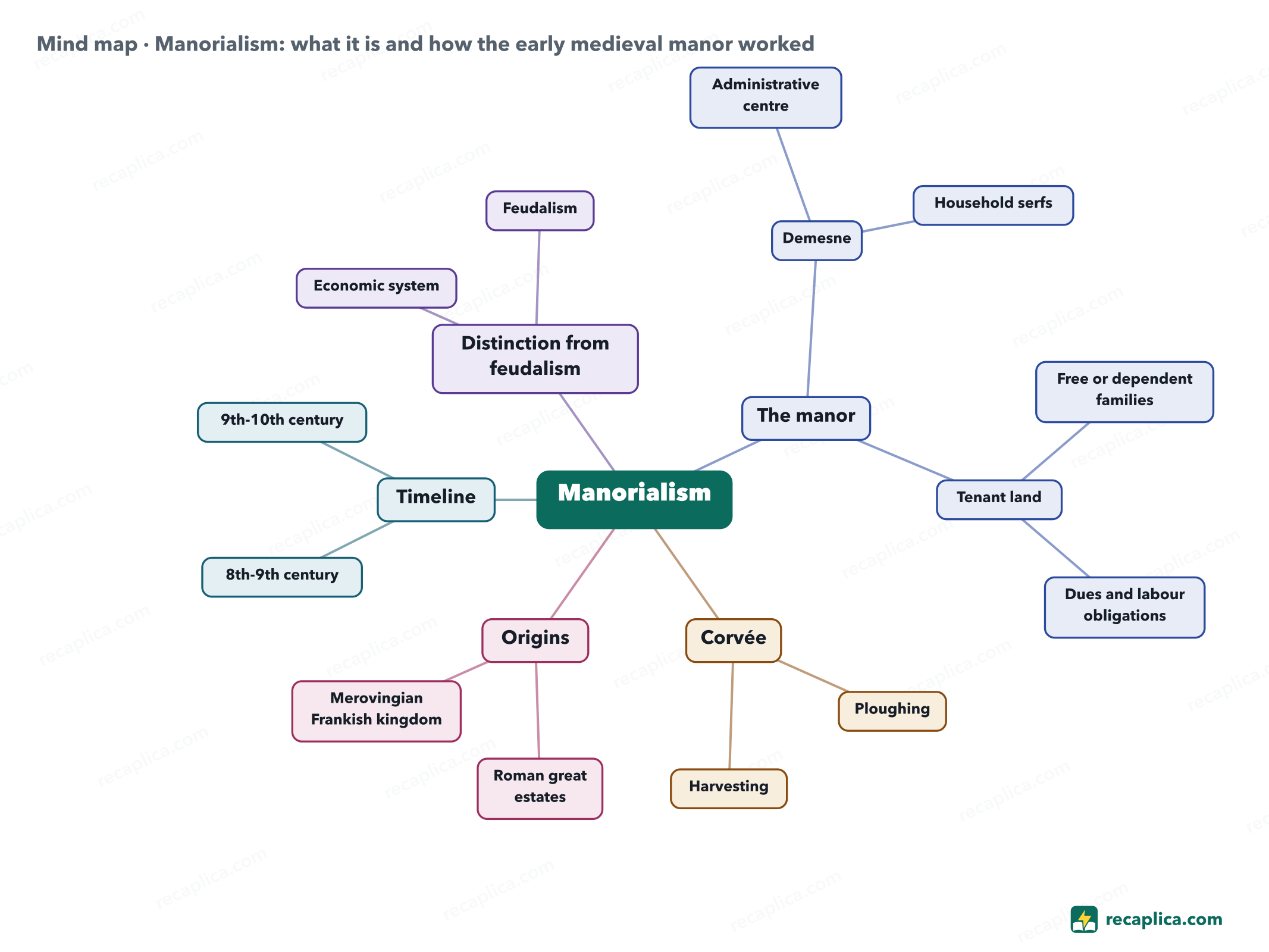
    Mind map: Manorialism: what it is and how the early medieval manor worked
    • Manorialism
      • The manor economic and administrative unit
        • Demesne land farmed directly for the lord
          • Administrative centre residence, storehouses, workshops
          • Household serfs supported directly by the landowner
        • Tenant land mansi worked by peasant families
          • Free or dependent families
          • Dues and labour obligations
      • Corvée compulsory labour owed by tenants
        • Ploughing
        • Harvesting
      • Origins
        • Roman great estates the model favoured by recent historiography
        • Merovingian Frankish kingdom between the Loire and the Rhine, before Carolingian expansion
      • Timeline
        • 8th-9th century manorialism takes hold across Carolingian Europe
        • 9th-10th century gradual shift into local lordship
      • Distinction from feudalism
        • Economic system management of land and labour
        • Feudalism political bond between lord and vassal

    Quiz: test yourself

    Answer the questions to check what you have learned: you get instant feedback and a short explanation.

    Grade 0/10 0/5
    1 What is the part of the manor farmed directly for the landowner called?

    The demesne is the part of the manor the landowner kept under direct cultivation, including the administrative centre and the quarters of the serfs he supported.

    2 What was a mansus?

    A mansus was one of the small productive units on the tenant land, assigned to a free or dependent peasant family in exchange for dues and labour service.

    3 Manorialism and feudalism are the same thing.

    They are two distinct systems. Manorialism organises the work and output of the land inside the manor; feudalism legally binds a lord to a vassal, who receives a fief in exchange for military service.

    4 Where does recent historiography trace the origins of the manorial model?

    Historians now link manorialism to the organisation of the great Roman estates of the imperial era, rather than to Germanic custom, as was once assumed.

    5 What happened to the manorial system between the 9th and 10th centuries?

    As public authority weakened, manorialism evolved into local lordship, with a lord's jurisdiction extending over land and people that had not previously been his.

    Answers: 1-B · 2-B · 3-B · 4-B · 5-B

    Flashcards

    Tap the card to flip it and check whether you remember the answer, then move to the next one.

    1 / 7

    Explain it in your own words

    The ultimate test: if you can explain it in simple words, you've truly understood it. Write your explanation, then compare it with the Recap.

    Your explanation is saved only on this device.

    Manorialism was how large landed estates were organised in Carolingian Europe between the 8th and 9th centuries. The manor (or curtis) split into two parts: the demesne, farmed directly for the lord, and tenant land worked by peasant families in exchange for dues. Labour obligations, known as corvée, tied the two halves together. Historians now trace this model back to the Roman-era great estates. It is an economic system, distinct from feudalism, which is a political relationship between a lord and a vassal.

    Frequently asked questions

    What is manorialism?

    Manorialism is the organisation of large landed estates that spread between the 8th and 9th centuries across Carolingian Europe. The manor was split into a demesne, farmed directly for the lord, and tenant land worked by peasant families, held together by the obligation of corvée labour.

    What is the difference between the demesne and tenant land?

    The demesne is the part of the manor farmed directly for the landowner, including the administrative centre and the quarters of the serfs he supported. Tenant land is the collection of mansi, plots handed to peasant families in exchange for dues and labour service.

    Are manorialism and the manorial system the same thing?

    Yes, they are synonyms for the same model of organising the manor in the early Middle Ages. Some textbooks prefer "manorial system" to underline its economic nature, distinct from political feudalism.

    Is manorialism the same thing as feudalism?

    No. Manorialism is an economic model for managing land and agricultural labour. Feudalism is a political relationship between a lord and a vassal, based on exchanging a fief (land) for military service. The two often coexisted in the same period, but they describe different things.

    When did manorialism end?

    There was no single end date. Between the 9th and 10th centuries it gradually turned into local lordship as public authority weakened. In Italy, from the second half of the 9th century, the shrinking demesne reflects population growth more than a system in crisis. Some historians, notably the World History Encyclopedia, use "manorialism" more broadly to describe serfdom and manorial farming right up to its decline after the Black Death of 1347-1352 — a later, wider use of the term than the Carolingian phase covered here.

    Sources

    • Treccani, «curtense, sistema» (Dizionario di Storia)
    • Treccani, «L'economia curtense e la signoria rurale» (Storia della civiltà europea a cura di Umberto Eco)
    • Skuola.net, «L'evoluzione del sistema curtense e il suo impatto economico»
    • World History Encyclopedia, «Manorialism» (Mark Cartwright)
    • Wikipedia, «Polyptych of Irminon»

    Every Recap goes through an independent review before publication.

    Every evening, the day's new Recaps on our Telegram channel. Join the channel →

    Keep learning

    • History Florentine Renaissance: Brunelleschi, Ghiberti, Masaccio, Donatello The Florentine Renaissance is the moment when Italian art breaks, step by step, with the Gothic style and turns back toward the classical world. In Florence, in the first half of the fifteenth century, four names mark that shift: Filippo Brunelleschi, who builds linear perspective into his architecture; Lorenzo Ghiberti, who wins the 1401 competition for the Baptistery doors; Masaccio, who brings naturalism into painting; and Donatello, who brings it into sculpture and becomes a reference point for the city's artists. Their work, often paid for by craft guilds or the Medici family, changes how painters, sculptors and architects work. Read the Recap →
    • History Declaration of the Rights of Man: What It Is and What It Says The Declaration of the Rights of Man and of the Citizen is the text that France's National Constituent Assembly adopted on August 26, 1789, at the start of the French Revolution. Its preamble and 17 articles set out rights such as liberty, property, security and resistance to oppression, alongside principles like national sovereignty and the separation of powers. The Marquis de Lafayette put forward a personal first draft, which five deputies appointed by the Assembly then reworked before the final vote. It should not be confused with the Universal Declaration of Human Rights, adopted by the UN in 1948: a similar name, but a different document in era, authorship and content. Read the Recap →
    • History Trasformismo: What It Is and How Agostino Depretis Invented It Trasformismo is the political practice, born in Italy between late 1882 and early 1883, of building parliamentary majorities around individual politicians and short-term programs rather than along the line dividing right and left. Agostino Depretis started it: he had led the Historical Left since 1876, and in May 1883 he assembled a new majority out of the more moderate wings of both camps. The name comes from a line he delivered in Stradella on October 8, 1882, offering a place in his ranks to anyone willing to "transform" politically. The word has carried a critical edge in Italian politics ever since, and historians still argue over how to weigh it: some read it as a conservative retreat, others as a flawed but real answer to the fragility of a state that had only just been unified. Read the Recap →

    recaplica

    Clear in 30 seconds, yours in 10 minutes.

    Recaps Mind maps Request a Recap Telegram channel Mind map maker Our method About Privacy & cookies Legal notes & terms of use

    © 2026 Recaplica · A project by Curi S.r.l. — VAT IT05472000750

    Statistics, only if you say so

    To learn which Recaps help most we would use Google Analytics, with aggregate, anonymous data. It starts only with your OK, and you can change your mind anytime. Privacy policy