Skip to content
recaplica

    One moment: security check

    Cloudflare wants to make sure you're not a robot. Tick the box below and your search will continue on its own.

    IT
    recaplica Halloween History: From Samhain to Trick-or-Treating
    © 2026 Recaplica · recaplica.com — All rights reserved
    Home › History

    Halloween History: From Samhain to Trick-or-Treating

    By Recaplica Newsroom · Updated on September 8, 2026

    What to print

    Page numbers appear when printing with default margins.

    Slides

    Choose a cut

    Flash10 slidesThe essential thread, to present in classFull15 slidesEvery chapter and the deeper detail

    Both come with speaker notes.

    Telegram channel
    recaplica Clear in 30 seconds, yours in 10 minutes.
    In 30 seconds Key points Figures Deep dive Slides Myths Mind map Quiz Flashcards FAQ

    In 30 seconds quick read

    Halloween falls on the night of October 31 and, according to the most widely accepted reconstruction, traces back to the ancient Celtic festival of Samhain, which marked the new year and the start of winter. Over the centuries the festival became entangled with the Christian calendar, when the Church fixed All Saints' Day on November 1 and the night before took the name "All Hallows' Eve," the source of "Halloween." Symbols like the carved pumpkin and customs like trick-or-treating grew out of older practices, the hollowed-out turnips of Ireland and the medieval door-to-door customs of souling and guising, carried to America by nineteenth-century Irish and Scottish emigrants. From there Halloween also became a multibillion-dollar commercial event, with record U.S. spending in 2025.

    Key Points

    • Halloween falls on October 31 and, according to the most widely accepted reconstruction, comes from the ancient Celtic festival of Samhain, which marked the Celtic new year and the moment when, in their beliefs, the boundary between the living and the dead grew thin; different sources express different degrees of confidence about this origin.
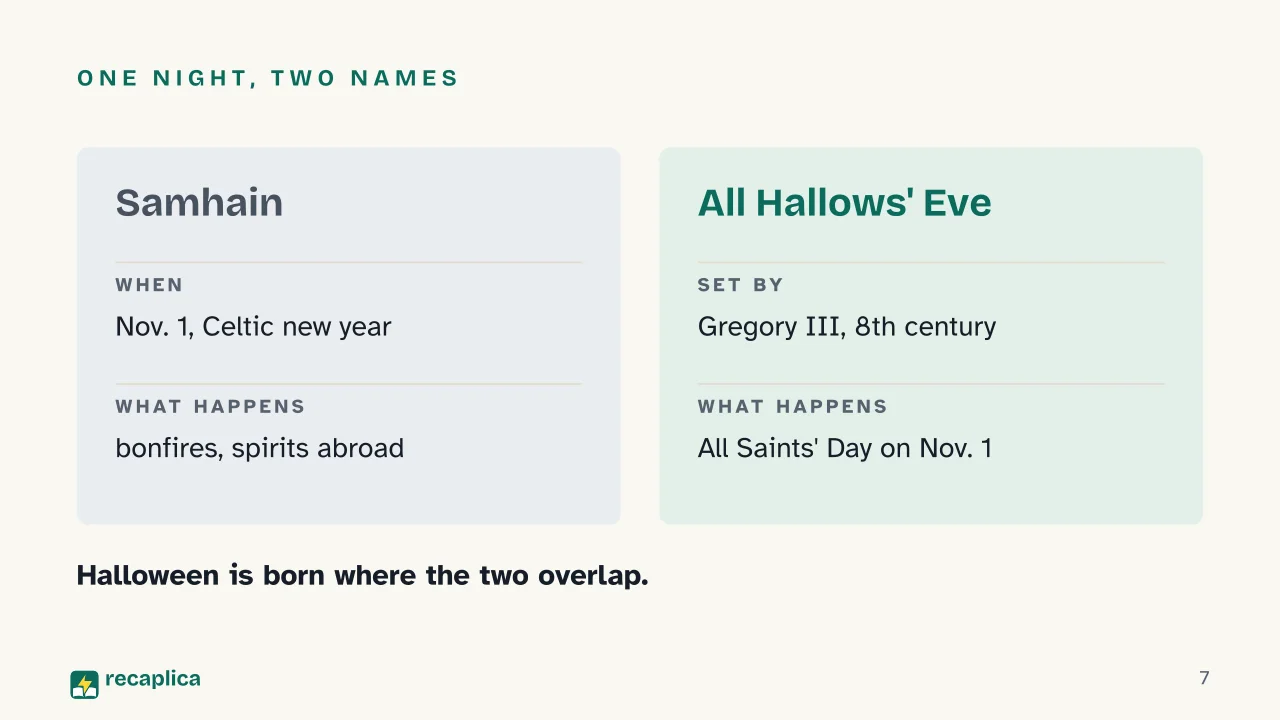
    • In the 8th century Pope Gregory III extended the feast to every saint and set it on November 1; the night before, tied to Samhain, took the name "All Hallows' Eve," later contracted into "Halloween."
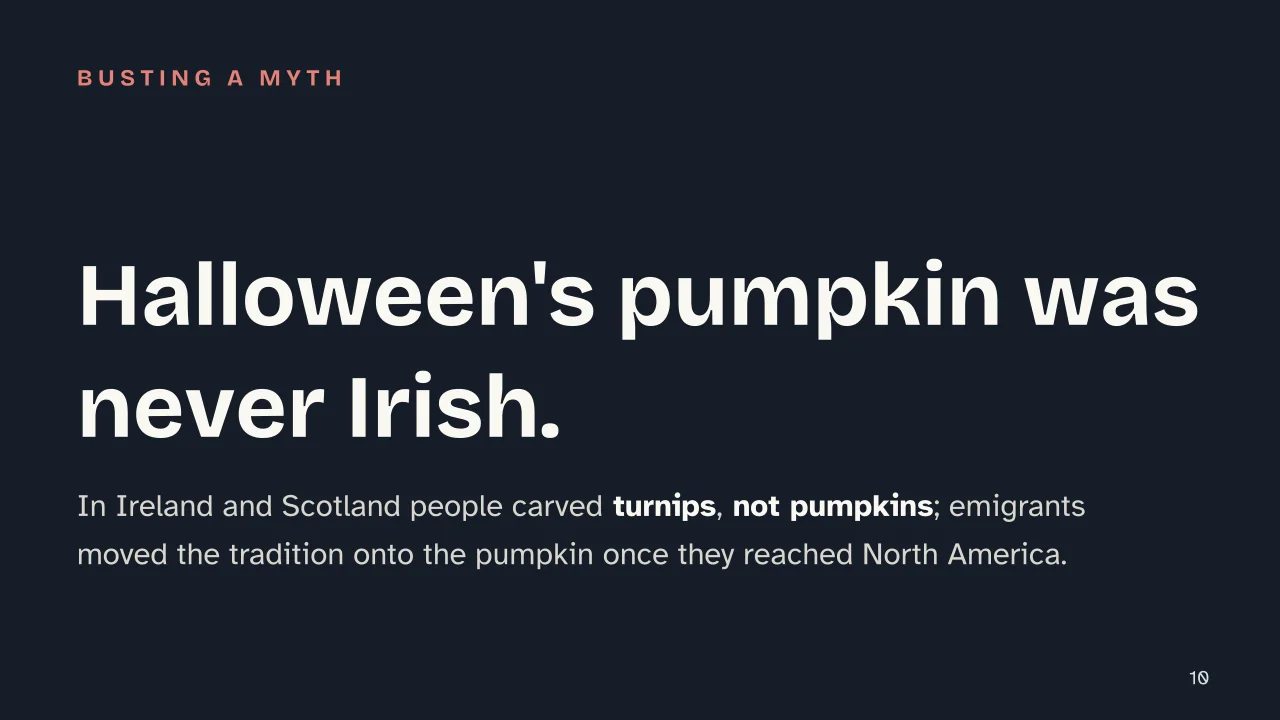
    • The carved pumpkin isn't the original lantern: in Ireland and Scotland people carved turnips, following the legend of Stingy Jack; the pumpkin spread only with emigration to North America, where turnips weren't available.
    • Trick-or-treating descends from medieval practices such as "mumming" and "souling" (going door to door for treats in exchange for prayers for the dead) and Scottish and Irish "guising," in which young people dressed up for small offerings.
    • Halloween spread across the United States mainly with the wave of Irish emigration during the Great Famine, in the mid-1800s; the organized trick-or-treating familiar now only took hold in the 1930s.
    • In 2025 expected American spending on Halloween reached a record $13.1 billion, according to the National Retail Federation survey, up from $11.6 billion in 2024.

    Key figures

    • $13.1 billion expected American spending on Halloween in 2025, a record, according to the National Retail Federation survey Source: National Retail Federation
    • 2,500 to 3,000 years ago the approximate era sources place the Celtic presence in Europe and Ireland (HISTORY cites roughly 3,000 years ago in west-central Europe, World History Encyclopedia an arrival in Ireland around 2,500 years ago) Source: HISTORY, World History Encyclopedia
    • 78% the share of U.S. consumers who bought Halloween decorations in 2025, up from 75% in 2024 Source: National Retail Federation

    Deep Dive

    Samhain: The Celtic New Year That Opened a Door to the Dead

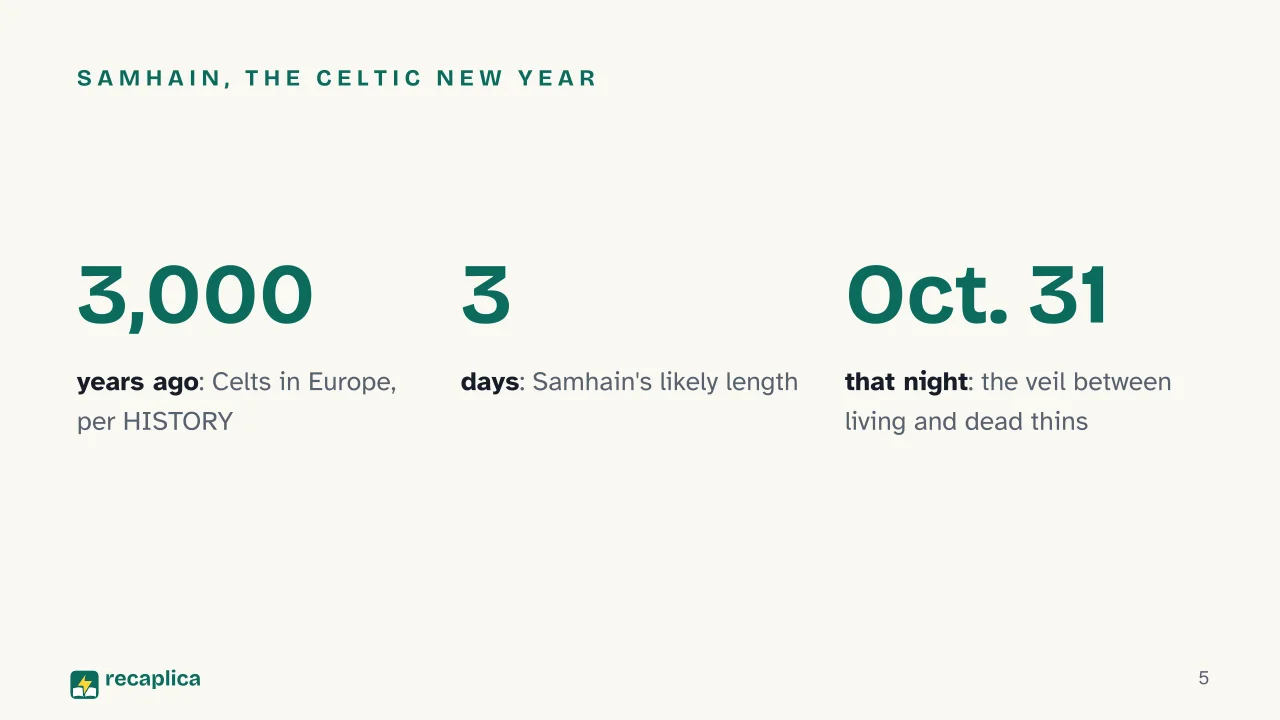
    Halloween, as the name suggests, began as a contraction of “All Hallows’ Eve,” but its story starts long before that name existed. According to the reconstruction most historians favor, though Encyclopedia Britannica frames the link more cautiously than other sources, saying the holiday “may have originated” this way, Halloween’s roots reach back to Samhain, the festival Celtic peoples across west-central Europe held around October 31. The Celts, who according to HISTORY had settled that region roughly 3,000 years ago, marked their new year and the start of winter on November 1; Samhain was the night that opened it. World History Encyclopedia instead dates the Celtic arrival in Ireland to roughly 2,500 years ago, a different figure that isn’t necessarily inconsistent with the first, since it covers a narrower time and place.

    That night, according to the beliefs the sources attribute to the Celts, the line between the living and the dead grew thin, and spirits found it easier to cross between the two worlds. Druid priests performed rites and lit bonfires to push back the dark and ward off anything supernatural, throwing the bones of sacrificed animals into the flames, a detail that, per World History Encyclopedia, may be behind the popular etymology of the English word “bonfire,” literally a fire of bones. People wore masks, old clothes or costumes made from animal hides, not for fun but to blend in with visitors from the other world. The festival, the same source notes, probably lasted three days.

    The Church Names the Night

    The shift from a pagan festival to a Christian one is better documented. In 609 CE, Pope Boniface IV dedicated the Pantheon in Rome to Christian martyrs. It was Pope Gregory III, whose papacy falls in the 8th century, who later extended the observance to every saint and moved it from May 13 to November 1, the same date as the Celtic new year. By the year 1000 CE the Church had also established November 2 as a day set aside for the dead.

    The night before, still tied to Samhain in popular memory, became known as “All-Hallows Eve,” “the eve of all the holy ones,” contracted over the centuries into “Halloween.” Britannica notes that the choice of date served, at least in part, to replace a pagan holiday with a Christian observance, a reasonable inference rather than something the period’s sources document directly. A similar pattern, a Christian date layered on top of a pre-Christian custom, shows up in the history of Christmas, where December 25 inherits rites and symbols from the Roman Saturnalia and the Norse Yule.

    Jack’s Lantern: From Turnip to Pumpkin

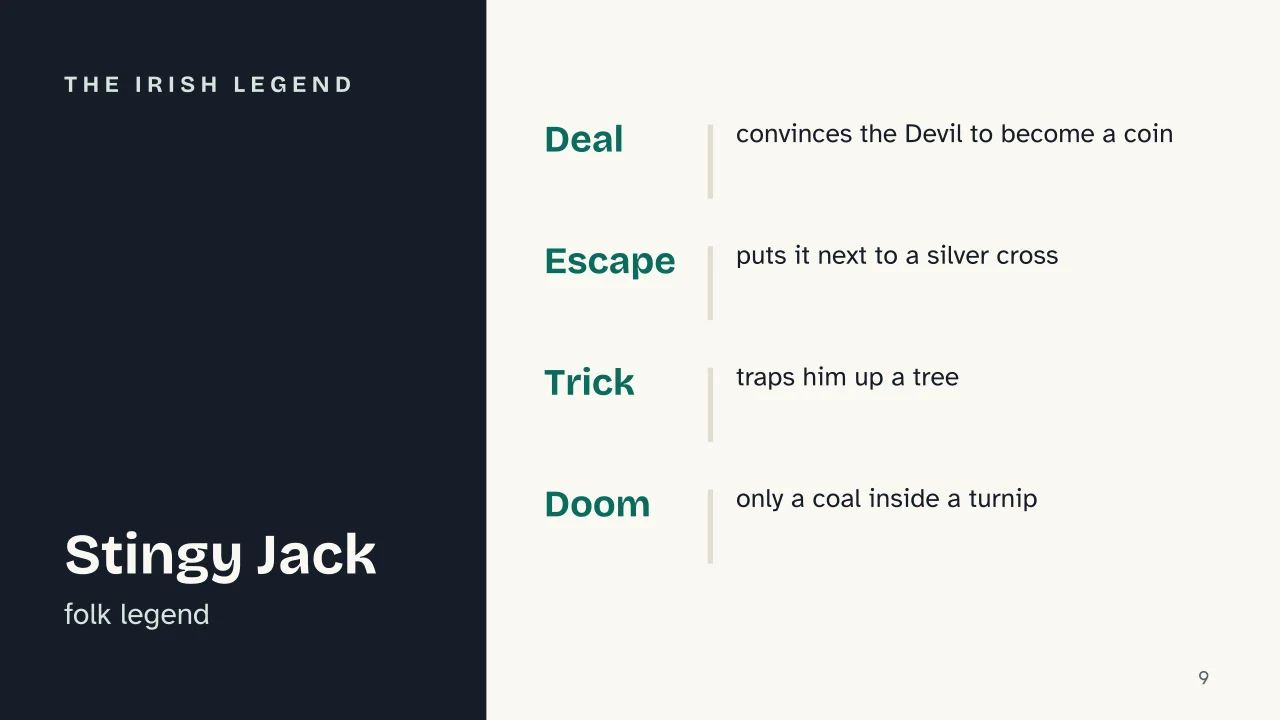
    No Halloween symbol has a more misunderstood history than the carved pumpkin. According to Irish legend, a man known as Stingy Jack invited the Devil for a drink and, to avoid paying, talked him into turning into a coin; Jack pocketed it next to a silver cross, which kept the Devil from changing back until he promised to leave Jack alone for a year and never claim his soul. Later Jack tricked him again, getting him to climb a tree and carving a cross into the bark so the Devil was stuck up there until he agreed to leave Jack alone for another ten years. When Jack eventually died, the story ends with a double rejection: heaven wouldn’t take him because of how he had lived, and hell wouldn’t take him because the Devil had given his word. He was tossed a single burning coal from the flames of hell, and Jack placed it inside a hollowed-out turnip to light his way as he wandered forever between the two worlds, which is, quite literally, how the first “Jack-o’-lantern” came to be.

    In Ireland and Scotland, turnips, not pumpkins, were the vegetable of choice for this: people hollowed out a menacing face and set it on a windowsill or by the door, a way to scare off Stingy Jack himself and other night-time visitors. The sources agree on one specific point: pumpkins weren’t native to Ireland, while turnips were. It was Irish and British emigrants who carried their vegetable-carving custom with them when they reached the United States, shifting it onto the pumpkin, which was available there and not back home, and turning a generic autumn pastime into a custom tied specifically to Halloween.

    Practical example: picture an Irish family newly arrived in North America in the mid-1800s and the shift from turnip to pumpkin becomes easy to see: the act of hollowing out a vegetable to make a lantern stayed the same, only the raw material changed, to something more plentiful and easier to carve.

    Checking where a popular symbol actually comes from, instead of settling for the most repeated version, is the same exercise worth doing with other traditions people assume are older or more “authentic” than they really are, the same thing happens with the real history of carbonara, a dish whose popular legend and documented facts tell two different stories.

    Trick-or-Treating: A Tradition Older Than It Looks

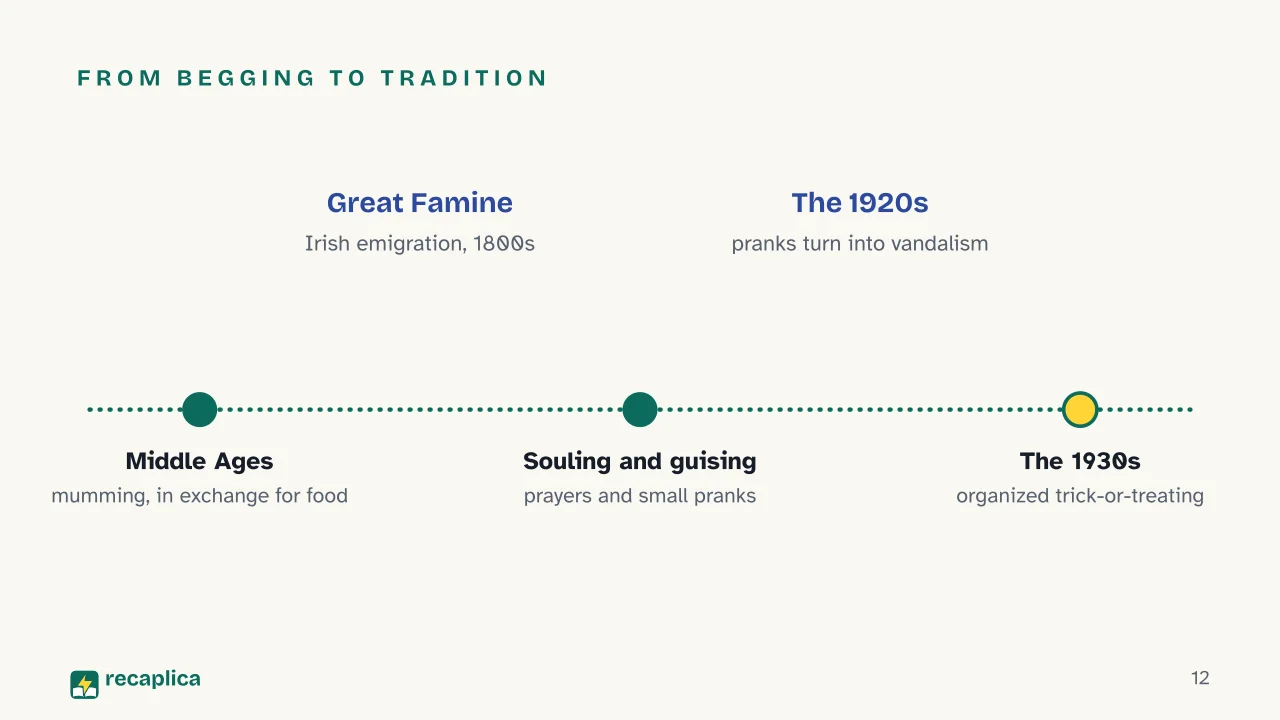
    Trick-or-treating also has a longer history than its modern form suggests. In the Middle Ages, people practiced “mumming”: dressing up as ghosts, demons or other creatures and performing skits or tricks in exchange for food and drink. As Christianity spread, “souling” emerged: poor people visited wealthier households and received treats called “soul cakes” in exchange for a promise to pray for the family’s dead. In Scotland and Ireland, “guising” developed instead: young people dressed up and received small offerings after singing a song, reciting a poem or telling a joke, a “trick” standing in for the prayer that souling called for.

    Practical example: picture a Scottish teenager in the late Middle Ages knocking on a door and reciting a poem for a bit of food, guising, and it’s easy to see the direct line to what, centuries later, would be called trick-or-treating: the setting changes, but the trade of a small performance for a reward stays the same.

    Guising and souling reached North America mainly with Scottish and Irish immigrants starting as early as the late 19th century, alongside the larger wave of emigration tied to the Great Famine of the 1840s. By the 1920s, though, pranks by young people had become the main activity of Halloween night, often edging into vandalism, a problem the Great Depression made worse. One theory holds that this very excess pushed communities, in the 1930s, toward an organized, community-based tradition instead: trick-or-treating in the form that endured. The term and the practice spread widely around the Great Depression years, only to be interrupted by World War II: with sugar rationed, there wasn’t much candy to hand out. The custom only became widespread again with the postwar baby boom.

    For anyone wondering where the calendar behind all these dates, including Halloween’s, comes from, the history of month names traces the Roman origins of the calendar still in use.

    The Numbers Behind a Billion-Dollar Holiday

    Halloween, brought to the United States mainly by 19th-century Irish and Scottish emigrants, has since grown into a sizable commercial event as well. According to the survey Prosper Insights & Analytics conducted for the National Retail Federation among more than 8,000 U.S. consumers, expected spending for Halloween 2025 reached a record $13.1 billion, with record average spending of $114.45 per person.

    YearTotal expected US spendingNote
    2023$12.2 billionrecord at the time
    2024$11.6 billiondown from 2023
    2025$13.1 billionnew record, per NRF

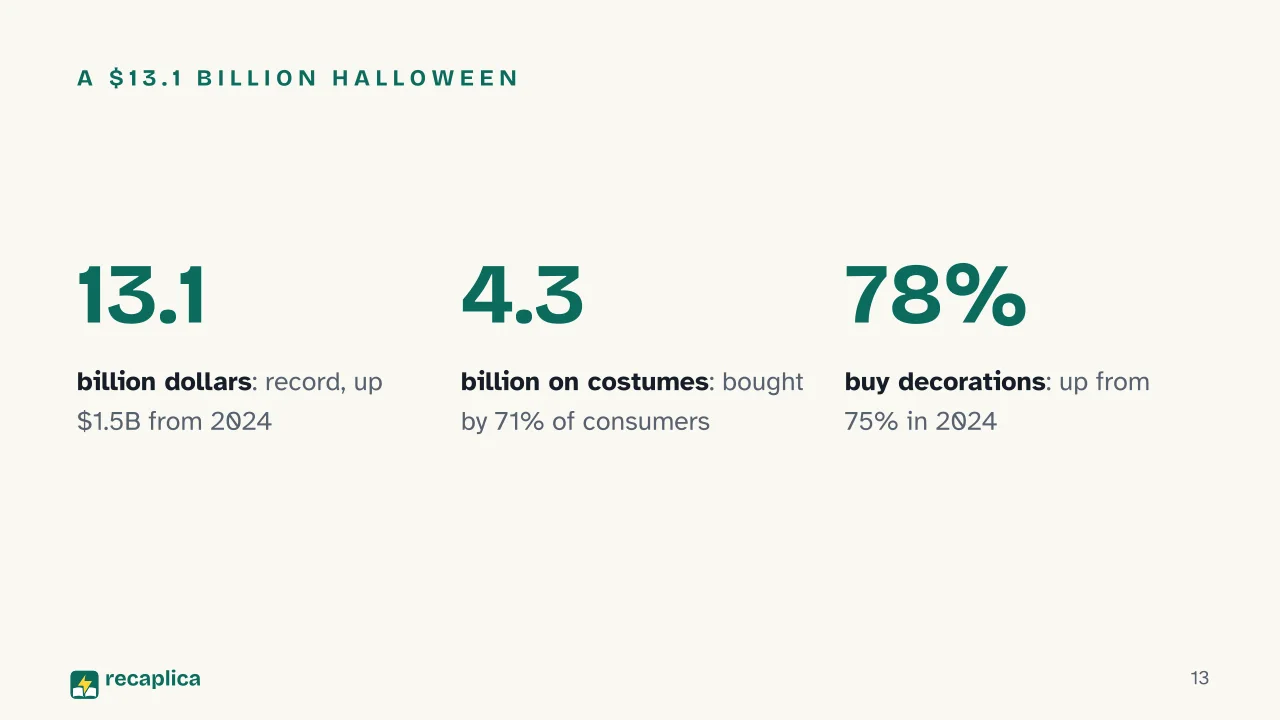
    Within the 2025 forecast, costumes account for $4.3 billion (bought by 71% of consumers), decorations for $4.2 billion (78% of consumers, up from 75% in 2024) and candy for $3.9 billion; another $860 million goes to pet costumes. 73% of consumers said they planned to celebrate in 2025, roughly in line with 72% the year before, while 79% of shoppers expected higher prices because of tariffs. A holiday that, according to the most widely accepted reconstruction, started out as a Celtic agricultural new year, and that later passed through a papal decree and an Irish legend about a man who outwitted the Devil, is in 2025 also measured in billions of dollars of costumes and decorations: from the druids’ bonfires to consumer spending surveys, with centuries of Christianization and emigration in between.

    Slide deck

    Slides ready to download and make your own in PowerPoint or Google Slides, with speaker notes. Pick the Flash cut or the Full one.
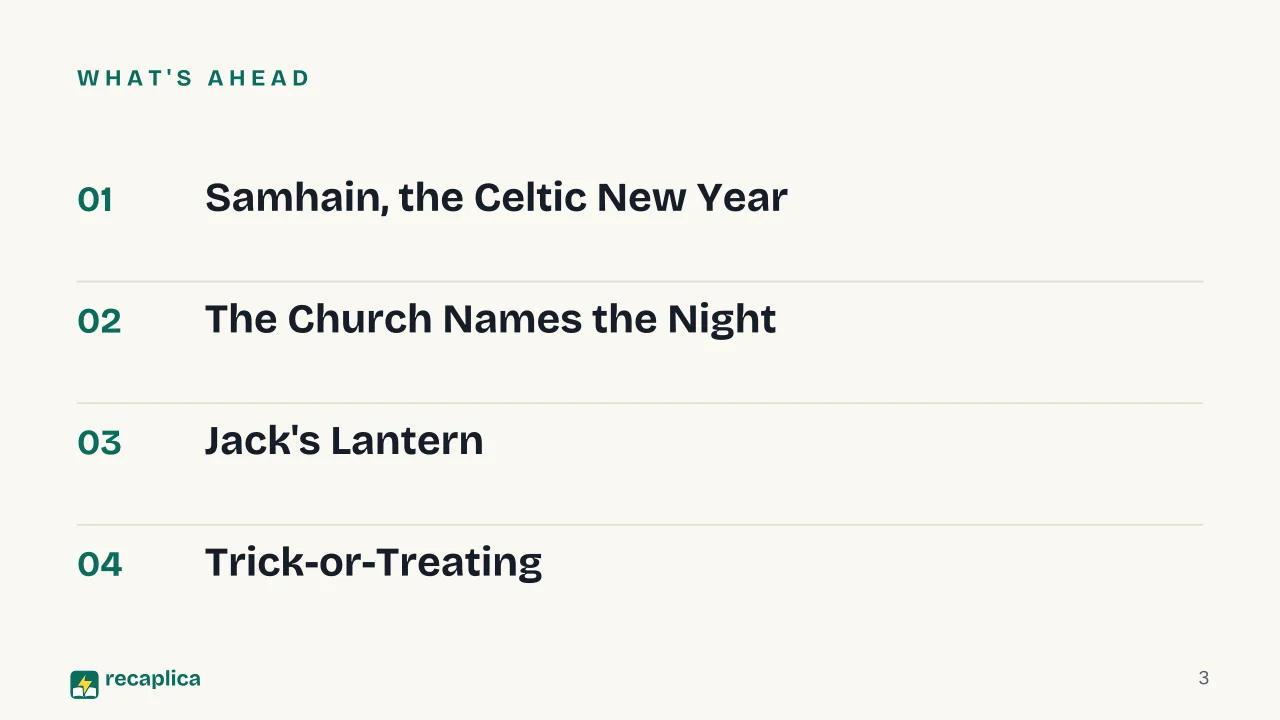
    Slide 1 of the presentation on Halloween History: The Night Samhain Became HalloweenSlide 2 of the presentation on Halloween History: Why does Halloween fall on October 31?Slide 3 of the presentation on Halloween History: What's aheadSlide 4 of the presentation on Halloween History: Chapter 01: Samhain, the Celtic New YearSlide 5 of the presentation on Halloween History: Samhain, the Celtic new yearSlide 6 of the presentation on Halloween History: Chapter 02: The Church Names the NightSlide 7 of the presentation on Halloween History: One night, two namesSlide 8 of the presentation on Halloween History: Chapter 03: Jack's LanternSlide 9 of the presentation on Halloween History: The Irish legendSlide 10 of the presentation on Halloween History: Halloween's pumpkin was never Irish.Slide 11 of the presentation on Halloween History: Chapter 04: Trick-or-TreatingSlide 12 of the presentation on Halloween History: From begging to traditionSlide 13 of the presentation on Halloween History: A $13.1 billion HalloweenSlide 14 of the presentation on Halloween History: According to the most widely accepted reconstruction, which Celtic festival does Halloween come from?Slide 15 of the presentation on Halloween History: Time to review
    Flash10 slidesThe essential thread, to present in classFull15 slidesEvery chapter and the deeper detail

    Common myths

    • ✗ Myth Many people think Halloween is an American commercial invention from the 20th century.

      ✓ Reality According to the most widely accepted reconstruction, though Encyclopedia Britannica frames it more cautiously than other sources, its roots reach back to the ancient Celtic festival of Samhain and medieval customs such as souling and guising, which arrived in America only with 19th-century Irish and Scottish emigration: the United States amplified and commercialized a holiday that already existed for centuries, it didn't invent it from scratch.

    • ✗ Myth Many assume the carved pumpkin has always been Halloween's symbol.

      ✓ Reality In Ireland and Scotland people carved turnips, not pumpkins, into lanterns tied to the legend of Stingy Jack. It was Irish and British emigrants who moved that tradition onto the pumpkin once they reached North America, where turnips weren't native and pumpkins were.

    • ✗ Myth Many take it for granted that trick-or-treating started out in the form now familiar.

      ✓ Reality It's the result of a transformation spanning centuries: from medieval mumming to souling, trading treats for prayers for the dead, to Scottish and Irish guising with songs or small pranks. The organized form of trick-or-treating only spread across the United States starting in the 1930s, after the 1920s, a decade when young people's pranks were mostly vandalism.

    Mind map

    Drag the background to move around and the nodes to reposition them; use − and + to collapse and expand branches.
    Customize
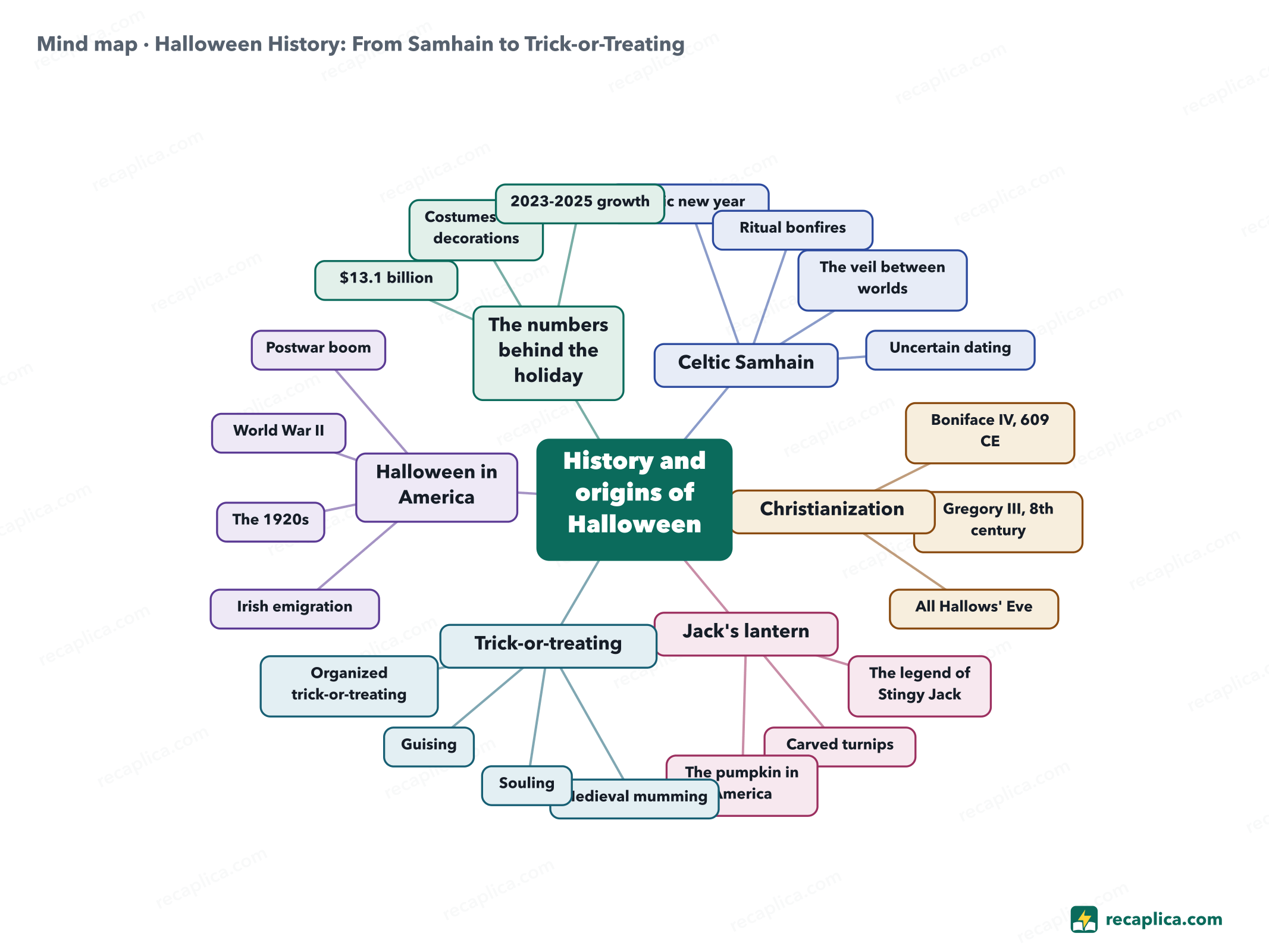
    Mind map: Halloween History: From Samhain to Trick-or-Treating
    • History and origins of Halloween
      • Celtic Samhain
        • Celtic new year November 1, the start of winter
        • Ritual bonfires druids, harvests and animals as sacrifices
        • The veil between worlds believed to thin on that night
        • Uncertain dating roughly 2,500 to 3,000 years ago, depending on the source
      • Christianization
        • Boniface IV, 609 CE dedicates the Pantheon to Christian martyrs
        • Gregory III, 8th century moves All Saints' Day to November 1
        • All Hallows' Eve the night before becomes Halloween
      • Jack's lantern
        • The legend of Stingy Jack tricks the Devil twice
        • Carved turnips in Ireland and Scotland
        • The pumpkin in America replaces the turnip with emigration
      • Trick-or-treating
        • Medieval mumming skits in exchange for food
        • Souling treats in exchange for prayers for the dead
        • Guising Scotland and Ireland, songs and small pranks
        • Organized trick-or-treating takes hold in the 1930s
      • Halloween in America
        • Irish emigration the Great Famine, mid-1800s
        • The 1920s pranks turn into widespread vandalism
        • World War II sugar rationing halts the practice
        • Postwar boom trick-or-treating becomes widespread again
      • The numbers behind the holiday
        • $13.1 billion expected 2025 U.S. spending, a record
        • Costumes and decorations $4.3 billion and $4.2 billion
        • 2023-2025 growth from $12.2 billion to $11.6 billion to $13.1 billion

    Quiz: test yourself

    Answer the questions to check what you have learned: you get instant feedback and a short explanation.

    Grade 0/10 0/5
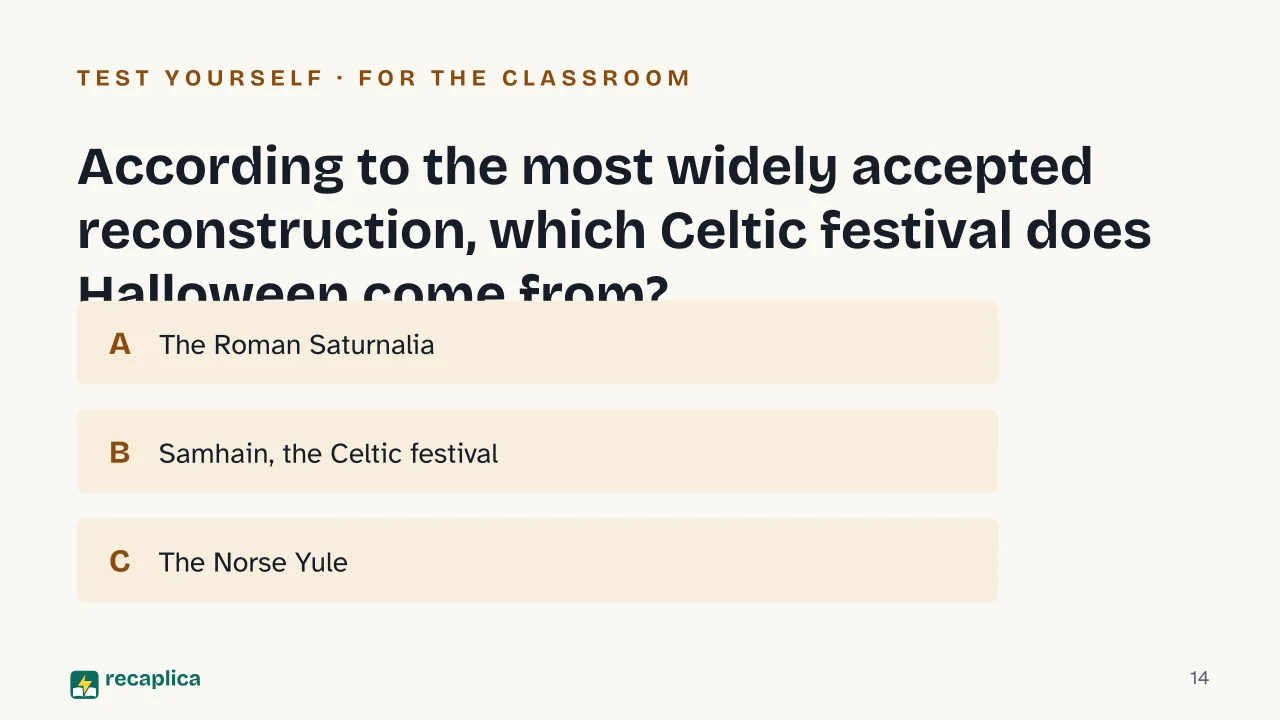
    1 According to the most widely accepted reconstruction, which Celtic festival does Halloween come from?

    According to the most widely accepted reconstruction, Halloween descends from Samhain, the festival that marked the Celtic new year on November 1; Encyclopedia Britannica frames the link more cautiously ("may have originated") than other sources.

    2 True or false: before the pumpkin, Halloween's lantern tradition used turnips.

    True. In Ireland and Scotland people carved turnips, not pumpkins; the pumpkin spread only once emigrants reached North America, where turnips were harder to find.

    3 Who is said to have tricked the Devil twice in the Irish legend behind the "Jack-o'-lantern"?

    According to the legend, Stingy Jack talked the Devil into turning into a coin and later trapped him up a tree; when Jack died he was turned away from both heaven and hell and wandered with a burning coal inside a hollowed-out turnip.

    4 In the 8th century, which pope moved All Saints' Day to November 1, laying the groundwork for the name "Halloween"?

    It was Pope Gregory III, in the 8th century, who extended the feast to every saint and set it on November 1. Boniface IV, in 609 CE, had dedicated the Pantheon in Rome to Christian martyrs, an earlier and separate step.

    5 According to the National Retail Federation survey, how much did Americans spend in total on Halloween in 2025?

    $13.1 billion, a record, up from $11.6 billion in 2024 and $12.2 billion in 2023, the previous record.

    Answers: 1-B · 2-A · 3-B · 4-B · 5-C

    Flashcards

    Tap the card to flip it and check whether you remember the answer, then move to the next one.

    1 / 8

    Explain it in your own words

    The ultimate test: if you can explain it in simple words, you've truly understood it. Write your explanation, then compare it with the Recap.

    Your explanation is saved only on this device.

    Halloween falls on the night of October 31 and, according to the most widely accepted reconstruction, traces back to the ancient Celtic festival of Samhain, which marked the new year and the start of winter. Over the centuries the festival became entangled with the Christian calendar, when the Church fixed All Saints' Day on November 1 and the night before took the name "All Hallows' Eve," the source of "Halloween." Symbols like the carved pumpkin and customs like trick-or-treating grew out of older practices, the hollowed-out turnips of Ireland and the medieval door-to-door customs of souling and guising, carried to America by nineteenth-century Irish and Scottish emigrants. From there Halloween also became a multibillion-dollar commercial event, with record U.S. spending in 2025.

    Frequently asked questions

    Why is Halloween celebrated on October 31?

    Because that night, according to the most widely accepted reconstruction, lines up with the ancient Celtic festival of Samhain, the eve of the new year the Celts marked on November 1. When the Church later set All Saints' Day on that same date, the night before took on the name "All Hallows' Eve," which became "Halloween."

    Where does the word "Halloween" come from?

    It's a contraction of "All Hallows' Eve," the eve of All Saints' Day. The name appeared after Pope Gregory III fixed All Saints' Day on November 1 in the 8th century, overlapping it with the night already associated with Samhain.

    Why did the pumpkin become the symbol of Halloween?

    It wasn't always. In Ireland and Scotland people carved turnips, tied to the legend of Stingy Jack; Irish and British emigrants moved the custom onto the pumpkin once they reached North America, where pumpkins were easier to find than turnips.

    What is trick-or-treating and where does it come from?

    It grew out of medieval customs such as mumming, souling (going door to door for treats in exchange for prayers for the dead), and Scottish and Irish guising (dressing up in exchange for a small performance). The organized version familiar now took hold in the United States in the 1930s.

    How much do Americans spend on Halloween?

    According to the National Retail Federation's survey, expected spending in 2025 reached a record $13.1 billion, up from $11.6 billion in 2024 and $12.2 billion in 2023.

    Sources

    • HISTORY (A+E Networks), Halloween: Origins, Movies & Traditions
    • HISTORY (A+E Networks), How Jack O'Lanterns Originated in Irish Myth
    • HISTORY (A+E Networks), How Trick-or-Treating Became a Halloween Tradition
    • Encyclopedia Britannica, Where Did Halloween Come From?
    • Encyclopedia Britannica, History of Trick-or-Treating
    • World History Encyclopedia, Samhain
    • National Retail Federation, NRF Consumer Survey Finds Halloween Spending to Reach Record $13.1 Billion

    Every Recap goes through an independent review before publication.

    Every evening, the day's new Recaps on our Telegram channel. Join the channel →

    Keep learning

    • History Florentine Renaissance: Brunelleschi, Ghiberti, Masaccio, Donatello The Florentine Renaissance is the moment when Italian art breaks, step by step, with the Gothic style and turns back toward the classical world. In Florence, in the first half of the fifteenth century, four names mark that shift: Filippo Brunelleschi, who builds linear perspective into his architecture; Lorenzo Ghiberti, who wins the 1401 competition for the Baptistery doors; Masaccio, who brings naturalism into painting; and Donatello, who brings it into sculpture and becomes a reference point for the city's artists. Their work, often paid for by craft guilds or the Medici family, changes how painters, sculptors and architects work. Read the Recap →
    • History Declaration of the Rights of Man: What It Is and What It Says The Declaration of the Rights of Man and of the Citizen is the text that France's National Constituent Assembly adopted on August 26, 1789, at the start of the French Revolution. Its preamble and 17 articles set out rights such as liberty, property, security and resistance to oppression, alongside principles like national sovereignty and the separation of powers. The Marquis de Lafayette put forward a personal first draft, which five deputies appointed by the Assembly then reworked before the final vote. It should not be confused with the Universal Declaration of Human Rights, adopted by the UN in 1948: a similar name, but a different document in era, authorship and content. Read the Recap →
    • History Trasformismo: What It Is and How Agostino Depretis Invented It Trasformismo is the political practice, born in Italy between late 1882 and early 1883, of building parliamentary majorities around individual politicians and short-term programs rather than along the line dividing right and left. Agostino Depretis started it: he had led the Historical Left since 1876, and in May 1883 he assembled a new majority out of the more moderate wings of both camps. The name comes from a line he delivered in Stradella on October 8, 1882, offering a place in his ranks to anyone willing to "transform" politically. The word has carried a critical edge in Italian politics ever since, and historians still argue over how to weigh it: some read it as a conservative retreat, others as a flawed but real answer to the fragility of a state that had only just been unified. Read the Recap →

    recaplica

    Clear in 30 seconds, yours in 10 minutes.

    Recaps Mind maps Request a Recap Telegram channel Mind map maker Our method About Privacy & cookies Legal notes & terms of use

    © 2026 Recaplica · A project by Curi S.r.l. — VAT IT05472000750

    Statistics, only if you say so

    To learn which Recaps help most we would use Google Analytics, with aggregate, anonymous data. It starts only with your OK, and you can change your mind anytime. Privacy policy