Skip to content
recaplica

    One moment: security check

    Cloudflare wants to make sure you're not a robot. Tick the box below and your search will continue on its own.

    IT
    recaplica What is PHP? The programming language running the web
    © 2026 Recaplica · recaplica.com — All rights reserved
    Home › Technology

    What is PHP? The programming language running the web

    By Recaplica Newsroom · Updated on September 4, 2026

    What to print

    Page numbers appear when printing with default margins.

    Slides

    Choose a cut

    Flash10 slidesThe essential thread, to present in classFull18 slidesEvery chapter and the deeper detail

    Both come with speaker notes.

    Telegram channel
    recaplica Clear in 30 seconds, yours in 10 minutes.
    In 30 seconds Key points Figures Deep dive Slides Myths Mind map Quiz Flashcards FAQ

    In 30 seconds quick read

    PHP is a programming language built for the web: the code runs on the server, not in the browser, and produces the HTML page a visitor sees. It was created in 1994 by Rasmus Lerdorf, who wanted to track visits to his own online résumé, and in 2026 it is the most widely used server-side technology in the world. It has gone through several major versions — with the curious exception of the sixth, which never shipped — up to the PHP 8, the major version in use in 2026 — far more modern than its reputation as an old language suggests. From WordPress to Facebook, and frameworks like Laravel and Symfony, PHP remains everywhere beneath the surface of the web.

    Key Points

    • PHP is a server-side scripting language: the code runs on the server and generates the HTML sent to the browser, not the other way around.
    • It was created in 1994 by Rasmus Lerdorf to track visits to his own online résumé.
    • In 2026 it is used by 70.2% of websites whose server-side language is known (W3Techs, September 2026).
    • PHP 6 was never released: the project for native Unicode support was abandoned in 2010.
    • PHP 8, released in 2020, introduced a JIT compiler and a stricter type system, far removed from its scrappy origins.
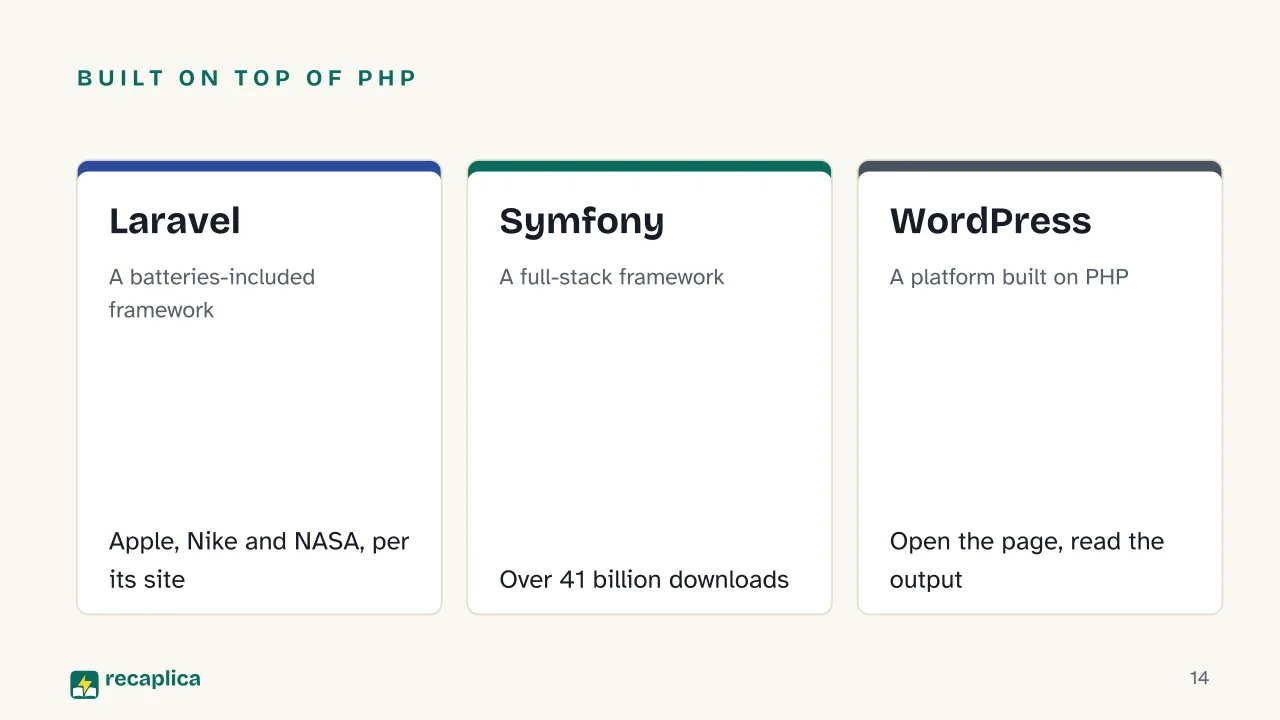
    • Frameworks like Laravel and Symfony, and platforms like WordPress, are built on PHP.

    Key figures

    • 70.2% the share of websites, among those whose server-side language is known, that run PHP Source: W3Techs, September 2026
    • 1994 the year Rasmus Lerdorf wrote the first scripts, then called 'Personal Home Page Tools' Source: Official PHP manual (php.net)
    • 63.4% the share of PHP sites already running version 8, the most recent as of September 2026 Source: W3Techs, September 2026

    Deep Dive

    A language that works behind the scenes

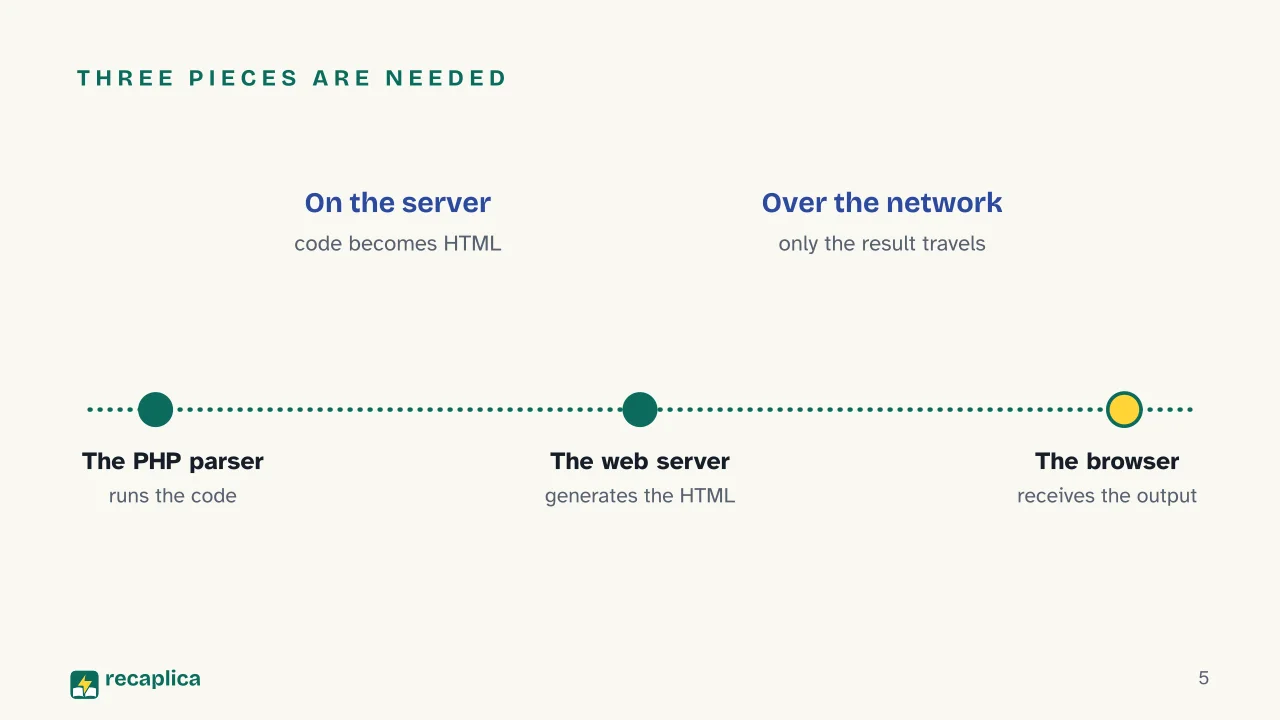
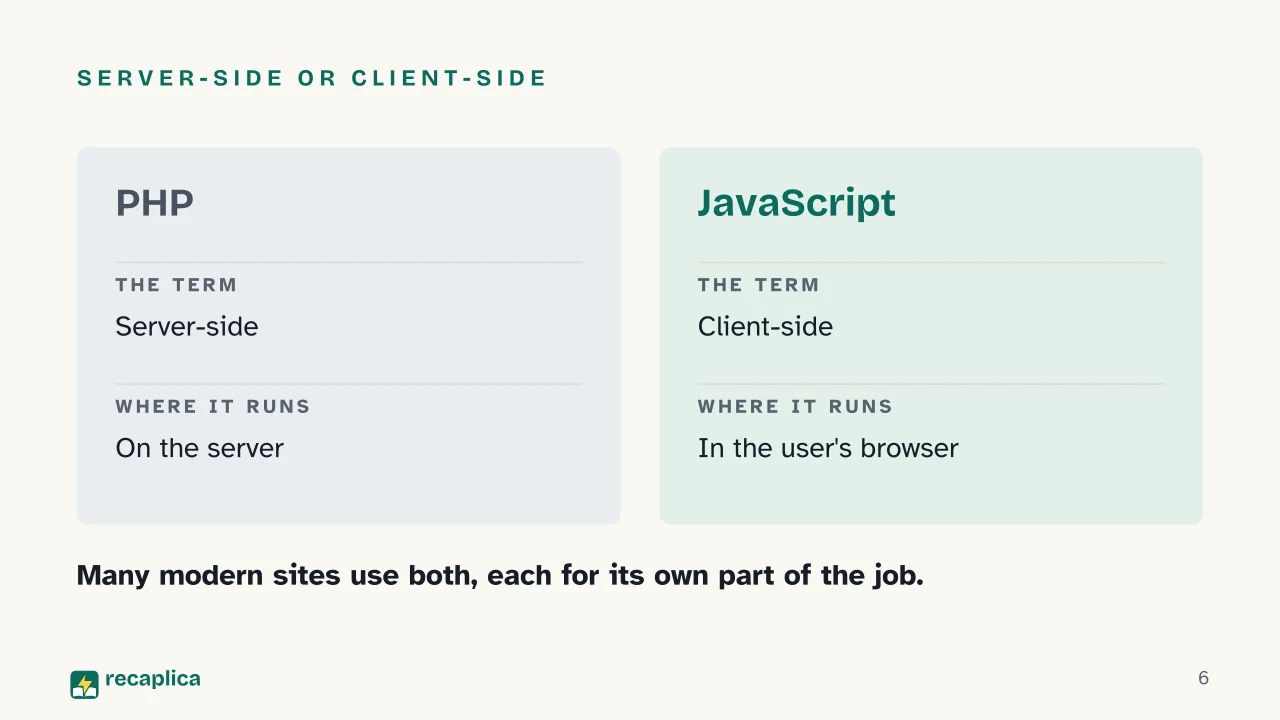
    When you open a page built with WordPress, you’re not reading PHP code: you’re reading its output. PHP (a recursive acronym for “PHP: Hypertext Preprocessor”) is a server-side scripting language, built specifically for web development and embeddable directly into HTML. The official manual draws a sharp line between it and a client-side language like JavaScript: PHP code runs on the server, which generates the HTML and sends it to the browser. Visitors receive the result, never the instructions that produced it.

    To work in its most common setup, PHP needs three pieces: a PHP parser, a web server and a browser to receive the output. There’s also a command-line mode, with no server or browser involved, used for scheduled tasks or for processing plain text.

    What it can actually do

    The list of PHP’s capabilities explains why it became the de facto standard for dynamic websites: it collects data from forms, generates different content on every visit, handles cookies and sessions, produces files in various formats (images, PDFs), encrypts data, sends email, talks to a wide range of databases (MySQL, PostgreSQL and others), processes text with regular expressions, and handles network protocols like HTTP, IMAP or LDAP. It runs on every major operating system and with most modern web servers, from Apache to nginx.

    A taste of the syntax, without turning into a course

    You don’t need to know how to code to understand PHP, but a couple of details help you recognize it when you see it. Variables always start with a dollar sign, followed by a name that must begin with a letter or underscore; they’re also case-sensitive, so $var and $Var are two different variables. Functions — small algorithms you can call by name — are defined with the keyword function:

    Example: a minimal script that defines and uses a variable might look like this:

    <?php
    $name = "Recaplica";
    function greet($who) {
        echo "Hello, $who!";
    }
    greet($name);
    ?>

    The server runs these lines and sends the browser only the result: “Hello, Recaplica!” No trace of the code reaches the visitor.

    From a programmer’s résumé to half the web

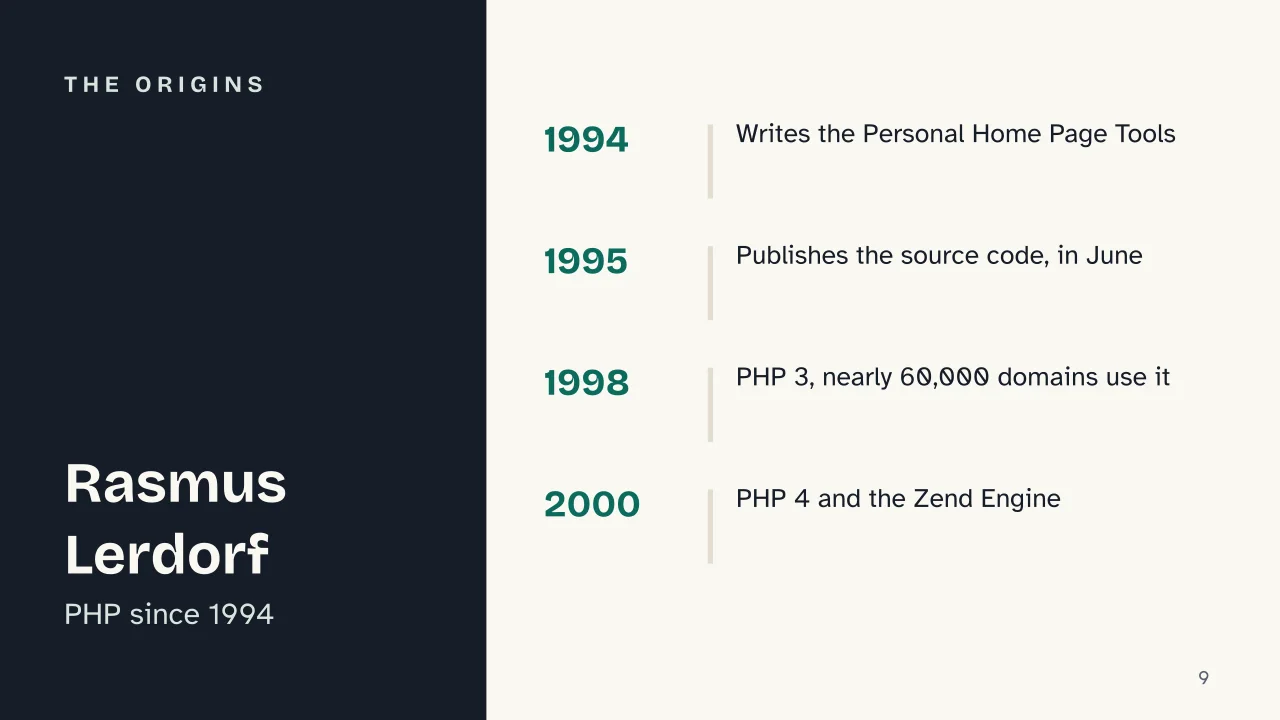
    PHP was born in 1994 out of a small, concrete need: Rasmus Lerdorf wanted to know who was visiting his online résumé, so he wrote some scripts he called “Personal Home Page Tools.” In June 1995 he published the source code; within months the project changed names a few times before merging into “PHP/FI.” By 1998, when version 3 came out, nearly 60,000 domains were already using PHP — roughly 1% of all domains at the time — and with the announcement of the new version, rewritten by Andi Gutmans and Zeev Suraski, that number climbed to about 70,000.

    From there, growth never really stopped, version after version:

    VersionYearKey change
    PHP 31998Parser rewrite; the recursive acronym “PHP: Hypertext Preprocessor” is born
    PHP 42000Zend Engine; much higher performance, HTTP sessions
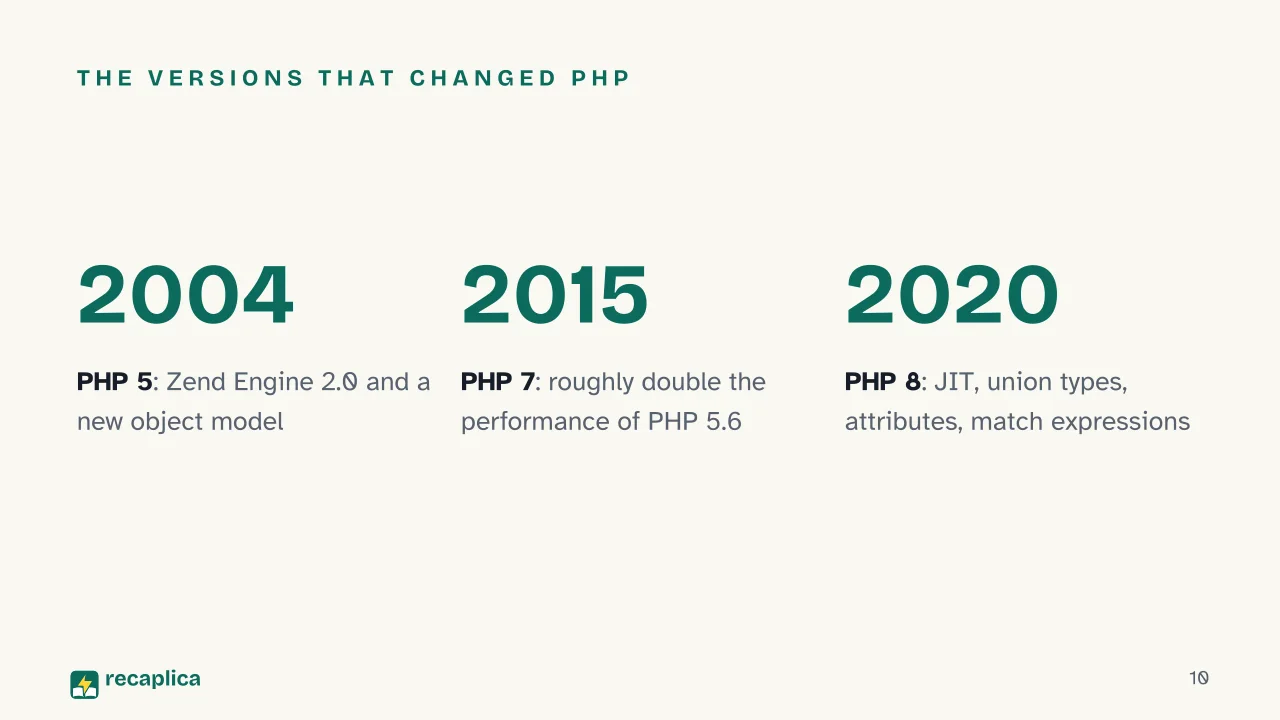
    PHP 52004Zend Engine 2.0; new object model
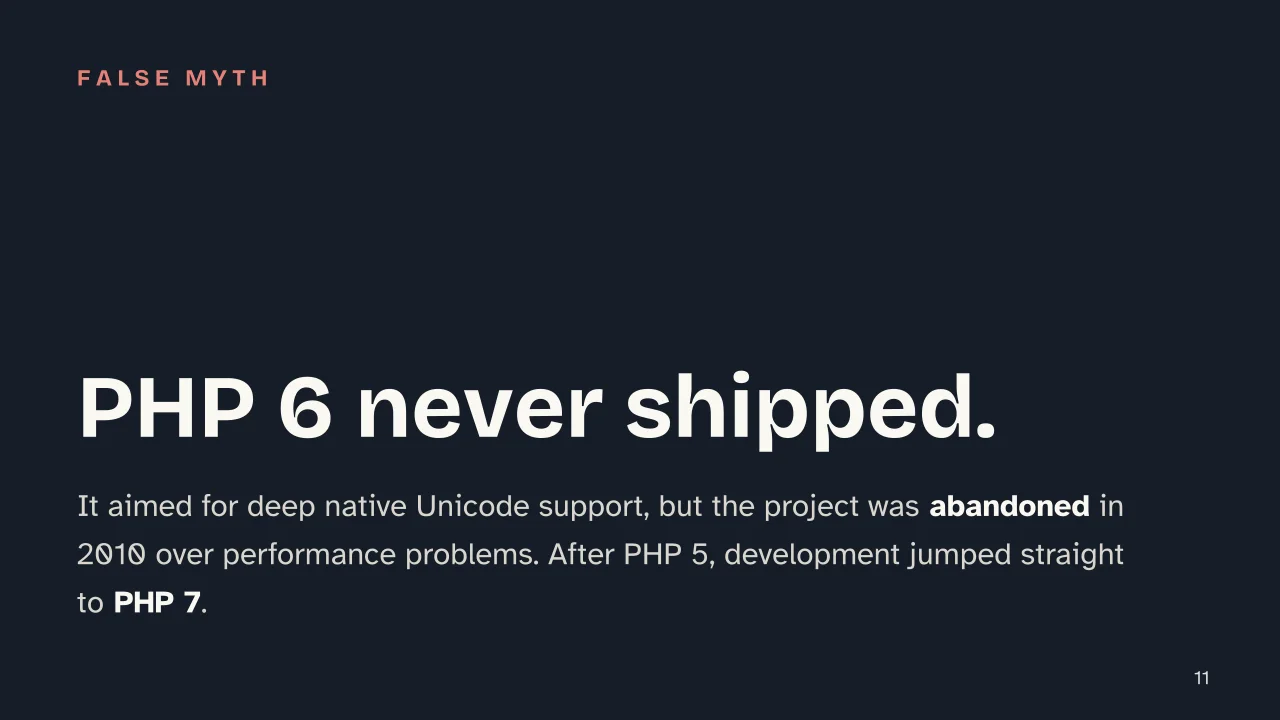
    PHP 6never releasedNative Unicode support abandoned in 2010 over performance issues
    PHP 72015Zend Engine 3; roughly double the performance of PHP 5.6, null coalescing operator
    PHP 82020JIT compiler, union types, attributes, match expressions

    The empty row for PHP 6 isn’t a typo: the project aimed for deep Unicode support built into the language’s own engine, but it was abandoned because of the performance problems that came with it. Some of the ideas planned for that version — namespaces, for instance — made it into PHP 5.3 and 5.4 anyway, before development jumped straight to version 7.

    Who uses PHP in 2026 (and who built on top of it)

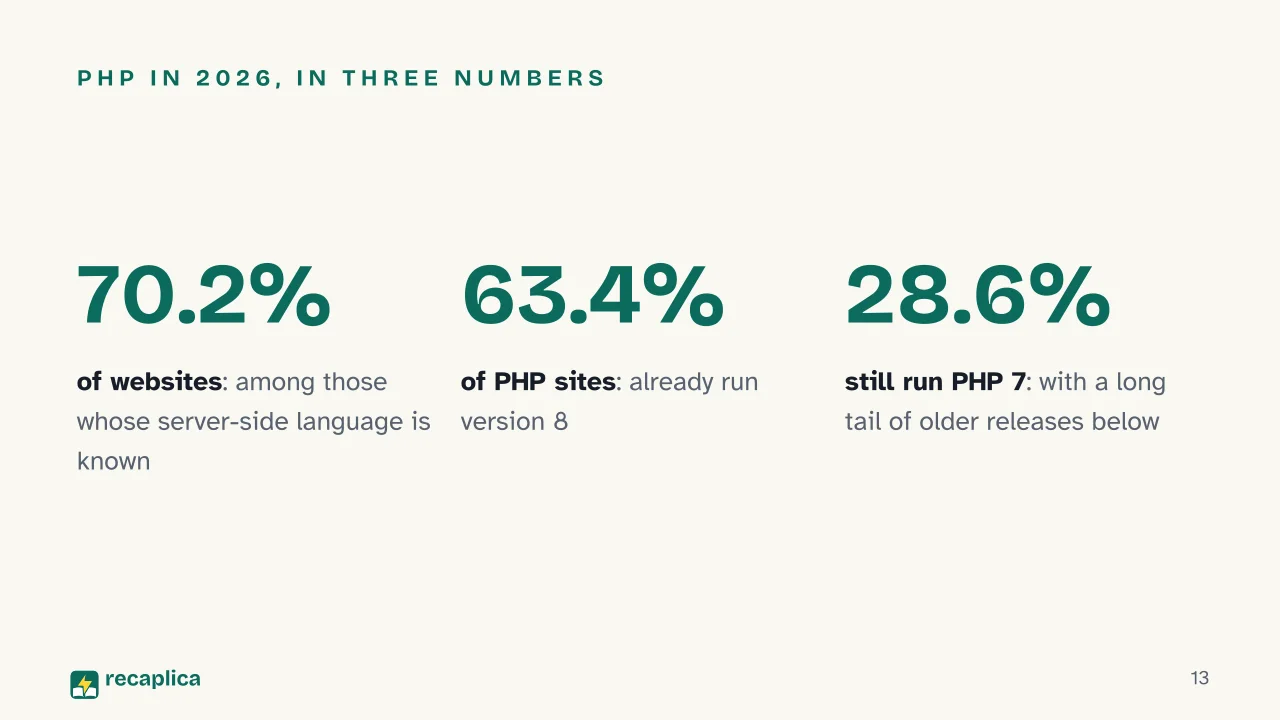
    According to W3Techs, as of September 2026, 70.2% of websites whose server-side language is known are written in PHP, with Facebook, Wikipedia, WordPress and some Microsoft subdomains among the well-known names that use it. Among PHP sites, version 8 is already the majority (63.4%), followed by version 7 (28.6%) and a long tail of older releases.

    On top of the language, frameworks have grown up to structure its use in large projects: Laravel, described by its official site as a “batteries-included” PHP framework, meaning most of the tools you need come ready to use, and Symfony, which bills itself as a “full-stack” framework and has passed 41 billion downloads according to its own site. Symfony also provides reusable components picked up by other projects: Laravel itself integrates several of them, and so does Drupal.

    Old by reputation, current in practice

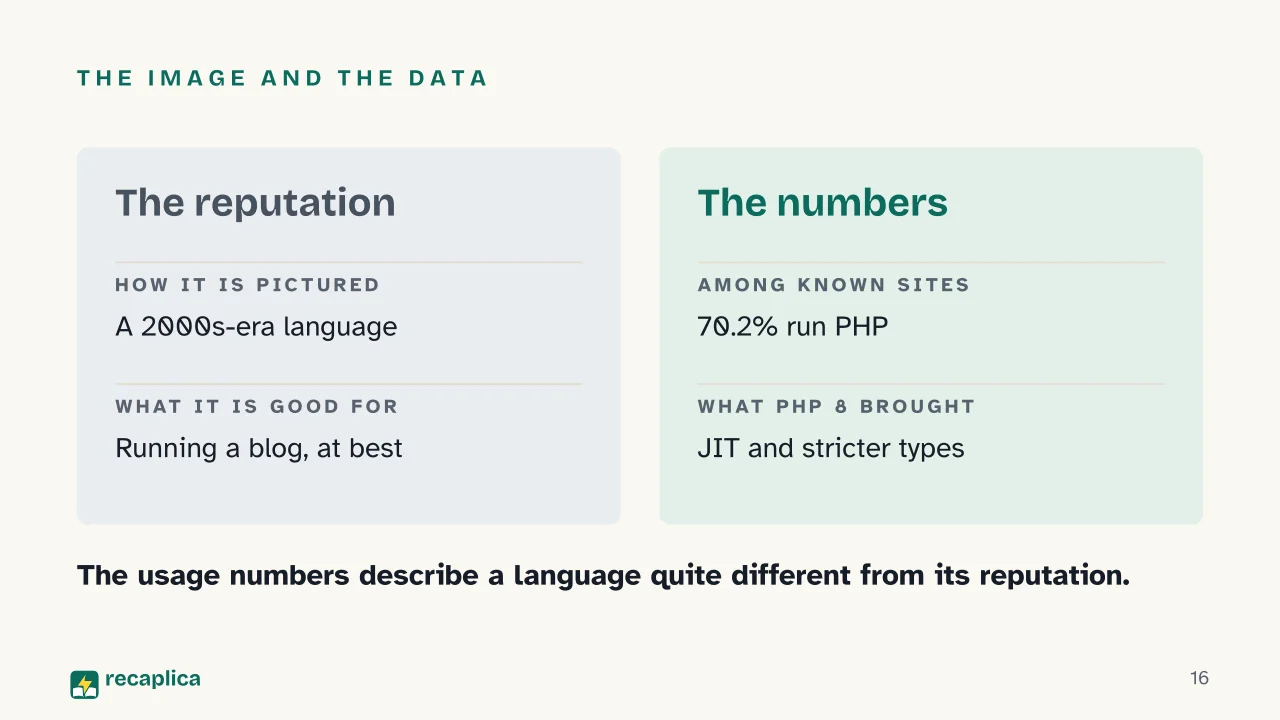
    PHP’s image is still often that of a 2000s-era language, good at best for running a blog. The numbers tell a different story: it remains by far the most widely used server-side technology, and version 8 brought a JIT compiler and a much stricter type system than its origins would suggest: the usage numbers describe a language quite different from the one its reputation suggests.

    Slide deck

    Slides ready to download and make your own in PowerPoint or Google Slides, with speaker notes. Pick the Flash cut or the Full one.
    Slide 1 of the presentation on What is PHP? The programming language running the web: PHPSlide 2 of the presentation on What is PHP? The programming language running the web: What actually reaches your browser?Slide 3 of the presentation on What is PHP? The programming language running the web: What we will coverSlide 4 of the presentation on What is PHP? The programming language running the web: Chapter 01: The code you never seeSlide 5 of the presentation on What is PHP? The programming language running the web: Three pieces are neededSlide 6 of the presentation on What is PHP? The programming language running the web: Server-side or client-sideSlide 7 of the presentation on What is PHP? The programming language running the web: How do you spot a PHP variable?Slide 8 of the presentation on What is PHP? The programming language running the web: Chapter 02: From a résumé to half the webSlide 9 of the presentation on What is PHP? The programming language running the web: The originsSlide 10 of the presentation on What is PHP? The programming language running the web: The versions that changed PHPSlide 11 of the presentation on What is PHP? The programming language running the web: PHP 6 never shipped.Slide 12 of the presentation on What is PHP? The programming language running the web: Chapter 03: Who built on top of itSlide 13 of the presentation on What is PHP? The programming language running the web: PHP in 2026, in three numbersSlide 14 of the presentation on What is PHP? The programming language running the web: Built on top of PHP: Laravel, Symfony, WordPressSlide 15 of the presentation on What is PHP? The programming language running the web: Chapter 04: Reputation against numbersSlide 16 of the presentation on What is PHP? The programming language running the web: The image and the dataSlide 17 of the presentation on What is PHP? The programming language running the web: What kind of language is PHP?Slide 18 of the presentation on What is PHP? The programming language running the web: And now, the review
    Flash10 slidesThe essential thread, to present in classFull18 slidesEvery chapter and the deeper detail

    Common myths

    • ✗ Myth PHP is an old language that's basically been abandoned.

      ✓ Reality It's actually still the most widely used server-side technology on the web, running 70.2% of sites whose server-side language is known (W3Techs); and it's under active development — PHP 8, the newest major version as of 2026, brought a JIT compiler and a modern type system, a world away from the improvised scripts it started as.

    • ✗ Myth PHP 6 exists somewhere and will show up eventually.

      ✓ Reality PHP 6 never shipped: it aimed for deep native Unicode support, but the project was abandoned in 2010 over performance problems. Some ideas planned for that version did make it into PHP 5.3 and 5.4 (namespaces, traits); after PHP 5, development jumped straight to PHP 7.

    • ✗ Myth PHP is only good for WordPress, not for serious projects.

      ✓ Reality WordPress does run on PHP, but it's far from the only case: massive sites like Facebook and Wikipedia use it too. Structured frameworks like Laravel and Symfony are chosen by companies such as Apple, Nike and NASA (Laravel), or reused as components by projects like Drupal (Symfony).

    Mind map

    Drag the background to move around and the nodes to reposition them; use − and + to collapse and expand branches.
    Customize
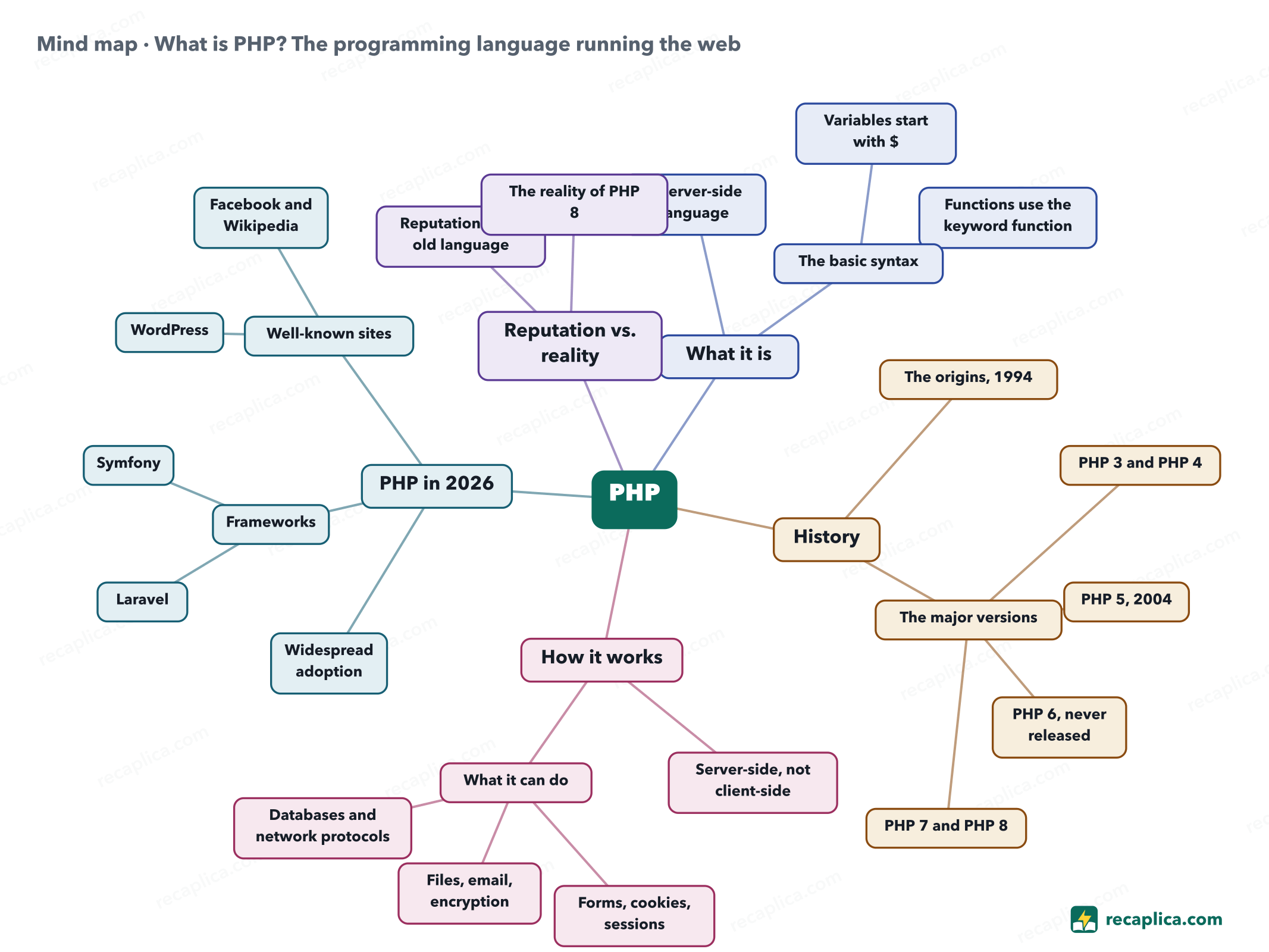
    Mind map: What is PHP? The programming language running the web
    • PHP
      • What it is
        • A server-side language Generates HTML that arrives ready-made in the browser
        • The basic syntax
          • Variables start with $
          • Functions use the keyword function
      • History
        • The origins, 1994 Rasmus Lerdorf tracks visits to his résumé
        • The major versions
          • PHP 3 and PHP 4
          • PHP 5, 2004
          • PHP 6, never released
          • PHP 7 and PHP 8
      • How it works
        • Server-side, not client-side The code runs on the server, not in the browser
        • What it can do
          • Forms, cookies, sessions
          • Files, email, encryption
          • Databases and network protocols
      • PHP in 2026
        • Widespread adoption 70.2% of sites whose server-side language is known
        • Frameworks
          • Laravel
          • Symfony
        • Well-known sites
          • WordPress
          • Facebook and Wikipedia
      • Reputation vs. reality
        • Reputation as an old language Often linked only to old blogs
        • The reality of PHP 8 JIT, modern types and attributes

    Quiz: test yourself

    Answer the questions to check what you have learned: you get instant feedback and a short explanation.

    Grade 0/10 0/5
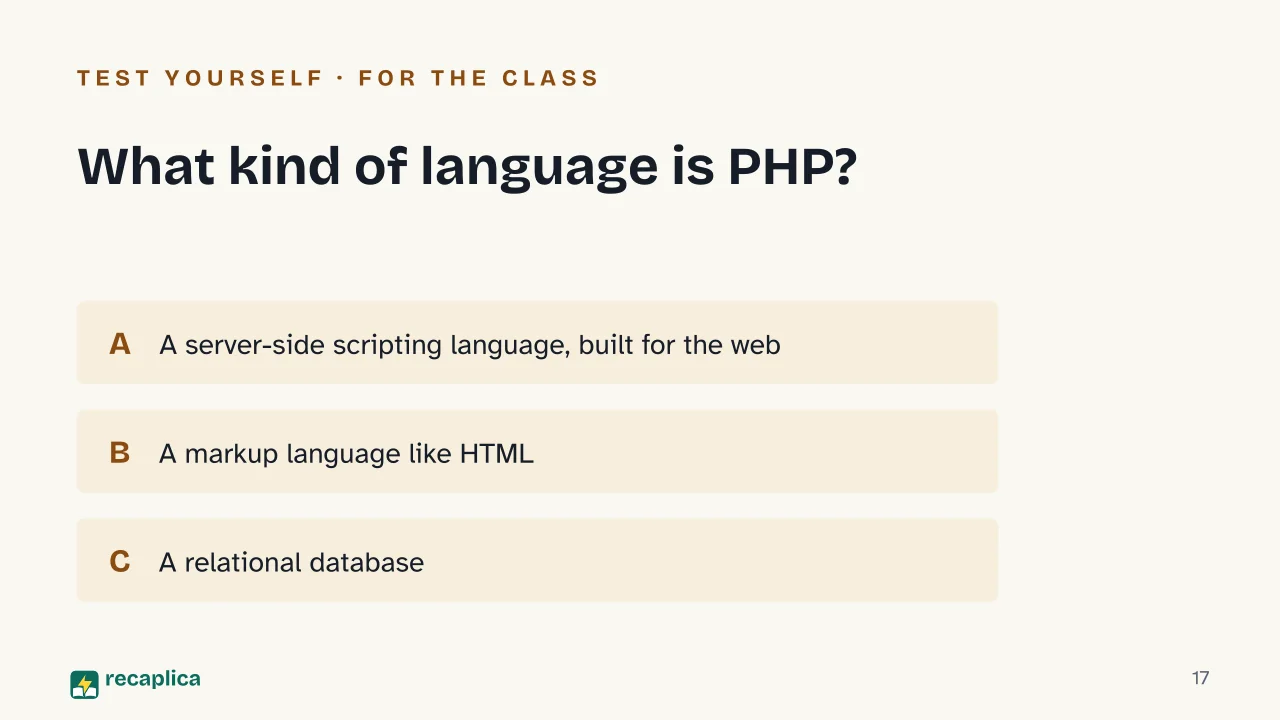
    1 What kind of language is PHP?

    PHP is a general-purpose programming language, but it was born and optimized for web development: the code runs on the server and produces the HTML that reaches the browser.

    2 Who created PHP, and in what year according to the official php.net manual?

    Rasmus Lerdorf wrote the first scripts, called 'Personal Home Page Tools', to track visits to his own online résumé. The official manual gives 1994 as the project's starting year.

    3 Which PHP version was never publicly released?

    PHP 6 aimed for deep native Unicode support, but the project was abandoned in 2010 over performance problems. After PHP 5, development moved straight to PHP 7.

    4 True or false: PHP is a declining language, used only by a few sites that haven't kept up.

    False: according to W3Techs, 70.2% of websites whose server-side language is known still run PHP, making it by far the most widely used technology in this space.

    5 What does PHP 8 introduce compared to earlier versions?

    PHP 8 (2020) brought the JIT compiler, union types, attributes and match expressions. Cookies, HTML generation and database support had already existed for a long time.

    Answers: 1-A · 2-A · 3-A · 4-B · 5-A

    Flashcards

    Tap the card to flip it and check whether you remember the answer, then move to the next one.

    1 / 7

    Explain it in your own words

    The ultimate test: if you can explain it in simple words, you've truly understood it. Write your explanation, then compare it with the Recap.

    Your explanation is saved only on this device.

    PHP is a programming language built for the web: the code runs on the server, not in the browser, and produces the HTML page a visitor sees. It was created in 1994 by Rasmus Lerdorf, who wanted to track visits to his own online résumé, and in 2026 it is the most widely used server-side technology in the world. It has gone through several major versions — with the curious exception of the sixth, which never shipped — up to the PHP 8, the major version in use in 2026 — far more modern than its reputation as an old language suggests. From WordPress to Facebook, and frameworks like Laravel and Symfony, PHP remains everywhere beneath the surface of the web.

    Frequently asked questions

    Is PHP still used in 2026?

    Yes, and it's the most widely used server-side technology: according to W3Techs, as of September 2026, 70.2% of websites whose server-side language is known are written in PHP, with version 8 already the majority among them (63.4%).

    What's the difference between PHP and JavaScript?

    PHP is server-side: the code runs on the server and produces the HTML that arrives ready-made in the browser, without the user ever seeing the original instructions. JavaScript, in its most familiar form, is client-side: it runs directly in the user's browser. Many modern sites use both, each for its own part of the job.

    What do you need to run a PHP script?

    In the most common setup, a web server with the PHP parser installed and a browser to receive the result. PHP can also run from the command line, without a server or browser, for example for scheduled tasks or plain text processing.

    What is Laravel?

    Laravel is a PHP framework for building web applications, described by its official site as 'batteries-included', meaning most of the tools you need come ready to use. Companies like Apple, Nike and NASA use it, according to the project's official site.

    What does the acronym PHP stand for?

    PHP is a recursive acronym for 'PHP: Hypertext Preprocessor'. Its original name, back when it was created in 1994, was 'Personal Home Page Tools'.

    Sources

    • PHP Manual — Introduction
    • PHP Manual — History of PHP
    • PHP Manual — Variables: Basics
    • PHP Manual — User-defined functions
    • W3Techs — Usage statistics of PHP for websites
    • Laravel — official site
    • Symfony — official site

    Every Recap goes through an independent review before publication.

    Every evening, the day's new Recaps on our Telegram channel. Join the channel →

    Keep learning

    • Technology OOP: What Is Object-Oriented Programming Object-oriented programming, or OOP, builds software around objects that bundle data and the functions that act on it, instead of keeping the two apart. Every object comes from a class, the blueprint that fixes its state and behavior, the same way one bicycle model fixes what every bike built from it can do. Documentation across languages keeps circling back to four recurring ideas — encapsulation, inheritance, polymorphism, and abstraction — though not every source tells the story the same way. Java, Python, and C++ each implement OOP with their own mechanics, and none of the sources treats it as the only way to write software. Read the Recap →
    • Technology DBMS: What It Is, the Main Types, and Real Examples A DBMS, short for database management system, is the software that lets people create, query and update the data in a database without having to know how that data is physically stored. Compared with spreadsheets or scattered files, it keeps data in one place and more consistent, cutting down on duplication and security gaps. The most common type is the relational model, which organizes data into linked tables and is queried with SQL. Nonrelational, or NoSQL, systems handle more flexible data, and two older models, hierarchical and network, sit alongside an object-oriented model. Read the Recap →
    • Technology ER Diagram (Entity-Relationship Diagram): What It Is and How to Build One An entity-relationship diagram, or ER diagram, is the map database designers draw before building a database: it shows which objects need tracking (entities), what information describes them (attributes) and how they connect to each other (relationships). It's a conceptual design step, not the finished database schema — the translation into real tables comes later. The two most common notations are Chen, which uses rectangles and ovals, and Crow's Foot, which uses lines ending in circles, bars and crow's feet to show how many instances connect. A relationship can be one-to-one, one-to-many or many-to-many, and each type has its own way of being drawn. Read the Recap →

    recaplica

    Clear in 30 seconds, yours in 10 minutes.

    Recaps Mind maps Request a Recap Telegram channel Mind map maker Our method About Privacy & cookies Legal notes & terms of use

    © 2026 Recaplica · A project by Curi S.r.l. — VAT IT05472000750

    Statistics, only if you say so

    To learn which Recaps help most we would use Google Analytics, with aggregate, anonymous data. It starts only with your OK, and you can change your mind anytime. Privacy policy